


When the Record Disappears
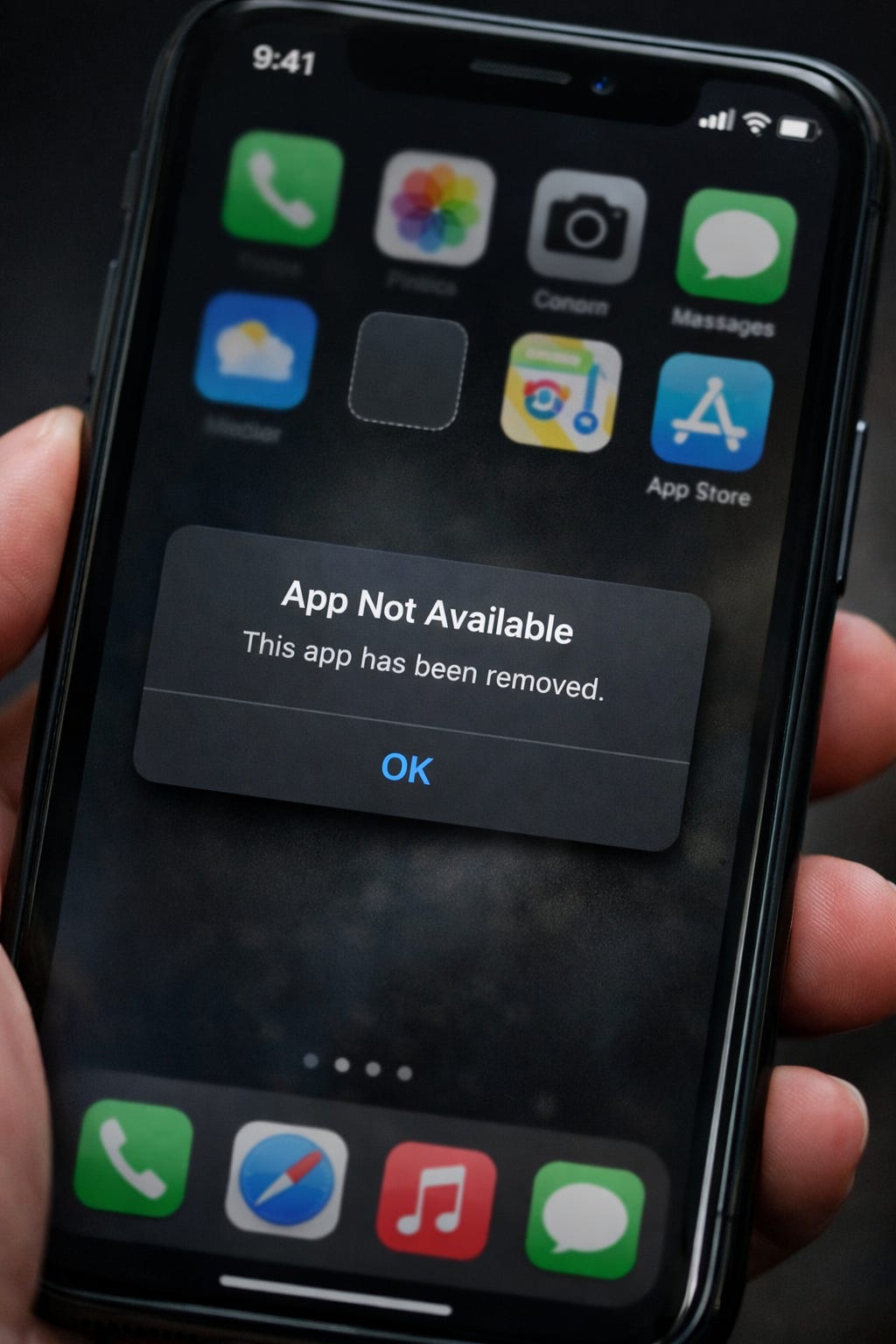
The app didn’t disappear because it broke the law. There was no court order, public finding, vote, or hearing. One day, it worked. The next day, it was gone, scrubbed from app stores with a brief explanation that raised more questions than it answered.
That disappearance wasn’t a glitch. It was a decision.
In recent months, a small but telling class of digital tools has quietly vanished from public view. Specifically absent are apps designed to document government activity, alert communities to enforcement actions, or preserve evidence for later accountability. They weren’t calling for violence. They weren’t coordinating crimes. They were doing something far more uncomfortable: creating records of state power as it moved through ordinary neighborhoods.
That, it turns out, was enough.
The official explanations were neat and bloodless. Specifically cited were safety concerns, policy enforcement, and risk mitigation, language so familiar it barely registers anymore. However, behind those phrases is a troubling pattern: federal pressure applied offstage, platforms acting without due process, and tools of public oversight erased without any requirement to prove wrongdoing.
This is not a story about one app. This is not even a story about immigration.
It’s a story about how, in modern America, the fastest way to make dissent disappear isn’t to ban it outright, but to quietly remove the tools that allow people to see, record, and remember what power is doing in their name.
Want to Know Your Rights?
Download a free digital copy of the U.S. Constitution, the same document Trump is trying to bulldoze. Learn exactly what he’s breaking, and how to fight back.
100,000+ strong — and counting.
This holiday, become a paid subscriber for just $1 a week and help us keep the truth alive.
Join The Coffman Chronicle — $1/Week
What Disappeared
The removals did not arrive with headlines. There were no splashy press conferences or dramatic policy announcements. Most people didn’t notice at all until they went looking for tools they had used just days earlier and found empty space where they had been.
One by one, small civic-facing apps vanished from major app stores. Some offered alerts when immigration enforcement activity was reported nearby. Others allowed users to document encounters, securely store video, or log timestamps and locations for later reference. A few combined those functions. None claimed to be perfect. All were explicitly framed as community awareness or documentation tools, the digital equivalents of a neighbor knocking on a door or a reporter taking notes.
Then they were gone.
In most cases, users learned about the removals the same way they learn about everything else now: through confusion. Links stopped working. App store pages returned error messages. Search results came up blank. Developers posted brief statements saying they had been notified of vague, publicly unappealable violations.
The justifications followed a familiar script. Platforms cited internal policies. Officials referenced safety. Everyone insisted this wasn’t censorship, just “responsible moderation.”
Yet the pattern was unmistakable.
These weren’t mass-market social apps. They weren’t monetized outrage machines. They were niche tools used by journalists, legal observers, community advocates, and ordinary people trying to understand what was happening around them. Their user bases were small. Their reach was limited. Their threat was not scale but documentation, and documentation is dangerous in a system that prefers not to explain itself.
What makes these removals distinct from routine moderation is not just what disappeared, but how it happened. There was no public allegation of criminal misuse supported by evidence, a court finding that the apps violated the law, or a transparent review process. Instead, federal officials raised concerns behind closed doors, platforms recalculated their risk exposure, and the apps were removed as a precaution.
A precaution for whom is the unanswered question.
In public framing, the concern was agent safety, an argument that carries emotional weight and shuts down scrutiny fast. However, that framing blurs an important distinction. Alerting people to government activity in public spaces is not new. News helicopters do it nightly. Traffic apps do it constantly. Neighborhood groups have done it for decades with text chains and phone trees.
What was new was that these apps created durable records. They timestamped reports, preserved videos, and allowed patterns to be analyzed after the fact. They made it easier to answer questions that authorities often prefer to leave vague, such as where did this happen? How often? Under what circumstances? And with what result?
Those are not radical questions. They are the foundation of accountability.
When the apps disappeared, those questions became harder to ask, not because the information stopped existing, but because the tools to collect it were quietly removed. And once removed, there was no formal mechanism to challenge the decision. Developers could issue statements. Civil liberties groups could protest. Users could complain. None of that required the platforms to restore anything.
This is the power of quiet removal. There is no law to repeal, no regulation to challenge, no clear violation to litigate — just a decision made somewhere between a government office and a corporate policy team, with the public learning about it only after the fact.
What vanished was not just software. It was a layer of visibility, and once visibility goes, oversight usually follows.
The Pressure Pipeline
What happened to these apps did not require a ban, a statute, or a judge. It required something far more efficient: a phone call, a meeting, or a letter followed by silence.
In public, platform companies describe their app marketplaces as neutral ecosystems governed by clear rules. In practice, they operate as high-stakes risk environments, especially when the federal government signals concern. When that signal comes, the question inside the company is rarely “Is this legal?” Instead, it’s “Is this worth the exposure?”
That distinction matters.
In multiple cases, federal officials contacted platform companies directly to express concerns about apps that tracked, documented, or archived immigration enforcement activity. The concerns were framed broadly as potential threats to safety, risks of misuse, and possible interference with law enforcement. The language was careful. No explicit demand was needed.
Because none was required.
Critically, none of this requires proving that an app actually caused harm. There is no requirement to show that agents were targeted, that violence increased, or that crimes were facilitated. The mere possibility is enough, especially when raised by an authority whose concerns platforms are structurally inclined to prioritize.
Once an app is removed, the burden shifts entirely. Developers must appeal within opaque systems. They must argue their case in the platform’s language, not in constitutional terms. They must accept that even a successful appeal may take weeks or months, time during which the tool is unusable, and its user base dissipates.
Federal agencies, meanwhile, face no reciprocal burden. There is no obligation to disclose what was said, what evidence was offered, or whether alternative remedies were considered. The pressure leaves no fingerprints.
The absence of formality is not a flaw in this system. It is the feature.
When suppression is routed through private platforms, constitutional protections become harder to invoke. The First Amendment constrains the government, not corporations. When the government doesn’t order speech to be removed — but instead persuades a private intermediary to do it — accountability dissolves into a gray zone where everyone denies responsibility and nothing is restored.
The apps are gone, the rationale is diffuse, and the public is left arguing through customer support emails instead of confronting a public decision-maker.
This is not an accident of bureaucracy. It is a model, and it works precisely because it never has to say its name.
Why “Safety” Ends the Conversation
The word that shuts everything down is safety.
Once it enters the discussion, scrutiny stops. Questions feel inappropriate, objections sound reckless, and accountability quietly exits the room. That is why it is the justification of choice, not because it is always wrong, but because it is almost never tested.
In these app removal cases, safety was invoked broadly and without specificity. Officials warned of risks to agents. Platforms echoed concerns about misuse. No public evidence was presented showing that harm had occurred, that threats had increased, or that these tools had been used to coordinate violence. None was required.
That absence matters.
In democratic systems, safety claims are supposed to trigger more transparency, not less. If a tool presents a genuine danger, the public should be able to see the evidence, understand the risk, and evaluate whether the response is proportionate. That process did not happen here. Instead, safety functioned as a conversational stop sign, a way to justify removal without explaining it.
The key distinction that went largely unexamined is that documenting public government activity is not the same thing as targeting individuals.
These apps did not publish home addresses. They did not dox agents. They did not issue calls to action. They logged sightings, archived reports, preserved video, and timestamped encounters, the same basic acts journalists perform every day. News outlets routinely report where enforcement actions are happening. Traffic apps routinely warn drivers about police presence. None of that is treated as inherently dangerous.
What made these tools different was not what they showed, but who controlled the record.
By lowering the barrier to documentation, these apps shifted power slightly away from institutions and toward communities. They made it easier to identify patterns instead of isolated incidents. They created a trail that could be reviewed later by lawyers, reporters, or the court, instead of disappearing into rumor and memory.
That is what safety language obscures.
When officials claim that any visibility into enforcement activity constitutes a threat, they are implicitly arguing that the public should not be able to observe the government doing its work in real time. That position, if taken seriously, would upend long-standing norms around transparency and press freedom. Yet because the claim is framed emotionally — protecting people from harm — it avoids that logical scrutiny.
Platforms, for their part, are structurally inclined to accept this framing. They are not courts or investigative bodies. They are risk managers. Faced with a choice between defending a small app and avoiding the possibility of being blamed for a hypothetical future incident, the incentive is always to remove first and ask questions later.
This creates a dangerous feedback loop.
Once safety becomes a sufficient justification for removal, the scope of what can be suppressed expands rapidly. Documentation becomes “tracking.” Observation becomes “interference.” Archiving becomes “coordination.” Each step is linguistically small, but collectively they redefine public oversight as a threat rather than a right.
Further, because these decisions happen quietly, without formal rulings or published findings, there is no limiting principle— no clear line, no precedent that can be challenged, just a growing category of tools that disappear because they make power uncomfortable.
The result is not greater safety, but less visibility.
History suggests that when visibility is reduced in the name of safety, accountability is usually the next thing to go.
The Accountability Gap
The most dangerous part of these removals is not what happens in the moment an app vanishes. It’s what happens afterward — quietly, predictably, and almost always out of public view.
When documentation tools disappear, accountability doesn’t fail all at once. It thins, fragments, and becomes harder to assemble. By the time anyone realizes what’s missing, the record is already gone.
Start with the most basic loss: contemporaneous evidence.
Apps that allowed users to log encounters, upload videos securely, and timestamp reports created something uniquely valuable — a real-time record that did not rely on memory, hindsight, or official summaries. These records mattered precisely because they were created outside institutional control. They captured what people saw as it happened, not what survived later review.
Once those tools are removed, the evidentiary burden shifts entirely. Individuals are left to store videos on personal devices, where files can be lost, corrupted, deleted, or challenged. Reports become scattered across text messages, social media posts, or handwritten notes, formats that are far easier to dismiss as incomplete or unreliable.
This matters most when disputes arise.
When an enforcement action is questioned weeks or months later, the distinction between a centralized, timestamped record and a collection of personal recollections is between a case that can be examined and one that evaporates. Lawyers know this. Journalists know this. Investigators know this. That is why the quiet elimination of documentation tools has consequences far beyond the moment of removal.
Then there is pattern loss.
Individual incidents can always be explained away. Patterns are harder. Patterns require aggregation — repeated observations, logged over time, across locations. That is exactly what these apps made possible. They allowed users to see frequency, clustering, escalation, and repetition. They turned anecdotes into data.
Without those tools, patterns dissolve back into isolated stories. Each incident must be argued on its own merits, stripped of context, disconnected from the larger picture. That fragmentation is not neutral. It benefits institutions whose actions are otherwise difficult to evaluate collectively.
Next comes the journalistic gap.
Local reporters, especially those operating without large newsroom resources, increasingly rely on digital tips, logs, and community-sourced documentation. These tools functioned as early-warning systems and verification aids. They helped reporters decide where to go, what to ask, and what records to request.
When those tools vanish, so does an entire layer of civic visibility. Coverage becomes reactive instead of investigative. Stories appear later, if at all. And the public narrative narrows to official statements and after-action summaries.
Finally, there is the legal chilling effect.
When people see that tools designed to document government activity can disappear overnight without explanation, appeal, or remedy, behavior changes. People stop recording. They hesitate to log encounters. They assume, rationally, that what they collect may never matter.
That hesitation is not theoretical. Civil liberties organizations have repeatedly warned that uncertainty itself is a form of suppression. When the rules are unclear and enforcement is invisible, people self-censor to avoid risk.
This is how accountability erodes without confrontation.
No one has to ban recording. No one has to criminalize observation. No one has to say, “You are not allowed to watch.”
They only have to make the tools unreliable. Once those tools are gone, power does not need to hide. It simply no longer has to explain itself in the same way.
That is the danger, not that a single app was removed, but that a system is emerging in which the easiest speech to suppress is the speech that documents what the government is doing, and the suppression leaves no obvious fingerprints.
When evidence becomes optional, oversight becomes fragile. When oversight is fragile, abuse no longer has to be dramatic to be effective. It only has to be routine.
The Platform State
At some point, it becomes dishonest to keep calling this moderation.
What we are watching instead is the consolidation of public-speech power into private hands, not because voters chose it or courts approved it, but because platforms are now the most efficient chokepoint for dissent.
This is the Platform State.
Companies like Apple and Google are no longer just software distributors. They are now gatekeepers for whether certain kinds of civic participation are even possible at scale. If an app cannot exist on their marketplaces, it effectively does not exist at all.
That reality turns “policy enforcement” into something much larger.
When Apple removes an app, it does not merely inconvenience a developer. It erases a tool from the primary digital infrastructure people rely on for communication, documentation, and organization. There is no meaningful alternative channel. There is no competing app store with comparable reach. There is no neutral public square to fall back on.
Yet these companies operate without the obligations that come with public authority.
They are not required to hold hearings, publish evidence, explain how decisions were reached, or apply constitutional standards.
That asymmetry is the entire point.
When federal officials want something suppressed, routing the pressure through platforms solves multiple problems at once. The speech disappears. There is no court challenge. There is no precedent. There is no formal censorship to defend. Everyone involved can plausibly deny responsibility.
The government didn’t order anything. The company didn’t censor anything. The app just vanished.
This structure allows officials to achieve outcomes they would struggle to defend openly. A law banning documentation of enforcement activity would face immediate constitutional scrutiny. A quiet request that leads to “policy-based” removal does not.
And platforms are incentivized to comply.
The apps in question were small. Their users were politically vulnerable. Their disappearance posed no risk to platform revenue. The upside of defending them was minimal. The downside of defying federal pressure — even informally — was potentially enormous.
This is not a conspiracy. It is risk management, but when risk management determines which accountability tools survive, democracy becomes collateral damage.
What makes this moment especially dangerous is how normalized it has become. Platform intervention is now treated as a neutral, technocratic act, as if these decisions exist outside politics. However, neutrality is impossible when one side of the conversation has institutional power, and the other does not.
Removing a documentation tool at the state's request is not neutral. Choosing not to defend that tool publicly is not neutral. Choosing silence over explanation is not neutral. It is alignment.
Once alignment becomes routine, the range of acceptable speech narrows without anyone ever having to announce it.
Today, it is immigration enforcement. Tomorrow, it is labor actions, environmental protests, policing, abortion access, or any area where documentation creates risk for institutions rather than individuals.
The pattern is already visible.
Platforms insist they are not arbiters of truth or speech. Governments insist they are not censoring anyone. Meanwhile, the public loses tools that enabled oversight, and no one is accountable for the loss.
This is not the future people imagined when they worried about censorship. It is cleaner than that, quieter than that, and far more effective.
This Is How It Spreads
There is a temptation, especially among people who follow politics closely, to treat this episode as narrow. It is about immigration enforcement, one category of apps, a temporary overreaction. It can be corrected later.
That instinct is wrong.
What matters is not the subject of the apps that disappeared, but the mechanism that made their disappearance easy, and the precedent it quietly sets.
In functioning democracies, suppression rarely arrives all at once. It spreads by delegation. Power learns where resistance is lowest, where scrutiny is thinnest, and where actions can be taken without triggering public backlash. Over time, those pathways harden into routine practice.
That is what we are watching here.
The federal government did not need to ban documentation tools outright. It did not need to criminalize recording or pass new surveillance laws. It simply needed to identify a pressure point — platform gatekeepers — and let institutional incentives do the rest.
Once that path exists, it does not remain confined to one issue. The logic is portable.
If apps that document immigration enforcement are considered a safety risk, then so are apps that document labor strikes. If archiving encounters with federal agents is framed as interference, then so is archiving police activity. If real-time visibility into enforcement is deemed dangerous, then so is visibility into environmental protests, pipeline construction, eviction actions, or reproductive health access.
The argument does not need to change, only the target does.
And because the removals are framed as platform decisions rather than state action, there is no natural stopping point, no doctrine, and no bright line. Each new case can be treated as an isolated moderation call, even as the category of prohibited tools expands.
This is how exceptions become norms.
History is clear on this point. Democratic backsliding does not usually begin with dramatic censorship laws. It begins with outsourcing. Governments rely on intermediaries — publishers, broadcasters, platforms — to enforce boundaries that would be controversial if imposed directly. Over time, those intermediaries internalize the role.
What makes the current moment uniquely dangerous is scale.
Digital platforms are not one intermediary among many. They are the infrastructure. When they remove a tool, the removal is near-total. There is no meaningful fallback.
That concentration means mistakes — or strategic choices — propagate instantly and invisibly.
It also means the chilling effect compounds. Developers see what happened and self-censor before building similar tools. Journalists hesitate to rely on platforms that may pull documentation systems mid-investigation. Communities learn quickly that tools meant to protect them are conditional and fragile.
None of this requires overt repression. It requires uncertainty— uncertainty about what is allowed, what might disappear next, and whether documentation will be there when it matters. That uncertainty is itself a form of control.
By the time people realize the boundaries have shifted, the tools that made the shift visible are already gone, and because no single dramatic action triggered the change, there is no obvious moment to protest, no vote to organize around, no ruling to appeal.
There is only a shrinking space where oversight used to live.
This is why the focus on intent misses the point. It does not matter whether every official involved believed they were acting responsibly. It does not matter whether every platform employee followed internal rules. Systems do not need malicious intent to produce dangerous outcomes. They only need incentives aligned in the wrong direction.
Right now, the incentives all point in the same direction: remove first, explain later—if at all.
That is not a sustainable model for a society that claims to value transparency. It is a recipe for governance without witnesses.
Why This Matters to People Who Never Downloaded the App
It’s easy to read everything up to this point and still think, This doesn’t really touch me. You didn’t download the app. You weren’t tracking enforcement. You weren’t documenting encounters. So why should you care?
The reason you should care is that the people who lose first are rarely the people who lose last.
The real impact of these removals isn’t confined to developers, activists, or immigrant communities. It reaches anyone who has ever relied on visibility to protect themselves, which is to say, anyone who has ever depended on the government to explain its actions after the fact.
Think about how accountability actually works in real life, not in theory.
When something goes wrong — a mistaken arrest, a raid at the wrong address, a confrontation that escalates — the official explanation comes later, often much later. And when it does, it arrives polished, filtered, and stripped of context. It is a summary, not a record.
Independent documentation is what allows the public to test those explanations.
Without it, you are left with statements instead of evidence, press releases instead of timelines, assurances instead of answers. That isn’t just an immigration problem. That’s a power problem.
If tools that document enforcement can be erased quietly today, then tools that document any government activity that makes officials uncomfortable can be erased tomorrow. The logic doesn’t care who you voted for or what issue you care about.
Consider how many times ordinary people rely on documentation to protect themselves:
A parent recording a school-board meeting.
A homeowner documenting an eviction.
A worker logging unsafe labor conditions.
A resident filming police activity during a traffic stop.
A community tracking environmental inspections near their homes.
None of those people sees themselves as activists. They see themselves as trying to protect their future — legally, financially, or physically.
Now imagine being told, after the fact, that the tool you relied on no longer exists. The app that preserved timestamps and metadata is gone. The system you trusted to store evidence quietly disappeared because someone, somewhere, decided it was too risky.
That is not hypothetical. That is the model being normalized.
The danger isn’t that the government suddenly becomes omnipotent. It’s that ordinary people lose the ability to prove what happened when power makes a mistake, or worse, when it doesn’t.
This is how accountability collapses at the kitchen-table level.
When evidence is hard to preserve, people stop trying. When documentation feels fragile, people hesitate. When tools disappear without explanation, people learn the lesson being taught: don’t rely on visibility.
That lesson reshapes behavior long before any law changes.
Once people internalize that lesson, the system doesn’t need to suppress speech aggressively. It doesn’t need to threaten or punish. It simply waits for silence to become habit.
That is why this story matters, even if immigration enforcement has never touched your life. The infrastructure being tested here is not immigration-specific. It is accountability infrastructure, and once it is weakened, it rarely gets rebuilt in the same form.
You don’t have to imagine a future where speech is banned. You only have to imagine a future where proving what happened becomes harder every year.
That future doesn’t arrive with sirens. It comes with error messages.
When the Record Disappears, Power Stops Explaining Itself
Every system reveals its priorities by what it preserves and what it allows to vanish.
In this case, what vanished were not threats, weapons, or calls for violence. What vanished were tools that made it easier for ordinary people to create a record, to document, to remember, and to ask questions later with evidence rather than suspicion.
That choice tells us everything we need to know.
Governments that are confident in their actions do not fear documentation. Institutions that believe their authority is legitimate do not need to erase the tools that record it. Power that expects to be accountable does not quietly pressure intermediaries to make evidence harder to collect.
Yet that is exactly what has happened here — not loudly, not clumsily, but efficiently.
No law was passed. No court ruled. No rights were formally revoked. The tools simply disappeared.
Since they disappeared through private platforms rather than public decree, no one had to justify the outcome in the open. No one had to stand at a podium and explain why visibility itself had become a problem. The public was left staring at an absence, told it was for their own good.
This is how oversight erodes in modern systems, not through confrontation, but through convenience, not through repression, but through delegation, not through censorship that announces itself, but through silence that spreads until it feels normal.
Once the record becomes fragile, accountability becomes optional. Once accountability becomes optional, explanations become performative. Once explanations no longer need to withstand independent verification, power is freed from one of its last remaining constraints.
That is the danger hiding in this story— not the disappearance of an app, but the normalization of a world where watching power is treated as a risk, and forgetting is treated as safety.
History is unambiguous about what follows when that trade-off is accepted. Abuse does not explode. It accumulates. Mistakes do not stop. They compound. And the public, lacking the tools to assemble a clear record, is told again and again that nothing unusual is happening.
Eventually, one day, the silence is complete. By then, the tools that could have shown what changed are long gone, and the people who benefited from their disappearance no longer need to explain themselves at all.
That is not a future problem. It is a present one, and it is being built quietly, one vanished tool at a time.
Support Independent Media. Become a Paid Subscriber.
If this piece unsettled you, that’s not an accident. Stories like this don’t surface in legacy coverage because they require time, pattern-tracking, and a willingness to follow power after the headline fades.
The Coffman Chronicle exists to document what disappears — the quiet decisions, the off-stage pressure, the consequences that never make the evening news. That work only happens with reader support.
Becoming a paid subscriber isn’t about perks. It’s about preserving the record while it still exists.
If you want journalism that watches power instead of echoing it, now’s the moment.
Become a paid subscriber. Support independent media.
Sources:
“Apple removes ICE tracking apps after pressure by Trump administration.” October 3, 2025. Reuters
“Apple and Google block apps that crowdsource ICE sightings.” Associated Press (AP News), October 3, 2025. AP News
“Apple removed Eyes Up, which collects videos and news reports documenting ICE abuses, from its App Store.” October 8, 2025. Nieman Lab
“Big Tech is Silencing the ICE Watchers.” October 17, 2025. WNYC Studios
“EFF Demands Answers About ICE-Spotting App Takedowns.” November 20, 2025. Electronic Frontier Foundation
“US lawmakers press Google, Apple to remove apps tracking immigration agents.” December 6, 2025. Reuters
“ICEBlock app maker sues Trump administration over its pressure on Apple to remove app.” December 8, 2025. AP News
“ICEBlock.” Wikipedia
So I guess we'll have to do it the old fashioned way. Use AI to recreate the videos and evidence.
(📣 Copy, paste, screenshot—GO! 🕯️ Boost your comments so TRUTH can grow! 🌱)
🇺🇸✨ Democracy Thrives When Communities Unite✨🇺🇸
In a land we all know, though a bit topsy-turvy,
Three leaders stood shouting—Trump, Rubio, and Musk-y.
“Let’s leave NATO now! Send your dollars our way!”
To private-run buddies who profit each day.
They shrugged at our soldiers, our friends, and allies,
Ignored those who fought ‘neath democracy’s skies.
They forgot WWII, Afghan vets, and our kin,
As they chased personal profits with executive whims.
They stirred up our neighbors with spiteful divides,
With words sharp as daggers, and hate on all sides.
They cheered when our fellow Americans fought,
And spoon-fed the nation conspiracies taught.
But we seniors remember what government meant—
A promise to help every life Heaven-sent.
Back in 1935, under Roosevelt’s hand,
Social Security lifted this beautiful land.
It sheltered the elders, the children in need,
And helped everyday families survive, grow, and lead.
So when they say “old rules,” return to the past,
They’re aiming to shatter protections that last.
Returning America to pre-1935 view,
Means “You’re on your own” for both me and for you.
But we—yes, we grandparents—step into the light,
With truth in our pockets and facts shining bright.
We’ll remind every household what fairness once meant,
What love for our neighbors and freedom once sent.
So gather your families, your children full-grown—
Keep courage, stay steady, don’t walk this alone.
For democracy thrives when our voices unite,
And we pass down the truth with our hearts burning bright. ✨🇺🇸
#ResharingBrigade #GrandparentsForTruth #IndyMedia #ProDemocracy #SupportUkraine #SupportPalestine #SupportAfghanVets #PeoplePoweredPolicies