


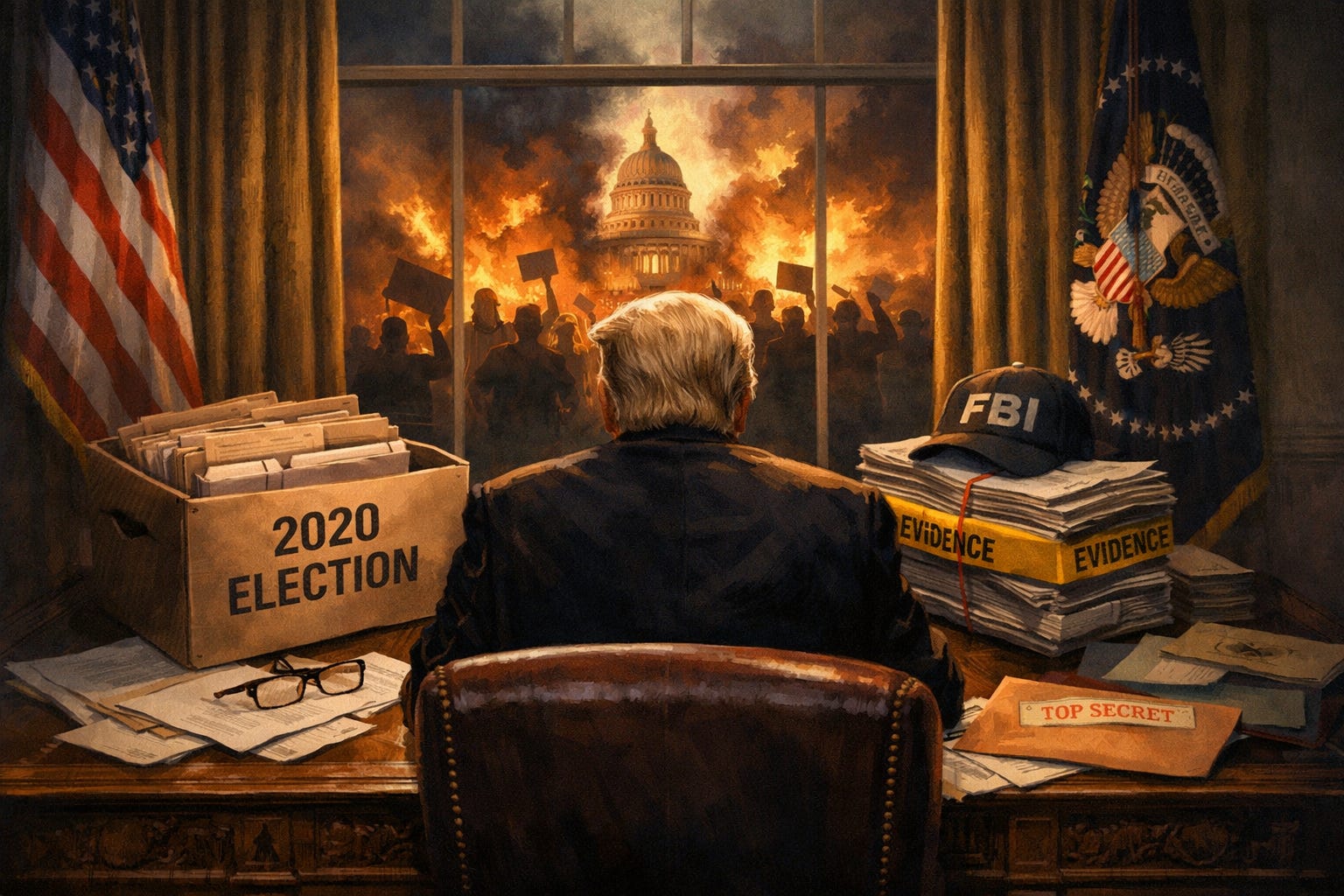
On January 28, 2026, the Department of Justice under President Donald Trump authorized the FBI to seize original 2020 election records from the Fulton County Elections Operations Center in Atlanta, Georgia. Federal agents arrived without prior notice to local officials and removed boxes of ballots, voter rolls, tabulator tapes, and ballot images. These were all physical remnants of an election that occurred more than five years ago.
No charges were announced. The warrant itself remains sealed. As of this writing, neither the FBI nor the DOJ has offered a public explanation for why this action was taken now. For some, the raid reignited hope that long-standing allegations of fraud in the 2020 election would finally be vindicated. For many others, the timing raised deeper questions about credibility, legality, and purpose.
Local officials were quick to object. Fulton County Commissioner Marvin Arrington Jr. announced that the county would file a federal lawsuit challenging the seizure's legality, citing concerns about jurisdiction, overreach, and the chain of custody for sensitive voter materials. Prominent Georgia Democrats, including Senator Raphael Warnock and Representatives Lucy McBath and Nikema Williams, called for a congressional investigation, pointing to what they described as an unprecedented intrusion into local election authority and a dangerous federal precedent.
This Community Is Powered by You
What started as a small circle has grown into something much bigger, and it’s all because of readers like you.
Every time you forward this email, post it on socials, or bring someone new into the fold, you’re helping build one of the most passionate, independent political communities out there.
Want to keep the momentum going?
Share this newsletter with someone who should be part of this conversation.
Thank you for being here. It means everything.
The 2020 Election: Settled Law, Settled Facts
Donald Trump’s false claims about the 2020 election began before the votes were even counted. He insisted it had been stolen, manipulated, and rigged, a narrative that would come to dominate conservative media, reshape the Republican Party, and culminate in the January 6 attack on the Capitol. However, in the years that followed, the legal system responded clearly and consistently.
More than sixty lawsuits were filed challenging the results in states across the country. Every one failed. Judges, some appointed by Trump himself, dismissed the claims for lack of evidence. In Georgia, a full hand recount was conducted alongside machine tabulations and audits. Each confirmed Joe Biden’s victory. Fulton County, long vilified in conspiratorial circles, was subjected to intense scrutiny. No credible evidence of fraud ever surfaced.
Election officials, both Republican and Democrat, certified the results. Congress certified the Electoral College vote. The American people moved forward. Trump, meanwhile, never did.
Too Late and Too Tainted
The federal government requires that election records be preserved for twenty-two months. This standard is codified in law and widely understood by state and local election officials. After that period, jurisdictions are permitted, and in many cases expected, to dispose of those materials according to local policy and capacity.
The ballots seized from Fulton County were five years and one month old at the time of the raid. They were, by federal standards, long past the point of mandated preservation. It is unclear why Fulton County still possessed them, and it is even less clear what legal theory justifies their seizure in 2026. The chain of custody is in question. The condition of the materials is in question. Most notably, the purpose behind the search is in question.
Even if the Trump DOJ were to claim they had uncovered evidence of fraud in these records, the finding would be practically meaningless. Joe Biden already served his term. Trump won reelection in 2024. Nothing discovered now can change that. Worse still, any claim of new evidence will inevitably be shadowed by the circumstances of its discovery. The timeline is suspect, the chain of custody is broken, and the actor making the claim — Trump’s own Department of Justice — is politically invested in the outcome. Any “evidence” uncovered will be considered, at best, convenient and, at worst, suspect.
In every sense that matters, the 2020 election is over. Yet the search for a narrative continues.
A Familiar Playbook
The timing of the Fulton County raid raised eyebrows not only because of its content, but because of what came before it. Throughout Trump’s second presidency, there has been a pattern. When political pressure mounts, when public backlash crests, when attention threatens to lock onto something damaging, another historical file is released. Another mystery is dangled. Another spectacle is staged.
The playbook is simple. Release something that sounds big. Let the headlines carry it for three days. Watch as it fades without consequence. It started with the UFO files during the pandemic, but in his second term, Trump has doubled down on the pattern.
The JFK Files
It began again in March 2025, with the long-promised release of classified files relating to the assassination of John F. Kennedy. The headlines came immediately: new files, new questions, new theories. However, the documents themselves revealed nothing of note. There was no explosive evidence, and no final answers. There were only redactions, familiar details, and inconclusive conclusions.
At the time, Trump’s administration was under fire. The Department of Government Efficiency (DOGE) had spent months gutting federal agencies, including USAID. Civil service protections were being stripped through the revival of Schedule F. Trump’s Department of Defense was trying to spin the narrative around Hegseth’s SignalGate inclusion of a reporter in classified real-time strikes in Syria. DEI language was being purged from federal websites. The attack on Voice of America was underway. The news cycle was full. The JFK files changed the subject, at least for a moment.
The RFK Files
Then came April through June, and with it, the release of documents related to the assassination of Robert F. Kennedy. It was a slow roll: tens of thousands of pages, many of them decades old, much of it already known. Once again, the media paused for breath. What if Sirhan Sirhan wasn’t alone? What if something was buried?
Meanwhile, ICE enforcement was escalating, with human rights organizations reporting abuses across the country. The No Kings protests gained national momentum. The United States bombed Iranian nuclear sites in one of the largest military escalations of the Trump presidency. The National Guard was deployed to cities like Los Angeles in response to civil unrest. New tariffs wreaked havoc on the agricultural and manufacturing sectors. Yet for a moment, the spotlight drifted. RFK was back.
The MLK Files
In July, the administration released previously classified documents relating to the FBI’s surveillance of Martin Luther King Jr. The records were damning but not new. The abuses of COINTELPRO had been widely documented for decades. There were no revelations, only reminders.
That month, the One Big Beautiful Bill was signed into law, signaling austerity for the people and tax breaks for the wealthy. Pressure to release the Epstein files was intensifying. New lawsuits targeted independent media outlets. Elon Musk publicly broke from Trump. Science agencies saw funding slashed to historic lows.
Again, the pattern repeated. The news cycle was pulled back to the past.
The Earhart Files
By September, the well of conspiratorial American history was nearly dry. Trump announced the declassification of all government records relating to the disappearance of Amelia Earhart. No documents of consequence emerged, yet the announcement itself was enough to dominate headlines for a weekend.
Meanwhile, real crises were erupting across the country. The U.S. Navy and Air Force launched strikes on vessels in the Caribbean, ICE abuse allegations dominated headlines in the national press, Charlie Kirk was assassinated at Utah Valley University, and leadership at the CDC collapsed amid scandal.
The pattern was clear. When reality became unmanageable, the administration offered up the past.
The 2020 Election Files
In January 2026, as that pattern repeated once more, the stakes had never been higher.
Just four days before the Fulton County raid, federal immigration officers shot and killed 37-year-old Alex Pretti during a protest in Minneapolis. Pretti, a critical care nurse at the local VA hospital, was unarmed. Eyewitnesses say he was helping other protesters when he was shot. The Hennepin County medical examiner ruled his death a homicide.
His killing ignited increased national waves of demonstrations, already exploding due to the shooting of Renee Good by immigration officers just weeks earlier. Thousands poured into the streets of Minneapolis, San Francisco, Los Angeles, Boston, and New York. Protesters demanded accountability from ICE and the DOJ, while civil rights leaders denounced the administration’s use of force against civilians. The situation was escalating. The streets were full again. Any headlines that weren't focused on ICE accountability covered the heavily redacted release of a tiny portion of the Epstein files. Then, on January 28, the Department of Justice turned its attention not to that crisis, but to a five-year-old election.
The timing was not subtle. It was not incidental.
It was a distraction, another act in a performance that had played out, again and again, for a watching press.
Priorities
Perhaps the most telling contradiction in this latest move isn’t the timing of the raid itself, but what it reveals about government priorities. For months, the DOJ has slow-rolled the release of files, claiming it could not comply with the Epstein Files Transparency Act because it lacked the staff and resources to process, redact, and release the documents. Despite the law’s deadline and longstanding law-enforcement practices that maintain dual-file systems for this exact purpose, the Epstein files remain only partially released. The delay has drawn criticism from members of both parties, from victims’ advocates, and from media organizations.
Yet this same DOJ had the capacity to raid a local elections office in Georgia for records long past their legal retention date, records that were widely acknowledged as having already been thoroughly reviewed. That is not a question of staffing. It is a question of priorities.
See our previous reporting here:


A Performance with Nothing Left
What remains is not governance. It is a show that loops back on itself. The classified file drops — JFK, RFK, MLK, Earhart — delivered nothing of substance. Each arrived with tepid fanfare. Each faded without impact. The public was promised truth. What they got were distractions, aimed not at illumination but at redirection.
Now, with no mysteries left to mine, the Trump administration has returned to its original stage: the 2020 election. However, this time, it is even further removed from reality. The ballots are old. The law is settled. The president has already changed. The cycle has already turned.
The Fulton County raid is not an investigation. It is a message that the past is never past, so long as it is politically useful, that facts can be revisited when narratives are needed, and that old lies can be reanimated when new ones fail to take hold.
There is no justice here— only performance — and it’s running out of material. If we are being honest, it would be pathetic if we did not know that desperate people resort to desperate actions. With nothing new to release, what will they do next to keep our focus anywhere but on the hellscape they have built?
Stay With Us
If this story resonated — if you’re tired of the distractions, the noise, the narratives designed to keep us looking backward while the damage happens in real time — subscribe to stay grounded in what matters. We follow the power, the patterns, and the stories others would rather you forget. No hype. Just clarity.
Sources:
FBI Executes Search Warrant at Fulton County Election Office (Atlanta Journal‑Constitution) — January 28, 2026
FBI Seizes 2020 Ballots in Georgia Amid Controversy (Associated Press) — January 29, 2026
Search Warrant at Georgia Elections Office Seeks 2020 Records (ABC7) — January 29, 2026
Georgia’s Fulton County to File Motion After FBI Seizes Ballots (CBS News) — February 2, 2026
Trump Says FBI Raid Will Show 2020 Election Was Stolen (The Atlanta Journal‑Constitution) — February 2, 2026
Fulton County to Sue over FBI Ballot Seizures and Trump Urges “Nationalize” Voting (Democracy Now) — February 3, 2026
Fulton County Official Slams 2020 Ballot Seizure (ABC News) — January 29, 2026
Experts Warn Raid May Be Illegal, Raises Fears (Democracy Docket) —January 29, 2026
Georgia Democrats Call for Inquiry into Gabbard at Fulton Raid (The Guardian) — February 3, 2026
Experts Sound the Alarm Over FBI’s Search (Truthout) — January 29, 2026
Results of Lawsuits Regarding the 2020 Elections (Campaign Legal Center)
Fulton County Election Interference Case Dismissed (Georgia Recorder) — November 26, 2025
FBI Searches Atlanta Election Office Amid Claims (PBS NewsHour) — January 28, 2026
Trump’s DOJ Sues Fulton County to Force Release of 2020 Ballots (Georgia Recorder) — January 28, 2026
Distraction, what magicians called misdirection, is one of the big parts of The Fapweasel’s (Trump) bag of tricks. While the public and the media is looking in one direction, they are doing something illegal elsewhere.
Where/what is the actual evidence for this alleged crime?