


Elon Musk has made a career out of blurring the lines between public service and personal gain, but now, we have a price tag.
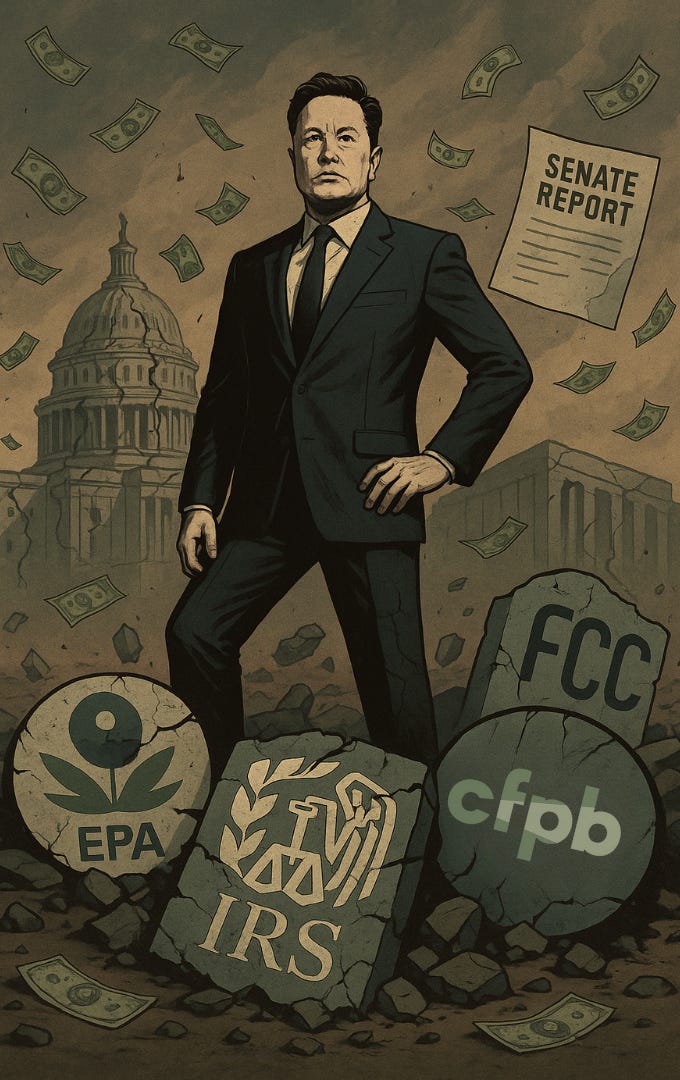
According to a newly released Senate report, Musk’s companies stand to avoid at least $2.37 billion in potential legal liability, and not just by accident. The report shows how Musk, as head of Trump’s Department of Government Efficiency (DOGE), may have used his power to dismantle or defang the federal agencies investigating him.
It’s not a conspiracy theory. It’s a line-by-line, case-by-case accounting from the Senate’s chief investigative subcommittee. It connects the dots between at least 65 actual or potential enforcement actions and the 11 agencies once tasked with keeping Musk’s empire in check. From faulty autopilot claims to improper subsidies, from spectrum grabs to workplace violations, Musk’s liability portfolio is staggering. But as it turns out, so is his reach inside the government.
This isn’t just about a conflict of interest. It’s about structural capture and the real-time monetization of regulatory collapse.
Independent News. Just $1/Week.
We just hit 12,000 subscribers—thank you! We’re offering full access to The Coffman Chronicle for just $1 a week ($52/year) to celebrate.
Get exclusive analysis and fearless reporting you won’t find in corporate media.
Support truth. Stay informed.
Who Released the Report & Why It Matters
The bombshell comes from the Permanent Subcommittee on Investigations (PSI), a powerful arm of the Senate Homeland Security and Governmental Affairs Committee. If that sounds obscure, it shouldn’t: PSI is one of Congress’s oldest and most serious watchdogs, with a legacy that includes exposing Enron’s fraud, oil industry collusion, and post-9/11 national security failures.
This particular report was issued by Democratic staff on the subcommittee, led by Senator Richard Blumenthal. It’s not a splashy op-ed or partisan stunt; it’s a carefully sourced 43-page memorandum, based on public records, agency filings, and enforcement data available as of January 20, 2025.
The committee’s estimates capture Musk’s legal exposure while he was still actively running DOGE, a role he held from January through April 2025. Quietly confirmed this week, his departure came just as the report landed. Officially, he says he’ll still spend “a day or two per week” on federal matters, but he’d previously said he wouldn’t scale down until the end of May. So what changed? Possibly this report. Or Tesla’s stock price. Or the polling.
The report’s conclusion? That Musk’s conflicts of interest aren’t theoretical; they’re measurable. His companies are under formal or potential investigation by at least 11 federal agencies. In 45 of those 65 known cases, the committee estimated the potential dollar value of fines or penalties Musk may be trying to avoid. The result: a conservative—but still jaw-dropping—$2.37 billion.
And that’s just what we know.
What the Report Says
The subcommittee’s report is methodical, not breathless. It doesn’t accuse Musk of criminal behavior, but it does something far more damning: it adds up the price of regulatory silence and shows how Musk may have rigged the system to buy it.
The memo identifies 65 enforcement actions—some ongoing, some quietly closed, and others plausibly threatened—spanning 11 federal agencies. In 45 of those, the committee’s staff quantified potential liability, either from statutory fine ranges, prior agency settlements, or Musk’s own financial disclosures. The result: $2.37 billion in conservatively estimated penalties or fines.
The most significant chunk—just under $1.2 billion—comes from Tesla’s false and misleading claims about its Autopilot system, which has been linked to fatal crashes and subject to multiple investigations. Other liabilities include:
Potential antitrust and deceptive practice fines tied to advertising and product claims;
Alleged violations of labor and safety laws in Tesla and SpaceX facilities;
Starlink’s aggressive and sometimes rule-bending expansion in contested airwaves;
Ongoing scrutiny over improper use of tax credits or federal contracts.
“The $2.37 billion in estimated exposure is a conservative figure that excludes unquantified risks, legal cost avoidance, and any financial gain resulting from the suppression of competition or regulation.”
— Senate PSI Minority Staff Memorandum, p. 11
Importantly, the report isn’t speculative. It leans heavily on public data, regulatory precedent, and government filings as of January 20, meaning it reflects Musk’s legal exposure before any DOGE-related agency slowdowns, shakeups, or shutdowns began to take effect fully.
However, understanding the liability is only half the picture; the real story is how Musk ended up with the power to defuse it.
DOGE and the Conflict at the Center
If you've been following our coverage, you already know what DOGE is. But if you’re new here, Trump created the Department of Government Efficiency on his first day back in office. And then he handed the keys to Elon Musk.
Officially, DOGE’s job was to streamline federal agencies, cut “waste,” and bring tech-sector agility to government. In practice, it’s functioned as a demolition crew in a business-casual hoodie, slashing regulatory budgets, ousting watchdog leadership, and rerouting agency authority into the White House’s private orbit. And it did all that under the leadership of a man whose companies were actively being investigated by the very agencies DOGE was empowered to reshape.
That’s the conflict of interest at the heart of the Senate report: Musk wasn’t just a federal advisor with massive private holdings. He was structurally positioned to shut down or sideline the regulators standing between him and billions in fines.
He didn’t even have to order agencies to stop investigating. All DOGE had to do was:
Freeze hiring or enforcement budgets,
Reassign senior staff mid-investigation,
Eliminate rulemaking authority,
Or delay regulatory timelines indefinitely.
“Mr. Musk simultaneously exercised federal authority over agencies investigating his companies while those same companies stood to benefit financially from reduced oversight.”
— Senate PSI Minority Staff Memorandum, p. 2
As the Senate report points out, this is precisely what happened in more than one case.
The Agencies Musk Needed Gone & DOGE Helped Sideline
We’ve covered DOGE’s fingerprints across multiple agencies. The Senate report shows how systematically those cuts lined up with Musk’s legal risks.
Here’s how the 11 affected agencies break down:
A. Financial and Consumer Protection
Agencies: CFPB, SEC, FTC
Estimated Exposure: Hundreds of millions
Musk’s companies have faced scrutiny for everything from deceptive advertising to shady lending.
The Consumer Financial Protection Bureau (CFPB) was investigating Tesla’s auto lending practices before DOGE intervened by removing its leadership and stalling its enforcement division.
The Securities and Exchange Commission (SEC) has long tracked Musk’s market-moving tweets and Tesla’s questionable disclosures about Autopilot and vehicle performance.
The Federal Trade Commission (FTC) has reportedly raised concerns about deceptive marketing claims, particularly those related to Tesla’s “Full Self-Driving” feature.
DOGE targeted all three agencies for budget “realignment” and regulatory “modernization,” which translated to: fewer watchdogs, fewer teeth, and a lot more room for risk.
We covered the early gutting of the CFPB. See our reporting here:
Note: This article is over 45 days old and now lives in our archive. Consider becoming a paid subscriber for the full 450+ article archive, exclusive content, and occasional early access.

B. Safety, Transportation, and Labor Oversight
Agencies: NHTSA, FAA, OSHA
Estimated Exposure: ~$1.2 billion (Tesla Autopilot alone)
This is where the most significant liability lives: Tesla’s Autopilot system, under investigation by the National Highway Traffic Safety Administration (NHTSA) after being linked to numerous crashes and fatalities. The Senate memo pegs this exposure at nearly $1.2 billion.
Meanwhile, SpaceX's launch operations frequently draw scrutiny from the Federal Aviation Administration (FAA), especially after multiple near misses and regulatory violations. Musk has long treated the FAA as an obstacle rather than a partner.
And on the ground, Tesla factories and SpaceX facilities have faced dozens of Occupational Safety and Health Administration (OSHA) complaints, ranging from basic worker protections to severe injury reporting failures.
DOGE’s contribution? Strip staff, consolidate oversight, and redirect industrial safety review to “public-private task forces.” Translation: Let Musk regulate Musk.
We’ve reported extensively on the gutting of OSHA and national health protections. This article may be of interest.

C. Environmental and Energy Oversight
Agencies: EPA, DOE
Estimated Exposure: Unknown, but potentially massive
Tesla and SpaceX rely on materials, manufacturing processes, and energy infrastructure that trigger oversight from the Environmental Protection Agency (EPA) and the Department of Energy (DOE). The environmental exposure here is extensive, from hazardous waste at gigafactories to EV battery supply chains, even if the Senate report couldn’t quantify all of it.
The EPA, already weakened before Trump returned to office, was an early DOGE target. Entire compliance teams were gutted, and several pending investigations disappeared from public dashboards. Meanwhile, DOGE placed energy subsidies and contracts under expedited review, while Musk’s companies continued receiving billions in grants and loans.
Our prior reporting on environmental procection roll-backs may be of interest for further context.

D. Taxpayer Dollars and Government Contracts
Agencies: Treasury, IRS
Estimated Exposure: Tens to hundreds of millions
Even before any headlines, DOGE had begun slowing compliance reviews and stalling audits across the Treasury Department, moves that directly benefited Musk’s companies. Then came the appointment of Daniel Shapley, a former Tesla tax advisor, as acting IRS commissioner. He lasted just 72 hours before resigning under pressure. While the timing raised eyebrows, the message was clear: Shapley’s arrival wasn’t the beginning of the interference; it was the acceleration. And his swift ouster may have signaled to Musk that his window to control federal oversight was closing faster than expected.
E. Communications and Public Infrastructure
Agency: FCC
Estimated Exposure: Moderate—but growing influence risk
Musk’s Starlink satellite network has sparked regulatory fights around spectrum use, broadband equity, and military contracts. The Federal Communications Commission (FCC) had been weighing public-interest complaints about Starlink’s dominance until DOGE helped reroute that process.
At the same time, Musk’s X (formerly Twitter) platform began absorbing public communication duties from federal agencies, including Social Security, NOAA, and even disaster alerts. This shift raises serious questions about access, bias, and accountability.
DOGE didn’t just slow the FCC. It moved communications oversight into Musk’s hands—functionally and literally.
See our earlier reporting on the attacks on the FCC here:

Why It Matters
This isn’t just a story about one billionaire avoiding a hefty fine. It’s a case study in regulatory capture at federal scale and a glimpse into what governance looks like when accountability is optional.
The Senate report doesn’t accuse Musk of criminality. It doesn’t need to. What it documents is more corrosive: how a sitting federal official used executive authority to undermine the systems meant to hold him accountable. And how, in doing so, he may have cleared the path for his companies to dodge billions in liability, while still collecting billions more in federal contracts, credits, and subsidies.
“Allowing a government official to control the levers of oversight over their own financial interests erodes public trust and invites the emergence of a modern oligarchy.”
— Senate PSI Minority Staff Memorandum, p. 3
It matters because this is not a hypothetical. It already happened. DOGE gutted oversight agencies, redirected federal communications, and rewrote enforcement priorities in ways that directly benefited its architect. And now that the Senate has added up the numbers, the bill isn’t just financial; it’s democratic.
If the rules don’t apply to the richest and most powerful, they’re not rules. They’re just polite suggestions. And when one of those influential figures is given federal authority to erase the referees, it stops being a loophole. It becomes a blueprint.
We just hit 12,000 subscribers—thank you! We’re offering full access to The Coffman Chronicle for just $1 a week ($52/year) to celebrate.
Get exclusive analysis and fearless reporting you won’t find in corporate media.
Bibliography:
Permanent Subcommittee on Investigations, U.S. Senate. Minority Staff Memorandum: Elon Musk Conflicts of Interest. April 27, 2025.
Blumenthal, Richard. "Blumenthal Exposes Billions in Legal Penalties and Fines Elon Musk Stands to Avoid Due to Government Power Grab." Press Release, April 28, 2025.
The Guardian. "Elon Musk's Doge Conflicts of Interest Worth $2.37bn, Senate Report Says." April 28, 2025.
The Verge. "Elon Musk's DOGE Ties Could Get His Companies Out of $2 Billion in Potential Liability." April 29, 2025.
Los Angeles Times. "Elon Musk's Companies Face at Least $2.37 Billion in Potential Federal Penalties, Report Says." April 28, 2025.
MarketWatch. "Democrats Ask Whether $1 Billion in 'DOGE' Cost Cutting at Social Security Has Hurt Recipients." April 26, 2025.
Reuters. "US Appeals Court Will Not Allow DOGE to Access Social Security Data." April 30, 2025.
The Verge. "The DOGE Days Have Just Begun." April 30, 2025.
MarketWatch. "Social Security Rule Reversals, Office Closures, Cost Cuts: Here's What's Happening Now." April 30, 2025.
Business Insider. "Most Americans Don't Think DOGE Has Actually Cut Government Waste, Poll Says." April 29, 2025.
