


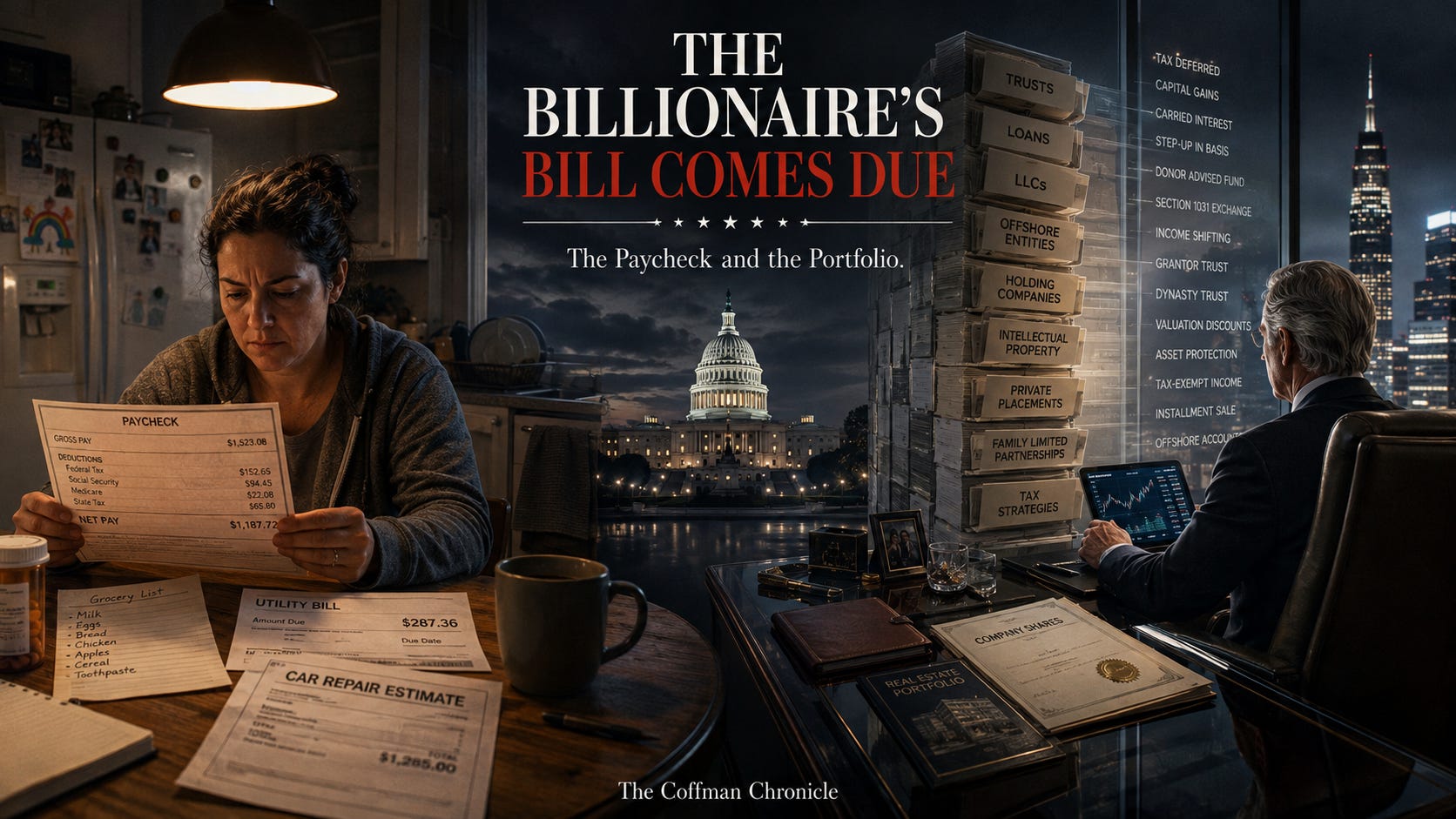
The Paycheck Arrives Already Divided
Before a working person can decide what the week’s labor will pay for, the government has already taken its share. The nurse sees it on the pay stub before the grocery list is finished. The mechanic sees it before the car payment clears. The warehouse worker sees it before the rent, electric bill, and prescription waiting at the pharmacy have been covered.
Federal income tax, Social Security, and Medicare taxes are withheld. State and local obligations may follow. The worker does not choose when the income becomes visible. The employer reports it, the government records it, and the obligation arrives before the money reaches the kitchen table. The Internal Revenue Service requires employers to report wages and withholding on Form W-2, and federal income tax is commonly withheld directly from employees’ paychecks.
The tax system does not pause because the transmission failed on Tuesday or a child woke with a fever on Thursday. Labor becomes taxable when it is earned.
For the owners of extraordinary fortunes, the clock may work differently. A person whose stock holdings rise by hundreds of millions of dollars may become vastly wealthier without owing federal income tax on that increase in the same year. Appreciating assets can remain unsold, be placed inside complicated ownership structures, or be used as collateral for loans, allowing the owner to access enormous purchasing power without creating the kind of taxable event that occurs every time a worker receives a paycheck.
Wages and unrealized investment gains are not the same, nor is it accurate to claim that every working family pays a higher overall federal tax rate than every wealthy household. Many affluent Americans pay substantial taxes. The deeper imbalance is how automatically, visibly, and unavoidably the obligation arrives.
Working people generally possess little control over when their income becomes taxable. Their wages are reported for them, their payroll taxes are collected before they can make another choice, and their contribution to the republic is treated as due.
The owners of great fortunes often possess more choices. They may decide when to sell, when to borrow, how to structure ownership, and when a gain becomes recognizable to the tax system. The greater the fortune, the greater the capacity to hire people whose job is to manage the boundary between economic wealth and taxable income.
The working class is not necessarily taxed more under every measure. It is taxed more automatically, more visibly, and with far less control over when the obligation becomes due.
The American tax system recognizes the worker’s obligation before the worker touches the money. It often recognizes the billionaire’s obligation only after the billionaire chooses to create one.
This Community Is Powered by You
What started as a small circle has grown into something much bigger, and it’s all because of readers like you.
Every time you forward this email, post it on socials, or bring someone new into the fold, you’re helping build one of the most passionate, independent political communities out there.
Want to keep the momentum going?
Share this newsletter with someone who should be part of this conversation.
Thank you for being here. It means everything.
Success Is Not the Offense
That imbalance does not mean every great fortune was stolen, every wealthy person cheated, or every successful business was built on exploitation. People take risks, develop products no one is certain will sell, and create companies that employ thousands. Innovation creates real value, and the people responsible for it should benefit from what they build.
The Square New Deal does not treat prosperity as a moral defect or ask government to decide how much success a person deserves. Private ownership should remain protected, productive investment encouraged, and honest success free to flourish.
However, prosperity and concentrated power are not the same. A household with enough savings to retire comfortably possesses security. A fortune worth hundreds of millions or billions of dollars possesses something more. It can buy companies, reshape housing markets, control sources of information, influence elections, finance lobbying campaigns, and sustain political access unavailable to ordinary citizens. At that scale, wealth is no longer merely a reward enjoyed in private. It has become a form of power exercised in public.
No person builds that power on private ground alone. The fortune grows inside a legal system that recognizes ownership, enforces contracts and allows businesses to recover debts. It relies on courts paid for by the public, currency backed by the United States, and financial markets governed by rules strong enough for strangers to trust one another with enormous sums.
Products move across public infrastructure. Workers are educated in taxpayer-supported schools and universities. Patents, limited liability, bankruptcy protection, public safety, and national defense all help private value survive and compound.
These institutions serve workers, families, and small businesses too. The difference is scale. A neighborhood store may depend on one public road. A multinational corporation may depend on networks of highways, ports, courts, power systems, communications infrastructure, and international agreements to preserve billions of dollars in value.
Government did not invent every product or make every management decision, but neither did the entrepreneur personally create the market, currency, workforce, courts, infrastructure, and stability that allowed one successful decision to compound into wealth large enough to shape the country.
The Square New Deal does not use that fact to claim ownership of private companies. It uses it to establish reciprocity. Private achievement is important, but so is the public foundation that allows private achievement to compound into extraordinary power.
Extraordinary wealth is not the offense. Escaping extraordinary responsibility is.
The Tax Code Sees Labor More Clearly Than Wealth
The tax code does not struggle to find a working person’s wages. Employers record and report them, and payroll taxes are collected through the same system. A worker generally cannot postpone Friday’s wages until a year when the tax rate is more convenient. The work happened, the wages arrived, and the obligation became due.
Wealth does not always enter the tax system through such a direct door. A person who buys an asset and watches its value rise generally does not realize a taxable gain merely because the market price increased. Gain is usually realized when property is sold or exchanged. Until then, the owner may be substantially wealthier without the increase appearing as current taxable income.
That rule is not inherently corrupt. An asset may rise one year and fall the next. A private company may be difficult to value, and a homeowner should not receive an income-tax bill every time neighborhood prices increase. Yet, the rule becomes more consequential as the fortune grows.
A worker has almost no choice about when wages become visible. The owner of billions in stock may decide when to sell, which gains to recognize, or whether to borrow against appreciating assets instead. Loan proceeds generally are not treated as income because the borrower remains legally obligated to repay them, although canceled debt can later become taxable.
A family borrowing against a home to repair a roof and a billionaire borrowing against a vast stock portfolio are therefore using the same legal principle without exercising the same economic power. The scale and consequence are not the same.
The contrast can continue across generations. Under current federal rules, the basis of inherited property is generally adjusted to its fair market value at death. When heirs later sell, the taxable gain is usually measured from that new basis rather than from what the original owner paid. Estate-tax rules may apply separately, but appreciation accumulated during the original owner’s life may escape capital-gains taxation.
A worker cannot pass untaxed wages to a child by dying before payday. A fortune can pass appreciated property under rules that may erase the income-tax history of the gain.
None of this means wealthy Americans pay nothing. Many pay enormous income, capital-gains, estate, property, state, and local taxes. The problem is not that every wealthy person escapes taxation. It is that wealth has more opportunities than labor to control when, where and in what form taxation occurs.
Working people receive income in the form easiest for government to identify and hardest for the taxpayer to defer. Extraordinary fortunes often grow through assets that provide more control over realization, borrowing, ownership structure, and inheritance.
The worker receives a tax form. The fortune receives a strategy meeting.
Ordinary working people already perform their stewardship obligation through every paycheck. Their wages are visible. Their contribution is collected. Their responsibility is treated as a settled feature of economic life. The Square New Deal asks why responsibility should become less certain as economic power becomes greater.
Forty Thousand Fortunes and the Wealth Above the Line
The number of Americans worth more than $100 million depends on what counts as wealth. Knight Frank reported that the worldwide population worth at least $100 million surpassed 100,000 in 2024 and that more than 40% of those individuals lived in the United States. That implies more than 40,000 Americans under its broad net-worth model.
Henley & Partners, using the narrower standard of liquid, investable wealth, counted approximately 10,800 American centi-millionaires and more than 850 billionaires in its 2025 report
The estimates measure different things: total net worth versus liquid, investable wealth. The responsible conclusion is that tens of thousands of Americans possess fortunes beyond $100 million.
The policy is not aimed at people earning $100 million in one year. It is aimed at households possessing net wealth above $100 million after legitimate liabilities are counted. Billionaires are not a separate population added later. Every billionaire has already crossed the $100 million line.
The first $100 million would remain outside the tax. A household worth $110 million would have $10 million above the line. A household worth $1 billion would have $900 million above it. A household worth $100 billion would have $99.9 billion above it.
That is why revenue depends less on the number of taxpayers than on the volume of wealth above the exemption. A relatively small number of billionaire and multibillionaire households would owe much of the total.
Existing models of related wealth-tax proposals show the possible scale while warning against false precision. The Tax Policy Center estimated that a broad 1% tax on net wealth above $50 million could raise approximately $1.9 trillion over ten years after adjustments for avoidance and evasion. Raising the rate to 2% above $100 million added roughly another $1 trillion to that model, while excluding pensions, much housing wealth, and actively operated private businesses reduced the estimate by about 45%.
That is not a score of the Square New Deal proposal. Our threshold, rates, and treatment of assets would require independent modeling of their own. The evidence supports a narrower conclusion: a broad, enforceable obligation on extraordinary wealth could generate revenue well into the hundreds of billions of dollars annually, but the amount would depend on the final tax base, valuation rules, exemptions, economic responses, and enforcement.
The argument is not built on forty thousand people merely crossing a line. It is built on the extraordinary concentration of wealth that exists above it.
The Square New Deal Draws the Stewardship Boundary
The Square New Deal does not begin with a tax rate, but with a question of responsibility: What does power owe when it becomes large enough to shape the lives of people who do not possess it?
That question applies to government. Public officials receive authority from the Constitution and the people. They must exercise it within the law, submit it to oversight, and preserve rights even when doing so is inconvenient.
It applies to corporations. A company may earn profits, expand, and reward investors, but it should not transfer the costs of its success onto workers, communities, and taxpayers while keeping every benefit for itself.
It applies to citizens. Self-government requires participation, vigilance, defense of due process, and protection of the rights of people with whom we disagree.
It also applies to private wealth. When a fortune becomes large enough to influence markets, employment, housing, information and government itself, it has crossed from prosperity into power. The Square New Deal calls the duty attached to that power great-fortune stewardship.
The Square New Deal is the governing program. Good Steward Capitalism is its economic model. Stewardism is the philosophy beneath both.
Stewardism rejects the idea that freedom means transferring every burden downward. It does not believe power becomes less accountable because it was accumulated through markets rather than elections. Rights remain protected. Ownership remains private. Power carries responsibility.
Working people already live under that rule. Their wages are reported, their payroll taxes withheld, their purchases taxed, and their homes assessed. Their obligation is embedded in ordinary economic life.
Yet the present system often allows responsibility to become more negotiable as wealth becomes more extraordinary. That disparity reflects a political choice about whose obligations are fixed and whose remain open to design.
A billionaire may hold no elected office and still be able to move jobs, influence legislation, finance political organizations, purchase communications platforms, or reshape a community through one investment decision. That does not make the billionaire an enemy. It makes them powerful.
The public therefore has the right to establish rules for extraordinary private power. Government must carry its side of the bargain by administering those rules lawfully and using the revenue transparently.
That is the difference between Stewardism and resentment. Resentment asks who has too much. Stewardism asks what power owes.
The Great Fortune Stewardship Tax
The Square New Deal would turn that responsibility into a rule Congress can enforce.
The Great Fortune Stewardship Tax would apply annually to household net wealth above $100 million. The working structure would impose no tax on the first $100 million, 1% on wealth between $100 million and $1 billion, 2% between $1 billion and $10 billion, and 3% above $10 billion.
Those rates would be marginal. A household worth $150 million would owe 1% only on the $50 million above the exemption, producing an annual obligation of $500,000. A household worth $1 billion would owe nothing on the first $100 million and 1% on the remaining $900 million, producing an obligation of $9 million. A household worth $12 billion would owe $9 million on the first taxable bracket, $180 million on the next, and $60 million on the $2 billion above $10 billion, for a total of $249 million. The household would still retain a fortune measured in billions.
The purpose is not to erase extraordinary wealth, but to establish that responsibility continues rising after prosperity becomes power.
Congress would need to define net wealth carefully. The calculation should include assets owned or effectively controlled by the household, reduced by legitimate debts. Public stock, private-company interests, real estate, trusts, partnerships, artwork, and other major holdings could not disappear merely because ownership was divided among legal entities.
At the same time, debt could not become a manufactured escape route. A genuine mortgage or business loan should reduce net worth. A circular loan among controlled entities or an artificial liability created only to shrink the taxable balance sheet should not.
The $100 million exemption should be written directly into law and protected from administrative erosion. No agency or president should be able to lower it. Any future decision to reach less wealthy households should require new legislation, public hearings, and recorded votes.
The rule must also account for genuine illiquidity. A founder may hold most of a fortune in a private company that employs thousands but produces less available cash than its appraised value suggests. Congress should permit installments or deferral when immediate payment would cause substantial harm to a productive business, but deferral cannot become forgiveness. Deferred obligations should carry interest and remain secured until shares are sold, control changes, or the estate is settled.
The owner keeps the asset. The company remains private, and government receives no board seat. The public receives a defined contribution from wealth whose value depends on public institutions and whose scale carries public consequence.
The Square New Deal would not place a ceiling on success. It would place a floor beneath responsibility.
The Revenue Must Return to the People
A stewardship tax should not disappear into the Treasury as another number too large for ordinary people to recognize.
Congress should establish a Great Fortune Stewardship Fund with annual audits, public reporting, and clearly defined purposes. The public should see what was collected, what enforcement cost, where the money went, and what protection it produced.
The fund should not become a political checking account or a promise that one revenue stream can finance every worthy cause. A serious proposal must choose. The clearest public return would be divided between retirement security and healthcare costs.
Social Security should be first. The 2026 trustees projected that the combined retirement and disability trust funds could pay all scheduled benefits until 2034, after which continuing income would cover approximately 83%. The retirement fund alone is projected to deplete its reserves in the fourth quarter of 2032, when continuing revenue would cover about 78% of scheduled retirement and survivor benefits.
Those figures do not mean Social Security disappears. They mean an earned promise and its financing are moving toward collision. The stewardship tax should not replace the payroll contributions that give Social Security its earned-benefit character or excuse Congress from broader reform, but a defined share of the revenue could protect scheduled benefits and reduce pressure for cuts or a higher retirement age.
The second public return should reduce household healthcare costs. In 2025, average employer-sponsored family premiums reached $26,993, with workers contributing an average of $6,850. Among covered workers in plans with a general annual deductible, the average deductible for single coverage was $1,886.
Congress could use stewardship revenue to lower premiums and cost-sharing, reduce prescription expenses, or strengthen primary care and rural hospitals. The governing purpose should be unmistakable: reduce what ordinary people must surrender merely to remain healthy.
Government must practice stewardship too. Every dollar should be traceable. Administrative costs should be disclosed. Independent audits should measure whether the fund strengthened retirement security or reduced household healthcare expenses.
The owners of extraordinary fortunes must contribute honestly, Congress must spend honestly, and the people must be able to inspect the bargain.
The public obligation must produce a public return the people can see. It should arrive at the kitchen table as greater security.
Serious Rules and a Constitutional Mechanism
A tax on extraordinary wealth is easy to announce and difficult to administer. That difficulty is not an argument against the obligation. It is an argument against pretending the obligation can be collected through slogans.
Congress would need uniform valuation standards for public stock, real estate, private businesses, and other significant assets. Volatile holdings could be averaged over time. Taxpayers must be able to challenge unreasonable valuations, but honest review cannot become permanent delay. Deliberate concealment, sham debts, and false appraisals should carry serious penalties.
The Internal Revenue Service would also need the specialists required to examine great fortunes. An underfunded system would collect mainly from the assets easiest to see, reproducing the imbalance the proposal is meant to correct. The Tax Policy Center has identified valuation, exemptions, family transfers, avoidance, and administration as central difficulties in designing a wealth tax.
Even a perfectly administered tax would still have to pass a more fundamental test: whether Congress may impose it in that form. Article I requires direct federal taxes to be apportioned among the states according to population. Although the Supreme Court has not drawn one comprehensive boundary around every direct tax, it has identified capitation taxes and taxes on real and personal property as direct taxes. Under apportionment, a state’s assigned share would depend on population rather than the amount of extraordinary wealth located there.
That creates a serious constitutional problem for a straightforward national tax imposed directly on net property. The Supreme Court’s 2024 decision in Moore v. United States did not settle whether Congress may impose an unapportioned annual tax on total net wealth. The Court upheld a tax attributing a corporation’s realized but undistributed income to its shareholders. It deliberately framed the decision around that narrow question rather than authorizing a general tax on unsold household property.
Supporters should not pretend the constitutional objection is frivolous. Opponents should not treat uncertainty as proof that extraordinary wealth is permanently beyond congressional reach.
The Square New Deal places the Constitution above the policy. Congress must hold hearings, examine competing constitutional arguments, and write the strongest lawful mechanism available. If a direct tax on net wealth cannot survive review, Congress should pursue the stewardship obligation through a combination of minimum taxes on broader economic income, mark-to-market rules for certain traded assets, taxation of gains at transfer or death, stronger estate and gift taxes, reform of basis rules, and limits on arrangements that use borrowing as a long-term substitute for realizing gains.
Those alternatives may raise different amounts and create different incentives. That is why Congress must legislate rather than gesture.
The strongest objections deserve answers too. Some will call the proposal double taxation, yet enormous fortunes contain appreciation that may never have been taxed as income or capital gains. Prior taxation does not make every continuing obligation illegitimate.
Some will warn that wealthy people will leave. Congress should answer with residency, exit, and offshore-reporting rules. The possibility of resistance is an argument for carefully written law, not automatic surrender.
Some will warn that investment and productive companies will suffer. A careless tax could do that. The answer is a high threshold, credible valuation, and structured payment for illiquid businesses, not permanent exemption.
Others will argue that wealthy households already pay most federal income taxes. Many do pay extraordinary sums. The case for stewardship does not depend on claiming otherwise. It asks whether their contribution reflects their full economic capacity, whether labor and wealth are reached with comparable certainty, and whether extraordinary private power owes a measurable return to the system protecting it.
Government waste is also a legitimate concern. That is why the fund requires audits, measurable purposes, and public reporting. Waste proves government must practice stewardship. It does not prove extraordinary wealth owes nothing.
The objections deserve serious answers. They do not deserve permanent veto power over the public obligation of extraordinary wealth. The Constitution may shape the instrument. It does not erase Congress’s responsibility to confront extraordinary concentrations of economic power.
The Fortune May Remain Private
The Square New Deal does not ask government to seize companies, occupy boardrooms, or decide the maximum reward for private achievement. It asks Congress to establish what extraordinary private power owes to the public foundation beneath it.
Working people already meet their obligation through paychecks that arrive taxed, purchases that carry levies, homes that carry assessments, and labor that cannot be hidden inside a trust or delayed until a more convenient year. The individual may retain the company. The family may retain the fortune. The entrepreneur may retain the reward, but the courts, infrastructure, workers, research, markets, and national stability that allowed that reward to become extraordinary cannot remain invisible when the public bill arrives.
The tax would exempt the first $100 million, apply graduated rates above it, protect productive businesses through structured payment and direct the revenue toward retirement security and lower healthcare costs.
Most importantly, Congress would write the rule. No president should own this obligation. No administration should be able to weaken it for allies, intensify it against enemies, or redirect the public return toward private political purposes.
The final legal mechanism may change. Courts may require Congress to reach the same obligation through income, capital-gains, estate, transfer, or anti-avoidance law. That possibility should shape the legislation, but it should not erase the principle.
The Square New Deal does not promise that one tax will repair every imbalance. No honest governing program should spend the same dollar six times, but revenue potentially measured in the hundreds of billions would not be symbolic. Properly designed and honestly administered, it could protect retirement benefits, reduce healthcare burdens, and demonstrate that the country no longer treats working people as the only source of obligations that must be collected on time.
The deeper return would be political. The law would declare that economic power does not sit above democratic responsibility. It would tell working people their sacrifice is not the only sacrifice the republic knows how to require, and it would tell the wealthy that success remains protected but protection is not exemption.
That is Good Steward Capitalism. It preserves private enterprise without allowing private power to govern itself. It rewards achievement without pretending achievement occurred alone. It protects ownership while making responsibility proportional to consequence.
The Square New Deal does not ask who should be punished for possessing too much. It asks what power owes. Government power owes constitutional restraint. Corporate power owes responsibility to workers and communities. Citizen power owes participation and defense of the rights of others. Extraordinary wealth owes a measurable return to the republic that protects it.
Stewardism does not destroy power. It places responsibility beside it. The Square New Deal protects the freedom to build extraordinary wealth. It also protects the republic from the belief that extraordinary wealth owes nothing in return. Working people already meet their obligation every time the paycheck arrives divided. Extraordinary fortunes should not receive the power to make responsibility optional.
The fortune may remain private. The obligation cannot. Congress must write the rule. The return must belong to the people.
Help Build the Square New Deal-Support Independent Media
The Square New Deal begins with a simple promise: power should never be allowed to separate itself from responsibility.
Working people already carry their obligations every time the paycheck arrives divided. Extraordinary fortunes should not be permitted to make their own responsibility optional.
If this argument matters to you, share this article with someone who believes private success and public duty can exist together. Subscribe to the Coffman Chronicle so we can continue building a governing program rooted in constitutional power, working-class dignity, and Good Steward Capitalism.
If you can afford to support this work with a paid subscription, your contribution helps keep the Coffman Chronicle independent and allows this rebellion from home to continue.
Sources:
Congressional Research Service. “Overview of Direct Taxes.” Constitution Annotated. Article I, Section 9, Clause 4. Accessed August 6, 2026.
Henley & Partners. “USA Wealth Report 2025: America Tops Global Wealth Growth—But the Wealthy Eye Opportunities Abroad.” Press release. May 20, 2025.
Holtzblatt, Janet, and Gabriella Garriga. Taxing Wealth in the United States: Issues and Challenges. Urban-Brookings Tax Policy Center. February 2025.
Internal Revenue Service. Publication 505: Tax Withholding and Estimated Tax. Publication 505. 2026.
Internal Revenue Service. Publication 544: Sales and Other Dispositions of Assets. Publication 544. February 6, 2026.
Internal Revenue Service. Publication 559: Survivors, Executors, and Administrators. Publication 559. February 4, 2026.
Internal Revenue Service. “Topic No. 431: Canceled Debt—Is It Taxable or Not?.” Tax topic. Accessed August 6, 2026.
KFF. 2025 Employer Health Benefits Survey. Annual survey. October 22, 2025.
Knight Frank. The Wealth Report 2025. 19th ed. 2025.
Social Security Administration. “Social Security Board of Trustees: Projection for Combined Trust Funds Remains Consistent with Prior Year.” News release. June 9, 2026.
Social Security Board of Trustees. The 2026 Annual Report of the Board of Trustees of the Federal Old-Age and Survivors Insurance and Federal Disability Insurance Trust Funds. Annual report to Congress. June 9, 2026.
Supreme Court of the United States. Moore v. United States. 602 U.S. 572, No. 22-800. June 20, 2024.
I did not work my entire life to spend retirement time managing the money I earned to survive
mismanagement and incompetence by my government. This is America to be enjoyed, and I am retired after 33 years teaching, 5 years as a soldier and 5 years as a business owner. I earned enough to be comfortable in retirement but the mismanagement and dysfunction I am witnessing in the current federal government is unfair to citizens of color, retired workers and young professionals. Young Americans are watching and must pay close attention. Through Citizens United corporations are replacing American votes to determine elections. If we abandon the goal of creating an America that is prosperous for all we are no better than a communist system that also favors oligarchs. Trump is mismanaging every aspect of government that our constitution pledges to uphold. Civil rights, fair taxation, home ownership, morals and truth in governmental are details Trump has minimized in favor of himself and those with wealth. It is time to ask yourself if you want to live in an America that ignores democracy where opinions are shared to govern. Robert Reich is wise and experienced. Listen to him and vote your conscience.
The explanation of why to tax multi millionaires and billionaires is very clearly elucidated and very compelling. You make an excellent point about how wealth becomes influence and power and thus has more responsibility to the general good than it is taking right now. Thank you for explaining the nuances of this!