


For years, American democracy has operated on a dangerous assumption that the people entrusted with immense power would exercise restraint simply because restraint was expected of them.
Congress steadily ceded authority to the executive branch because it was politically convenient. Presidents of both parties expanded the scope of executive power because there was rarely an immediate cost for doing so. Norms remained uncodified because lawmakers assumed bad optics, public outrage, or institutional shame would deter the worst behavior. Courts often deferred. Oversight weakened. The system continued functioning largely because most political actors observed limits they were not always legally required to observe.
Now, the weaknesses in that arrangement are impossible to ignore.
The controversy surrounding Acting Attorney General Todd Blanche’s memo and the Trump administration’s new “Anti-Weaponization Fund” is not merely another headline in an endless news cycle. It is the latest and perhaps clearest example of a deeper structural failure. When democratic guardrails are informal, concentrated power eventually finds the gaps.
What makes this episode so alarming is not only the substance of the memo itself, though the substance is extraordinary. It is the broader pattern surrounding it. A sitting president sued an agency he ultimately oversees. His own administration then negotiated a sweeping settlement involving taxpayer money, broad legal protections, and language that critics argue could chill future scrutiny into Trump, his businesses, his family, and his political allies.
Viewed in isolation, it is difficult to believe such an arrangement would ever have been politically survivable in modern American history. Viewed alongside the steady erosion of institutional checks over the last decade, it feels less like an anomaly and more like another stress test.
This Community Is Powered by You
What started as a small circle has grown into something much bigger, and it’s all because of readers like you.
Every time you forward this email, post it on socials, or bring someone new into the fold, you’re helping build one of the most passionate, independent political communities out there.
Want to keep the momentum going?
Share this newsletter with someone who should be part of this conversation.
Thank you for being here. It means everything.
How we got here
The underlying facts of the case are straightforward.
In 2023, former IRS contractor Charles Littlejohn pleaded guilty to unlawfully disclosing confidential tax return information belonging to Donald Trump and other wealthy taxpayers. Federal prosecutors said Littlejohn accessed and leaked sensitive tax records to media organizations in violation of federal law. He was later sentenced to five years in prison.
Trump had legitimate grounds to be outraged by the disclosure. Federal tax privacy laws exist for a reason, and the unauthorized release of tax return information is illegal regardless of the target’s politics. The leak was not justified merely because many Americans believed Trump should have voluntarily released his tax returns years earlier.
Still, the broader context has merits. Trump had repeatedly promised during the 2016 campaign to release his tax returns, only to abandon those promises once in office. Unlike every major-party presidential nominee for decades, he refused to voluntarily disclose his finances while simultaneously fighting congressional and legal efforts to obtain the records. Even so, the eventual leak by an IRS contractor remained unlawful.
Trump later sued the IRS and Treasury Department over the disclosure, reportedly seeking as much as $10 billion in damages. On its own, that was already extraordinary. A sitting president was effectively suing his own executive branch for massive taxpayer-funded compensation.
The situation escalated dramatically after Trump returned to office.
This week, the Department of Justice announced a settlement tied to the lawsuit alongside the creation of a $1.776 billion “Anti-Weaponization Fund.” According to reporting and publicly released documents, the settlement language signed by Acting Attorney General Todd Blanche does far more than resolve claims stemming from the original tax leak.
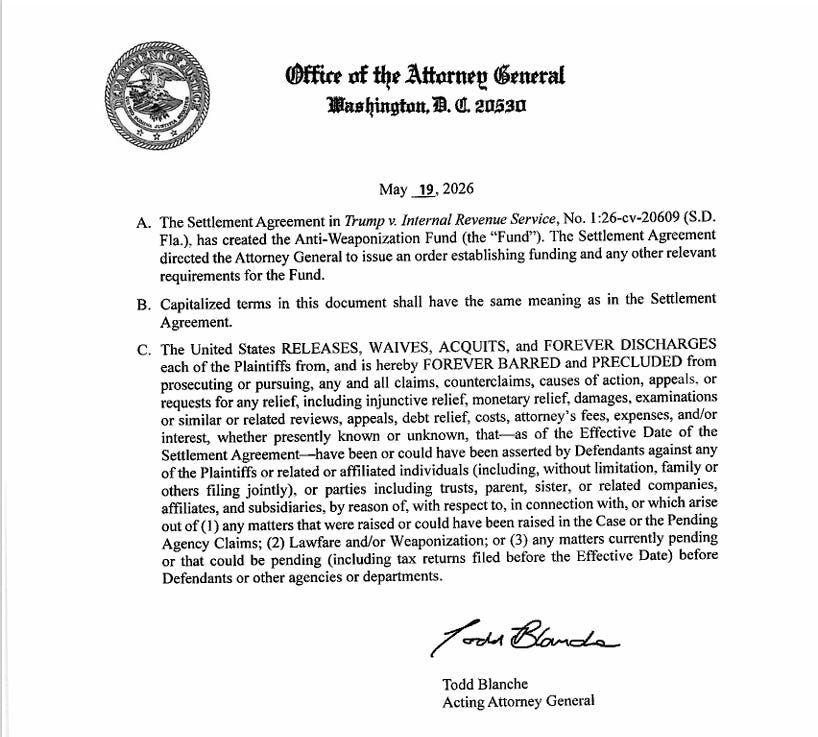
The memo states that the United States “releases, waives, acquits, and forever discharges” Trump-related plaintiffs and is “forever barred and precluded” from pursuing a broad range of claims, liabilities, examinations, reviews, appeals, and administrative actions involving Trump, his family, businesses, trusts, subsidiaries, and affiliated individuals or entities.
The language extends not only to known claims but also to matters that “could have been asserted” and includes references to “lawfare” and “weaponization.”
That wording is the source of the current firestorm.
Normally, legal settlements resolve specific disputes arising from specific conduct. This agreement appears to go much further. Critics argue the memo may attempt to limit future federal scrutiny, including potential IRS examinations or administrative reviews of Trump-related entities.
Even if courts ultimately narrow the agreement’s scope, the practical implications are profound. Agencies may hesitate to pursue sensitive matters if they fear violating a settlement signed by the Department of Justice. Lawyers representing Trump or affiliated entities could invoke the agreement whenever future scrutiny arises. At a minimum, the memo creates ambiguity around what kinds of oversight the federal government believes it can still pursue.
That ambiguity alone carries consequences.
Why this feels unprecedented
American history contains no shortage of controversial pardons, settlements, or assertions of executive authority. However, this situation combines several extraordinary elements that make this truly unprecedented.
A sitting president sued an agency under his own executive branch. His administration negotiated the settlement. The acting attorney general involved in the matter previously served as Trump’s personal criminal defense lawyer. The settlement created a massive taxpayer-funded compensation structure framed around alleged governmental “weaponization.” The language of the agreement appears broad enough that critics fear it could be used to challenge future scrutiny into Trump or his allies.
That combination is difficult to compare to anything in recent American political history.
The administration and its defenders argue that the settlement simply reflects the seriousness of the unlawful leak and the broader harms Trump and others allegedly suffered from politically motivated investigations. They also note that broad release language is common in complex settlements.
However, there is a significant difference between resolving liability for past conduct and attempting to constrain future sovereign authority.
Healthy governments are generally not supposed to permanently bargain away core public powers. Courts have long been skeptical when administrations attempt to surrender future regulatory or enforcement authority without explicit congressional authorization. The inclusion of terms like “examinations,” “reviews,” and “administrative actions” raises obvious questions about whether the executive branch can lawfully bind future administrations in this way.
There are also unresolved constitutional questions surrounding the fund itself. Critics argue that the executive branch may have effectively created a large compensation mechanism using taxpayer money without clear congressional approval. Others question whether a president can ethically benefit from a settlement negotiated by his own administration, particularly when the acting attorney general previously represented him personally.
Meanwhile, questions of standing may make judicial review difficult. Courts generally require plaintiffs to show concrete harm before challenging government action. That means some of the broadest constitutional questions surrounding the memo may not be answered quickly, even as the agreement begins shaping agency behavior in real time.
Already, Capitol Police officers Harry Dunn and Daniel Hodges have sued to block portions of the fund, arguing that it could be used to compensate January 6 defendants and political allies under the banner of “anti-weaponization.” That possibility has only intensified scrutiny surrounding the program, and Trump’s own statements make it clear he is not opposed to that use.
None of this means the agreement will ultimately survive intact. Courts may narrow it substantially. Future administrations could attempt to repudiate parts of it. Congress could investigate or legislate limits on similar settlements in the future.
However, the mere existence of the memo represents something significant about the current moment in American governance.
The deeper problem is not only Trump
It would be comforting to believe this controversy exists solely because of Donald Trump’s personality. That interpretation allows Americans to imagine the crisis ends when he eventually leaves the political stage.
The reality is more troubling.
Trump did not create the gradual concentration of executive power. He inherited it. He did not invent congressional weakness, partisan institutional loyalty, or the erosion of oversight norms. He simply proved how vulnerable those systems had become when confronted by someone willing to ignore restraints that previous presidents generally respected.
That is why this current headline cannot be separated from the broader pattern.
The mass firing of inspectors general has weakened internal oversight mechanisms across the government. The constant attacks on the press and aggressive litigation against media organizations have normalized the idea that independent journalism is inherently illegitimate. Repeated lies about elections have undermined public trust in democratic outcomes. Expansive theories of presidential immunity and executive authority continue to steadily move from fringe legal arguments toward mainstream governing philosophy.
Individually, each development generated outrage and then faded into the churn of the news cycle. Together, they reveal something more consequential: a political system increasingly dependent on voluntary restraint after decades of weakening formal checks on power.
That is why the Blanche memo feels so alarming. It is not only the document's content but also what it represents within the larger trajectory of American governance.
For years, critics warned that democratic institutions cannot rely indefinitely on good-faith actors while simultaneously expanding the powers available to bad-faith ones. They warned that uncodified norms are not durable safeguards. They warned that concentrating authority in the executive branch would eventually produce consequences far beyond the intentions of the people temporarily benefiting from it.
Those warnings no longer feel abstract. The scandal is not only that Trump pushed through the gap. It is that generations of political actors have helped leave the gap open. And those with the most power to correct these failures increasingly lack the will to do anything about it beyond generating sound bites.
If you’ve been reading our work for the last 18 months, you know this is the thread we keep returning to: not just the outrage of the day, but the deeper structural failures underneath it. We believe those patterns matter, and we believe documenting them clearly and honestly matters too.
If you value independent commentary that focuses less on the noise and more on the systems shaping American democracy, consider subscribing.
Sources:
U.S. Department of Justice, “Justice Department Announces Anti-Weaponization Fund,” May 18, 2026.
U.S. Department of Justice, “Settlement Agreement, Trump v. IRS (SDFL),” May 18, 2026.
U.S. Department of Justice, Todd Blanche letter/order regarding release language, May 19, 2026.
Reuters, “Trump drops IRS lawsuit in exchange for DOJ $1.8 billion ‘weaponization’ fund,” May 18, 2026.
Reuters, “Trump’s $1.776 billion ‘weaponization’ fund sparks outrage, but court challenges will be tough,” May 20, 2026.
Associated Press, “Officers who defended Capitol from rioters sue to block payouts from $1.8B ‘anti-weaponization’ fund,” May 20, 2026.
Reuters, “Police officers who guarded Capitol sue to block Trump’s $1.8 billion ‘slush fund’,” May 20, 2026.
U.S. Department of Justice Archives, “Former IRS Contractor Sentenced for Disclosing Tax Return Information to News Organizations,” January 29, 2024.
What is written about “gaps” in controls seems factually correct but does not make “legal” theft of taxpayer dollars any less illegal. Our country looks like it’s running on these gaps.
I don’t think the founding fathers could conceive of the crooked politicians we have today.