


If you have been watching the wave of book challenges and “Don’t Say LGBTQ” style laws wash across state legislatures, you probably will not be surprised that Congress now has a federal version on the table.
On February 24, 2026, Representative Mary E. Miller of Illinois, with 17 Republican cosponsors, including Greg Steube, Paul Gosar, Andy Ogles, Harriet Hageman, Chip Roy, and others, introduced H.R. 7661 in the U.S. House of Representatives. The bill is titled the Stop the Sexualization of Children Act.
The timing here is not subtle. As Freedom for All Americans points out, H.R. 7661 landed in the House on the same day Trump used a section of his State of the Union address, on Tuesday, February 24, 2026, to single out school policies involving gender identity and demand an immediate national ban. “We must ban it, and we must ban it immediately,” he told Congress, according to the Associated Press transcript of the speech.
For now, the bill has been referred to the House Committee on Education and the Workforce, which oversees K–12 education issues at the federal level. At the moment, the bill is in committee. There have been no hearings, no amendments, and no votes.
That early stage matters. This is not law. Yet the way the bill is written tells us a great deal about where some members of Congress want to take the “parental rights” fight next, and why school librarians, educators, and civil liberties groups are already sounding the alarm.
This Community Is Powered by You
What started as a small circle has grown into something much bigger, and it’s all because of readers like you.
Every time you forward this email, post it on socials, or bring someone new into the fold, you’re helping build one of the most passionate, independent political communities out there.
Want to keep the momentum going?
Share this newsletter with someone who should be part of this conversation.
Thank you for being here. It means everything.
What H.R. 7661 Actually Does
H.R. 7661 does not create a new federal crime. It does something subtler and, in some ways, more powerful. It proposes to change the Elementary and Secondary Education Act of 1965, better known as ESEA. ESEA is the main federal education funding law. It funnels billions of dollars each year to states and school districts, especially those serving low-income students.
The bill says that no funds under ESEA may be used to “develop, implement, facilitate, host, or promote any program or activity” for minors under 18 if that program or activity includes what the bill calls “sexually oriented material.” It also forbids using ESEA money to “provide or promote literature or other materials” for minors that contain the same category of content.
The key question is obvious. What counts as “sexually oriented material” here?
Part of the definition points to existing federal law about “sexually explicit conduct,” which is what you would expect if the goal were truly to keep pornography away from children. However, the bill goes much further. It states that “sexually oriented material” also includes material that “involves gender dysphoria or transgenderism.”
That phrase is doing enormous work. A young adult novel with a transgender main character, a memoir about navigating gender dysphoria, a non-fiction book explaining what the word “transgender” means, or even a support brochure in a school counselor’s office could all be swept into that category, regardless of whether there is any explicit sexual content whatsoever. The bill collapses transgender identity into the same statutory bucket as sexually explicit material. That is not a drafting accident.
Supporters are quick to point to a rule of construction buried later in the bill, which says the new restrictions should not be read to block “standard science coursework,” including biology, genetics, human health, and human anatomy and physiology. It also protects “the texts of major world religions,” along with “classic works of literature” and “classic works of art.”
That sounds broad at first glance. However, the bill immediately narrows those last two categories by writing specific, pre-approved lists into federal law. “Classic works of art” are defined as the works depicted or referenced in the five volumes of the Smarthistory Guide to AP Art History from 2019–2020. “Classic works of literature” are restricted to titles included in the 1990 second edition of Great Books of the Western World, and two Compass Classroom reading lists titled “Classics Every Middle Schooler Should Read” and “Classics Every High Schooler Should Read.” In other words, the statute does not simply protect “classics” in the ordinary sense. It locks one narrow, heavily curated vision of Western art and literature into the law as the only safe harbor, while everything else, including contemporary work with LGBTQ characters, has to live under the shadow of the “sexually oriented” label.
The carve-out matters, but it does not erase the core design. H.R. 7661 is a funding filter that treats any ESEA-supported program or material “involving gender dysphoria or transgenderism” as suspect, even when it is not sexual in any everyday sense of that word.
Where the Blast Radius Really Is
Because this is an amendment to ESEA, the bill’s direct blast radius is the K–12 school system. That includes school libraries, classroom collections, reading lists, and school-sponsored programs that rely on ESEA dollars.
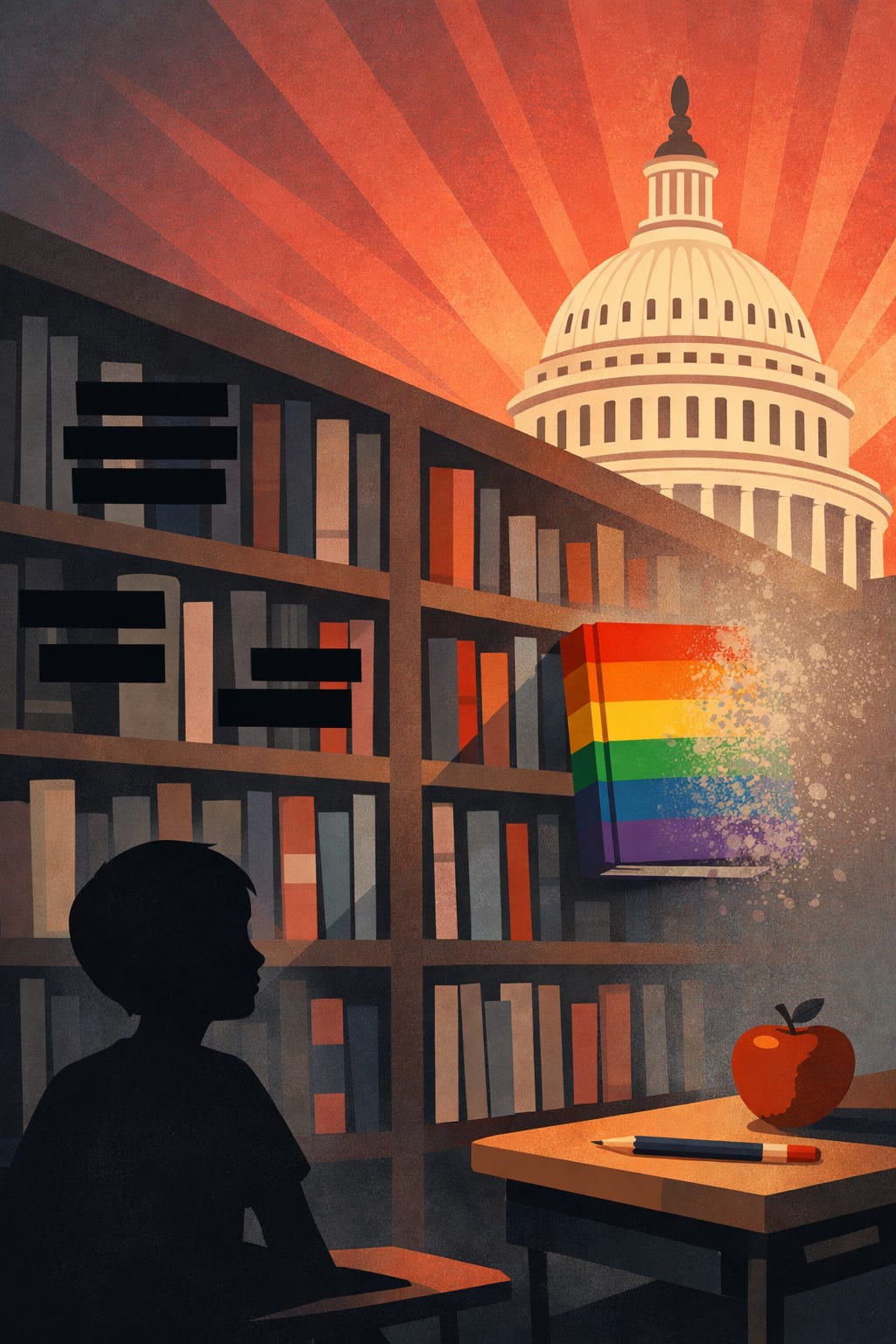
School libraries sit directly in the crosshairs. Collection development, book orders, curated displays, and even reading recommendations can easily be described as “providing” or “promoting” literature. If a school librarian wants to put together a Pride Month display that includes a few age-appropriate titles featuring or including transgender characters, H.R. 7661 raises the question of whether any federal funds that touch that library space are now at risk.
Public libraries, strictly speaking, are outside the statute’s direct reach. They are not funded through ESEA and do not sit within the federal K–12 accountability framework in the same way. That does not mean they are safe from political fallout. Many public libraries partner with schools, especially those without their own library, on collection and programming. Additionally, when you tell the public that “the government is banning trans books in libraries,” many people will not hear or care about the word “school.”
However, the legal hook in this particular bill is the school funding stream. It is a federal attempt to hardwire a specific culture-war position into the conditions attached to K–12 dollars.
What Supporters Say
Supporters of H.R. 7661 frame it as a straightforward “protect the children” and “parental rights” bill. They argue that federal tax dollars should not support programs or materials they view as sexually inappropriate for minors. For them, that category includes not only explicit sexual conduct but also classroom or library content that affirms or even describes transgender identities.
In this telling, the bill does not target any student directly. It simply says that if a controversial topic is going to be discussed with children, that conversation should happen at home under parental guidance rather than at school with federal money.
“Parents deserve complete confidence that their tax dollars are being used to promote academic excellence — not to expose children to harmful and explicit material that undermines their innocence. My legislation draws a clear and enforceable line to ensure our schools remain focused on education, not explicit ideological agendas or radical indoctrination.”
— Representative Mary Miller
Many supporters also point to the clause preserving “standard science coursework” as evidence that the intent is not to wipe out puberty education or basic reproductive biology. They present the bill as a corrective measure, not an educational purge.
It is worth taking that argument seriously because it is how the bill will be defended in hearings, town halls, and campaign ads. Yet when we look at how the language actually operates, a different picture comes into focus.
The Chilling Effect on Schools and Libraries
Federal funding conditions rarely act with surgical precision. School districts are bureaucratic institutions. When lawmakers tell them that certain content will jeopardize federal dollars, they tend to respond not with a scalpel but with a broom.
H.R. 7661 uses verbs such as “provide” and “promote” without clear limits. A cautious superintendent, worried about audits or complaints, can easily decide that the easiest way to comply is to strip anything that might be challenged. Why risk a fight with the state or federal government when you can quietly take the books off the shelf or remove the section of the curriculum?
That is the chilling effect in practice. The law does not require a district to ban a specific title by name to remove it. It simply needs to create a credible threat that someone might argue the district is “promoting” prohibited material with federal funds. Over-compliance becomes the rational administrative choice.
The dynamic is especially dangerous for high-poverty districts that rely heavily on ESEA funding. Those are often the communities that already have the fewest local resources and the least ability to weather a funding dispute. In that context, the “choice” between full collections and safe compliance is not really a choice at all.
Representation, Literacy, and Who Gets to Exist in School
It is true that transgender students make up a minority of the student population, currently estimated at 3%, with an additional 2% questioning. They are a small percentage, concentrated more in the teenage years than in elementary grades. Yet small does not mean negligible. In a typical large high school, the difference between zero and “three percent of students” is the difference between no one and a handful of young people in every grade.
“H.R. 7661 isn’t fundamentally about protecting kids. It’s about giving politicians broad authority to restrict whose stories are allowed on our shelves. That should concern anyone who believes in the freedom to read and the right of families to make decisions for themselves.”
— American Library Association press release
For those students, the question is not abstract. If any book or program “involving gender dysphoria or transgenderism” is treated as suspect by default, the message is clear. Your identity is not appropriate even to mention in the place where you spend most of your waking hours.
For their peers, the issue is basic literacy. Students already live in a world where the word “transgender” appears on social media, in pop culture, and in politics. Schools can either provide neutral, age-appropriate explanations and stories, or they can leave children to piece together meaning from rumor, TikTok, and weaponized talking points. Ignorance does not protect kids. It just leaves them vulnerable to whoever shouts the loudest.
There is also a fundamental category error at work. Being transgender is not, in itself, a sexual act. A novel about a trans girl navigating school is no more inherently ‘sexually oriented’ than a novel about a straight boy trying to make the baseball team. H.R. 7661 erases that distinction by definition. It quietly equates a group of students’ very existence with sexual content. That move is neither neutral nor accidental.
A Legislative Template for Future Fights
Even if H.R. 7661 never leaves committee, it serves as a template. It shows how federal lawmakers can fold cultural and political battles into funding law. First, identify a set of ideas you want to keep out of public schools. Second, define them as a type of “sexually oriented material” or other disfavored category. Third, prohibit the use of federal funds for any program or material that “provides or promotes” them.
This time, the explicit target is “gender dysphoria or transgenderism.” We have already watched this pattern play out in the states and, more recently, in Trump’s 2025 executive orders that dismantled DEI programs and targeted ‘gender ideology’ and critical race theory in K–12 schools. H.R. 7661 is Congress experimenting with a similar strategy in statute form, using federal education funding as the enforcement tool. Once the model is accepted, changing the list of disfavored topics is little more than a find-and-replace exercise.
That does not mean expansion is inevitable. It does mean that H.R. 7661 is not just about this year’s fight over trans representation. It is about whether we normalize a federal book and curriculum filter built into the conditions for school funding.
For years, Republican leaders have argued that education policy belongs to states and local districts, and have called for dismantling or hollowing out the Department of Education. Yet the same movement that has pushed through legislation in Florida and other states is now leaning heavily on federal power when it comes to policing ideas about gender, sexuality, and race nationwide.
Where Things Stand Procedurally
For the moment, the bill's status is simple. H.R. 7661 has been introduced. It is sitting in the House Committee on Education and the Workforce. The committee can schedule a hearing and invite witnesses. It can mark up the bill, amend it, and vote on it. It can advance the bill to the full House. It can also allow it to die quietly in the stack of proposals that never move.
If the committee reports the bill out, the House leadership would decide whether to bring it to the floor. If it were to pass the House, the Senate would have to take up either the same text or a companion version. Only then would a finished bill land on the President’s desk. Most bills never get that far.
In other words, there is time to read the text, ask questions, and tell members of Congress whether you want this approach wired into federal education law.
What We Think This Moment Requires
We do not believe schools are perfect or that every book choice is beyond debate. We do believe that attaching a broad, ideologically loaded definition of “sexually oriented material” to federal education dollars is a serious escalation.
The heart of H.R. 7661 is not porn in classrooms, which is already illegal and already barred by policy. The heart is a sentence that says anything involving “gender dysphoria or transgenderism” belongs in the same legal bucket as sexually explicit conduct. That is a political statement dressed up as a funding rule.
For students, especially the ones who are already targets of bullying and misunderstanding, the signal is simple. You can be talked about as a problem to be solved, but you cannot be seen in a book on the shelf.
We think families and educators deserve an honest conversation about what children see, read, and learn in school. However, we think that conversation should start from reality, not from the fantasy that schools are running secret hormone clinics when they cannot even hand a student aspirin without a form on file. We also think that hiding trans lives from view will not make trans kids disappear, but rather only make them lonelier and more at risk of bullying.
If you oppose this bill, the next step is not despair. It is ordinary, unglamorous civic work. Call your representative. Mention H.R. 7661 by name, and say that you do not want federal education funds turned into a weapon against school libraries and against the students whose stories live there. Ask the members of the Education and Workforce Committee to let this one die in the stack.
Even if they do not, they should at least have to say, on the record, that they believe a trans kid’s existence belongs in the same category as obscenity. That is a vote worth forcing.
If you found this useful and want to keep tracking how bills like H.R. 7661, Trump’s executive orders, and state-level curriculum fights fit together, you can subscribe below. We cover education, civil rights, and “culture war” policy with a bias toward facts, context, and the students and workers caught in the middle. No outrage farming, no both-sides fog—just clear-eyed analysis you can use when you call your school board, your union, or your member of Congress.
Sources:
U.S. Government Publishing Office – H.R. 7661 Introduced in House (IH)
Representative Mary Miller – “Rep. Miller Introduces Bill to Protect Children from Sexually Explicit Content in Schools”, February 24, 2026.
PBS NewsHour – “Read Trump’s full 2026 State of the Union address”, February 25, 2026.
Quiver Quantitative – “New Bill: Representative Mary E. Miller introduces H.R. 7661: Stop the Sexualization of Children Act”, February 25, 2026.
American Library Association – “ALA denounces federal book banning bill”, February 26, 2026.
People – “New Bill Seeks to Ban LGBTQ+ Books from Public Schools Nationwide”, February 26, 2026.
Publishers Weekly – “‘Same Ingredients, Different Recipe’ in Proposed U.S. Book Ban: HR 7661 Threatens to Withhold Federal Funds from Classrooms, Libraries”, March 2, 2026.
Freedom for All Americans – “House Republicans Push National ‘Don’t Say Trans’ and Book Ban Bill After Trump’s SOTU Broadside”, February 26, 2026.
I am so impressed with how you cover issues in such detail and completely surround all of the parts---amazing reporting that gives us significant depth.
People don’t become LGBTQ. It is something they are. It’s not contagious.