


“I ended six or seven wars.”
“I guess I’m a war hero.”
“Ukraine can stop the war immediately—if they want to.”
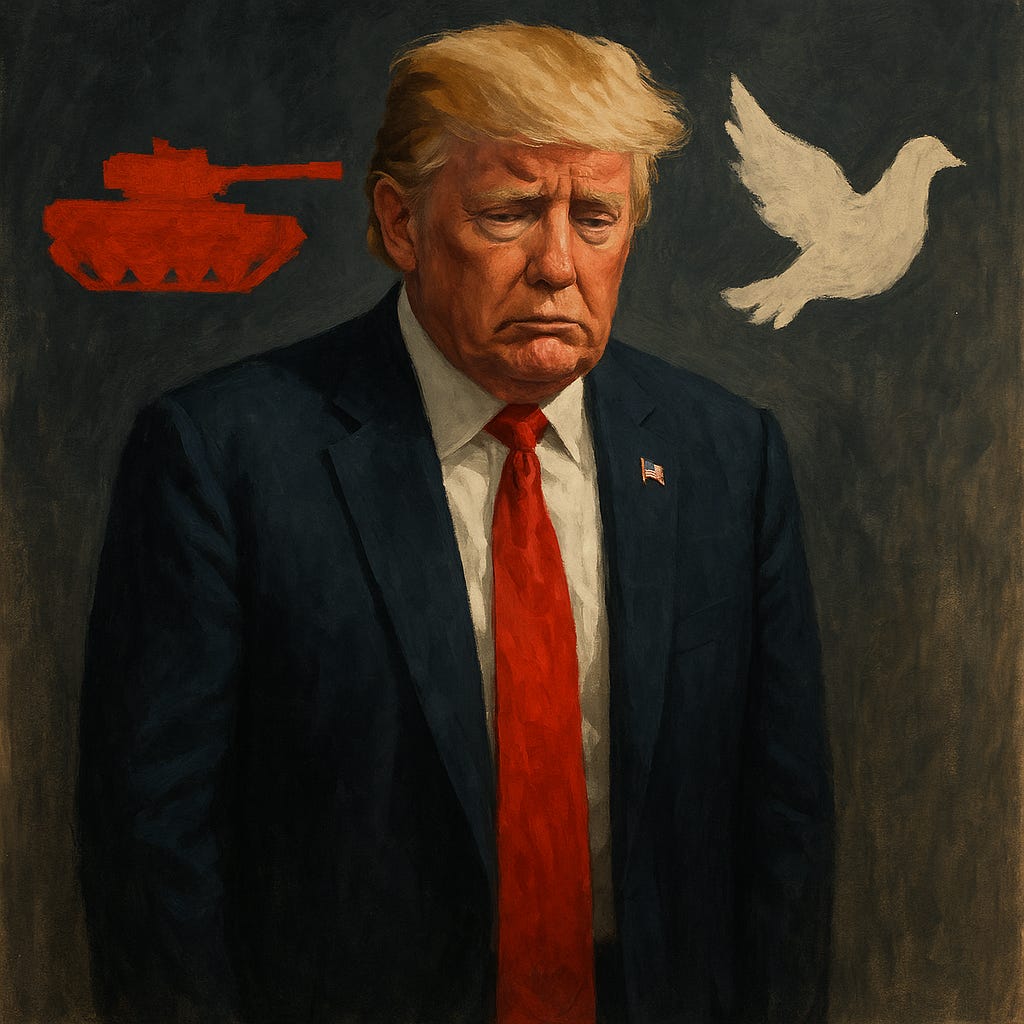
These are the words of Donald Trump in just the past few weeks, framing himself as a global peacemaker, a reluctant hero, a dealmaker above all the chaos.
But behind these declarations lies a different truth, a darker one, not of peace achieved, but of power endorsed, not diplomacy, but domination, not principled leadership, but a bully’s doctrine dressed up as statesmanship.
Trump didn’t end wars. He didn’t forge durable peace. He didn’t unite enemies or secure the future.
Instead, he consistently backed the strong against the weak, pressuring Ukraine to give up land, praising Netanyahu after airstrikes, legitimizing Rwanda over the Congo, and pushing Armenia toward compromise while ignoring Azerbaijan’s aggression.
In conflict after conflict, a pattern emerges: Trump amplifies the aggressor, blames the victim, and demands surrender.
It’s not peace, but appeasement. There’s no negotiation, only coercion. Trump offers no leadership, but cowardice wrapped in bravado.
This is the real story of Trump's “peace legacy”: a parade of authoritarian appeasement, strategic misdirection, and performative power plays, all while the world grows more dangerous and divided.
Stay Informed. Stay Loud.
Subscribe to The Coffman Chronicle for no-BS political analysis, action guides, and daily truth bombs you won’t get from corporate media.
The Peace Claims Are a Lie, But They Tell a Bigger Truth
Donald Trump says he’s ended six, maybe seven, wars. He repeats it in rallies, interviews, and posts. Ask for details, however, and things start to unravel.
Many of the conflicts he references, such as Cambodia and Thailand, DRC and Rwanda, Serbia and Kosovo, were low-level tensions, already de-escalating, or never full-scale wars to begin with. Some countries, like India, even deny that the U.S. was involved at all.
In cases like Armenia and Azerbaijan, the supposed "peace" is just a vague trade pact that offers no real resolution, no security guarantees, and no end to military buildup. In Congo, rebel groups weren't even invited to the table. In Israel and Iran, the so-called ceasefire came after U.S. airstrikes. Nothing says arbiter of peace like bombs first, truce second.
These are not models of conflict resolution. They're PR stunts with geopolitics as a backdrop.
So yes, Trump’s claim to be a global peacemaker is a lie, but like many lies he tells, it’s rooted in something real: his worldview.
What matters most isn’t whether a war is just, or who suffered, or what values are at stake. What matters is who has the power and how quickly they can be appeased.
That’s the bigger truth behind the lie: Trump isn’t ending wars. He’s cutting deals with bullies and telling the victims to live with it.
Ukraine: The Victim Trump Keeps Blaming
If there’s one conflict that defines Trump’s foreign policy, it’s Russia’s war on Ukraine.
Here, the imbalance of power is undeniable. A nuclear-armed dictatorship invaded a smaller, sovereign democracy. Civilians were slaughtered. Cities were razed. War crimes documented.
Trump’s response? “Ukraine can stop the war immediately—if they want to.”
That’s what he posted on Truth Social after meeting with President Zelenskyy and NATO leaders. A day earlier, he’d stood beside them at the White House and talked about “coordination” and “security guarantees.”
The shift wasn’t subtle. It was strategic.
He wasn’t looking for unity. He was looking for an out. Once again, it came at the victim’s expense.
Trump’s Ukraine Doctrine:
Blame Kyiv for the war (“they shouldn’t have provoked Russia”).
Pressure Ukraine to give up territory (“they’ll lose more if they don’t settle”).
Float conspiracies about NATO aggression and Ukrainian elections.
Refuse to condemn Putin in clear, moral terms.
This isn’t diplomacy. It’s a loyalty test, one that Ukraine, fighting for its existence, continues to fail in Trump’s eyes.
Even his much-hyped Alaska summit with Vladimir Putin delivered no ceasefire, no roadmap, and no credibility. Instead, it was just a photo op, a short meeting, and a recycled narrative: “both sides will need to make concessions.”
However, let’s be clear. Only one side was invaded. Only one side lost thousands of civilians. Only one side is being told to give something up.
So predictably, Trump keeps telling them it’s their fault.
The Pattern Across the Map
Trump’s treatment of Ukraine isn’t a one-off. It’s a global strategy. Call it “peace,” call it “dealmaking,” call it “tough love”, but the result is always the same:
Side with the strong, pressure the weak, blame the victim, and call it diplomacy.
In Israel and Iran:
Trump praised Israeli Prime Minister Netanyahu as a “war hero” following U.S.-Israeli airstrikes on Iran’s nuclear sites, then immediately added, “I guess I am too.”
Presumably, he was referencing the bombing he authorized. There was no negotiation with Tehran, no peace talks, just bombs followed by a fragile ceasefire. Power was affirmed, not peace.
In the DRC and Rwanda:
Trump hailed Rwanda’s president as a “visionary,” even as international watchdogs accused Rwandan forces of cross-border aggression in eastern Congo. His so-called peace deal centered on mineral rights and export logistics, not security, not justice.
Congo’s suffering was treated as a footnote.
In Armenia and Azerbaijan:
Trump brokered a “preliminary economic agreement” after skirmishes between the two countries, pressuring Armenia to allow a transport corridor backed by Azerbaijan. There’s no treaty, no demilitarization, no formal peace, just a quiet surrender of leverage by the weaker side. The cost of calm was compromise with no justice.
In India and Pakistan:
He claimed to have mediated a ceasefire in Kashmir. India denied it happened. Pakistan briefly rewarded him with a Nobel Peace Prize nomination until it was retracted days later after he bombed Iran. It was all smoke. No fire.
In Egypt and Ethiopia:
He boasted of “preventing war” over the Grand Ethiopian Renaissance Dam. However, there was no war, nor an agreement or summit. In reality, it was simply Trump inserting himself into a situation for credit he didn’t earn.
Across the board, a clear pattern takes shape:
Find a flashpoint.
Praise the stronger actor.
Coerce or sideline the weaker one.
Frame the result as “peace,” even when nothing has changed.
It’s not diplomacy, neutrality, or strength. It’s a worldview that says: might makes right, and the victim should stop whining.
Empty Rhetoric vs. Real Leadership
Trump briefly acknowledged the humanitarian catastrophe in Gaza, calling the starvation “real” and even urging Israel to “let in every ounce of food.” For a moment, it sounded like conscience. But that was July 28. Since then, nothing.
He’s offered no condemnation of the ongoing violence against civilians. There’s been no further demand that Israel ensure safe humanitarian corridors. And predictably, following his one-off statement, there have been no follow-up statements, pressure, or policy changes.
Instead, there has been silence. Perhaps worse, the best Trump has offered is distraction. His administration sent envoys to “assess” aid distribution, but those visits produced no public rebuke of the military chokehold strangling Gaza’s food supply.
His single acknowledgment stands alone, a moment of moral clarity with no muscle behind it, a press soundbite, not a shift in policy. Once again, Trump offers words, not leadership.
This Isn’t Peace. It’s Appeasement
Peace requires principles, boundaries, and justice. It demands that we recognize who was attacked and who did the attacking, who is seeking protection, and who is demanding power.
Trump’s foreign policy doesn't recognize any of that. It doesn’t ask who suffered. It doesn’t care who invaded whom. It only asks one question: Who has the leverage?
In conflict after conflict, Trump praises the powerful, indulges the aggressor, and pressures the victim to surrender, then calls it "the art of the deal."
This isn’t peace. It’s appeasement, the kind that rewards force, silences resistance, and teaches authoritarians that violence works if you can survive the headlines.
When he tells Ukraine to “give up land,” it’s appeasement.
When he offers Netanyahu a pass on blocking aid to Gaza, it’s appeasement.
When he cuts deals that ignore rebel groups in Congo or pressures Armenia to accept corridor concessions, it’s appeasement.
When he turns Gaza’s suffering into a resort fantasy, it’s not peace—it’s exploitation.
He isn’t bringing an end to war. He’s just giving cover to those who start them.
Peace is hard. It requires diplomacy, moral clarity, and the courage to tell your allies when they’ve gone too far. Trump doesn’t do any of that.
He finds the strongest man in the room, stands next to him, and says: “Let’s make a deal.”
No wonder Pakistan reversed its Nobel Peace Prize nomination after less than 24 hours.
The Bully Who Wanted to Be a Peacemaker
Donald Trump wants the world to believe he’s a man of peace. He talks about Nobel Prizes. He calls himself a war hero. He says he ended wars, solved crises, and could stop a brutal invasion in “24 hours.”
But the truth is darker and simpler. He didn’t end wars. He didn’t forge peace. He didn’t bring people together.
He empowers the powerful. He silences the weak. He praises violence when it comes from allies and shrugs at suffering when it comes from civilians.
Trump’s version of “peace” has always been transactional, never transformational. It’s about optics, not outcomes, winners and losers, not justice and reconciliation.
And in that world, the bullies always win. And the biggest wannabe bully and strongman of them all, he’s standing beside them, offering a cheesy thumbs-up, and taking all of the credit.
Stay Informed. Stay Loud.
Subscribe to The Coffman Chronicle for no-BS political analysis, action guides, and daily truth bombs you won’t get from corporate media.
Sources:
“‘Draft‑Dodger’ Trump Calls Himself a ‘War Hero’ for Ordering Bombings” The Daily Beast, August 20, 2025
“Fact Check: Which ‘Six Wars’ Has Trump Stopped?” The Times, August 2025
“Pakistan debates Trump Nobel peace prize nomination after US strikes on Iran” The Guardian, June 25, 2025
“Pakistan Flip‑Flops on Trump Nobel Peace Prize Nomination After Less Than 24 Hours” Fox News, June 23, 2025
“Trump Acknowledges ‘Real Starvation’ in Gaza and Tells Israel to Let in ‘Every Ounce of Food’” The Guardian, July 28, 2025
“Trump Says U.S. to Set Up Food Centers in Gaza to Address ‘Real Starvation’” The Washington Post, July 28, 2025
“Top Trump Officials Visit Gaza as Hunger Crisis Draws Outrage” The Washington Post, August 1, 2025

I think the problem is that he's surrounded by people who pay homage to him and make him believe what a great guy he is. And that's what he believes. But that makes him the worst possible president.
Look, he learned that all from Roy Cohn.
The Bloated Yam has not had an original idea since Suzy showed up in class in a tight sweater.