


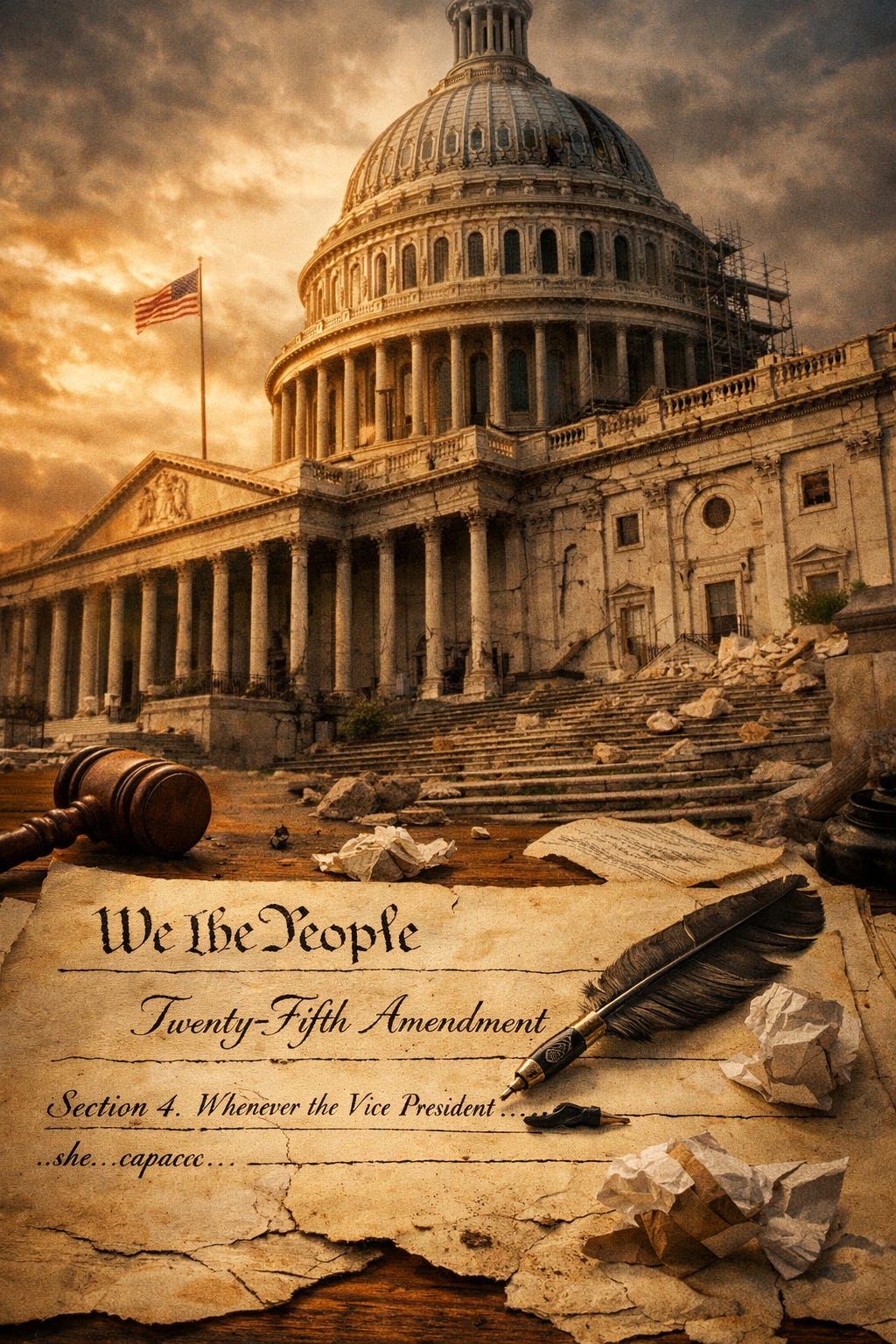
On Tuesday, April 14, 2026, roughly fifty House Democrats introduced legislation to create a commission envisioned by the 25th Amendment but never built. The proposal, led by Representative Jamie Raskin of Maryland, would establish a “Commission on Presidential Capacity to Discharge the Powers and Duties of Office,” a body that, alongside the Vice President, could help determine whether a president is unable to serve.
The headline is straightforward, but the implications are not. This moment reflects several recurring features of modern American governance: Congress leaving constitutional questions unresolved for decades, relying on informal norms to bridge the gap, and only turning to formal structure once timing ensures that any action will be viewed through a partisan lens.
This Community Is Powered by You
What started as a small circle has grown into something much bigger, and it’s all because of readers like you.
Every time you forward this email, post it on socials, or bring someone new into the fold, you’re helping build one of the most passionate, independent political communities out there.
Want to keep the momentum going?
Share this newsletter with someone who should be part of this conversation.
Thank you for being here. It means everything.
The Proposal and Its Origins
The proposed legislation would create a bipartisan, independent commission of 17 members. Appointments would be made by congressional leadership from both parties, and the group would include former executive officials as well as medical professionals such as physicians and psychiatrists. The commission would not act on its own authority. Instead, it would serve as the “other body” referenced in Section 4 of the 25th Amendment.
That section of the amendment provides a mechanism for addressing presidential incapacity. It allows the Vice President, together with a majority of either the Cabinet or another body created by Congress, to declare that the President is unable to discharge the powers and duties of office. If the president contests that determination, Congress ultimately decides the outcome.
The key point is that Congress has always had the authority to create this alternative body. It simply never has.
This is not the first attempt. Raskin introduced a version of this legislation in 2017, and a similar proposal was reintroduced in 2020 with then–Speaker Nancy Pelosi. Each effort reflected the same underlying idea: that the Cabinet, composed of officials appointed by and serving at the pleasure of the president, may not always be the most independent group to assess presidential capacity.
The broader constitutional context is older still. The 25th Amendment was ratified in 1967 after years of concern about presidential succession and incapacity, concerns intensified by the assassination of President John F. Kennedy in 1963. Once Congress acted, the amendment moved relatively quickly through the ratification process. The constitutional problem was identified, debated, and formally addressed.
Yet one piece of the framework remained unfinished.
The Limits of the Proposal
The current legislation faces immediate and significant constraints, both political and structural.
The most visible challenge is timing. Efforts to create such a commission have only gained traction in the Trump era, beginning in 2017 and resurfacing in subsequent years. Regardless of the intent behind the proposal, that timeline invites the perception that the effort is directed at a particular president rather than designed as neutral constitutional infrastructure.
There is, however, a deeper timing issue that extends far beyond recent political cycles. The 25th Amendment was ratified nearly six decades ago. Congress had the authority to create this commission at any point during that time, yet did not do so. The result is that a mechanism that could have been designed under calmer, more neutral conditions is now being introduced at a moment when neutrality is difficult to establish and harder still to persuade.
Even if the legislation were to pass Congress, another obstacle would remain. The president could veto the bill, requiring a two-thirds majority in both the House and the Senate to override the veto. That is a high bar under any circumstances, and particularly so for legislation of this sensitivity.
More fundamentally, the proposal does not alter the constitutional requirement that the Vice President must be involved in any determination under Section 4. The commission would replace the Cabinet as the partner body, but it would not eliminate the Vice President’s role. If the Vice President declines to participate, the process does not move forward. That reality limits the practical availability of the mechanism regardless of how the commission is structured.
These constraints do not render the proposal meaningless. They do, however, underscore that the legislation does not resolve the central challenge embedded in the amendment itself. The system depends on individuals in positions of power choosing to act.
The Gap Congress Left Open
The more revealing story is not about the specifics of this bill, but about the decades that preceded it.
Amending the Constitution is intentionally difficult. It requires supermajorities in Congress and ratification by three-fourths of the states. The 25th Amendment cleared that bar because the problem it addressed was widely understood to be serious. Presidential incapacity was not a theoretical concern, but a recognized vulnerability in the structure of American government.
Once that recognition was codified, the remaining task was comparatively modest. Congress was authorized to create an alternative body to assist in determining presidential capacity. That work did not require another amendment. It required legislation.
For nearly 60 years, that legislation never came.
This was not a matter of sudden urgency or unforeseen risk. The constitutional text itself pointed to the need. Lawmakers discussed the issue intermittently, and scholars proposed various models. Yet the framework was never built, and the gap remained.
That absence is difficult to explain as ordinary legislative delay. Congress has demonstrated, at other moments, the ability to act quickly when it views an issue as pressing. The decision not to act here reflects something closer to institutional neglect.
When Norms Do the Work of Law
For much of that period, the gap may have appeared manageable. The system relied not only on formal rules, but also on informal expectations about how power would be exercised.
There was an assumption that senior officials would place constitutional duty above personal or political loyalty. There was an expectation that the reputational cost of inaction in a moment of crisis would be significant. There was a belief that institutional norms would discourage extreme behavior even where the law was silent.
The 25th Amendment’s Section 4 mechanism reflects those assumptions. It is a legal process that depends on the willingness of the Vice President and other senior officials to initiate it. It is not self-executing. It relies on judgment, restraint, and a shared understanding of responsibility.
As long as those norms held, the absence of a formal commission may have seemed less consequential. As those norms weakened, the same absence became more significant. A mechanism that exists on paper but depends on actors who may not feel bound by those expectations becomes harder to use in practice.
Reactive Lawmaking and Its Consequences
The failure to create a commission also fits a broader pattern in how Congress has approached governance in recent decades.
On a range of issues, lawmakers have delayed action even as the risks have become clearer. Federal privacy law has remained fragmented despite the growth of large-scale data collection. The regulatory framework for the internet developed unevenly, often through agency interpretation and court decisions rather than comprehensive legislation. Artificial intelligence is now advancing rapidly in the absence of a cohesive federal structure.
In these areas, Congress has often allowed executive agencies, courts, and private actors to shape outcomes in the absence of clear statutory guidance. That approach can appear workable in the short term, yet over time, it leaves major questions unresolved.
When pressure builds, Congress sometimes responds quickly. The USA PATRIOT Act, passed in the aftermath of the September 11th attacks, expanded surveillance authorities in ways that have been debated and contested for years. The urgency of the moment shaped both the scope and the speed of the legislation.
This pattern creates a cycle. Problems are left unaddressed during periods when careful, deliberative policymaking is most possible. When those problems become acute, the options narrow. Lawmaking becomes more reactive, more politically charged, and more likely to produce unintended consequences.
The unbuilt 25th Amendment commission fits within that cycle. It is a structure that could have been developed gradually, with input from across the political spectrum, long before any single presidency dominated the discussion. Instead, it is now being considered in a context that makes consensus more difficult.
A Question of Institutional Responsibility
The recurring theme across these examples is not simply partisanship. It is the role Congress has chosen to play.
The Constitution assigns Congress a central place in the structure of American government. It is intended to be a coequal branch, responsible for legislating, overseeing, and shaping the framework within which the executive operates. Over time, Congress has often deferred that role, allowing authority to shift toward the executive branch or to remain undefined.
That dynamic is not the product of a single party or moment. It reflects decisions made across administrations and across political alignments. When executive action aligns with legislative preferences, there is less incentive to assert institutional prerogatives. When norms appear to function, there is less urgency to codify them.
The result is a gradual erosion of capacity. Powers that are not exercised can be difficult to reclaim. Responsibilities that are deferred can become harder to fulfill under pressure.
The proposed commission brings that pattern into focus. It is an attempt to fill a gap that Congress has long acknowledged and long left unaddressed. It arrives at a moment when the conditions for neutral institution-building are no longer present.
The Larger Lesson
The debate over a presidential-capacity commission is not only about how to respond to a particular presidency. It is also about how and when institutions choose to act.
The United States identified a constitutional vulnerability, debated it, and amended its founding document to address it. What followed was a decades-long failure to complete the framework that the amendment envisioned. That delay has consequences. It shapes how current proposals are perceived and how they function in practice.
A legislature that postpones structural decisions until moments of crisis should not be surprised when those decisions are viewed as reactive or targeted. The challenge is not simply to recognize institutional gaps, but to address them before the context in which they are filled undermines their legitimacy.
The commission now being proposed may still be worth debating on its merits. Its existence would not resolve all of the constraints built into the 25th Amendment, and it would not guarantee that the mechanism it supports would be used. It would, however, represent an effort to complete a piece of constitutional architecture that has remained unfinished for nearly sixty years.
The more difficult question is why that work was left undone for so long, and what that delay suggests about Congress's willingness to act as a coequal branch when the moment is less urgent, and the stakes feel less immediate.
Subscribe for analysis that looks beyond the headline and examines how power is exercised, avoided, and reshaped across American government.
Sources:
Ranking Member Raskin Introduces Legislation Establishing Independent Commission on Presidential Capacity, April 14, 2026, House Judiciary Committee Democrats
US Democratic lawmaker Raskin seeks commission to oversee removal of presidents, April 10, 2026, Reuters
Twenty-Fifth Amendment, Constitution Annotated / U.S. Congress
Overview of Twenty-Fifth Amendment, Presidential Vacancy and Disability, Constitution Annotated / U.S. Congress
The Establishment and First Uses of the 25th Amendment, Gerald R. Ford Presidential Library and Museum
Final Congressional Approval and State Ratification of the Twenty-Fifth Amendment, Legal Information Institute / Cornell Law School
Raskin Introduces Bill to Establish Independent Commission on Presidential Capacity, May 12, 2017, Office of Rep. Jamie Raskin
Rep. Raskin’s 25th Amendment Bill Gains Momentum, Garners 50 Cosponsors, December 6, 2017, Office of Rep. Jamie Raskin
Raskin Reintroduces 25th Amendment Legislation Establishing Independent Commission to Determine Presidential Inability to Serve, October 9, 2020, Office of Rep. Jamie Raskin
The 25th Amendment Needs an Update: Rep. Jamie Raskin Explains Why He Thinks We Need a New Commission to Determine When a President Is Incapacitated, October 5, 2020, Rep. Jamie Raskin / Slate reprint page
I do not have much confidence that this commission will be formed and will carry out its assignment. Perhaps it will be made ready for the next time we have such a crisis as we have now.
If they had done this with Reagan as he was obvioiusly deep in the throes of dementia or Alzheimer's, we might be better off now.