


On January 22, 2026, amid the precision and prestige of Davos, Donald Trump stood before the world and unveiled a new international initiative: the Board of Peace. The setting was cinematic, complete with flags arranged symmetrically, cameras flashing, and applause timed to the pause. Trump called it a solution, a new approach to the crisis in Gaza, and a platform for resolving global conflicts with American leadership at the helm.
To his supporters, this was a masterstroke. It was bold, outside the usual institutions, and unshackled from the slow pace of multilateral diplomacy. To critics, it was an improvised, ill-defined project that seemed less about peace than about control.
However, beyond the rhetoric and ceremonial signatures, one simple question hovered in the air: Who showed up?
In diplomacy, as in life, we are defined not by what we say, but by who chooses to stand with us. This is who stands with Trump’s America.
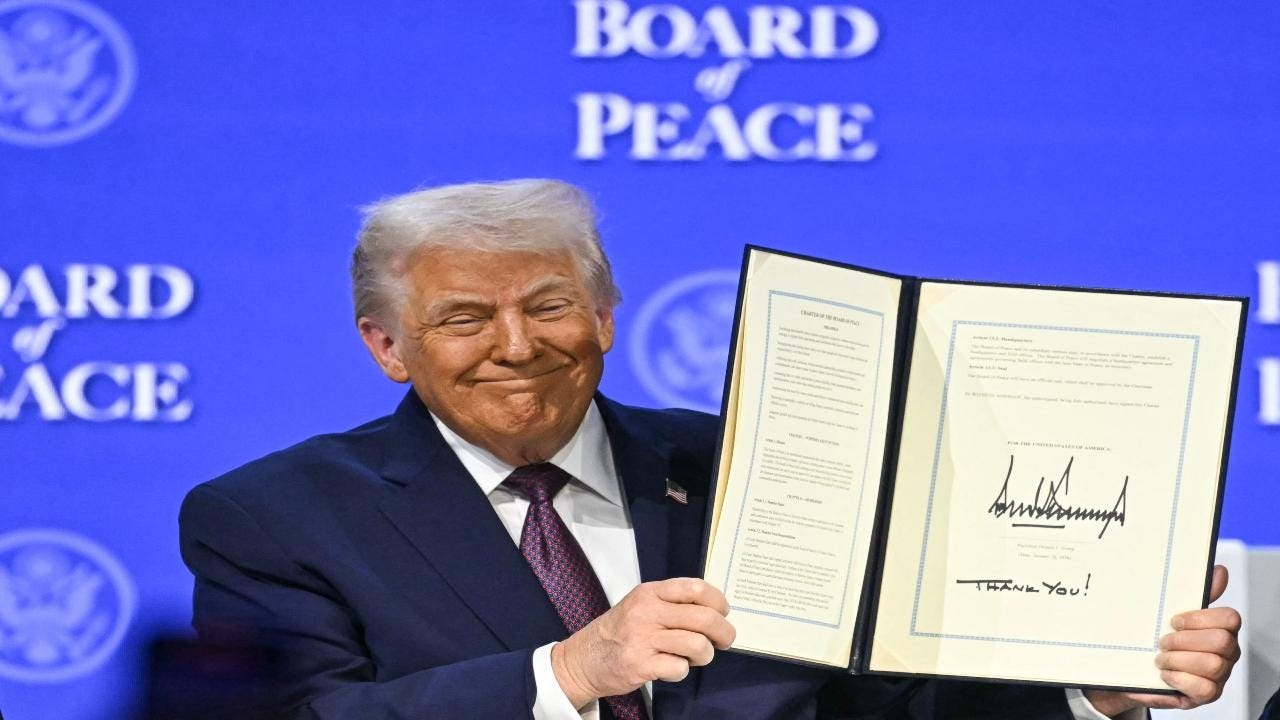
PIC/AFP
This Community Is Powered by You
What started as a small circle has grown into something much bigger, and it’s all because of readers like you.
Every time you forward this email, post it on socials, or bring someone new into the fold, you’re helping build one of the most passionate, independent political communities out there.
Want to keep the momentum going?
Share this newsletter with someone who should be part of this conversation.
Thank you for being here. It means everything.
The Nations That Said Yes
As of this writing, nineteen countries have joined the Board of Peace. Together, they are meant to represent a new vision for peacebuilding, one unconstrained by the United Nations or international courts. Yet when we examine the makeup of this coalition, the vision that emerges is less about peace and more about power: who has it, who protects it, and who wants it without having to answer for it.
Argentina
Argentina, under President Javier Milei, is navigating a volatile moment in its just over 40-year history of democracy. Milei, an admirer of Trump’s populist style, has embraced aggressive economic reforms and confrontational politics. Argentina is also a country still haunted by the legacy of its Dirty War, during which tens of thousands were tortured, disappeared, or killed under a brutal military dictatorship. That history remains a wound, and the state’s relationship to justice remains deeply conflicted.
Armenia
Armenia is a relatively new democracy under pressure. Caught between powerful neighbors and weakened by its defeat in the Nagorno-Karabakh conflict, its government faces internal instability and growing distrust. Though it holds elections, its democratic institutions are fragile, and its strategic calculus is increasingly shaped by desperation rather than democratic idealism.
Azerbaijan
Azerbaijan, ruled for decades by the Aliyev family, is not a democracy in any meaningful sense. Political opposition is tightly controlled, journalists are imprisoned, and the state is built around petro-wealth and surveillance. Its recent military campaigns to reclaim Nagorno-Karabakh have been widely condemned for alleged war crimes and ethnic cleansing.
Bahrain
Bahrain is a monarchy that has skillfully positioned itself as a moderate voice in the Gulf, particularly through its normalization with Israel. However, beneath that diplomatic sheen lies a legacy of crushed dissent. After the Arab Spring, the regime violently suppressed pro-democracy protests and imprisoned political leaders, and it has shown little interest in genuine reform since.
Belarus
Under Alexander Lukashenko, Belarus has earned its status as Europe’s last dictatorship. The 2020 elections were widely regarded as fraudulent, and mass protests were met with violent crackdowns. Opposition leaders have been jailed, exiled, or disappeared, and the regime survives on surveillance and fear.
Egypt
Egypt is ruled by former general Abdel Fattah el-Sisi, who seized power in a military coup and has since presided over mass incarcerations, media censorship, and a brutal crackdown on civil society. Once the heart of the Arab Spring, Egypt is now one of the most repressive states in the region.
Hungary
Hungary’s Viktor Orbán has reshaped his country’s democratic institutions into instruments of personal power. Independent courts have been weakened, academic institutions shuttered, and the press brought under control. Though Hungary remains a member of the European Union, it is often cited as a textbook case of democratic backsliding.
Indonesia
Indonesia is the largest Muslim-majority democracy in the world, and its presence on this list may raise eyebrows. However, it, too, grapples with entrenched problems, including the repression of West Papuan activists, the marginalization of religious minorities, and a legacy of mass violence from 1965 that has never been reckoned with. While Indonesia holds elections, its democracy is far from immune to pressure.
Jordan
A constitutional monarchy in which power ultimately resides with the king, Jordan has long walked a tightrope between Western alignment and domestic control. Political opposition is tolerated within limits, but criticism of the monarchy is criminalized, and dissent is tightly managed by the security apparatus.
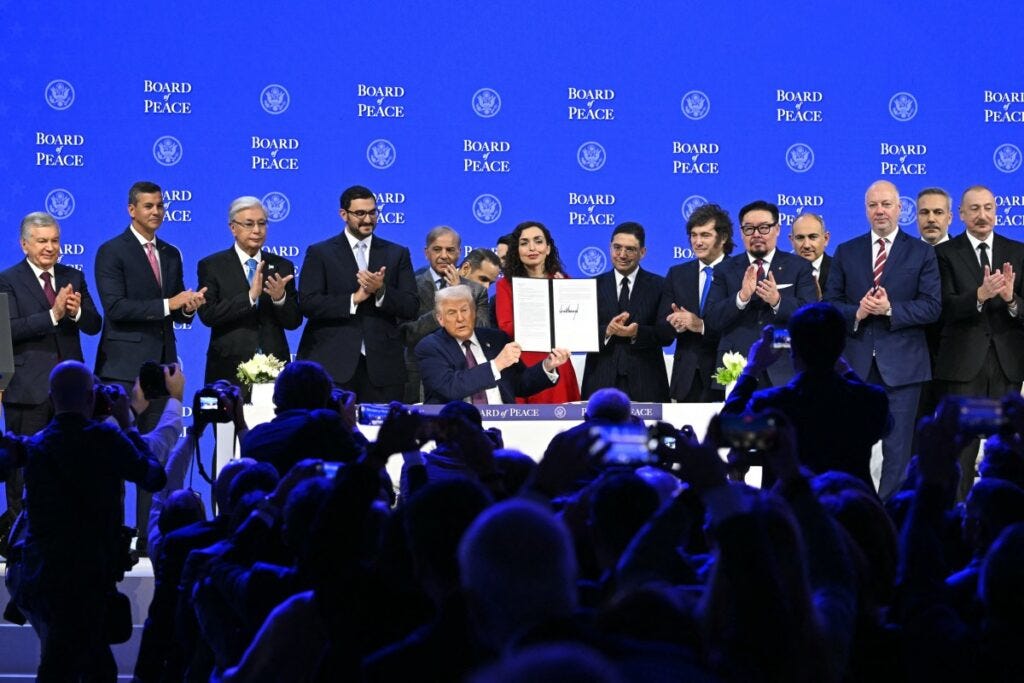
Photo by Fabrice Coffrini / AFP
Kazakhstan
Kazakhstan emerged from the Soviet Union as an oil-rich state ruled for decades by Nursultan Nazarbayev and now his successors. Despite gestures toward reform, it remains an authoritarian state with little tolerance for protest or opposition. Its 2022 crackdowns on unrest led to dozens of deaths and mass arrests.
Kosovo
Kosovo is a young and vulnerable democracy still fighting for full international recognition. Its inclusion on the Board likely reflects a strategic need for U.S. support. Internally, Kosovo struggles with corruption, political fragmentation, and an unresolved relationship with Serbia, from whom it declared independence in 2008.
Morocco
Morocco blends monarchy with limited parliamentary power, but real authority remains concentrated in the palace. Activists and journalists are regularly prosecuted, and the ongoing occupation of Western Sahara continues to draw international criticism.
Pakistan
Pakistan is a democracy in structure but a military state in function. Civilian governments come and go, often at the army's behest, which controls foreign policy and security. Blasphemy laws are used to silence dissent, and elections are marred by intimidation and interference.
Qatar
Qatar projects modernity through skyscrapers and diplomacy, yet governs under an absolute monarchy. It has faced extensive criticism for labor abuses, especially in the lead-up to the World Cup, and its internal politics remain closed to meaningful public participation.
Saudi Arabia
Saudi Arabia is an authoritarian monarchy with global oil influence and a record of domestic repression. Crown Prince Mohammed bin Salman has executed reforms on paper, but dissent is met with prison or worse. The murder of journalist Jamal Khashoggi in 2018 remains a defining symbol of the regime’s approach to opposition.
Turkey
Turkey once offered a model of Islamic democracy. Under Recep Tayyip Erdoğan, it has become a cautionary tale. A failed coup in 2016 opened the door to sweeping purges, censorship, and constitutional changes that have consolidated one-man rule.
United Arab Emirates
The UAE brands itself as a global hub of innovation, but it remains a federation of monarchies with no space for political dissent. The state surveils its citizens and jails activists while cultivating soft power abroad.
Uzbekistan
Uzbekistan remains a tightly controlled state where political opposition is effectively nonexistent. While there have been small gestures of reform, the core machinery of authoritarian control remains intact.
Vietnam
Vietnam is a one-party state where dissent is illegal and independent media does not exist. The Communist Party governs without opposition, and its human rights record remains troubling despite economic liberalization.
The Chairman Who Never Leaves
One of the most striking elements of the Board of Peace is that President Donald Trump is explicitly named as its inaugural chairman with no fixed term limit. According to the board’s draft charter, Trump will serve as chairman “until he resigns,” and has the exclusive authority to invite countries to join, revise the charter, create or dissolve subsidiary entities, and designate his own successor. Only the chairman has the power to shape the board’s membership and governance structure, with no independent checks on that authority.
This arrangement has drawn attention because it means Trump could retain global diplomatic influence even after leaving the White House, effectively giving him a lifetime leadership role in an international body, something unprecedented in modern diplomacy. U.S. officials have confirmed that the chairmanship could extend beyond his current presidency and that future U.S. administrations could appoint or designate a U.S. representative to the board if Trump steps down.
In addition, the board’s structure creates a tiered membership model. Nations that join for a standard three-year term do so at Trump’s invitation, but those willing to contribute $1 billion secure permanent membership. According to U.S. officials, that money is intended to fund reconstruction in Gaza, though the board’s charter offers little public detail on how those funds are governed or spent. Critics argue the system amounts to a pay-to-play arrangement with limited transparency, concentrating influence while obscuring oversight.
Finally, the board’s establishment was backed by United Nations Security Council Resolution 2803 (2025) as part of a U.N. mandate tied to the Gaza ceasefire and reconstruction process. However, critics point out that the board’s charter broadens its mission beyond Gaza and does so in a way that sidesteps traditional multilateral governance structures, placing authority in the hands of a single individual rather than strengthening international cooperation under existing institutions.
What Do They Have in Common?
These countries differ in culture, geography, and wealth. However, politically, they share something unmistakable: an aversion to oversight, a discomfort with transparency, and a history—recent or enduring—of repression.
Some are authoritarian states with little pretense of democracy. Others are electoral regimes where democratic institutions exist but are hollowed out. A few are young democracies seeking survival, willing to trade silence for support.
None of them are models of liberal democracy. None of them is known for their commitment to human rights. Importantly, none of them would be accepted as moral leaders in any legitimate peace process rooted in justice.
And What Does That Say About Us?
This is where the mirror turns.
These nations joined the Board of Peace not necessarily because they believed in its mission, but because they recognized its appeal. Here was a forum where they would not be judged, where no one would ask too many questions, and where the United States would offer its name and its cover.
We created a space for the unaccountable, and the unaccountable showed up. So we must ask: are we the exception at this table, or are we simply looking at reflections of ourselves?
Our Reflection in Their Faces
Despite the mythology sold to us, the United States has never fully reckoned with its own record. It has never atoned for colonization, slavery, Japanese internment, or the countless foreign interventions conducted under the guise of freedom. It has toppled democracies, armed dictators, and called it peacekeeping for generations.
We have long claimed moral leadership while refusing to be bound by the rules we expect others to follow. We reject the International Criminal Court. We shield our soldiers and officials from war crimes investigations. We market freedom, but export force.
Is it any surprise that these are the nations that responded when we issued the invitation?
This Isn’t Peace. It’s Impunity
The Board of Peace is not a peace project. It is a shield for power. It is a place where the powerful gather not to answer for the past, but to rewrite it.
It offers no truth, no reconciliation, and no justice. The Gaza plans so far revealed do not include security for Palestinians, nor does it include Palestinian voices. Instead, it offers only optics, the illusion of progress.
Beneath that illusion lies the truth. What unites this board is not a shared vision of peace, but a shared interest in escaping accountability.
The Final Question
So look around this table. These are the nations that said yes.
Now ask yourself: Do we still believe we’re different?
Because if we do, it is time to prove it, and if we don’t, it is time to ask why they came when we called.
Stay With the Story
We don’t do clickbait. We follow the power, even when it’s uncomfortable.
If you want more stories that challenge the myth and confront the mirror, subscribe below.
We publish truthfully, with purpose, and we don’t look away.
Sources:
“Trump launches Board of Peace at signing ceremony in Davos” — Al Jazeera, January 22, 2026
“Trump hosts signing ceremony for Board of Peace in Davos despite reservations from key allies” — ABC News, January 22, 2026
“Trump launches Board of Peace that some fear rivals UN” — Reuters, January 22, 2026
“Trump claims world ‘richer, safer’ than year ago at launch of his ‘board of peace’” — The Guardian, January 22, 2026
“Who is Trump’s Board of Peace and who has joined so far?” — Reuters, January 21, 2026
“Trump unveils Board of Peace in Davos after Greenland furor” — Associated Press, January 22, 2026
“Trump names Kushner, Rubio, Blair to Gaza board; Israel objects to lineup” — The Washington Post, January 17, 2026
“WATCH: Trump introduces Gaza ‘Board of Peace’ at Davos” — PBS NewsHour, January 22, 2026
“World leaders show caution on Trump’s broader ‘Board of Peace’ amid fears for UN” — Reuters, January 18, 2026
Board of Peace — Wikipedia
56th World Economic Forum — Wikipedia
Gaza Strip under Resolution 2803 — Wikipedia
Feels like 1984 where it says that those in control were able to put their differences aside and agreed that their desire to remain in power was more important.
Thanks Marie! Trumps incessant need to rebrand everything in his own likeness is repellent. I can’t wait for him to be gone.