


When Government Has to Decide Who Is a Citizen
On September 4th, the U.S. Court of Appeals for the D.C. Circuit refused to suspend a lower-court order blocking the federal government’s modified Systematic Alien Verification for Entitlements program, known as SAVE, while an appeal proceeds. The judges pointed to evidence that inaccurate Social Security citizenship data had already produced consequences in Texas. Citizens could be required to prove citizenship to remain registered, and some registrations could be canceled.
For the person behind a mistaken record, citizenship is not an abstract legal concept. It can determine whether government recognizes that person as a member of the political community. You might expect the Constitution to have defined something that important with extraordinary care from the beginning. It did not.
The original Constitution required seven years of citizenship to serve in the House, nine years for the Senate, and restricted the presidency to a “natural born Citizen,” or someone who was already a citizen when the Constitution was adopted. It also used "citizens" to define federal court jurisdiction and relations among the states. However, it never supplied a general definition of who counted as one.
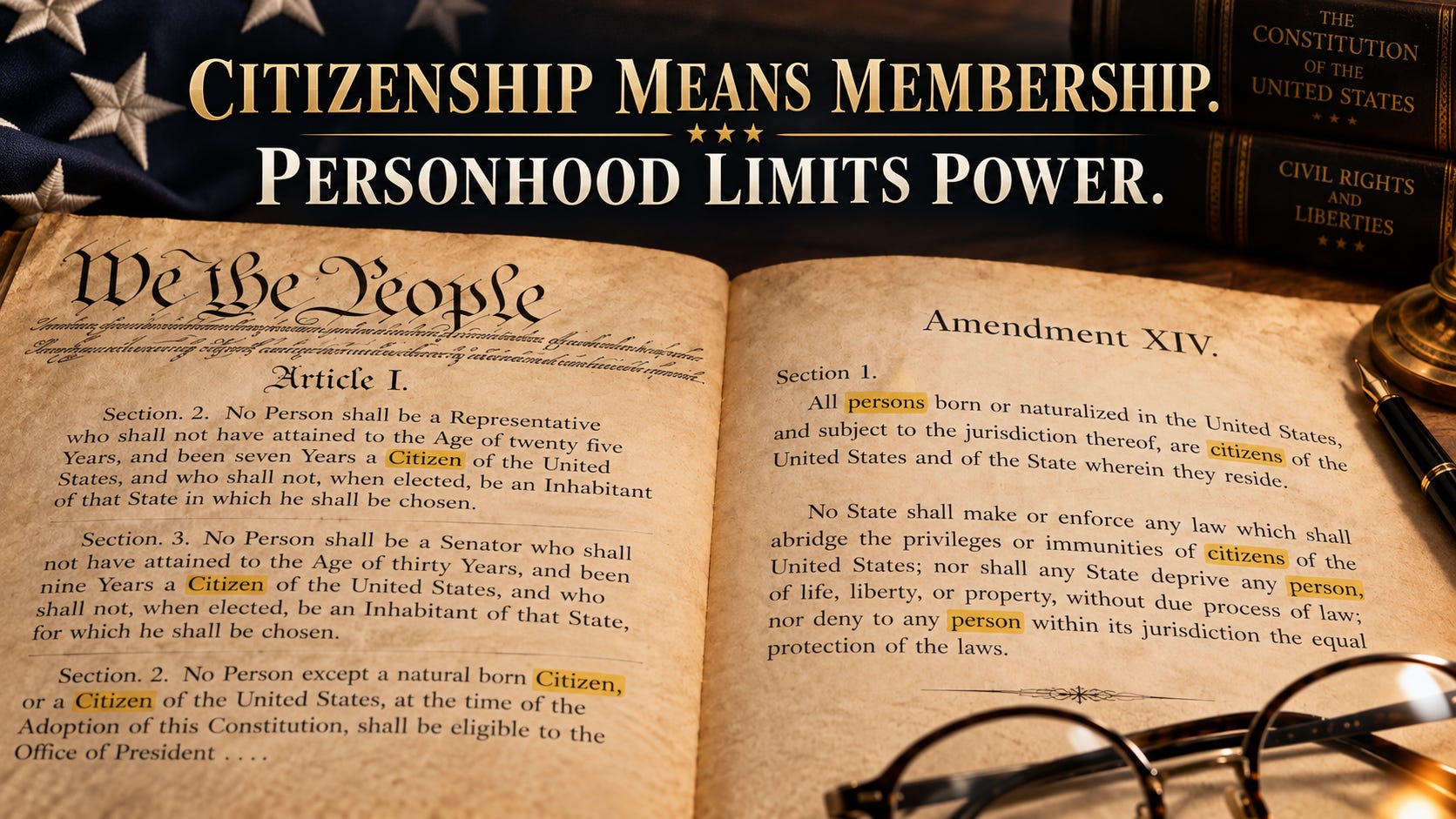
Counting the operative text of the original Constitution and all twenty-seven amendments, “citizen” and “citizens” appear twenty-two times. The word “citizenship” does not appear at all. Those numbers do not make citizenship unimportant. Instead, they make the Constitution’s choice of words more interesting, because when later Americans finally wrote a constitutional rule establishing who a citizen was, they almost immediately chose a different word when placing some of the most important limits on government power: person.
This Community Is Powered by You
What started as a small circle has grown into something much bigger, and it’s all because of readers like you.
Every time you forward this email, post it on socials, or bring someone new into the fold, you’re helping build one of the most passionate, independent communities out there.
Want to keep the momentum going?
Share this newsletter with someone who should be part of this conversation.
Thank you for being here. It means everything.
The Constitution Had Citizens Before It Defined Them
The Constitution’s silence did not mean Americans had no idea what citizenship was. States recognized their own citizens, legal traditions supplied inherited understandings, and the Constitution gave Congress power to establish a uniform rule of naturalization. However, the Constitution itself did not otherwise settle who was a citizen of a state or of the United States.
That left an odd structure. The document could require citizenship for office without first defining the category's boundaries. It could distinguish citizens of one state from citizens of another without explaining who qualified as a citizen of the nation.
For a new republic, that ambiguity may have seemed manageable. The states and their political communities already existed after all. However, the United States was also divided by slavery, race, state identity, and competing ideas about national membership. A category as important as citizen could not remain constitutionally unsettled forever.
When the Supreme Court Answered the Question
In 1857, the Supreme Court confronted that conflict in Dred Scott v. Sandford. Scott, an enslaved Black man who had lived in free territory, sued for his freedom in federal court. His ability to invoke federal diversity jurisdiction depended in part on whether he could be considered a citizen.
Chief Justice Roger Taney’s majority opinion answered no. The Court held that Black Americans descended from people brought to the United States as slaves could not be citizens of the United States within the meaning of the Constitution. A state might recognize a Black person as its citizen, the Court reasoned, but that did not make the person a citizen of the United States for purposes of federal jurisdiction.
The Constitution’s failure to define national citizenship did not cause Dred Scott. Slavery, racism, and decades of conflict over national membership were already embedded in the country. However, the constitutional question was unresolved, and the Supreme Court supplied one of the most infamous answers in American history.
America had built a republic around citizens before it had constitutionally settled who could be one. The country would eventually rewrite the answer.
The Country Rewrote the Answer
In 1866, Congress passed the Civil Rights Act, establishing a federal citizenship rule for people born in the United States and not subject to a foreign power, with an exclusion then written for “Indians not taxed,” and declaring equal civil rights regardless of race or previous condition of slavery. Two years later, the Fourteenth Amendment placed a national citizenship rule into the Constitution itself.
Its opening sentence declared that all persons born or naturalized in the United States, and subject to its jurisdiction, are citizens of the United States and of the state where they reside. The Citizenship Clause repudiated Dred Scott’s rule of national citizenship.
For the first time, the Constitution had answered the question it had left unresolved at the founding. Then, almost immediately, the amendment changed the word.
Then the Constitution Changes One Word
Section 1 of the Fourteenth Amendment begins with citizenship. It defines who a citizen is, then prohibits states from abridging the privileges or immunities of United States citizens.
The language then shifts. No state may deprive any person of life, liberty, or property without due process of law, or deny any person within its jurisdiction the equal protection of the laws.
The amendment showed that its authors knew how to use the word citizen. When they wrote some of the most important restraints on state power, however, they chose a broader word: person.
The amendment that finally answered who a citizen was also made clear that citizenship was not the boundary of every constitutional protection. The text asks two different kinds of questions: who belongs to the political community, and what limits government must obey when it exercises power over a human being.
Citizen and Person Do Different Constitutional Work
Citizenship still carries enormous constitutional weight. It marks political membership, affects eligibility for public office, and appears in provisions written specifically for citizens, yet the Constitution does not use citizenship as the dividing line for every protection against government power.
The Fifth Amendment says no person may be deprived of life, liberty, or property without due process of law. The Fourteenth Amendment applies due process against the states and adds equal protection for any person within a state’s jurisdiction.
That does not mean every constitutional right applies identically to every person in every circumstance. Different provisions do different work, and citizenship remains legally significant. The narrower point is enough. The Constitution itself refuses to treat “citizen” and “person” as interchangeable.
A person can stand outside the category of citizen and still remain within the Constitution’s protection when government exercises certain powers over life, liberty, property, or equal treatment. The distinction is not only about an individual's status. It is also about what obligations government carries with the power it uses.
Citizenship Means Membership. Personhood Limits Power.
As a constitutional lens, citizenship often concerns membership in the political community. Personhood becomes especially important when the Constitution tells government how it must behave toward someone subject to its power.
A citizen may possess political rights, qualifications, and responsibilities that another person does not. However, when government exercises coercive power, the Constitution does not simply ask whether the person on the receiving end has enough status or influence to command restraint. It asks whether government itself is acting within the rules.
A prosecutor does not gain extra constitutional authority because a defendant is unpopular. A state does not acquire broader power because the person affected has little political influence. The limits written into the Constitution travel with the power government exercises.
The Government Does Not Become Less Bound Because You Have Less Power
Constitutional limits matter most when government exercises power over people who have little ability to resist it. A wealthy defendant can hire lawyers. A powerful corporation can assemble a legal team. A well-connected citizen may know whom to call when government makes a mistake. Many people standing across from the state have none of those advantages.
Their lack of power does not enlarge the government’s. Due process is essential precisely because government can take liberty or property. Equal protection is foundational because the state possesses authority an individual cannot match. Constitutional rules established before a conflict begins remain in place when the person on the receiving end cannot negotiate better ones.
A republic's strength is not measured only by how it treats citizens who can fight back. It is also measured by whether government remembers the rules when almost nobody powerful is watching.
A Square Government Asks What Power Is Being Used
The Square New Deal begins with a simple question: what power is being exercised, and what rules come with it?

Government can arrest, prosecute, imprison, tax, regulate, seize property under lawful conditions, and use force. Those powers are sometimes necessary. A government unable to perform legitimate public duties is not sufficient, but crucially, sufficient government is not unchecked government.
The legitimacy of the goal does not erase the limits on the method. If government possesses extraordinary authority, stewardship requires that authority to remain bounded by law, procedure, and constitutional restraint.
A square government asks more than whether government has power to act. It asks who authorized that power, what constitutional limits accompany it, and whether those limits are being honored in practice. Public power does not become harmless because its purpose is legitimate. Legitimate power still needs rules.
Sufficient government means enough power to do the public’s work and enough constitutional discipline to keep it from becoming its master.
Citizenship Still Has to Mean Something
None of this makes citizenship less important. Citizenship is membership in the political community. It carries rights, qualifications, and responsibilities that do not attach to every person in the same way. Citizens share responsibility for the institutions that act in their name.
If citizens claim ownership of self-government, constitutional restraint cannot be someone else’s problem. When public power is abused against a person with little influence, citizens still have a stake in whether the rules were followed because that power was exercised in their name.
The fact that the Constitution restrains government when it deals with someone outside the political community does not diminish citizenship. It tells us what responsibilities citizenship carries. Citizens are not merely customers of constitutional government. They are its custodians.
What Citizenship Is For
At the beginning, twenty-two uses of “citizen” and “citizens” can seem almost too few, but the Constitution was never merely a membership handbook. It is a framework for public power: who gets it, how it is divided, which institutions may exercise it, and what limits remain when they do.
Citizenship answers one essential question: who belongs to the political community responsible for governing the country? The Constitution must answer another: what may that political community, acting through government, do with the power it holds?
The original Constitution used the word citizen before it settled who could be one. Dred Scott showed the stakes of that unresolved question. The Fourteenth Amendment supplied a constitutional rule for national citizenship, then almost immediately used another word: person.
That choice does not weaken citizenship. It places citizenship inside a larger constitutional responsibility. Citizenship tells us who belongs to the republic and the Constitution tells the republic how power must behave.
A square government must understand both, and citizens who claim ownership of self-government must insist that it does.
Support Independent Media
If this article gave you a clearer way to think about citizenship, constitutional power, and the responsibilities that come with self-government, please share it with someone who may find it useful.
The Coffman Chronicle is building a home for constitutional accountability, working-class dignity, and the Square New Deal idea that public power must remain both sufficient and restrained.
If you can afford to support that work with a paid subscription, it helps us keep researching, writing, and publishing these stories. If you cannot, stay with us anyway. Read, share, discuss, and help carry the argument forward.
The republic belongs to all of us. So does the responsibility to keep it.
Sources
Library of Congress. Constitution Annotated. “Citizenship Under Privileges and Immunities Clause.” Accessed September 6, 2026.
Library of Congress. Constitution Annotated. “Fifth Amendment: Rights of Persons.” Accessed September 6, 2026.
Library of Congress. Constitution Annotated. “Fourteenth Amendment, Section 1: Rights.” Accessed September 6, 2026.
Library of Congress. Constitution Annotated. “Historical Background on Citizenship Clause.” Accessed September 6, 2026.
National Archives. “The Constitution of the United States: A Transcription.” Last reviewed December 19, 2025. Accessed September 6, 2026.
United States. “An Act to Protect All Persons in the United States in Their Civil Rights, and Furnish the Means of Their Vindication.” 14 Stat. 27. April 9, 1866. U.S. Government Publishing Office.
United States Court of Appeals for the District of Columbia Circuit. “League of Women Voters, et al. v. United States Department of Homeland Security, et al.” Nos. 26-5243 and 26-5301. Order filed September 4, 2026.
Spectacular. And between the lines is that "citizen" is not clearly exclusionary. We have, over time, recognized our failure to include more citizens, so that African Americans are no longer slaves, women can vote, and anyone born in this country is a citizen. We accepted the Statue of Liberty, added a poem that says we're looking for more Americans, and we've never returned the Statue. We haven't settled up adequately with the Native Americans, and we're not going to, because we don't want to return their land to them. But that should be the last frontier.
This means Trump’s actions against immigrants with his snatch and grab policy is unconstitutional and must be rejected and the responsible parties brought before congress for adjudication