


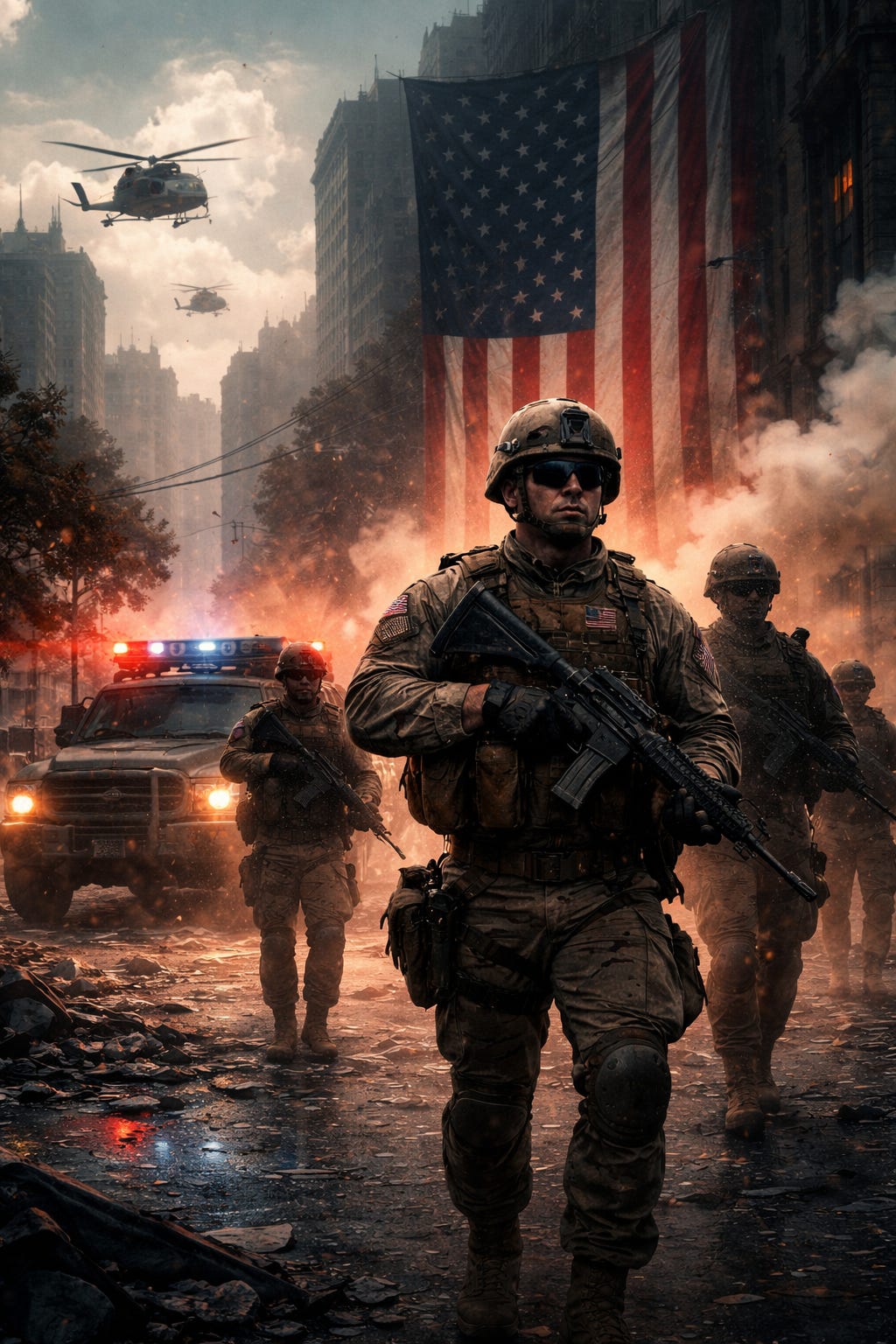
When the nonpartisan Congressional Budget Office released its latest estimate on January 28, 2026, it quietly confirmed something momentous: the U.S. government has already spent nearly half a billion dollars deploying National Guard troops and Marines into American cities, and that number could easily double in 2026 if current policies continue unchanged. According to the CBO, between June and December of 2025, these domestic military deployments cost taxpayers roughly $496 million, covering pay, benefits, lodging, transportation, and support for troops in places like Washington, D.C., Chicago, Memphis, Portland, and Los Angeles. Continued deployments at the same scale would run at roughly $93 million per month, meaning the federal bill for a full year could exceed $1 billion.
At face value, these numbers might seem abstract or technical. However, they reflect a deeper shift in how the U.S. government thinks about crime, public safety, and the use of military force on domestic soil. What the CBO report reveals, and what many Americans instinctively feel in their guts, is that this policy isn’t about safety, but rather about militarization.
This Community Is Powered by You
What started as a small circle has grown into something much bigger, and it’s all because of readers like you.
Every time you forward this email, post it on socials, or bring someone new into the fold, you’re helping build one of the most passionate, independent political communities out there.
Want to keep the momentum going?
Share this newsletter with someone who should be part of this conversation.
Thank you for being here. It means everything.
The Justification: Crime, Fear, and the Rationale for Troops in the Streets
From the very beginning, the administration’s public justification for sending troops into cities was framed around crime control and supporting local law enforcement. The messaging was straightforward: violent crime is rampant, local authorities are overwhelmed, and federal forces are needed to bring order.
How does this justification hold up against the facts?
By the time large numbers of National Guard troops were mobilized in mid‑2025, violent crime in the United States was already declining precipitously. A new report from the Council on Criminal Justice shows that from 2024 to 2025, the homicide rate across 35 major U.S. cities fell by about 21 percent, with declines also seen in other major crime categories such as carjackings, aggravated assaults, and shoplifting. This represents roughly 922 fewer homicides across those cities alone, and the trend continued a long‑term pattern of post‑pandemic declines in violent crime.
These weren’t isolated blips. Other cities tell the same story. Detroit, long emblematic of urban violence, recorded its lowest number of homicides since at least the 1960s in 2025, with killings down sharply from 2024. In San Francisco, crime rates, including homicides, were on track for historic lows for the city. Even FBI data showed violent crime falling in 2024, long before the Guard deployments began.
In other words, crime was already trending down long before soldiers were sent into the streets, and the causes of that decline are complex and multifaceted, including broader public safety efforts, demographic shifts, and social stabilization after the pandemic.
Yet the political narrative has been otherwise. If crime dropped while troops were present, then their presence must have prevented it. That logic, however, conflates correlation with causation, and it sets a dangerous intellectual precedent. If soldiers appear to coincide with crime declines, then even permanent militarized occupations could be justified. That is not public safety. That is militarization cloaked in crime statistics.
Where the Money Comes From: The Pentagon and the Defense Budget
One of the most revealing aspects of the CBO cost estimate is where the money is actually coming from. These National Guard and Marine deployments are not funded from local police budgets, nor are they a special line item in a public safety bill. They are being absorbed into the Department of Defense's enormous budget.
To put that in context, the DoD budget is the single largest portion of America’s discretionary federal spending, regularly exceeding $800 billion and approaching $1 trillion in recent years. Critics on both sides of the aisle have long pointed out that this budget dwarfs other public safety or social service investments, yet continues to grow year after year.
We’ve reported several times on the budget issues at the Pentagon. See that here:
Notes: Articles move into our archive after 45 days. Consider becoming a paid subscriber for full access to the extensive archive and exclusive perks.


And yet, despite commanding such vast resources, the Pentagon has never passed a full financial audit. Annual audits of the department’s sprawling books, mandated by Congress beginning in 2018, have repeatedly failed. Every year since the requirement took effect, the department has failed to meet basic accountability standards. In the most recent audit cycle, the Pentagon was unable to issue a clean opinion on its financial controls, identifying dozens of material weaknesses and deficiencies, and remains the only major federal agency that has never passed an audit.
Even beyond the audit opinions, the Pentagon’s accounting problems are stark. Independent analyses have found that the department cannot properly track the majority of its assets, meaning trillions of dollars in equipment, parts, and liabilities are not fully documented in any reliable way. Estimates suggest that over 60 percent of the Pentagon’s nearly $4 trillion in assets are inadequately accounted for, with the department still years away from having systems in place that could generate accurate, auditable books.
For decades, lawmakers have justified massive annual increases in defense spending by claiming that the department must be prepared for global threats, conflicts overseas, and national security challenges. However, if the same massive budget can be tapped at a moment’s notice to fund domestic militarization — without new appropriations, without congressional approval, without breaking a sweat — then the narrative that the Pentagon needs more money becomes far harder to sustain.
Put bluntly, if the Pentagon has the money to spend a billion dollars a year sending soldiers into cities on top of its existing global commitments, then it doesn’t need that money in the first place, much less a budget increase.
When Defense Turns Inward
There’s a deeper issue buried beneath the cost, beyond even the mismanagement of defense dollars. The Department of Defense exists — at least in theory — to protect the nation from external threats. Its mandate is military defense, not domestic crime control. That distinction is not incidental. It is foundational to civilian rule in a democracy.
So when that apparatus, designed for war, scaled for empire, and funded without limit, is turned inward, something fundamental changes.
What we’re seeing is not simply an expansion of policing, but the slow normalization of a military presence in public life. Troops in camouflage uniforms patrolling American cities under the banner of “public safety” are not engaged in defense. It is occupation. And once that line is crossed, the question becomes inescapable: Who is the Department of Defense defending us from?
When a government uses military force to manage urban crime, poverty, and protest, the implication is clear: the threat is no longer foreign. It is domestic. This inversion does not make the public safer. It recasts them as adversaries.
That’s the architecture of authoritarianism, power justified by fear, funded without accountability, and enforced through militarized presence. It doesn’t happen with a coup. It happens with budget votes, PR campaigns, and quiet CBO reports.
Why This Matters: Militarization Instead of Solutions
The story of these deployments is not just about money and budgets, but rather what we choose to invest in as a society.
For decades, research on public safety has revealed that the most effective strategies to reduce crime are not militarized patrols or armed troops, but community‑based interventions and social investments that address the root causes of violence, including poverty, trauma, lack of opportunity, mental health needs, and insecure housing.
Programs like community violence intervention (CVI) initiatives, designed to empower local leaders and credible messengers to mediate conflicts, connect at‑risk individuals to services, and build trust within neighborhoods, have shown significant promise in reducing gun violence and shootings in some cities, with associated cost‑benefit ratios that vastly outperform militarized deployments or investment in local law enforcement.
Other research highlights the effectiveness of credible messenger programs, organized support systems that leverage local relationships to interrupt cycles of violence at the street level.
If one were to take the roughly $1 billion projected to be spent on Guard deployments in 2026 and reallocate it to evidence‑based violence prevention, public health approaches, housing stability, and youth opportunity programs in the affected cities, the result would be a radically different public safety landscape, one grounded in prevention and healing rather than occupation.
A System That Profits from Pain
This brings us to a deeper structural truth. The way the U.S. handles public safety — and budgets for it — is shaped not by what works, but by what is profitable, fundable, and institutionally entrenched.
In health care, we don’t pay for cures; we pay for treatment. In policing, we don’t invest in community care; we invest in force and incarceration. In defense spending, we don’t prioritize accountability; we prioritize scale.
If addressing the root causes of crime — economic inequality, lack of housing, mental health support — reduces the need for enforcement, then it undercuts the justification for massive budgets devoted to militarization and coercion. That’s why those investments are underfunded. They threaten the business model that turns fear and disorder into a continuous stream of spending and profit.
What the CBO Report Really Shows
The CBO report did more than tally expenses. It laid bare a fundamental choice in American governance.
We can treat symptoms with force and spend untold billions to put soldiers in our cities, enriching military contractors, the prison pipeline, and their associated infrastructure, or we can invest boldly in the conditions that actually reduce violence and build safety from the ground up.
The former enriches powerful institutions and preserves a militarized, unaccountable approach to public life. The latter nurtures communities and actually addresses the conditions that lead to crime in the first place.
The figures are clear. The trends are clear. The evidence is clear.
What remains is whether policymakers and the public are willing to see the truth.
Did this piece make you think? Stay with us.
We follow the money, challenge the narratives, and tell the truth about power, even when it wears camouflage. If you’re tired of politics that perform and budgets that betray, subscribe to get our latest pieces straight to your inbox.
Sources:
Federal troop deployments to US cities cost taxpayers $496M and counting — Associated Press, January 28, 2026
National Guard deployment in Chicago cost $21M — Axios, January 28, 2026
National Guard deployments cost taxpayers almost half a billion dollars — The Washington Post, January 28, 2026
Homicide rate declines sharply in dozens of US cities, a new report shows — Associated Press, January 22, 2026
U.S. murder rate hits lowest level since 1900, report says — Axios, January 22, 2026
Why have homicide rates reportedly plummeted in the last year? — The Week, January 27, 2026
Trump suggests more US cities need National Guard but crime stats tell a different story — Associated Press, August 29, 2025
FactCheck.org: Trump Distorts Violent Crime Statistics in Ordering Takeover and Troops to D.C. — FactCheck.org, August 12, 2025
Crime in the United States — Wikipedia
Insidious funneling money by GOP criminals
What causes crime: socioeconomic disparities: low income and limited access to education; family instability, peer pressure, mental health issues, substance abuse. Reducing crime means encouraging education, family and drug counseling, better health care - not more soldiers, more military, more violence and more tyranny.