


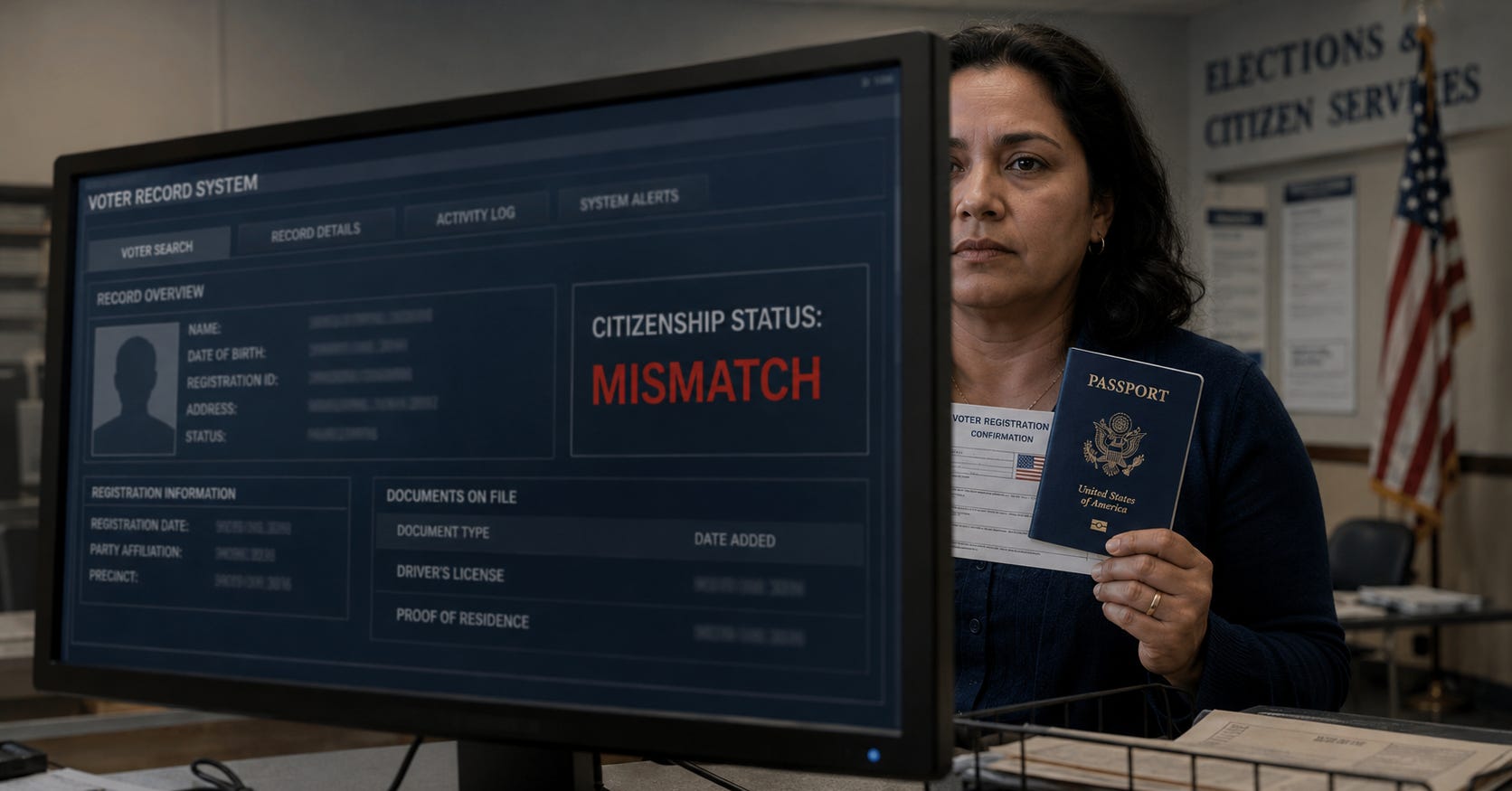
The Record Still Saw the Immigrant
Anthony Nel had already done what the country required. He completed the process, took the oath, and became an American citizen. More than a decade later, he lived under the same Constitution and held the same right to vote as any other citizen. Then a government database looked at him and saw someone else.
The record still reflected an earlier chapter of his life. It saw the immigrant he had once been, not the citizen he had become. Texas election officials acted on that information, and Nel’s voter registration was temporarily canceled.
Officials would later emphasize that the mistake could be corrected, but the database did not make the telephone calls, search for documents, or wait for the government to recognize what the government had already granted. The burden shifted from the institution holding the inaccurate record to the citizen whose right depended on its correction. Nel’s citizenship had not changed. The record had simply failed to keep up.
From the administrative side, the process can appear orderly: A name is entered, a result is returned, and a notice is sent. From the citizen’s side, a settled right can suddenly become uncertain because the machine has introduced a question where the law had already supplied an answer.
The question is not whether voter rolls should be accurate, but rather what happens when the government’s record becomes more persuasive than the citizen standing in front of it.
This Community Is Powered by You
What started as a small circle has grown into something much bigger, and it’s all because of readers like you.
Every time you forward this email, post it on socials, or bring someone new into the fold, you’re helping build one of the most passionate, independent political communities out there.
Want to keep the momentum going?
Share this newsletter with someone who should be part of this conversation.
Thank you for being here. It means everything.
Election Integrity Requires the Whole Truth
The danger of an inaccurate voter roll does not run in only one direction. New Jersey officials disclosed that a software failure registered roughly 6,600 people who had indicated that they were not United States citizens while applying for driver’s licenses or identification cards. The system ignored their answers and registered them anyway. A preliminary review found that fewer than 400 later cast ballots. That failure is serious, and the public deserves to know how it occurred, when officials discovered it and why the registrations remained in the system.
The ballots require a separate examination. Officials must determine each voter’s citizenship when the ballot was cast, what the person understood about the registration, and whether anyone knowingly violated the law. Registration, voting, and intentional fraud are related questions, but they are not the same question.
New Jersey presents a legitimate argument for stronger verification. It does not prove that every system offered as a solution must be trusted. A government system capable of registering someone after being told that person is not a citizen can be no more blindly trusted than one that questions a citizen because an old record still describes the person as an immigrant.
The failures move in opposite directions, but they share the same weakness: The institution assumes its machine is more reliable than the person affected by its decision. Accurate voter rolls require accurate evidence, lawful procedures, and a government willing to investigate its own records before making someone pay for defects in its records.
The answer to one unreliable government system is not unquestioning dependence on another.
What the Administration Actually Built
The federal system that questioned Anthony Nel was not created as a national voter-roll database. The Systematic Alien Verification for Entitlements program, known as SAVE, had long been used to confirm citizenship or immigration status when government agencies decided eligibility for public benefits, licenses, and other authorized programs. Its original structure centered largely on individual inquiries tied to a specific transaction.
That changed after President Donald Trump signed an executive order on elections in March 2025. The order directed the Department of Homeland Security (DHS) to give election officials access to federal systems capable of checking applicants and registered voters. Soon afterward, the department announced a broad overhaul of SAVE.
The revised system allowed agencies to submit large groups of names, incorporated Social Security information, expanded data sharing among federal departments, and made voter-list maintenance an expressly documented use. A state could now send a voter list into a federal process that compared registration information against records assembled for different purposes. The result could carry immigration history, Social Security records, and citizenship indicators into an election office that had not collected the underlying information and could not guarantee that every field was current.
The objective is legitimate: States must maintain accurate voter rolls, and federal law prohibits noncitizens from voting in federal elections. However, the administration did more than improve a search function. It connected sensitive federal records to election administration and created a process capable of placing millions of voters under automated review.
SAVE may identify a discrepancy and give officials a reason to look more closely, but it cannot turn an old record into conclusive proof about a citizen’s present status. This was not merely a faster search function. It was the construction of federal election infrastructure.
Congress Wrote the Firewall
The administration did not enter an empty field. Long before federal agencies began connecting Social Security information to voter files, Congress had decided that personal records could not be moved across government merely because officials found a new use for them. Congress restricted disclosure of Social Security information and enacted the Privacy Act of 1974 after public alarm over federal data banks and the possibility that the executive branch could assemble centralized dossiers from information citizens had supplied for unrelated purposes.
The law does not prevent the government from maintaining records. Instead, it imposes conditions. Agencies must identify what information they hold, why they hold it, how it may be used, and how individuals can challenge it. When records can affect a person’s rights, agencies must maintain them with enough accuracy, relevance, timeliness, and completeness to assure fairness. Congress later added protections governing computerized matching. Agencies could not simply exchange large collections of records with other authorities without written agreements and safeguards.
These laws were not relics written for filing cabinets. They anticipated the temptation now before the country: Information collected for one legitimate purpose becomes attractive to officials pursuing another. U.S. District Judge Sparkle Sooknanan concluded that the SAVE overhaul crossed boundaries Congress had already established. Her ruling found violations of the Privacy Act, the Social Security Act, and the Administrative Procedure Act, and she vacated the 2025 modifications and related notices.
The administration may disagree, and appellate courts may decide how much of the ruling survives, but the constitutional order is clear. The president issued an executive order. Federal agencies moved rapidly to carry it out. Congress had already enacted laws governing the information they wanted to combine. The court’s role was to determine whether the executive branch obeyed those laws.
A legitimate objective does not become its own source of legal authority. Preventing ineligible voting does not repeal the Privacy Act, and maintaining accurate voter rolls does not make Social Security information available for any executive purpose. Congress had already written the firewall. The executive branch treated it like paperwork.
A Federal Record Is Not a Citizenship Registry
The Social Security Administration knows a great deal about the people whose earnings pass through its system. That does not mean it knows the current citizenship status of everyone carrying a Social Security number. A lawful permanent resident may receive a number and later become a United States citizen. Naturalization changes the person’s legal status immediately. It does not automatically update every government record.
A citizen may have little reason to discover that an old field still reflects a former status. For years, the stale information may cause no visible problem. The SAVE expansion changed the consequence without first correcting the data.
Anthony Nel had been a citizen since 2013. He had possessed a United States passport and voted repeatedly in Texas. After SAVE identified him during a state review, officials demanded proof of citizenship within 30 days. His passport had expired, and obtaining a new one took longer than the deadline. His registration was canceled before he restored it.
The sequence exposes the weakness in treating a database response as proof. The government granted Nel citizenship and issued the passport confirming it. Another government record failed to reflect it. The state then treated the incomplete record as sufficient reason to question the citizen rather than sufficient reason to question the record.
The uncertainty began inside the government, where records failed to agree. It traveled through SAVE to a state election office and arrived in the citizen’s mailbox carrying a deadline and a warning. The institution holding the conflict did not resolve it before acting. The person was told to do it.
That work has real costs: time away from work, transportation, replacement documents, and repeated calls to government offices. None of those burdens appears in the database.
Nel’s registration was eventually restored, but that does not mean the system worked. It means the person harmed by the system succeeded in repairing the harm.
The same duty to separate legal status from a software result applies in New Jersey. The state must remove registrations created improperly and investigate unlawful ballots. It must also examine its own role before assigning criminal intent. A person who lies about citizenship has made a deliberate choice. A person who answers truthfully and is registered by defective software has not committed the same act. A machine can show that a registration exists or that two records conflict. It cannot determine intent, nor can it decide whether an old field reflects present legal reality.
Election administration will always depend on databases, but efficiency changes in character when the government saves time by shifting the cost of uncertainty onto the individual. That is especially dangerous in voting because elections occur on a fixed day. The government may correct the record later, but it cannot return the vote.
A database match can be a lead, and a lead can justify an investigation. Removing a citizen requires current and corroborated proof. The state possesses the power, and it should carry the first burden. A government record may fail to recognize a citizen. That failure does not make the citizen disappear.
Two Courts, Four States and One National Contradiction
Judge Sooknanan’s ruling did not end the modified SAVE system everywhere. It divided it. After the federal district court in Washington, D.C., vacated the overhaul, DHS disabled the disputed bulk-upload function and Social Security number searches in most states.
Florida, Ohio, Iowa and Indiana had previously reached a settlement requiring enhanced SAVE capabilities. When DHS disabled the system, those states returned to federal court in Florida. U.S. District Judge T. Kent Wetherell II ordered the department to restore the promised functions. He acknowledged that the government was caught between contradictory district-court orders but concluded that the settlement remained enforceable unless an appellate court ruled otherwise.
The administration responded with a workaround. The four states could send voter information to DHS, federal officials would perform the disputed searches, and the results would be returned to the states. The same functions remained unavailable elsewhere. The interface changed, but the data continued to move, searches continued, and results continued to reach election offices.
The dispute is now moving through the appellate courts, yet the deeper problem predates the collision. A system affecting voter eligibility, privacy law, and millions of personal records should not depend on which district judge acts last or which states negotiated a settlement first. National election infrastructure cannot be created through executive improvisation and divided by courtroom geography.
Congress Must Decide What a Database Match Can Do
The country does not need to choose between accurate voter rolls and the rights of eligible citizens. Congress has the authority to require both. Article I gives the people’s branch substantial power over federal election rules, and Congress has already used that authority to govern voter registration and list maintenance.
The modified SAVE system has exposed a question federal law does not answer clearly enough: What is a database match legally permitted to do? Congress should begin with a rule simple enough for every voter and election official to understand. No person should lose a registration solely because an automated system produces a possible citizenship mismatch.
That rule would not prevent an investigation. A state could examine the result and compare it with current sources. Before taking adverse action, however, the government should have to verify independently that the information is current, belongs to the correct person, and establishes ineligibility rather than mere inconsistency.
Congress must also require a correction process that fits the right at stake. A notice should identify the record that created the concern, explain what evidence may resolve it, and provide a simple, no-cost method of review. A timely challenge should preserve the voter’s ability to participate while the government resolves the dispute.
The same evidentiary discipline should govern criminal referrals. A software-generated registration or database mismatch does not establish intent. Prosecutors should need evidence beyond the machine before treating someone as a criminal.
Public accountability must extend to the systems themselves. Federal agencies, state election offices, and private vendors should disclose how many records were screened, how many people were flagged, how many challenges were confirmed, and how many results proved wrong. Accuracy reviews should specifically measure errors involving naturalized citizens.
Data use also needs a boundary. Information transferred for voter verification should not quietly become available for unrelated immigration enforcement, policing, benefit investigations, or commercial use. Retention should be limited, access controlled, and major software defects disclosed promptly.
Most important, Congress must decide whether SAVE should perform this role at all. That question should not be answered through an executive order, a revised privacy notice, a settlement with selected states, or a workaround devised after conflicting rulings. If the federal government is going to operate a national citizenship-screening system for elections, the authority should appear in legislation that identifies the records, limits their use, and protects the person being screened.
Lawmakers should hold hearings, demand error rates and correction times, question the officials who built the system, and hear from voters it misidentified. Then they should vote.
Courts can decide whether the current system violated existing law. They cannot substitute for legislation. When Congress leaves the rules unclear, agencies build first and defend later, states receive different access, judges inherit the contradiction, and citizens become the test cases. The people’s branch should establish the boundary before the machine reaches the voter. Private information and voting rights should be governed by laws written in public, not by code and interagency agreements written around the people’s branch.
The Citizen Is the Sovereign
Anthony Nel did not become an American when a database finally recognized him. He became an American when he completed naturalization and took the oath. The later failure of a government record did not weaken that status.
The same principle applies in New Jersey. A person who told the state that he was not a citizen did not become eligible to vote because defective software created a registration. The machine could place a name on the rolls. It could not create the legal status required to remain there.
In both cases, the record was wrong. A registration file is not citizenship. A Social Security indicator is not citizenship. A SAVE response is not citizenship. Each may contain useful evidence and expose a discrepancy worth examining. None has the legal power to create, revoke, or redefine the status of the person behind the record.
Modern government will continue relying on databases. States must remove registrations that are genuinely ineligible and investigate credible evidence of unlawful voting. However, accuracy cannot be measured only by how many names a system flags. A government that removes an ineligible registration has protected the election. A government that prevents an eligible citizen from voting has injured it. Both results belong in the same accounting.
Election integrity, therefore, requires scrutiny of both the machinery and the voter. Officials must ask whether the information is current, whether it belongs to the correct person, whether it was verified before action was taken, and whether the individual could correct a mistake before the election passed. Those questions are not obstacles to election integrity. They are what keep election integrity from becoming a justification for administrative carelessness.
The administration was entitled to pursue accurate voter rolls. It was not entitled to assume that every federal record was accurate enough to bear the consequences, to treat privacy protections enacted by Congress as clutter, or to build election infrastructure through interagency agreements and to rely on citizens to discover where it failed.
The rule should be understandable at the kitchen table. The government may investigate an inconsistency and remove a registration when current, corroborated evidence establishes ineligibility, but when its own records disagree, the government must resolve the uncertainty before transferring the danger to the citizen.
Election integrity does not require blind faith in a database. It requires a government accurate enough to find an error, honest enough to disclose it, and lawful enough to correct it without making an innocent person carry the cost.
A machine may identify a question. It cannot deliver the final verdict on citizenship. The database is the government’s record. The citizen is the sovereign.
Support Independent Media
The Coffman Chronicle follows the places where executive power expands, Congress retreats, and ordinary people carry the consequences.
Share this article with someone who believes election integrity must protect lawful voters as seriously as it removes unlawful registrations.
If you can afford it, consider becoming a paid subscriber. Your support keeps this work independent and focused on the people’s branch.
Sources:
“Congress and Elections Clause.” Constitution Annotated, Library of Congress. Accessed July 22, 2026.
“Declaration of Anthony Nel.” Common Cause et al. v. U.S. Department of Justice et al., No. 1:26-cv-01352-SLS, Exhibit G, Document 29-8. Citizens for Responsibility and Ethics in Washington. Executed May 14, 2026; filed May 19, 2026.
“DHS, USCIS, DOGE Overhaul Systematic Alien Verification for Entitlements Database.” U.S. Department of Homeland Security, April 22, 2025.
Florida et al. v. U.S. Department of Homeland Security et al. “Order Enforcing Settlement Agreement.” Case No. 3:24-cv-509-TKW-HTC. Ohio Secretary of State, July 7, 2026.
Florida et al. v. U.S. Department of Homeland Security et al. “Order Granting Motion to Intervene.” Case No. 3:24-cv-509-TKW-HTC. Democracy Docket, July 19, 2026.
Florida et al. v. U.S. Department of Homeland Security et al. “Notice of Appeal.” Case No. 3:24-cv-509-TKW-HTC. Democracy Docket, July 20, 2026.
League of Women Voters et al. v. U.S. Department of Homeland Security et al. “Memorandum Opinion.” Civil Action No. 25-3501-SLS. Electronic Privacy Information Center, June 22, 2026.
“NVRA List Maintenance Guidance.” Civil Rights Division, U.S. Department of Justice, September 2024.
“Preserving and Protecting the Integrity of American Elections.” Executive Order 14248. Federal Register, March 28, 2025.
“Privacy Impact Assessment for the Systematic Alien Verification for Entitlements ‘SAVE’ Program.” DHS/USCIS/PIA-006(d). U.S. Department of Homeland Security, October 31, 2025.
“Records Maintained on Individuals.” 5 U.S.C. § 552a. U.S. Government Publishing Office, 2024 edition.
“Statement by Governor Mikie Sherrill.” Office of the Governor, State of New Jersey, July 21, 2026.
“Systematic Alien Verification for Entitlements (SAVE) Program.” U.S. Department of Homeland Security, updated October 31, 2025.
“Update Citizenship or Immigration Status.” Social Security Administration. Accessed July 22, 2026.
clearly Congress did not go far enough