


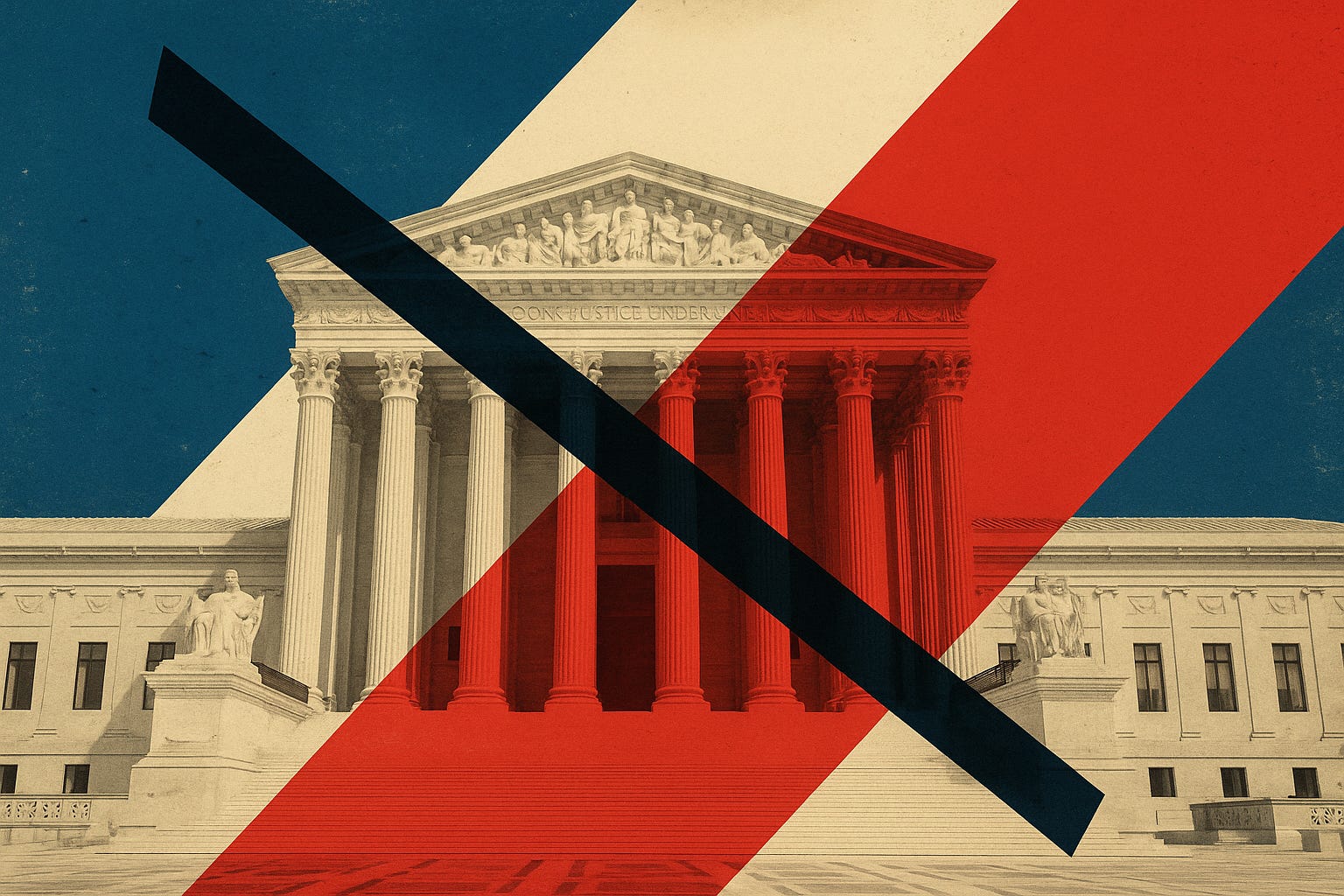
While public attention remains locked on headline-grabbing battles over the Epstein files, militarization in D.C., and immigration, a quieter, more foundational crisis is unfolding at the U.S. Supreme Court. In late June, the Court took the extraordinary step of ordering a reargument in Louisiana v. Callais, a major case about redistricting, race, and representation.
It didn’t rule. It didn’t clarify. It delayed.
Legal experts, civil rights advocates, and political observers are now warning: this procedural move could become one of the most consequential judicial moments of our era—not because of what it says, but because of what it sets up.
Stay Informed. Stay Loud.
Subscribe to The Coffman Chronicle for no-BS political analysis, action guides, and daily truth bombs you won’t get from corporate media.
What Callais Is Actually About
At its core, Louisiana v. Callais is a challenge to Louisiana’s congressional map, redrawn in early 2024 to add a second majority-Black district. This change was ordered by lower courts after findings that the original map diluted Black voting power in violation of Section 2 of the Voting Rights Act.
Opponents of the new map argue it relied too heavily on race, violating the Equal Protection Clause of the 14th Amendment. Supporters argue the use of race wasn’t just justified—it was required to comply with federal civil rights law.
Now, the question before the Supreme Court is this: Can states use race to remedy racial vote dilution without violating the Constitution?
Instead of answering, the Court called for a reargument next term, raising fears of a deeper, more transformative ruling ahead. The rearugment is scheduled to begin October 15, 2025, with a decision in spring 2026.
Why Reargument Is a Red Flag
It’s rare—very rare—for the Supreme Court to rehear a case. It usually signals one of three things:
The justices are deadlocked or divided.
They want to broaden the scope of a future ruling.
They’re laying groundwork for a major doctrinal shift.
All signs point to the third.
By punting Callais to the next term, the Court left in place the contested Louisiana map for now, but also opened the door to a potentially seismic decision in 2026 that could reshape how (or if) minority voting power is protected nationwide.
This Isn’t Just About Louisiana
There are currently 141 majority-minority congressional districts across 27 states. Many of them exist only because of Section 2 litigation following the 2020 Census. States like Alabama, Georgia, Florida, Texas, and South Carolina are already facing legal battles over similar maps.
A ruling in Callais that restricts or invalidates the use of race to draw remedial districts could make those maps vulnerable or impossible to defend in court.
In short, this case could be the end of Section 2 as we know it.
We’ve covered some of these battles before, especially in Texas, where lawmakers drew aggressive maps that weakened Latino and Black political influence. Those same legal pressures are now amplified by the precedent Callais could set.
Texas is the current battleground. See our reporting here:


The Quiet Path to Minority Rule
What makes Callais so dangerous is that it doesn’t scream. It whispers. It doesn’t ban rights outright. It simply erodes the political representation that makes all other rights possible.
Abortion bans? Who draws the districts determines who passes them.
Book bans? LGBTQ+ rollbacks? Same story.
Climate inaction? Labor suppression? Tax cuts for billionaires? All downstream from who gets to govern.
If the Court rules in Callais that race-conscious remedies are unconstitutional—even when required to fix proven racial vote dilution—it gives the green light for legislatures to permanently dilute Black and Brown representation under the guise of “colorblindness.”
This Isn’t Just Politics. It’s Design.
This is not a glitch. It’s the plan.
By eroding Section 2, blocking Section 5 enforcement (post-Shelby), and greenlighting gerrymanders, the conservative legal movement is quietly constructing a system where the majority doesn’t govern, and the governed don’t choose their leaders.
The reargument in Callais signals that the Roberts Court may now be ready to formalize this structure, locking it in for a generation.
What Comes Next
The Court will rehear Callais in Fall 2025, likely with a decision in early to mid-2026. Legal experts are watching closely, especially Chief Justice Roberts and Justices Barrett and Kavanaugh, who may hold the swing votes.
If the ruling goes against Louisiana, it will likely limit the scope of race-conscious districting nationwide, putting dozens of House seats at risk, and potentially ensuring long-term Republican control of Congress regardless of national vote margins.
Final Word: Democracy by Delay
The danger of Callais isn’t just in what it decides. It’s in what it allows in the meantime.
Maps stay in place. Voter power is diluted. Laws are passed. Lives are changed. All while the Court stays silent.
This is democracy not by debate, but by procedural erosion, one ruling at a time.
Call to Action: Make Callais Moot
The Supreme Court may soon decide that race-conscious redistricting violates the Constitution, even when it's used to remedy racial discrimination. But we don’t have to wait for a ruling to protect representation.
We can make cases like Callais irrelevant by fixing the system that leads to them.
Here’s how:
Use AI and algorithms to draw districts based on geography and population, not politics or race.
Establish independent redistricting commissions in every state, insulated from partisan manipulation.
Ban partisan gerrymandering outright, through state constitutional amendments and federal legislation.
Pass laws that strengthen protections for communities of interest, ensuring fair and equal representation for all.
The fight over Callais is a symptom. The disease is a redistricting system built to preserve power, not reflect the people.
We can cure it.
Stay Informed. Stay Loud.
Subscribe to The Coffman Chronicle for no-BS political analysis, action guides, and daily truth bombs you won’t get from corporate media.
Sources:
U.S. Supreme Court sets date for Louisiana redistricting case rehearing — Louisiana Illuminator
Supreme Court Orders Re-Argument of Louisiana Redistricting Case for Next Term — ACLU of Louisiana
SCOTUS Sets October Date to Rehear Case That Could Gut the VRA — Democracy Docket
The Supreme Court’s Most Worrisome Non-Decision — The New Republic
US Supreme Court sharply divided on Louisiana race-based redistricting case — The Guardian
The Supreme Court appears determined to blow up its one good Voting Rights Act decision — Vox
20 attorneys general, including Illinois, backing states' right to redraw legislative maps — Journal-Courier
Supreme Court to rehear case over Louisiana's second majority-Black district — The Washington Post
The big stakes in the Supreme Court's new, absurdly messy gerrymandering case — Vox

Unfortunately, the people have lost the Supreme Court to the government. That's a shame and I don't know if and when that can be changed.