


On December 22, 2025, The Guardian reported that more than one hundred U.S. organizations serving survivors of human trafficking had lost their federal funding. The Department of Justice, through its Office for Victims of Crime (OVC), had failed to release nearly $90 million in funds appropriated by Congress for fiscal year 2025 to support survivors. The lapse began in October. Three months later, no new grants had been posted, no updates had been offered, and no money had been distributed.
The reporting was stark. The consequences were immediate. Programs closed. Staff were laid off. Survivors were left without housing, legal aid, or trauma counseling. No one from the DOJ has explained why.
Want to Know Your Rights?
Download a free digital copy of the U.S. Constitution, the same document Trump is trying to bulldoze. Learn exactly what he’s breaking, and how to fight back.
80,000+ strong — and counting.
This holiday, become a paid subscriber for just $1 a week and help us keep the truth alive.
Join The Coffman Chronicle — $1/Week
The Vanishing Grants
The federal fiscal year begins on October 1. That’s when the previous year’s grant cycles expire, and new funding typically begins. When Congress fails to pass a full budget in time, which happens often, a short-term measure known as a continuing resolution allows federal agencies to keep operating at prior-year levels until a permanent budget is passed. This year, that continuing resolution was signed in early November.
Because of that timeline, it wasn’t surprising that anti-trafficking funds didn’t arrive in October. Nor was it shocking that nothing happened in the early days of November. What is startling — and still unexplained — is the silence that has followed.
The continuing resolution gave the Department of Justice full legal authority to disburse the funds Congress had already allocated. In normal grant cycles, especially for recurring programs like these, funding opportunities are drafted well in advance of the fiscal year and posted as soon as possible after a CR is signed. Nonprofits are used to planning under these conditions. The DOJ is used to operating under them.
Yet since the resolution passed, the OVC has not posted a single trafficking-specific grant opportunity.
The money didn’t just pause. It disappeared.
How Federal Grantmaking Usually Works
Federal grant cycles, especially in victim services, are built for predictability. The Office for Victims of Crime doesn’t wake up each October and start from scratch. Grant opportunities are drafted months in advance. Continuing resolutions, like the one passed this November, are common, and agencies know how to navigate them.
Even without a full budget, departments post notices of funding opportunity (NOFOs), open applications, and notify awardees that disbursement may be delayed, but action still moves forward.
That didn’t happen here. There have been no notices, timelines, or warnings. When the legal authority to act returned in November, DOJ still did nothing.
That’s not standard delay. That’s strategic silence.
This Goes Beyond Trafficking Grants
Trafficking-specific grants are not the only ones missing. As of this writing, the Office for Victims of Crime has not posted a single new funding opportunity for fiscal year 2025— not for trafficking, not for domestic violence shelters, not for sexual assault response teams, not for transitional housing, legal advocacy, or trauma services. Nothing.
This does not absolve the trafficking lapse. In fact, it amplifies it. When all victim services funding disappears from a federal agency designed to protect survivors, that’s not merely a missed deadline. It’s systemic failure or intentional inaction.
That silence isn’t isolated. It’s part of a larger pattern emerging from inside the Department of Justice.
The DOJ and the Files
The same agency that could not—or would not—disburse funding to organizations supporting survivors now asks the public to trust its handling of the most high-profile trafficking case in modern American memory.
For years, survivors, journalists, and the public have demanded transparency around the Jeffrey Epstein case. Who were his clients? Who funded his empire? Who enabled it? We already knew the names of many of the victims. Their stories were long ago pried loose, their credibility questioned, their pain litigated in both courts and headlines. However, the powerful people Epstein trafficked them to—his network of co-conspirators—remained largely unnamed. That concealment has always rested in part with the federal government. At the center of that concealment sits the Department of Justice.
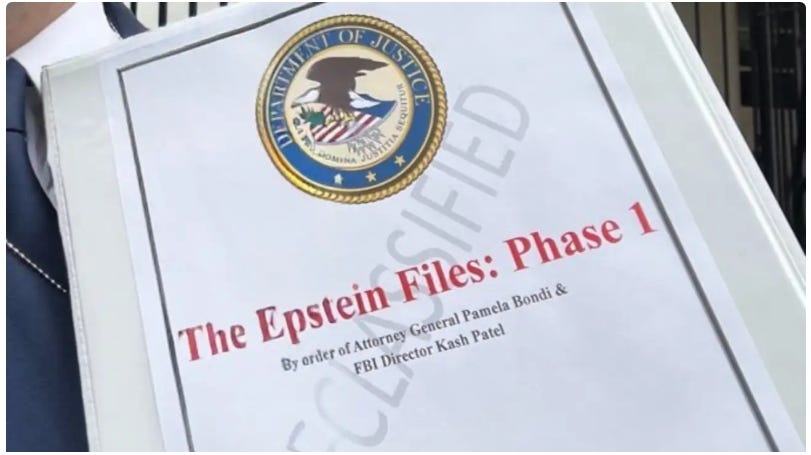
During his 2024 campaign, Donald Trump promised to release the Epstein files. It was part of a broader narrative his political faction embraced. Draining the swamp, exposing the elite, fighting child trafficking. Yet after retaking office, the urgency behind that promise faded. On February 27, 2025, then-newly appointed Attorney General Pam Bondi delivered what she framed as a revelatory release. The documents, delivered to select influencers in binders, contained no new information. Many were already public. The fanfare accompanying their publication sounded less like exposure and more like distraction. Predictably, the DOJ argued that court orders and sealed records prevented them from releasing more.
After over four months of public outcry, on July 7th, a DOJ memo was released stating that the files had been reviewed and no client list existed. They further signaled that there would be no further releases.
By July 16th, officials began spinning a new narrative. Trump posted on Truth Social, calling the Epstein file controversy a “totally fake and made-up story” created by Democrats. He labeled the ongoing calls for release a “scam” and “hoax” and criticized Republicans who pressed for transparency as having been “duped.” By late fall, committee members were releasing new files, many obtained from the Epstein estate.
By late November, under mounting bipartisan and public pressure, Trump signed legislation to release more files, citing transparency. Then came the December 19th DOJ release. The resulting release was, in sheer volume, significant. In substance, it was something else entirely.
Trump immediately complained that the disclosures risked damaging the reputations of people who had “innocently met” Epstein, dismissing the release in part as politically motivated and as a distraction from other issues. Yet the release was not what most critics or advocates had expected.
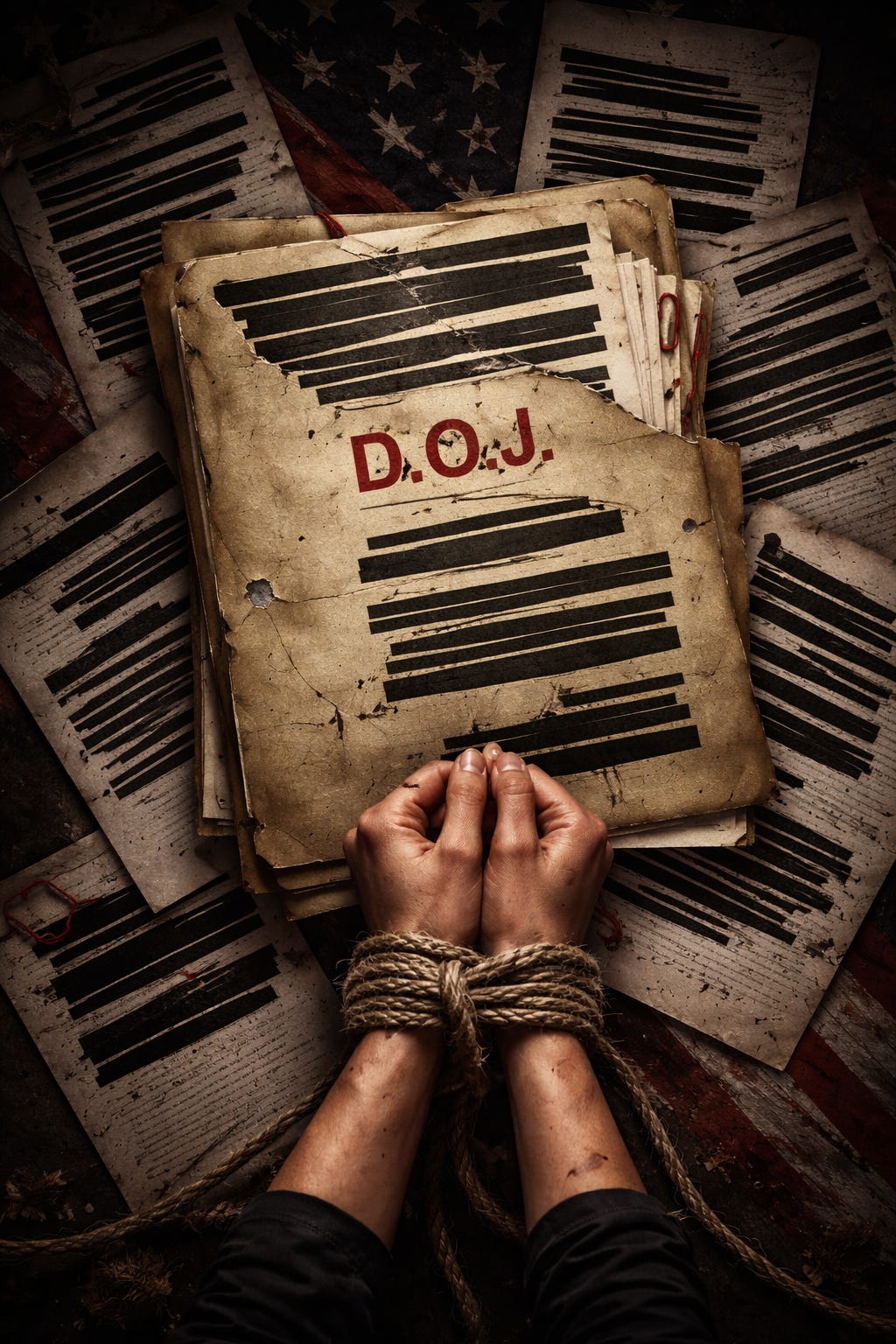
Pages upon pages were entirely blacked out. This was not a phrase here or a name there, but whole sheets of solid redaction. In some cases, dozens of pages in a row bore nothing but black ink. The argument advanced by DOJ spokespeople was that this redaction effort was meant to protect victims. Yet at least one known victim, whose identity had not previously been public, was named in the release. She had, until that moment, managed to avoid the scrutiny, harassment, and retraumatization that disclosure so often invites. Her anonymity was stripped, but no explanation was given.

Reuters
In contrast, there have been no verified reports of any Epstein client being inadvertently named in these documents. If one had been, it would have made international headlines. That silence is telling.
Redactions, Revealed
The Department of Justice is not new to high-profile disclosures. It is not new to public interest lawsuits, congressional mandates, or the complex task of balancing transparency with protection. There is a protocol for these situations. Files are prepared in two versions: a full unredacted version used internally and in court proceedings, and a redacted version meant for the public. That redacted version is built over time as new information emerges, ensuring that when a release becomes necessary, the DOJ is ready. These two versions are created and curated in parallel.
This is not a novel practice. It is a federal standard procedure.
The Epstein case has been under DOJ oversight for more than fifteen years. The allegations against Epstein became a national scandal in 2006. His sweetheart deal with U.S. attorneys was finalized in 2008. He was federally charged again in 2019, and he died in custody not long after. Ghislaine Maxwell was tried and convicted in 2021. The files were not created last week. They’ve existed for decades. The redactions should not have been rushed.
And yet, according to reporting, the DOJ approved hundreds of hours of employee overtime in the final weeks of 2025 to redact the Epstein documents. Some estimates place the total cost of that effort near $1 million. This might be easier to accept if the redactions were precise, surgical, and deliberate. Instead, they were anything but.
Entire pages were blacked out — not lines, not names, not phrases, but everything. This wasn’t redaction. It was erasure.
When every word on a page is redacted, what does that page contain? Names, yes. Identifying details, likely. Descriptions of abuse, perhaps. However, the scale of the blackout points to something else: the sheer volume of information the DOJ still refuses to make public. These weren’t missing lines. They were missing truths.
Then there’s what wasn’t redacted.
Despite months of effort, at least one victim was named in the released files. The same DOJ that blacked out entire pages somehow missed the one redaction that mattered most. The result was not just a breach of protocol. It was a breach of trust. The survivor’s name was exposed to the public, and the DOJ has offered no clear explanation for how it happened.
Meanwhile, no client has been reported as accidentally named. Not one.
That’s not balance. That’s not error. That’s something else entirely.
What This Tells Us
All of it — the silence, the stalled grants, the erasure by redaction, the exposed survivor, the untouched clients, the shifting narratives — points to one of two possibilities.
Either the Department of Justice is so disorganized, so broken, and so incapable of executing its most basic responsibilities that it cannot manage timely victim funding or surgical redaction in the most high-profile trafficking case of the century, or it’s something worse, and intentional.
It’s protection, not of survivors, but of the people who exploited them.
There is no plausible way to look at hundreds of pages of blackout ink, the selective exposure of a victim, and the flawless concealment of every name with power, and walk away believing this was simply incompetence. Mistakes don’t protect the same class of people every single time.
For months, Trump-aligned voices and Trump himself demanded the release of the Epstein files. They framed it as a righteous pursuit of truth, a final reckoning for the elite. Yet by July, as pressure mounted and the DOJ began signaling that no such reckoning would come, Trump pivoted. He dismissed the files as a Democratic hoax, a distraction, a scam. He had run on exposing the system, and now he defended it.
Even Pam Bondi, Trump’s attorney general and one of his most loyal political allies, could not deliver a credible release. Her spring “binder” revealed nothing new. Her December rollout, forced by Congress, delivered pages and pages of information — most of it unreadable. What could be read added little clarity. The most revealing parts were the ones that remained hidden, and what or who was left out.
We cannot know what those blacked-out pages contain. However, we do know who paid the price. Survivors lost funding, one lost her anonymity, and the public lost any remaining reason to believe the DOJ is acting in good faith.
The DOJ spent a million dollars in overtime for a last-minute, and frankly, poor and lackluster reduction, and more than $90 million in congressionally appropriated funding for the victims is missing.
If this is what transparency looks like, what does a cover-up look like?
If this is how the Department of Justice protects victims, maybe we should ask who they think the victims are.
If you’ve made it this far, we hope you have seen value in our work. Please consider becoming a paid subscriber to fuel our work.
Sources:
US justice department halts funding for human-trafficking survivors - The Guardian (Dec 22, 2025)
Attorney General Pamela Bondi releases first phase of declassified Epstein Files - U.S. Department of Justice (Feb 27, 2025)
Epstein client list doesn’t exist, DOJ says, walking back theory Bondi promoted - PBS NewsHour (July 7, 2025)
Trump calls Epstein client list a ‘Democrat hoax’ amid DOJ memo backlash – Politico (July 16, 2025)
Trump reverses stance on Epstein Files, urges House Republicans to release them - Reuters (Nov 17, 2025)
Justice department releases trove of Epstein files - The Washington Post (Dec 19, 2025)
Epstein survivors call out Trump’s Justice Department for ‘extreme redactions’ in latest file release - The Guardian (Dec 22, 2025)
Schumer to ask Senate to back legal action over partial Epstein files release - The Guardian (Dec 22, 2025)
Lawmakers threaten to take action against Bondi and the DOJ for only partially releasing Epstein files - TIME (Dec 22, 2025)
Two lawmakers seek to find Bondi in contempt over Epstein files — The Washington Post (Dec 21, 2025)
Top Trump administration official defends partial release of Epstein files as Democrats cry foul - AP News (Dec 21, 2025)
16 Epstein files, including photo of Donald Trump, disappear from DOJ website shortly after release - People.com (Dec 21, 2025)
Newly released Epstein files fall short of full transparency, Democrats say — The Washington Post (Aug 23, 2025)
Trump calls Epstein files a hoax - C-SPAN (Jul 28, 2025)
False or misleading statements by Donald Trump — Epstein hoax segment - Wikipedia (Jul 12 & 16, 2025)
Trump slams his own supporters as ‘weaklings’ for falling for what he now calls the Epstein ‘hoax’ - AP News (Jul 16, 2025)
Trump Disowns Supporters Who’ve ‘Bought into’ Epstein Files ‘Bulls---’ as MAGA Fractures - People.com (Jul 16, 2025)
🌟🇺🇸 “When Democracy Wasn’t a Police State”
We remember a time,
not too long ago,
when Main Street could blossom
and small shops could grow.
When government’s message
to neighbors was clear:
“Start up your dream—
we’ll help, not interfere.”
But then came the tariffs,
the taxes in disguise,
that jacked up the prices
on everyday buys.
They rattled our markets,
they rattled our town,
till factories shuttered
and wages fell down.
He picked fights with allies
who’d long stood beside,
where many have family
and kin they still pride.
He snarled at our partners,
he fractured our trust,
turning teamwork to tantrums
and friendship to dust.
Then visas got tangled
in red-tape and fear,
with five years of socials
to sift and to smear.
Tourism suffered,
farms lost their hand,
students and nurses
were stalled at the land.
From boardwalks and diners
to bright concert lights,
the jobs slowly vanished
like stars in bad nights.
It hammered our teachers,
our clinics, our art,
the everyday engines
that once drove our heart.
Yet one line of business
kept growing in size—
more ICE, more informers,
more watchful cold eyes.
Bounty-hunt biceps
and cages and gates,
more boots and more badges,
less hope in our states.
But we, older watchers,
recall something great—
when “democracy”
didn’t mean “police state.”
When laws still had limits,
and rights had a space,
and neighbors felt welcome
in our common place.
So we talk to our children,
we share what we know,
we lift up the voices
that truthfully show
How policies hurt us,
how cruelty spreads—
and how we can choose
better paths instead.
With comments and resharing,
with facts we relate,
we’ll guard the America
that once felt less late.
For a freer tomorrow
is still ours to make—
when we stand up together
for a non–police state. ✨🇺🇸
#ResharingBrigade #GrandparentsForTruth #IndyMedia #ProDemocracy #SupportUkraine #SupportPalestine #SupportAfghanVets
Shame, shame, shame!!!