


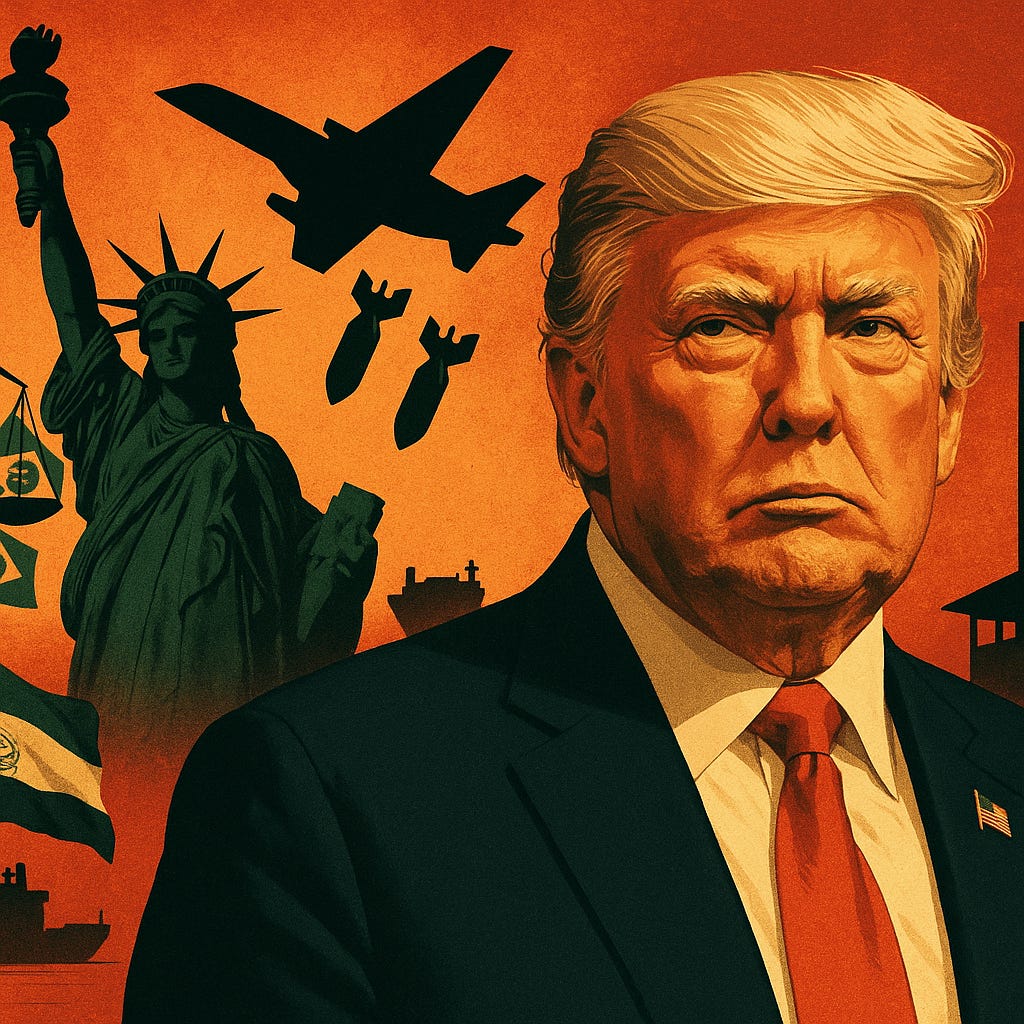
Donald Trump isn’t conducting foreign policy. He’s staging a global audition for authoritarianism.
With each new move in Latin America — billion-dollar backroom deals, bombing campaigns, mass deportations to secret prisons — he’s not just helping strongmen. He’s mirroring them, modeling them, learning from them, and desperately trying to be one of them.
He’s testing what he can get away with — not just abroad, but at home.
It’s a strategy with deep roots in American history. In the 1980s, Reagan’s White House used Latin America as a proving ground for Cold War imperialism: propping up dictators, crushing leftist movements, and funding covert wars, all in the name of “freedom.” The real goal, however, was always control.
This isn’t a fight against communism. It’s not even just about escaping accountability. It’s a war against democracy itself.
Because democracy doesn’t defend itself, and neither does your sanity. Subscribe here to keep your eyes open and your sarcasm sharp.
Brazil: Tariffs for Justice
In July, Trump imposed tariffs of up to 50% on a wide range of Brazilian imports, from beef to oil to coffee, under the guise of a “national emergency.”
The timing was no coincidence.
Former Brazilian president Jair Bolsonaro — Trump’s close ideological ally — was on trial, not for politics, but for corruption and inciting political violence. Trump didn’t see justice being done. He saw one of his own being “persecuted.”
So he struck back, not at Brazil’s government, but at its people.
The tariffs are devastating for Brazilian exporters, but they also hit American consumers — hard. Tariffs don’t punish foreign governments. They raise prices at home, hitting small businesses and working families first. The cost of groceries, fuel, and construction supplies just went up, all because Trump is using trade as political retribution.
In the 1980s, the U.S. turned a blind eye to Brazil’s military dictatorship in exchange for loyalty. Today, Trump is doing the same, only now, he’s using economic warfare to defend authoritarian friends from democratic consequences.
Argentina: Bailouts for a Buddy
When Argentina’s far-right libertarian president Javier Milei teetered on the edge of political collapse, Trump didn’t wait for diplomacy. He delivered $40 billion in U.S. aid without Congressional approval.
Weeks later, Milei won re-election.
There was no oversight or vote. Just a backroom deal that used American taxpayer money to prop up an authoritarian ally during a democratic election.
It’s a page ripped straight from the Cold War playbook.
Reagan funneled money and arms to right-wing insurgents and puppet governments across Latin America, using “foreign aid” as cover for regime engineering. Trump’s cash drop to Argentina wasn’t aid. It was influence and a political investment.
And it paid off.
El Salvador: Deportation as Control
Earlier this year, Trump’s administration began deporting migrants — many from Venezuela, some legally in the U.S. — to CECOT, El Salvador’s massive prison complex run by President Nayib Bukele.
This wasn’t standard deportation. These were extrajudicial transfers to a foreign super-prison where detainees are held without trial, legal access, or communication.
Trump struck a deal with Bukele — another authoritarian darling — to warehouse deportees in exchange for cash. Millions of dollars exchanged hands with no transparency or oversight.
It’s hard to overstate the horror: the U.S. government is literally paying to outsource its detention system, sending human beings to a facility known for torture, isolation, and international condemnation.
In the 1980s, El Salvador was one of America’s deadliest playgrounds, where U.S.-trained death squads murdered thousands under the cover of “anti-communism.” Today, the method has changed, but the message hasn’t.
El Salvador is still being used as a proxy for U.S. violence, this time against migrants.
Venezuela: Regime Change, Rebooted
Trump has already authorized the bombing of Venezuelan fishing vessels, citing anti-narcotics operations. However, the real goal isn’t interdiction, but intimidation.
He’s made no secret of it: Trump wants regime change in Caracas. He’s said as much publicly, threatened it, and framed it as righteous, just as Reagan did when he backed insurgents to overthrow the Sandinistas in Nicaragua.
The script is recycled, but the stakes are higher. Military escalation with Venezuela won’t just destabilize the region. It could drag the U.S. into a conflict it’s neither prepared for nor justified in starting.
But for Trump, it’s not about readiness. It’s about power.
And war — or the threat of it — is a powerful political tool in the authoritarian playbook.
The Constitutional Crisis Beneath It All
Beyond the global implications, Trump’s actions are triggering a quiet but profound crisis at home, one that cuts to the very heart of American democracy.
Under the Constitution, only Congress can declare war. Only Congress can approve foreign spending. Only Congress can regulate trade and tariffs.
Yet Trump:
Bombed Venezuelan targets with no war powers resolution.
Moved $40 billion in U.S. funds to Argentina without legislative approval.
Signed secret pacts with Bukele to deport migrants to foreign prisons.
Imposed sweeping tariffs on Brazil (and other nations) without Congressional input.
This is not how a democracy functions. This is not how power is meant to be used. It is the presidency behaving more like an imperial throne, a consolidation of unchecked authority that threatens both foreign nations and our own institutions.
Trump isn’t just testing authoritarianism. He’s practicing it.
And Congress? They’ve made noises, but so far, they have failed to act meaningfully.
Authoritarianism Without Borders
Trump doesn’t just admire strongmen abroad. He learns from them. He praises Putin. He echoes Orbán. He calls Xi “brilliant.” Now he emulates Bolsonaro, Milei, and Bukele, not just in rhetoric, but in practice.
He sees loyalty as law. Secrecy as strategy. Violence as virtue.
And he’s not exporting democracy. He’s importing despotism.
We Know How This Ends
We’ve been here before. In the 80s, the U.S. propped up fascists and funded killers in the name of stability. We called it freedom. It brought only death.
Now, it’s happening again, not as memory, but as mandate.
Trump is using the same tools:
Secretive funding
Executive orders
Manufactured emergencies
Military muscle
Mass incarceration
Foreign prisons
Election interference
But this time, he’s not just aiming it outward. He’s bringing it home.
His Golden Age? Or Ours?
For Donald Trump, the 1980s were the golden years, a time of power without consequence. However, for the rest of us, they were a warning.
We saw what happened when America used its might to crush dissent, prop up tyrants, and export cruelty. We lived through the refugee crises, the dictators, and the blowback.
We learned. Trump didn’t. And if we don’t stop him, he’ll make sure none of us forget.
Don’t let the bastards sneak anything past you. Subscribe and get your daily dose of rage and receipts delivered fresh, before the spin doctors can scrub it.
Sources:
“US Senate passes bill to terminate Trump tariffs against Brazil” — Reuters, Oct 28, 2025.
“Senate approves bipartisan resolution to end tariffs on Brazil” — Washington Post, Oct 28, 2025.
“US Senate passes bill with Republican support to rescind Trump’s tariffs on Brazil” — The Guardian, Oct 29, 2025.
“Trump says Milei had ‘a lot of help’ from US for Argentina election win” — Reuters, Oct 27, 2025.
“Bessent says US considers doubling aid to Argentina by tapping outside funding” — Politico, Oct 15, 2025.
“After U.S. bailout, Argentine voters give Milei a friendlier Congress” — Washington Post, Oct 26, 2025.
“US deports more alleged gang members to El Salvador amid court challenge” — Reuters, Mar 31, 2025.
“Trump deported 238 Venezuelans to El Salvador. Dozens have active asylum cases” — Reuters, Apr 1, 2025.
“Migrants who were sent to CECOT are the responsibility of US, El Salvador tells UN” — AP News, Jul 7, 2025.
“US Senate rejects bid for transparency on El Salvador deportations” — Reuters, May 15, 2025.

It's horror on repeat