


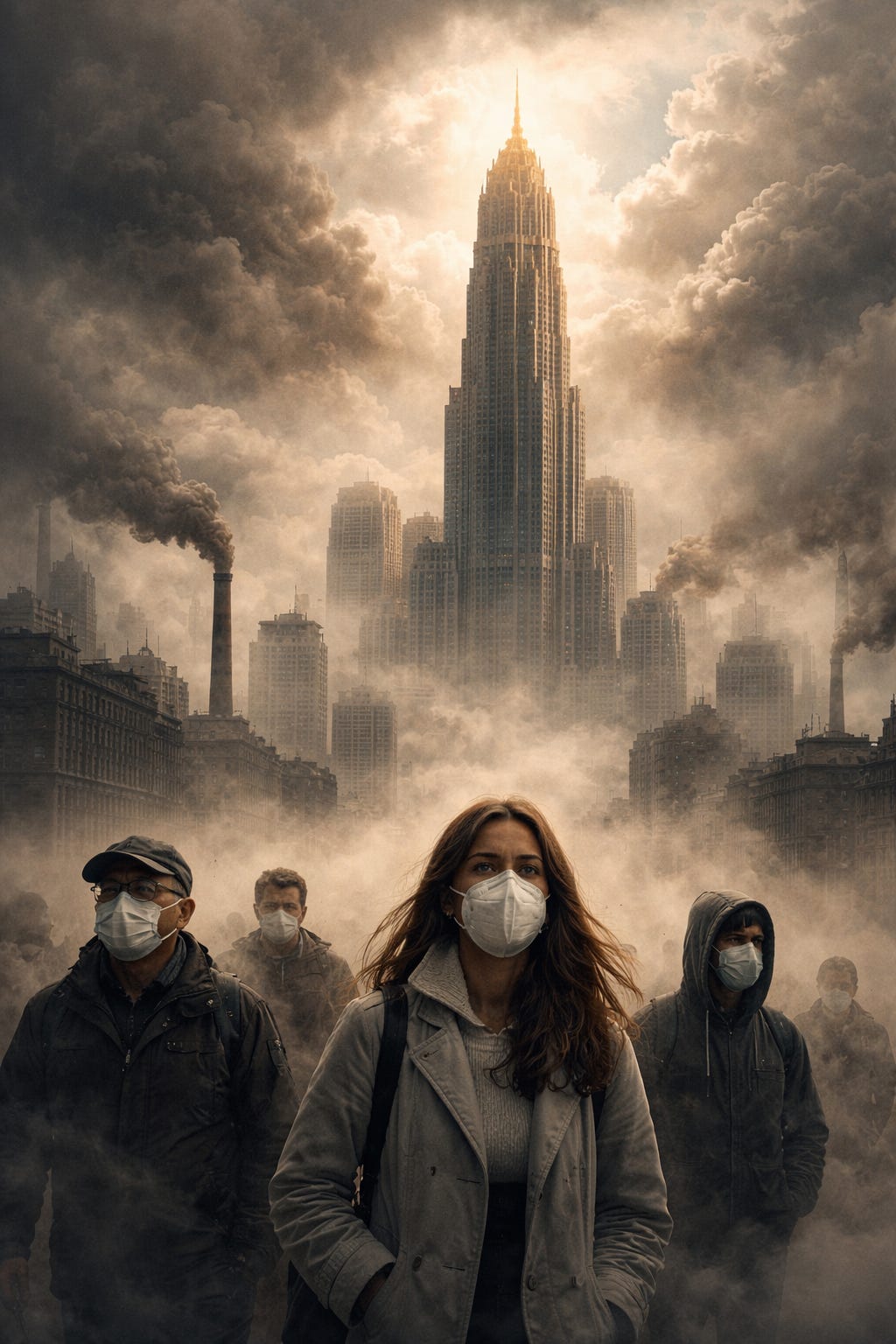
On January 11, 2026, the Environmental Protection Agency quietly announced a new framework for crafting future air pollution regulations. Going forward, the EPA will no longer consider the number of lives saved or the health care costs avoided when setting limits on key air pollutants, such as fine particulate matter (PM2.5) and ground-level ozone. Instead, the agency will prioritize the financial cost to businesses and industry.
Yes, the federal agency responsible for protecting public health and the environment has decided that quantifying human suffering is too messy, and that factoring in how many people will die early or get sick from pollution just isn’t worth the effort. This isn’t a glitch in the system. It’s the system doing exactly what it’s been restructured to do.
This decision affects every environmental regulation that governs the air we breathe. While the EPA insists it will still “consider” health effects in a general sense, the change means that future rules will no longer calculate the monetary value of lives saved from asthma attacks, strokes, heart failure, or cancer.
Guess those ivory towers stretch above the smog, or at least come with premium air filters.
Want to Know Your Rights?
Download a free digital copy of the U.S. Constitution, the same document Trump is trying to bulldoze. Learn exactly what he’s breaking, and how to fight back.
100,000+ strong — and counting.
This winter of our discontent, become a paid subscriber for just $1 a week and help us keep the truth alive.
Join The Coffman Chronicle — $1/Week
“The EPA exists to protect people and the environment, not to promote corporate profits. Any cost-benefit analysis that excludes human life is dishonest and contrary to decades of precedent. Clean air is not negotiable.”
House Representative Mike Thompson
Who gets hurt when lives stop being counted
The people most at risk from this change are the same communities that have always lived closest to environmental harm: the vulnerable and marginalized.
This includes children with developing lungs, seniors with fragile hearts, and people living with asthma, COPD, autoimmune disease, or cancer. It impacts pregnant people, low-income families whose homes sit next to highways or industrial corridors, and, naturally, Black, Brown, and Indigenous neighborhoods already drowning in cumulative exposure to toxic air.
They’re not theoretical. They’re measurable.
Black Americans breathe in about 56% more air pollution than they cause. For Hispanic Americans, it is roughly 63% more. By contrast, on average, White Americans breathe in 17% less pollution than they produce. However, this number does not illustrate the actual risks in mixed and poor white neighborhoods. The government has known this for years. It just doesn’t seem interested in doing anything about it.
In places like Louisiana’s Cancer Alley, where petrochemical facilities line an 85-mile stretch along the Mississippi River, predominantly Black communities are already facing cancer risks up to 50 times the national average. Residents there aren’t just statistically at risk. They’re burying loved ones from rare diseases no one in power seems willing to investigate.
Now, those same communities are being told that their suffering won’t be part of the equation when pollution rules are written or revised. Their lives don’t make the balance sheet, but the companies destroying their lungs? Their bottom line absolutely does, and the permission to expand and pollute more is being set.
The safety net is vanishing at the same time
As the government stops counting pollution deaths, it’s also making it harder for people to get the health care they need when pollution inevitably makes them sick.
At the end of 2025, the enhanced premium subsidies under the Affordable Care Act expired. Since January 1, 2026, insurance premiums on the ACA marketplace have surged, doubling for many, tripling for some. For millions of Americans, basic health coverage now costs upwards of 15% of their annual income.
And if you’re thinking about skipping insurance and just paying for what you need, consider this: a rescue inhaler without insurance can cost between $45 and $100. A maintenance inhaler can run over $300. That’s per month. Hope your lungs are budget-friendly.
It doesn’t stop there. Rural hospitals are disappearing. As of early 2026, 432 rural hospitals across the country are considered at risk of closure. Many have already ended inpatient services entirely, leaving entire counties without local access to emergency care. Even if you have insurance, there may be no nearby provider to use it with.
We are being poisoned faster and treated less.
It’s not just the air. The water is tainted, too.
The EPA is also backing away from protections against water pollution and toxic land contamination. In 2025, the agency delayed enforceable limits on PFAS—also known as “forever chemicals”—in drinking water. These industrial toxins are linked to cancer, fertility issues, immune system damage, and developmental disorders. The decision to delay limits until 2031 affects over 158 million Americans already exposed.
See our previous reporting on PFAS here:
Note: Articles roll into the archive over time. Consider becoming a paid subscriber for full access to our 2000+ article archive, exclusive content, and occasional early access.

At the same time, the EPA is rewriting how the Clean Water Act is enforced. By narrowing the definition of what counts as protected water, the agency is stripping federal oversight from wetlands, streams, and drinking water sources across the country. Fewer protections mean more industrial runoff, more contamination, and fewer tools for communities to push back.
This isn’t theoretical. In fracking-heavy regions, including large swaths of Appalachia and the Southwest, communities have already watched their water turn undrinkable. They use bottled water to drink, to cook, and to boil pasta. Their showers have filters to catch whatever’s coming out of the tap, and still they’ve watched rare cancers appear with eerie regularity.
The EPA knows this, and it’s now telling those communities your exposure doesn’t count.
This is what deregulation looks like
The EPA’s decision to stop counting health benefits and lives saved doesn’t come out of nowhere. It’s the latest in a long line of environmental deregulations that accelerated through 2025.
See part one of our deregulation series here:
Note: Articles roll into our archive over time. Become a paid subscriber for full access to the complete archive.
Deregulation Nation: Trump’s War on Public Protections
In Donald Trump’s second term, the government isn’t just turning a blind eye to corporate greed—it’s actively empowering it. Through the Department of Government Efficiency (DOGE), headed by Elon Musk, federal protections designed to keep Americans safe, healthy, and financially secure are being torn apart with brutal efficiency. This isn’t a case of me…

Last year alone, the agency weakened mercury emission rules, delayed the replacement of lead pipes, rolled back PFAS standards, proposed bringing asbestos back into limited use, and softened the national standard for fine particulate matter. It also stripped state and tribal governments of the authority to challenge water-contaminating projects. Further, it reshaped EPA science advisory boards to favor industry perspectives.
See our previous reporting on asbestos and lead here:
Note: Articles roll into our archive over time. Become a paid subscriber for full access to our 2000+ article archive.


These aren’t isolated decisions. They’re a coordinated retreat from public health, one that predictably benefits polluters, sacrifices communities, and removes any obligation for the government to measure the damage.
This is not a change in policy priorities. It’s a change in what the government believes is worth protecting.
If your life doesn’t make the spreadsheet, it doesn’t exist
This new EPA framework won’t appear as a plume of smoke or a toxic spill. It’ll show up in the pediatric ward, in the spike in asthma ER visits, in rising cancer rates near chemical plants, and in the town where you boil bottled water for pasta because the tap smells like sulfur. It will show up slowly, quietly, and unevenly until the people most affected are too sick, too broke, or too exhausted to fight back.
When they do ask why no one stopped it, the answer will be simple: because the agency responsible for protecting them decided their lives weren’t worth counting.
They aren’t even trying to hide it anymore. Now, it is policy.
Fuel the fight. The Coffman Chronicle is a reader-supported publication.
We tell the stories corporate media ignores, dig into the history, and expose the patterns behind the punditry.
Sources:
EPA says it will stop calculating health care savings from key air pollution rules — Associated Press, January 13, 2026
EPA Will No Longer Consider Lives Saved in Pollution Rules, Only Cost to Business — Truthout, January 12, 2026
EPA moves to value human lives at zero in air pollution rules while prioritizing industry costs — Nation of Change, January 13, 2026
EPA says it will no longer consider health costs in pollution regulations — Washington Post, January 12, 2026
Study Finds Exposure to Air Pollution Higher for People of Color — U.S. EPA Science Matters, September 20, 2021
Communities of color disproportionately exposed to PFAS pollution in drinking water — Harvard T.H. Chan School of Public Health, May 15, 2023
Nearly One‑Third of Americans Face Unregulated Water Contaminants; Hispanic and Black Communities Hit Hardest — American Journal of Managed Care, January 15, 2025
Over 97 million U.S. residents exposed to unregulated contaminants in their drinking water — Silent Spring Institute, January 15, 2025
New EPA data shows 158 million Americans exposed to ’forever chemicals’ in U.S. drinking water — Environmental Working Group, March 27, 2025
Environmental racism in the United States — Wikipedia
Toxic waste in the United States — Wikipedia
EPA EJScreen tool and its removal under the 2025 rollbacks — Wikipedia
Trump EPA moves to weaken drinking water limits on toxic ’forever chemicals’ — Politico, May 14, 2025
EPA will weaken rule curbing ’forever chemicals’ in drinking water — Washington Post, May 13, 2025
Landmark U.S. study reveals sewage sludge and wastewater plants tied to PFAS pollution — The Guardian, July 4, 2025
Statement on the EPA excluding Human Life from Cost‑Benefit Analysis for Rulemaking — U.S. House press release, January 12, 2026
Pollution can be thought of as a form of chemical warfare against big (primarily blue) cities.
Please help save our precious dwindling wildlife and habitats and Mother Earth Nature and US citizens! Keep counting human costs of pollution by industry and any other sources! Do your job, protect us!