


On Monday, October 20, 2025, heavy machinery began tearing off a portion of the east façade of the East Wing of the White House. A backhoe ripped windows out of their frames, the entrance canopy was disassembled, and dust drifted across the grounds of the Treasury Department. The project is a proposed 90,000-square-foot ballroom, a lavish new event space on the White House complex. The officially announced cost is $250 million, funded by corporate donors and the president himself.
This isn’t just another renovation. It is, in fact, a physical re‑imagining of the People’s House — shattering a façade, yes, but perhaps more importantly, stripping away the pretense of democratic service.

Because democracy doesn’t defend itself, and neither does your sanity. Subscribe here to keep your eyes open and your sarcasm sharp.
What’s Being Built And Why It Matters
According to the formal announcement on July 31, 2025, the ballroom will reside in the East Wing and “modernize” the space. The capacity is advertised as up to 999 people (an increase from initial estimates of 650), and the square footage is nearly double the size of the main Executive Residence (approximately 55,000 sq ft). The justification? The current largest interior venue in the White House, the East Room, holds about 200 people, so the ballroom is framed as filling an alleged “functional gap”.
Notably, no former president has found this to be too large a burden to overcome. Realistically, the facility will be used between 2 and 5 times per year. It may be used for an occasional state dinner, a holiday party, or perhaps a cultural event. However, historically, these have been rare.
Funded privately, the ballroom is pitched as being built “with zero cost to the American taxpayer” and reliant on “many generous Patriots, Great American Companies, and … yours truly.”
However, here’s the key detail: when completed, this space will become the largest single room in the White House complex, and it will be dedicated not to governance, public access, or crisis response, but to spectacle. That shift is profound.
As the facade of the East Wing crumbles, so too does the mask of this administration's care for the people.
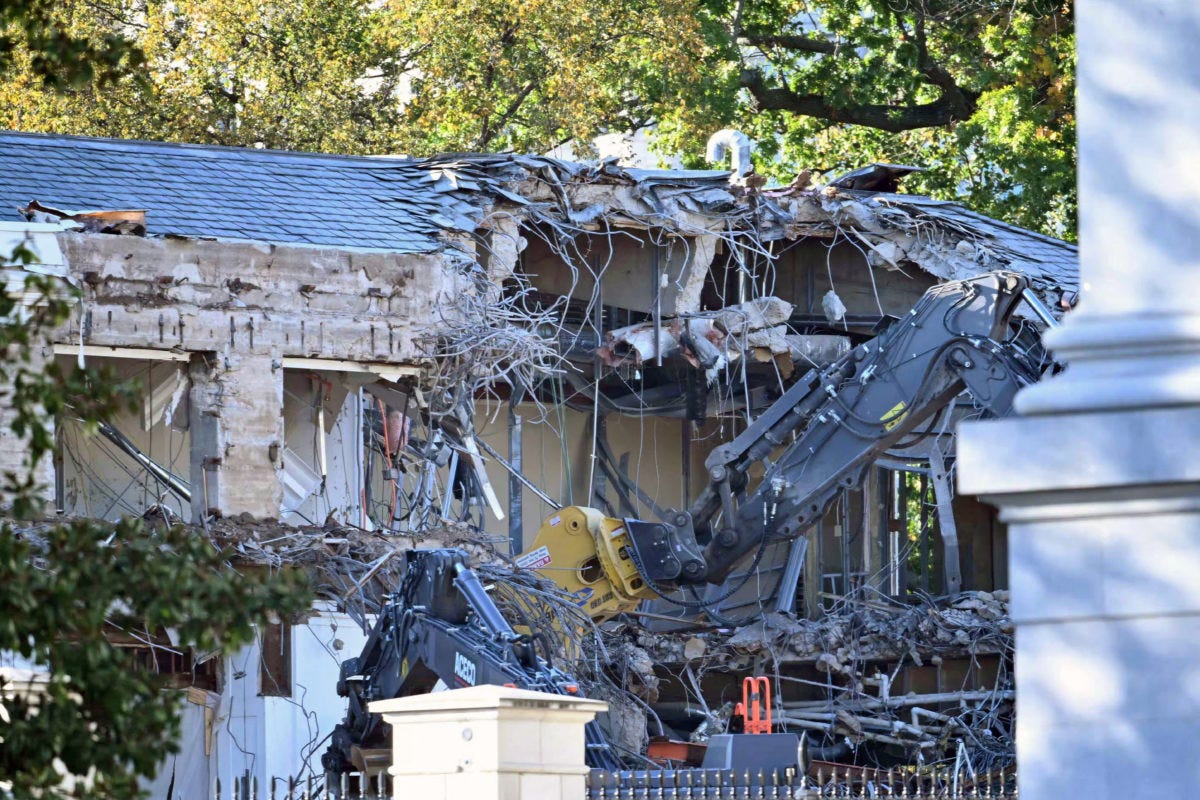
Photo by Pedro UGARTE / AFP via Getty Images
What It Replaces: History, Function, Access, and the Truth
The East Wing stands at the threshold of the People’s House. Built in 1902 and expanded in 1942 during World War II, it houses the First Lady’s offices, serves as the main entrance for public tours, and connects visitors to the historic Executive Residence.
When President Trump first announced the ballroom project, he downplayed concerns, insisting that the new construction would not interfere with the East Wing itself. “It won’t interfere with the current building,” he said. “It won’t be. It’ll be near it, but not touching it — and pays total respect to the existing building.”
He said that instead, it would be a modest modernization, respectful of the building’s integrity. That claim no longer holds.
What’s happening now isn’t an update, but a replacement.
Demolition crews have begun tearing down the East Wing’s façade — not just windows and awnings, but structural walls. According to the plans now taking shape, the new ballroom will sit directly on the East Wing’s footprint, effectively erasing the existing structure in favor of something far larger, flashier, and fundamentally different.
On Truth Social, Trump posted: “Completely separate from the White House itself, the East Wing is being fully modernized as part of this process, and will be more beautiful than ever when it is complete.”
This isn’t a renovation. It’s a redesign of the White House’s function and message.
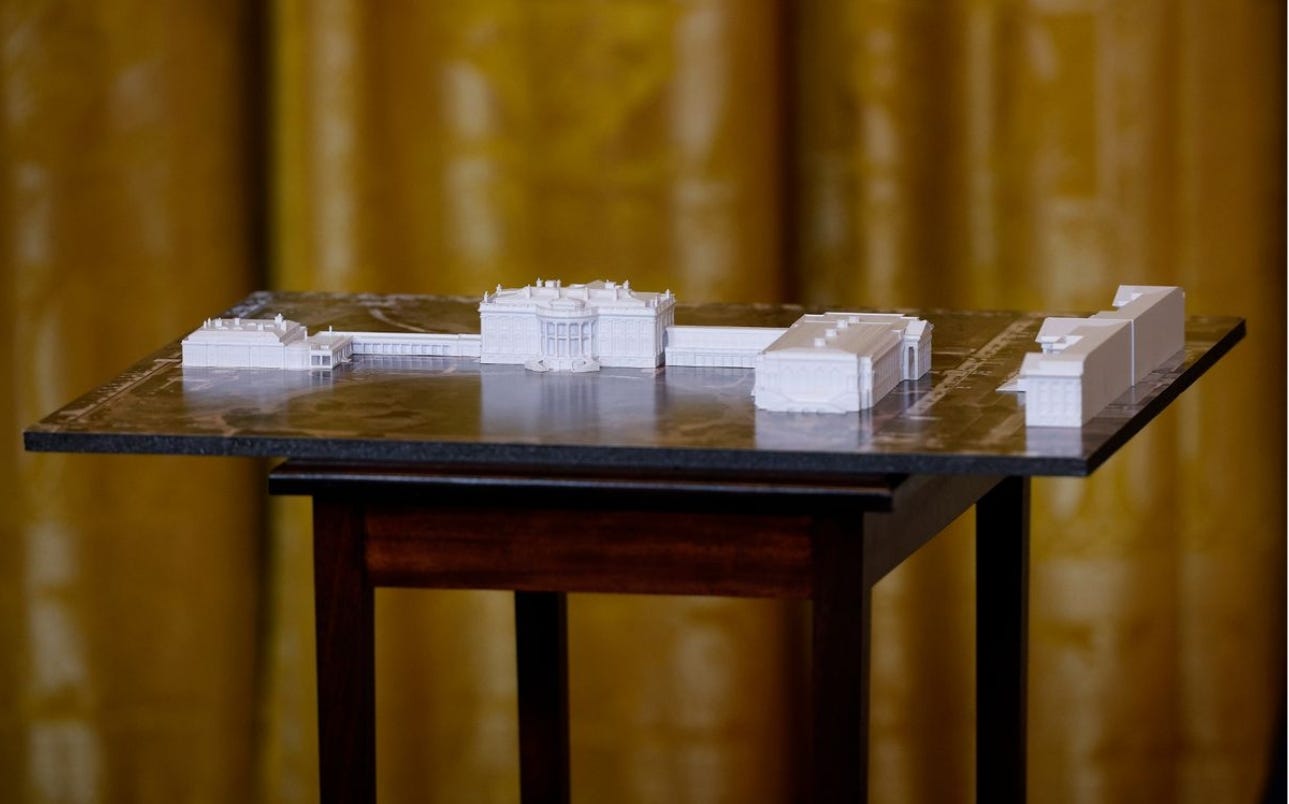
A model of the White House and proposed ballroom displayed(Getty Images)
It has real, operational consequences, and it’s affecting some of the most public-facing and logistically essential parts of the White House.
Among the spaces being torn down are the office of First Lady Melania Trump and several offices used by her staff. Also impacted is the White House Visitors Office, which manages public tours and events, as well as workspaces for the Office of Legislative Affairs. The White House Military Office, which oversees presidential transportation, medical response, and hospitality, is also losing offices in the demolition. Most have been moved to the Eisenhower Executive Office Building.
Gone, too, are the calligrapher’s studio, a central conference room, and a well-known formal lobby that for years served as the ceremonial entrance for guests arriving at state dinners.
Until now, the East Wing offered visitors a quiet welcome. Assuming the East Wing remains the public entrance, once the ballroom is complete, that entrance will open into an exclusive chamber, the largest room in the White House complex, designed for high-capacity, high-society events.
The public may still pass through, yes, but they’ll be passing through a room that no longer represents them, a space built not for the people, but for the powerful.
Rule‑Breaking, Environmental Hazards & Oversight Workarounds
This renovation is not simply about changing the décor. It triggers a cascade of red flags.
First, oversight. The National Capital Planning Commission (NCPC) usually reviews major federal building construction. Yet, its chair, Will Scharf (who also serves as White House staff secretary), publicly stated in September 2025 that demolition and site preparation do not require the commission’s approval. Instead, he says only the “vertical build” phase does.
The ballroom project moved ahead with visible demolition before a full documented review of anything was completed or made public.
Notably, the environmental and health hazards are of concern. The East Wing’s core structure dates to 1902 and 1942, periods when asbestos, lead‑based paint, and other hazardous building materials were widely used. The White House has already acknowledged the risks of asbestos in the West Wing, yet we have no clear public record of a comprehensive asbestos survey or abatement specifically for the East Wing. It’s reckless to tear into a 1940s structure without proving that the hazard has been addressed or that specialists are available for appropriate abatement. Millions of Americans live under the assumption that the People’s House meets high safety standards. Evidence suggests that this may not be true.
Despite this, media coverage of the demolition has conspicuously omitted detailed discussion of hazard mitigation, air‑quality safeguards, or worker protections. A historian described removing the façade as “almost like slashing a Rembrandt,” but what workers and potentially staff will be breathing in may be far more deadly than old paint.
In a building where tours, public access, and staff offices coexist, the failure to prominently address these environmental risks is alarming, especially when federal employees, contractors, and visitors are exposed.
From People’s House to Palace
Once, the first impression of the People’s House was dignity, transparency, and service. Now the lobby will open into something more akin to a banquet hall of a monarch.
It isn’t the Middle Ages when a king would host nightly feasts in a great hall. And yet a president is carving out a 90,000‑square‑foot ballroom in the heart of the republic, funded by corporations, housed in the People’s House, and framing power as pageantry. The scale is staggering. The aim: spectacle over substance. The elite are building their own ivory tower.
The public may pass through the entrance, but the chamber they enter will not be for them. Access will be limited, invitation‑only, for corporate donors, state dignitaries, and high‑profile fundraisers. The average citizen will never set foot in this hall, will never be recognized there. And that is the point.
Luxury Amid Crisis: The Context Matters
In 2025 America, this kind of investment carries an especially heavy weight. The federal government is in a partial shutdown; hundreds of thousands of federal employees are furloughed or uncertain about their status, while social service programs such as SNAP and Medicaid face cuts. Additionally, tariffs are driving up everyday costs. At a time when economic disparity may be at its most grotesque, a gilded ballroom rises in the People’s House.
Compare the public’s need for affordable housing, healthcare access, and job security to the Wall Street‑style donor dinner held just prior to demolition, where corporate executives and major tech firms committed money to the project. The contrast is stark, the signal clear: priorities are not about the many, but the few.
A New Temple to Power
When the dust settles and chandeliers are lit, the People’s House will quietly have become the palace of the elite. The public entrance will still function, the tours may still run, but the heart of the building will beat for donors and spectacle, not for service.
The façade wasn’t just a physical structure. It was a symbol, and as it fell, the promise behind it fell too, the promise that democracy governs from service, not swagger.
What we are witnessing is more than a renovation. It is a vision, one where the leader is a monarch, the building is a temple, access is limited, and the people are mere guests in their own house. If that isn’t what is being pursued, show another explanation, because all the signs point to one: the People’s House is changing its owner.
This ballroom exemplifies everything Trump policies are about: serving the elite, ignoring health and safety, defying the rules and guidelines, recklessly destroying history to create his own myth, placing ego over service, and elevating power over the people.
Don’t let the bastards sneak anything past you. Subscribe and get your daily dose of rage and receipts delivered fresh, before the spin doctors can scrub it.
Sources:
“The White House Announces White House Ballroom Construction to Begin.” WhiteHouse.gov, July 31, 2025.
“Trump plans $200M ballroom he’s long sought in East Wing expansion.” The Washington Post, July 31, 2025.
“Who’s paying for the White House ballroom and what’s in it for them.” CBS News, September 19, 2025.
“Construction of Trump’s $200 million White House ballroom to begin in September.” Reuters, July 31, 2025.
“White House begins demolishing East Wing facade to build Trump’s ballroom.”
The Washington Post, October 20, 2025.“PHOTOS: White House starts East Wing demolition to build Trump’s ballroom.”
PBS Newshour, October 21, 2025.“Here are the White House East Wing offices Trump is demolishing, according to sources.” CBS News, October 21, 2025.
“Demolition for new White House ballroom doesn’t need approval, Trump‑appointed commission head says.” Associated Press, September 4, 2025.
“Map, Images Show How Trump’s Golden Ballroom Will Change White House.” Newsweek, August 1, 2025.

He spits on the people.
And he isn't a king; he is a Queen. Consider what his love of ballrooms, gold facades and fluttering finishes suggests:
https://davidgottfried.substack.com/p/glowering-glittering-queen-trump
When's renovations going to be completed? Will he still be in office? I hope the upcoming administration likes the Epstein/Obama ballroom.