


Yesterday, the Food and Drug Administration (FDA) announced a decision that most Americans likely missed. After more than a year of preparation, the agency officially withdrew a proposed rule that would have required all talc‑based personal care products to be tested for asbestos before being sold. On November 25, 2025, multiple news outlets reported that the FDA had decided to withdraw the asbestos testing rule. The decision became official three days later, when it was published in the Federal Register on November 28.
Their stated reasons were “scientific, technical, and legal complexities” raised during the comment period. In essence, cost and pushback prevailed over consumer safety.
Products we smear on our bodies may again go untested for one of the deadliest substances known to humanity.
If you use cosmetics or personal care products, this should terrify you.
Want to Know Your Rights?
Download a free digital copy of the U.S. Constitution—the same document Trump is trying to bulldoze. Learn exactly what he’s breaking… and how to fight back.
75,000+ strong — and counting.
This Early Black Friday, become a paid subscriber for just $1 a week and help us keep the truth alive.
Join The Coffman Chronicle — $1/Week Early Access
Talc and Asbestos: A Geological Time Bomb
The risk is not theoretical. It is geological.
Talc — the soft mineral used in powders and many cosmetics — is often mined from deposits that sit next to or intermingle with asbestos-bearing rock. Because of this geological proximity, asbestos fibers can contaminate talc during mining and processing, often invisibly and sometimes irreversibly. Once mined, talc is ground, pressed, packaged, and sold as various products.
What Products are Talc Found in?
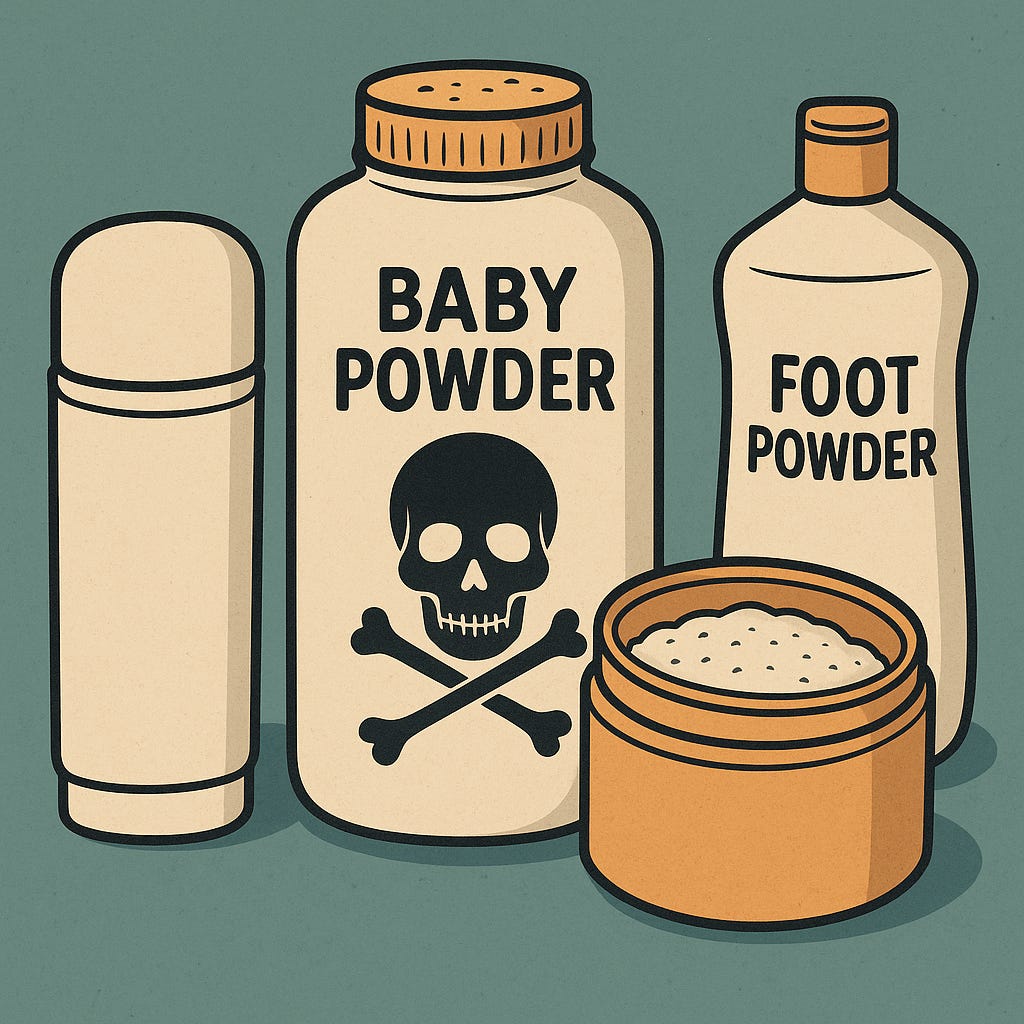
Talc isn’t just in blush and baby powder. It’s in personal care products used by millions. You don’t have to wear makeup to be exposed. You just have to use a product designed to keep you “fresh,” “dry,” or “clean.”
Talc Can Be Found In:
Deodorants (stick, powder, and spray)
Body powders (often labeled “freshening” or “cooling” powders)
Foot powders
Medicated powders (e.g., Gold Bond)
Aftershave and men’s grooming products
Dry shampoos
Lotions and creams — especially those with a “matte,” “non-greasy,” or “smooth” finish
Baby powder
First-aid powders and anti-chafing products (common in sports, military, and outdoor settings)
And yes, blushes, eye shadows, and setting powders, as well as other makeup products
This issue touches everyone. The risk is not about makeup. It’s about daily exposure to products marketed as hygiene, grooming, or wellness.
Why Asbestos Contamination Matters
Asbestos is not a speculative risk. It is a known human carcinogen. Its fibers, which are microscopic, friable, and persistent, lodge in lungs, pleura, or other tissues and can lead decades later to mesothelioma, lung cancer, ovarian or peritoneal cancer, or other deadly diseases.
We’ve known about the risks of asbestos since at least the 1970s. If you grew up in the 80s and 90s, you probably remember late-night commercials for mesothelioma class-action lawsuits.
The inhalation risk is well known and often associated with construction, but the FDA itself recognized the risk of non-industrial exposure via products. Beginning in 2019, the agency sampled talc-based cosmetics. Based on those findings, the FDA proposed standardized testing methods for talc products to identify asbestos contamination before products reach consumers.
The danger wasn’t hypothetical. It was real and already documented.
Regulation Came Late and Still Isn’t Here
To understand how this happened, we need to understand the lack of cosmetic oversight in the United States.
The foundational law for regulating food, drugs, and cosmetics in America is the Federal Food, Drug, and Cosmetic Act (FD&C Act), passed in 1938. For decades, cosmetics existed in a strange limbo. Many everyday items you rub on your body require no pre‑market safety testing, no mandated ingredient disclosure, and no approval from regulators unless they make drug‑like claims (e.g., “anti‑wrinkle,” “treatment,” “medical”).
MoCRA was a Start
That changed — slightly — at the end of 2022, when Congress passed the Modernization of Cosmetics Regulation Act of 2022 (MoCRA), signed into law as part of the Consolidated Appropriations Act.
MoCRA represented the first major overhaul of U.S. cosmetics regulation in more than 80 years. It required cosmetics firms to register their facilities, list their products and ingredients with the FDA, report serious adverse events, and gave the FDA authority to recall dangerous products.
Critically, MoCRA also directed the FDA to develop standardized testing protocols for asbestos in talc-containing products, acknowledging, once and for all, that talc, unlike many cosmetic ingredients, poses a unique and dangerous risk.
This is what makes what happened recently — the withdrawal of that testing rule — all the more shocking. After decades of regulatory neglect, Congress tried to fix the problem. The FDA took the first steps. Yet in the final hour, the plan was abandoned.
Your Skin Is an Organ, Not Armor
It’s tempting to dismiss cosmetics as harmless “surface stuff.” However, that’s scientifically wrong and dangerously complacent.
Our skin is not an impenetrable suit of armor. It’s the body’s largest organ, constantly exchanging with the environment. Medicines, hormones, nicotine patches, even magnesium creams, they all work because the skin absorbs.
Cosmetic powders, lotions, and creams are applied over large surface areas, repeatedly, often daily, for years. And in the case of talc-based powders and cosmetics, they don’t just touch the skin. They create microscopic dust that can be inhaled, brushed off onto bedding, inhaled into the lungs, and deposited onto mucous membranes.
If those powders are contaminated with asbestos — even in tiny amounts — the exposure risk is real, cumulative, and potentially deadly. It’s not just vanity anymore. It’s exposure.
The Baby‑Powder Scandal and What No One Told Us
Most people know bits and pieces of the scandal and lawsuits involving Johnson & Johnson (J&J). However, the true danger was never fully explained to the public.
Over the last decade and a half, tens of thousands of lawsuits alleged that long-term use of J&J’s talc-based baby powder caused ovarian cancer. In 2023 alone, the company agreed to pay billions in settlements. But what few knew — until internal documents were released — was that J&J executives had known for decades that talc mining and processing could result in asbestos contamination. Some test results reportedly showed asbestos-like fibers as early as the 1970s. Yet the company continued to market the product as “pure talc,” “safe,” “for babies.”
While the public framing focused relentlessly on “talc and ovarian cancer,” the broader and far more explosive implication was muted. It may not have been talc per se that caused the harm, but the asbestos contamination.
That matters because if asbestos is the culprit, the danger isn’t limited to one brand, one use case, or one demographic. It’s universal. It impacts every talc-based cosmetic, everywhere, anytime.
And now, thanks to the FDA’s reversal, it remains untested and unregulated.
Other Countries Did the Hard Work
Here’s where the so-called “complexity” excuse falls apart. In other nations, regulators didn’t shrug when confronted with talc‑asbestos risk. They acted.
Across Europe, Japan, Australia, and many other regions, cosmetics containing asbestos or asbestos-contaminated talc are banned. Cosmetic regulators require ingredient safety reviews, enforce stringent purity standards, and in many cases have phased talc out entirely from powders and face products.
Meanwhile, the U.S. defaults to voluntary compliance, industry self‑policing, and vague assurances. If the rest of the world can mandate asbestos‑free talc and implement safety testing, there’s no credible argument left for why Americans shouldn’t have the same protections.
“Too complex” wasn’t a scientific judgment. It was a political choice.
This Is About More Than Talc
To see the systemic problem, don’t stop at baby powder. Look at the bigger picture:
The U.S. still allows hundreds, perhaps thousands, of chemicals in cosmetics with no requirement for pre‑market testing.
Ingredients known or suspected to be endocrine disruptors, carcinogens, or persistent environmental toxins, such as PFAS, formaldehyde releasers, untested preservatives, and secret “fragrance” compounds, remain legal.
The regulatory framework remains largely reactive. Only when enough people get sick, sue, or raise a racket does anything happen.
Talc is the disease we caught. Cosmetics regulation, or the lack thereof, is the illness.
The Real Risk Is the System Itself
Let’s be clear. We aren’t saying big‑beauty brands are injecting poison into their lotions. The scandal is far more subtle and far more ordinary.
The truth is that regulators have the science. They have the authority. However, they are tangled in red tape, pressured by corporate interests, and willing to walk away at the first sign of pushback.
So, the next time you open a compact, rub on lotion, or dust powder on a baby, ask yourself:
Who decided this was safe? And why wasn’t I given the choice to know what’s really inside?
Because until cosmetic safety becomes more than “trust the brand,” this isn’t just vanity. It’s risk.
Don’t let the bastards sneak anything past you. Subscribe and get your daily dose of rage and receipts delivered fresh, before the spin doctors can scrub it.
Sources:
FDA withdraws proposed rule to test cosmetics made with talc for asbestos — Cosmetics Business (Nov 28, 2025) Cosmetics Business+1
FDA drops proposed rule on asbestos testing in cosmetics — ConsumerAffairs (Nov 25, 2025)
FDA scraps plans to test cosmetics for asbestos — Newsweek (Nov 26, 2025)
U.S. pulls back on asbestos protections again — this time in your cosmetics — Fast Company (Nov 28, 2025)
Mesothelioma risk remains after FDA withdraws asbestos‑testing rule for talc products — Mesothelioma.net (Nov 28, 2025)
US FDA proposes standardized testing to detect asbestos in talc products — Reuters (Dec 26, 2024)
FDA Issues Proposed Rule on Testing Methods for Detecting and Identifying Asbestos in Talc‑Containing Cosmetic Products — U.S. Food and Drug Administration (Dec 26, 2024)
Modernization of Cosmetics Regulation Act of 2022 (MoCRA) — U.S. Food and Drug Administration
Legal Implications Following the FDA’s Release of Data on Talc‑Containing Cosmetics — Product Law Perspective (Jun 12, 2024) +1
FDA Withdraws Proposed Rule On Testing Talc Cosmetics For Asbestos — Inside Health Policy (Nov 26, 2025)
Talc — Wikipedia
It is insane that, in addition to talc, we do not require testing of ANY of the chemicals or materials in the products we use on our bodies. This doesn't happen in other developed nations. The focus on deregulation and the idea that these companies will police themselves is ridiculous. No wonder life expectancy is decreasing. Who knows what all we are being exposed to on a daily basis? Our water isn't clear, our air is polluted, the soil is depleted and loaded with countless chemicals, the few regulations that did exist are being rolled back, and some industries never had to account for what they exposed us to at all.
So now anyone using talc powder including babies are once again being exposed to asbestos. We don’t need to go to war with a foreign country for there is the president who is slowly killing Americans right here at home.