


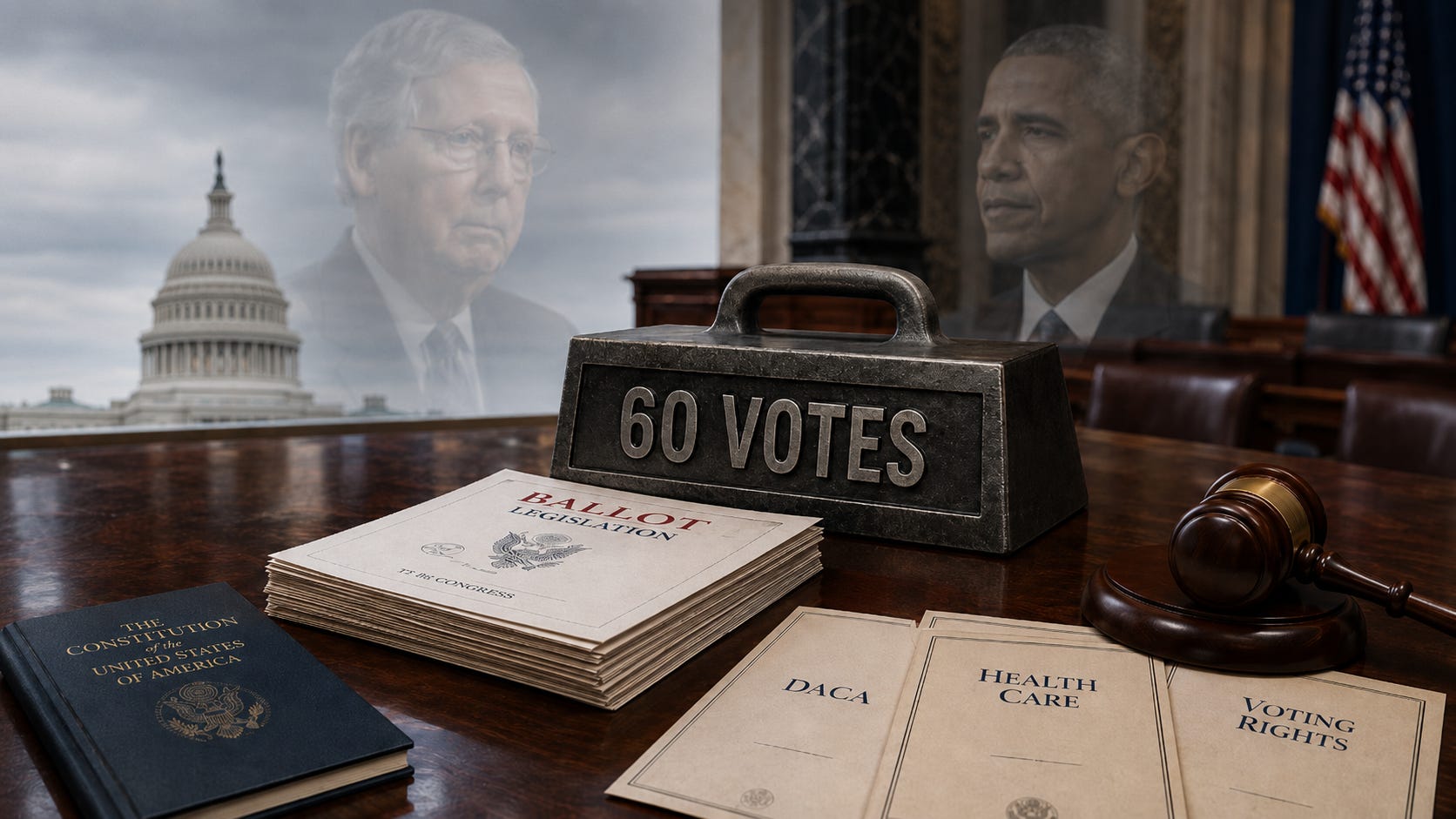
The fight over Trump’s White House ballroom is not really just about a ballroom. It is about how power moves in Washington.
The project was sold as privately funded, while Republicans also sought a legislative path to advance related federal funding through the Senate without facing the usual 60-vote threshold. When that route hit a procedural roadblock, the fight exposed something bigger than one building project: Washington treats the rules as sacred when they block ordinary people, but flexible when power wants a workaround.
That is the real filibuster story.
When ordinary people need Congress to act, procedure becomes a wall. A bill can have majority support and still die. A reform can be popular and still stall. A promise can pass the House, win 55 votes in the Senate, and still be treated like a failure because it did not reach 60. But when concentrated power wants something, Washington gets creative.
There are side doors, private donors, and procedural carveouts. There are executive actions, court fights, emergency claims, and back-channel negotiations. The rules that supposedly make change impossible for ordinary people become a puzzle to solve for people who already have money, access, and influence.
This is not just a Democratic problem or a Republican problem. Both parties defend the filibuster when it protects them and condemn it when it blocks them. The real winner is concentrated power. In a Senate where 41 votes can stop what 59 votes support, obstruction is not a flaw in the system. It is the business model.
This Community Is Powered by You
What started as a small circle has grown into something much bigger, and it’s all because of readers like you.
Every time you forward this email, post it on socials, or bring someone new into the fold, you’re helping build one of the most passionate, independent political communities out there.
Want to keep the momentum going?
Share this newsletter with someone who should be part of this conversation.
Thank you for being here. It means everything.
The Filibuster Is Sold as Principle, But Used as Power
The filibuster is usually defended in noble language. Its supporters call it Senate tradition. They say it protects minority rights, forces compromise, and stops the majority from ramming through reckless legislation. That is the sales pitch.
However, the filibuster is not in the Constitution. Article I gives legislative power to Congress, but the 60-vote Senate blockade is a rule the Senate created for itself. The Senate adopted Rule XXII in 1917 to allow cloture, or a way to end debate, and later reduced the cloture threshold in 1975 to three-fifths of all senators — usually 60 votes.
In modern Washington, the filibuster often works less like a tool of debate and more like a tool of power. Most major legislation does not simply need majority support in the Senate. It needs enough votes to overcome a procedural blockade. As a result, a bill can win majority support and still die. A reform can be popular and still stall. A party can win elections, pass legislation through the House, and still watch the Senate say no because 55 votes somehow count as failure.
That changes what democracy means. Voters are told that elections matter, to organize, show up, vote, and elect people who will fight for them. However, when those voters actually produce a majority, the filibuster gives Washington another excuse. Politicians can campaign on promises, raise money on them, and then blame Senate procedure when those promises disappear.
That is why both parties love the filibuster when they need it. When a party is in the minority, the filibuster becomes sacred. It is suddenly the great protector of democracy, deliberation, and minority rights. When that same party is in the majority, the filibuster becomes obstruction. It becomes gridlock, the reason popular bills cannot move. The rule does not change. The party’s relationship to power changes.
That is why this cannot be reduced to one party being good and the other bad. Both parties have defended the filibuster when it protected their leverage. Both parties have attacked it when it blocked their agenda. However, the consequences are not equal for everyone.
Workers need labor protections. Patients need health care policy. Families need immigration reform. Voters need voting rights protected. Communities need action on wages, housing, prices, and basic services. Power has a different set of needs. It can benefit from delay, confusion, weakened oversight, frozen labor law, protected tax advantages, and a status quo that survives one more Congress.
That is where the filibuster becomes more than a Senate rule. It becomes a power structure.
McConnell Mastered the Machine
No modern senator understood this machinery better than Mitch McConnell.
McConnell did not invent the filibuster. He did not create the Senate’s obsession with procedure, delay, and veto points. However, he understood something essential about the modern Senate: power does not always come from passing laws. Sometimes, power comes from making sure laws cannot pass at all.
That is what made him so effective. He understood that obstruction could become a governing strategy. If the other party wins an election, controls the House, controls the White House, and holds a majority in the Senate, the filibuster can still turn that majority into a negotiation, a delay, or a defeat.
That changes the meaning of political power. A party need not win the public argument every time if it can control the procedural choke points. It does not need to offer a better solution if it can make action impossible. It does not need to take responsibility for the consequences if it can blame the rules.
McConnell is not the whole story. He is the proof of the larger problem. Once a system rewards obstruction, the people most skilled at obstruction become powerful. And in that kind of system, the public can vote for change while the Senate quietly protects the status quo.
Congress Had the Power. It Barely Used It.
That is the part Washington does not like to admit. Congress is not powerless here. It has the power to write immigration law, pass health care law, regulate corporations, protect voting rights, strengthen labor law, tax wealth, and build durable national policy.
The problem is not that Congress lacks power. The problem is that Congress often refuses to use it, then hides behind procedure when the consequences arrive.
DACA shows what happens when Congress fails to act. Dreamers needed a permanent legislative fix, and that fix had to come from Congress. Instead, Congress left the issue unresolved, and the Obama administration created DACA through executive action. That gave temporary protection to people who had grown up in the United States, but it also left their lives dependent on presidential discretion.
Then Trump tried to end it. Courts got involved. Administrations changed positions. Lawsuits dragged on. The people affected were left living under uncertainty that Congress had the power to end.
That is what happens when Article I refuses to do its job. The power does not disappear. It moves to presidents, agencies, judges, and legal fights that can last for years. Ordinary people are left trying to build lives around policies that can be changed, challenged, frozen, revived, or reversed depending on who controls the White House or which court gets the case.
Obamacare shows the other side of the same problem. Congress did act, but barely. The Affordable Care Act had to survive the Senate’s 60-vote obstacle course before it could become law. It was attacked, challenged, weakened, campaigned against, and dragged through the courts. Yet because Congress actually used its power and wrote the policy into law, it had a stronger foundation than an executive order.
That is the contrast: DACA remained vulnerable because Congress would not act. The ACA survived because Congress barely did.
That is why the filibuster matters. It does not erase congressional power. It gives Congress a way to avoid responsibility for failing to use it. Senators can point to the rules, blame the math, blame the other side, and pretend that inaction was inevitable. But inaction is a choice, and when Congress chooses inaction, somebody else fills the vacuum.
That is not a healthy balance of power. That is Congress surrendering its own authority and calling it procedure.
The Filibuster Protects Concentrated Power
This is where the filibuster becomes bigger than Senate procedure.
The public usually experiences politics through problems that demand action. Wages are too low. Rent is too high. Health care is too expensive. Immigration law is unstable. Voting rights are under attack. Workers have less power than employers. Communities watch corporate interests shape their lives while Congress argues over process.
For families, delay is not neutral. It is expensive. For entrenched interests, delay can be victory.
Corporations, billionaires, lobbyists, industry groups, and political machines often do not need Congress to pass something new. They need Congress to stop something from changing. They need regulation slowed down, oversight softened, tax loopholes protected, labor law left untouched, and campaign finance rules kept exactly where they are.
That is why obstruction is so valuable. Passing reform is hard. Blocking reform is easier. If major legislation requires 60 votes to pass, concentrated power does not have to win the entire public argument. It does not have to persuade most voters or even most senators. It only needs enough influence to preserve the blockade.
That is the imbalance. The filibuster turns delay into leverage. It lets politicians promise action to voters while reassuring donors that nothing too disruptive will survive the Senate. It lets senators say they support a bill, knowing it will never clear the procedural wall. It lets public concern and private reassurance live in the same campaign.
That is not an accident. That is the function.
The filibuster gives Washington a way to make majority support look insufficient. It gives senators a way to avoid final votes. It gives lobbyists a cheaper path to victory. Most importantly, it gives concentrated power one more layer of protection from democratic accountability.
The filibuster is sold as minority rights, but too often, it protects minority power.
Stop Calling It Procedure
That is the part voters have to see clearly. The filibuster is not some natural law. It is not gravity. It is not weather. It is not an unavoidable force that simply happens to Congress. It is a Senate rule, defended by politicians when it helps them, attacked by politicians when it blocks them, and used by both parties to explain why promises keep dying in the same place.
When Washington calls it “procedure,” it sounds neutral. It sounds technical. It sounds like nobody is really responsible. A bill did not fail because senators chose to block it. It failed because of cloture. It failed because of the process. It failed because of the rules.
But rules are choices. The choice to keep the filibuster is a choice. The choice to hide behind it is a choice. The choice to campaign on policies that cannot pass under rules you refuse to change is also a choice. And choices have consequences.
They decide whether Dreamers get permanent protection or temporary uncertainty. They decide whether health care law gets written by Congress or patched together through executive action and court fights. They decide whether workers get labor protections or another speech about bipartisanship. They decide whether voters get rights protected or excuses about Senate tradition.
This is why the filibuster is so useful to concentrated power. It turns political accountability into procedural fog. It lets politicians say they support something while preserving a system that prevents it from happening. It lets donors hear one thing in private while voters hear another thing in public.
That is the scam. The public is told that majority support is not enough. Working people are told to organize harder, vote harder, wait longer, and accept less. Yet when power wants a workaround, the same Washington that lectures everyone else about rules suddenly knows how to find another route.
The question is not whether the filibuster is good for Democrats or Republicans. The question is who benefits when Congress cannot act. Too often, the answer is the people who already have power.
The Rules Are Sacred Until Power Needs Them Bent
The filibuster is not just where bills go to die. It is where responsibility goes to disappear. It lets politicians promise more than they are willing to fight for, blame rules they choose to keep, and tell voters that majority support somehow is not enough.
The public should stop accepting that excuse. If Congress has the power to write laws, then Congress has the responsibility to use that power. Senators do not get to treat the rules as flexible for judges, nominees, budget bills, donor-backed priorities, and emergency workarounds, then call those same rules untouchable when working people need help.
That is the hypocrisy at the center of the filibuster fight. The rules are sacred when workers need labor protections. The rules are sacred when Dreamers need permanent security. The rules are sacred when patients need health care fixed. The rules are sacred when voters need rights protected.
Yet when concentrated power wants something, Washington suddenly remembers how flexible procedure can be. That is not tradition. That is not principle. That is power protecting itself.
Both parties know the game. Both parties have used the filibuster when it helped them and condemned it when it blocked them. But the people who benefit most are those who can afford delay, hire lobbyists, fund campaigns, wait out reform, and profit from the status quo.
Ordinary people cannot live on procedural excuses. They cannot pay rent with cloture. They cannot get health care from Senate tradition. They cannot build a future on temporary executive action. They cannot protect their rights with another speech about bipartisanship.
At some point, voters have to ask the only question that matters: Who benefits when Congress cannot act?
If the answer is the people who already have power, then the filibuster is not protecting democracy. It is protecting them.
Support Independent Media - The Coffman Chronicle
If this piece helped cut through the fog, consider becoming a paid subscriber.
The fights that shape people’s lives are often buried under procedure, process, and language designed to make power look untouchable. But rules are choices. Inaction is a choice. And when working people are told to wait while concentrated power gets a workaround, someone has to name the game clearly.
That is what independent media is for.
The Coffman Chronicle is here to follow the power, explain who benefits, and show how Washington’s choices land on the people who can least afford another delay.
Support independent media. Become a paid subscriber today, and help keep this work going.
Sources:
CBS News. “Reid Invokes ‘Nuclear Option’ to Get Obama Nominees Approved.” November 21, 2013.
Congress.gov. “Article I.” Constitution Annotated.
FactCheck.org. “Who’s Paying for the White House Ballroom?” May 14, 2026.
Reuters. “Federal Funding for Trump’s Ballroom in Jeopardy after Senate Ruling.” May 17, 2026.
Supreme Court of the United States. Department of Homeland Security et al. v. Regents of the University of California et al., 591 U.S. ___ (2020). June 18, 2020.
U.S. Citizenship and Immigration Services. “Consideration of Deferred Action for Childhood Arrivals (DACA).”
U.S. Department of Homeland Security. “Memorandum on Rescission of Deferred Action for Childhood Arrivals (DACA).” September 5, 2017.
U.S. House Committee on the Budget, Democrats. “Budget Reconciliation: The Basics.” August 11, 2021.
U.S. Senate. “About Filibusters and Cloture.” Accessed May 18, 2026.
https://www.senate.gov/about/powers-procedures/filibusters-cloture.htmU.S. Senate. “About Judicial Nominations: Historical Overview.”
U.S. Senate. “About Voting.”
U.S. Senate. “Roll Call Vote 111th Congress, 1st Session: Vote Number 395, Motion to Invoke Cloture on H.R. 3590, Patient Protection and Affordable Care Act.” December 23, 2009.
U.S. Senate. “Roll Call Vote 111th Congress, 2nd Session: Vote Number 278, Motion to Invoke Cloture on the Motion to Concur in the House Amendment to the Senate Amendment No. 3 to H.R. 5281.” December 18, 2010.
Face it. The “procedures” have been made by the rich and powerful for the competing rich and powerful. Ordinary citizens don’t count. This has been going on for decades and is baked into the system the rich and powerful created. Think Carnegie. Think Rockefeller. Think Mellon. It’s not any different now. Think Musk. Think Theil. Think Ellison. The only way to change the system is to make it not about money but about serving the people as the stupid people believe it’s about governance. Maybe the current corrupt administration has given America a warning sign. Maybe it’s already too late.
Logically, if you believe in majority rule, the filibuster's letting the senate minority obstruct good law is wrong. But if the majority wants bad law the filibuster is the senate minority's safety valve. I think what is needed is eqitable law, justice that an insuperable congresssional majority decide on, which a hostile president can't veto and a hostile supreme court cannot overturn.