


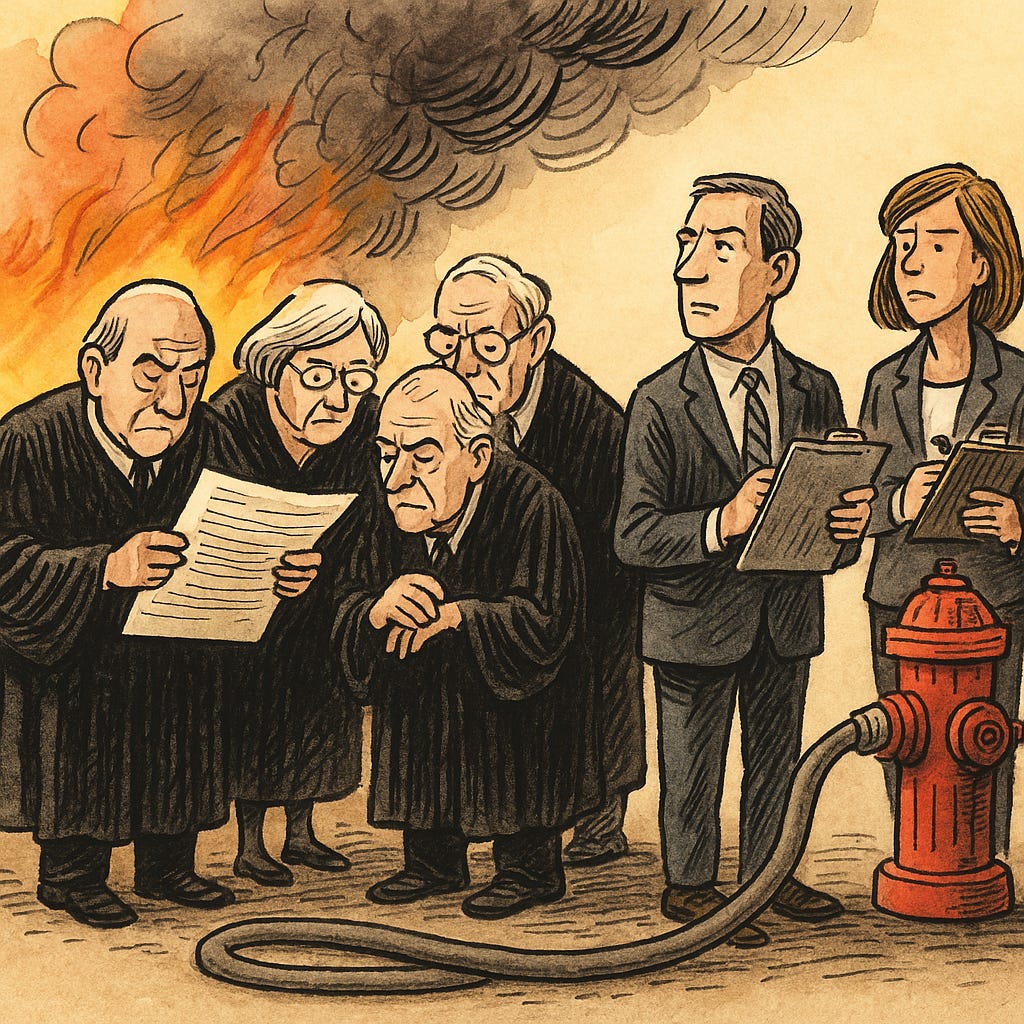
Imagine a building on fire.
Inside, small business owners are screaming. Shoppers are trying to get out without losing their wallets. The fire’s spreading. The pressure hose is coiled up right there, ready to go.
And instead of turning it on, nine judges are gathered around the manual, arguing about whether the Constitution allows them to spray water in this direction.
Meanwhile, Democrats in Congress have their hands on the hydrant, but instead of using it, they’ve formed a “Hose Use Oversight Committee,” scheduled a hearing, and emailed a fundraising link about how much they care.
This isn’t a metaphor for a hypothetical future.
This is what’s happening right now with Donald Trump’s tariffs.
We just hit 14,000 subscribers—thank you!
Get exclusive access for just $1/week or $52 a year.
Get exclusive analysis and fearless reporting you won’t find in corporate media.
The Legal Timeline: Yes, This Just Happened
April 2, 2025: Trump imposes his “Liberation Day” tariffs — 10% to 50% on virtually all imports, citing the International Emergency Economic Powers Act (IEEPA), a law meant for national emergencies, not trade wars. And then there’s China….
April 14, 2025: Small businesses and Democratic-led states sue, saying IEEPA doesn’t give Trump that power.
May 28, 2025: The U.S. Court of International Trade rules Trump’s tariffs are unlawful, a landmark decision declaring he overstepped his authority under IEEPA.
May 29, 2025: The very next day, a federal appeals court issues a temporary stay, meaning the tariffs, even though declared illegal, stay in effect while Trump appeals.
That’s not a metaphor. That’s the timeline. One day, it was ruled unconstitutional. The next day, it was back in effect.
See Tony’s episode here:

Consumers Bear the Brunt
While small businesses feel the immediate strain, it's the everyday consumer who ultimately shoulders the cost. Major retailers, such as Walmart and Macy's, have announced price hikes directly attributed to these tariffs.
Walmart has increased prices on over 4,200 items, including essentials like kitchenware and home décor.
Best Buy has lowered its annual profit outlook, citing reduced profits and stagnant sales due to tariffs.
Macy's has raised prices to offset increased import costs, with tariffs potentially reducing its annual gross margin by 20 to 40 basis points.
And Amazon? Trump reportedly demanded that Jeff Bezos not show tariff costs on product descriptions, an order more fitting for an autocrat than a president.
These price increases are not just numbers on a balance sheet; they translate to real dollars out of consumers' pockets.
See some of our tariff reporting here:


Retailers Under Pressure
The administration's approach has put retailers in a difficult position. President Trump has urged companies like Walmart to "eat" the cost of tariffs instead of passing them on to consumers. While megacorporations could afford to lose some shareholder profit in the short term, for small businesses, that’s not possible. With already thin profit margins, absorbing these costs is unsustainable.
This isn’t protectionism. It’s economic gaslighting.
International Implications
The U.S. Court of International Trade's decision to invalidate President Trump's tariffs has been met with approval from major trading partners:
Canada: Prime Minister Mark Carney welcomed the ruling, stating it aligns with Canada's longstanding position that the tariffs were "unlawful as well as unjustified." He emphasized the importance of reshaping Canada's economic and security relationship with the U.S. and strengthening collaborations with reliable global partners.
China: The Chinese government praised the decision, urging the U.S. to lift the tariffs permanently. Commerce Ministry spokeswoman He Yongqian reiterated China's stance that trade wars are counterproductive and called on the U.S. to heed both international and domestic voices opposing protectionism.
Australia: Trade Minister Don Farrell expressed hope that the ruling would aid efforts to remove U.S. tariffs on Australian exports, highlighting the significance of fair trade practices and the potential for improved economic relations.
And then there’s the EU, which dodged the threat of a 50% tariff on its goods by making a well-placed phone call on May 25th. After a single phone call with EU President Ursula von der Leyen, whom Trump has repeatedly praised in uncharacteristically glowing terms, the 50% tariff threat was suddenly on hold. It’s almost like she knew exactly how to talk to him: a little flattery, a touch of deference, and the self-styled strongman backs off. President Trump delayed implementation until July 9. Ursula took a well-earned hot shower.
This isn’t economic leadership. It’s hostage-taking with a tariff gun.
“Everyone’s Calling!” Except They’re Not
Amid the economic and legal chaos, Trump is still out claiming victory.
He recently said “hundreds of countries” are calling, desperate to strike trade deals with the U.S. A bold claim, considering there are only 195 countries on Earth.
But on May 29, his own Treasury Secretary, Scott Bessent, offered a more grounded update:
Yes, there are ongoing discussions with countries like Japan and India, but
Talks with China are “a bit stalled,” and may require direct intervention from Trump and President Xi Jinping.
Notably, no trade deals have been finalized.
So while Trump brags about global demand for U.S. deals, his administration is quietly admitting that the big ones — like China — are going nowhere fast.
This isn’t just exaggeration. It’s a gap between rhetoric and reality, one that leaves voters misinformed and policies unchallenged.
This is the grift in real time: Tell the public there’s progress. Feed the media a story. Let the courts stall. And meanwhile, do nothing.
Enter the “TACO” Doctrine
This pattern has become so predictable that it has a name: TACO — Trump Always Chickens Out. Coined by Financial Times columnist Robert Armstrong, it describes Trump’s habit of making big, aggressive trade threats, only to delay, walk back, or reframe them later when reality hits.
We’ve seen it with his repeated tariff threats against the EU (now delayed to July 9), with China (where talks are “stalled”), and now in the wide gap between his claims and Bessent’s admissions.
The takeaway? This isn’t a master negotiator at work. It’s a pattern of economic whiplash, powered by bluster and sustained by inaction. Now with more cilantro (with a 25% tariff, naturally)!
See our short-take here:

What Happens Next?
The legal battle is far from over, and here's what to expect in the coming weeks and months:
June 5, 2025: Plaintiffs (including small businesses and states) must respond to the government's appeal in federal court.
June 9, 2025: Trump’s legal team replies. The appeals court will then decide whether to lift the stay or keep the tariffs in place while the appeal proceeds.
Summer 2025: The appeals court issues its ruling. If it upholds the original decision, the tariffs could be blocked again, but only temporarily.
Likely October 2025: If either side loses, they’re expected to petition the U.S. Supreme Court. The Court would decide whether to take the case during its new term starting in October.
2026?: If the Supreme Court agrees to hear it, we may not get a final ruling until mid-2026.
Will the Supreme Court Step In?
That’s the big unknown.
This Court has shown an interest in limiting unchecked executive power, particularly when the president uses a law for a purpose far beyond its original intent, as Trump did here with IEEPA.
But the decision could still be close. Why?
Some conservative justices (like Gorsuch or Thomas) may say this is a clear case of presidential overreach that violates the Constitution’s separation of powers.
Other conservatives may still defer to the presidency on national security, arguing that courts shouldn’t second-guess a president’s emergency declarations.
Liberal justices may agree that the policy is bad and the process illegal, but hesitate to set limits that could restrict a future Democratic president’s ability to act in a real crisis.
So even if most of the Court dislikes how Trump used the law, they might disagree on how or whether to stop it. That’s how something that feels so obviously wrong to the public could still come down to a 5–4 or 6–3 decision, with multiple opinions and legal rationales.
So even if the Court agrees the house is on fire, we may still be waiting to see if they think they're allowed to turn on the hose, or if they’ll write a thoughtful opinion while the building burns.
The Real Problem: Power Without Accountability
Everyone knows this is unconstitutional. The courts ruled it. Economists warned it. Legal scholars predicted it.
So why is it still happening?
Because our institutions — built for caution, not confrontation — are failing to match the moment. The courts say “not yet.” Congress says, “We’re working on it.” And Democrats, terrified of seeming partisan, let an abuse of power fester for fear of touching it.
It’s not about Trump anymore. It’s about a system that allows the clearly illegal to become the dangerously normal.
More importantly, this is just about tariffs. How many other executive orders using the same shady logic remain in effect?
If We Can’t Stop This, What Can We Stop?
If an illegal tariff that’s hurting Americans, ruled unconstitutional by a federal court, can continue because no one is brave enough to stop it, what happens when something worse comes along?
If this is how we handle something as clear-cut as tariffs, what happens when it’s censorship? Or mass surveillance? Or war?
The fire is real. The hose is right there. And no one— no judge, no lawmaker, no administration— is turning it on.
What Now?
Talk about this. Share the facts. Most people are unaware that these tariffs were ruled illegal.
Call your reps. Demand they reclaim economic power from the executive branch.
Support candidates who understand the stakes and aren’t afraid to act.
Push the media to keep covering this. The legal fight isn’t over, and public pressure still matters.
We don’t need more hearings.
We need people who recognize a fire and turn on the damn hose.
We just hit 14,000 subscribers—thank you!
Get exclusive access for just $1/week or $52 a year.
Get exclusive analysis and fearless reporting you won’t find in corporate media.
Bibliography:
“Mexico’s Tariffs Under the April 2025 Executive Order.” Alvarez & Marsal, May 2025.
“Trump Delays 50% Tariffs on EU Goods after Von der Leyen Call.” AP News, May 25, 2025.
“Best Buy Lowers Outlook as Tariffs Weigh on Sales.” AP News, May 2025.
“Trump Postpones EU Tariffs Following Talks with Von der Leyen.” BBC, May 25, 2025.
Perkel, Sarah. “Macy’s, Walmart, Shein, and Other Major Brands That Say Trump’s Tariffs Are Pushing Them to Raise Prices.” Business Insider, May 27, 2025.
Armstrong, Robert. “The US Market’s Surprise Comeback.” Financial Times, May 2, 2025.
“Trump Wants Retailers to Eat the Cost of Tariffs. Do They Have the Appetite?” Investopedia, May 2025.
“What’s Happening with Trump’s Tariffs in 2025.” Kiplinger, May 2025.
“Revenge of the Killer Tomato Tariffs.” MarketWatch, May 2025.
“Trump Agrees to Extend Deadline for 50% Tariffs on European Union.” New York Post, May 25, 2025.
“U.S. Says Most Tomatoes Imported from Mexico Will Face 21% Duty July 14.” Reuters, April 14, 2025.
“Bessent Says U.S., Trading Partners Still Negotiating after Tariff Ruling.” Reuters, May 29, 2025.
“U.S. Appeals Court Stays Ruling Blocking Trump Tariffs.” Reuters, May 29, 2025.
“U.S. Court Blocks Trump’s Liberation Day Tariffs.” The Australian, May 28, 2025.
“Macy’s Blames Trump’s Tariffs as It Hikes Prices.” The Daily Beast, May 2025.
“Walmart Quietly Raises Prices after Trump Tariffs Hit.” The Sun, May 2025.
U.S. Customs and Border Protection. “Official CBP Statement on Tariffs.” CBP.gov, May 2025.
“Canada’s Carney Welcomes Trade Court’s Tariff Decision.” WSJ, May 29, 2025.
“China Hails Court Ruling Invalidating Trump Tariffs.” WSJ, May 29, 2025.
“Tariffs on Mexican Tomatoes Are Coming Back. Prices Will Rise.” The Washington Post, May 2025.
“Fact Sheet: President Donald J. Trump Imposes Tariffs on Imports from Canada, Mexico, and China.” WhiteHouse.gov, February 2025.
If we're going to go down, we might as well go down fighting. That's probably stating the obvious, but it bears repeating. Capitol Hill has no will to fight, with a few exceptions. I'm willing to bet it's because they're colluding with the domestic enemy within ... which makes them white collar domestic terrorists wielding weapons of mass destruction. And we can't get rid of just 1 or 2 of them, even if they're the proverbial head of the snake. We have to root them all out and then re-imagine and rebuild. Thanks for the excellent article.
Part of the population doesn't want a democracy, they want a dictatorship of their own liking.
.The appeals court here is starting the slow walk and then will hand off to the Supreme Court that may even hear oral arguments and the following year announce that the majority won't make a decision.