



A court blocked the retaliation. The damage was already done.
A federal judge may have blocked Donald Trump’s attempt to punish NPR and PBS, but that does not make this a clean victory for anyone who cares about independent institutions. The ruling matters because it says the government cannot use public power to retaliate against disfavored speech. But the harder truth is that public broadcasting was already being weakened long before the court stepped in. That is what makes this story bigger than a fight over media bias or Trump’s latest grievance. It is a case study in how political power can be used to intimidate, destabilize, and hollow out institutions even when the law eventually says no. In that kind of system, the point is not always to destroy the target outright. Sometimes it is enough to leave it diminished, making it easier to threaten the next time.
This Community Is Powered by You
What started as a small circle has grown into something much bigger, and it’s all because of readers like you.
Every time you forward this email, post it on socials, or bring someone new into the fold, you’re helping build one of the most passionate, independent political communities out there.
Want to keep the momentum going?
Share this newsletter with someone who should be part of this conversation.
Thank you for being here. It means everything.
What Trump tried to do
What Trump attempted here was simple in spirit, even if it was wrapped in legal paperwork and political messaging. He targeted public broadcasters his movement has long treated as ideological enemies, and tried to cut off federal support while framing the move as a response to bias. That framing matters less than the mechanism. Strip away the partisan language, and what remains is a president trying to use the power of the state against institutions because he did not like the speech they produced.
That is the part that should unsettle people, whether they watch PBS every night, listen to NPR on their commute, or never consume either. The real issue is not taste or branding. The question is whether the government can punish protected speech because those in power find it hostile, unfair, or politically inconvenient. Once that principle starts to erode, every institution that speaks independently becomes more exposed.
That is why reducing this episode to a culture-war spat misses the point. Trump was not just complaining about coverage. He was trying to convert grievance into policy and turn political resentment into material punishment. Complaining about the press is old. Using the machinery of government to make disfavored institutions weaker is something else entirely.
Public broadcasting made an especially useful target because it sits at the intersection of journalism, education, civic life, and public funding. That lets political actors dress retaliation up as reform. They can claim they are merely cutting waste, correcting bias, or reining in the public sector, while the actual message is understood by everyone watching: if your institution refuses loyalty, your independence can become a liability.
And once that message is sent, the damage does not stop with the immediate target. Other institutions absorb the lesson. Keep your head down. Soften your language. Avoid provoking the people who control the purse strings. That is how retaliatory power works in practice. It does not always need mass censorship or formal bans. Sometimes it only needs enough punishment to make independence feel expensive.
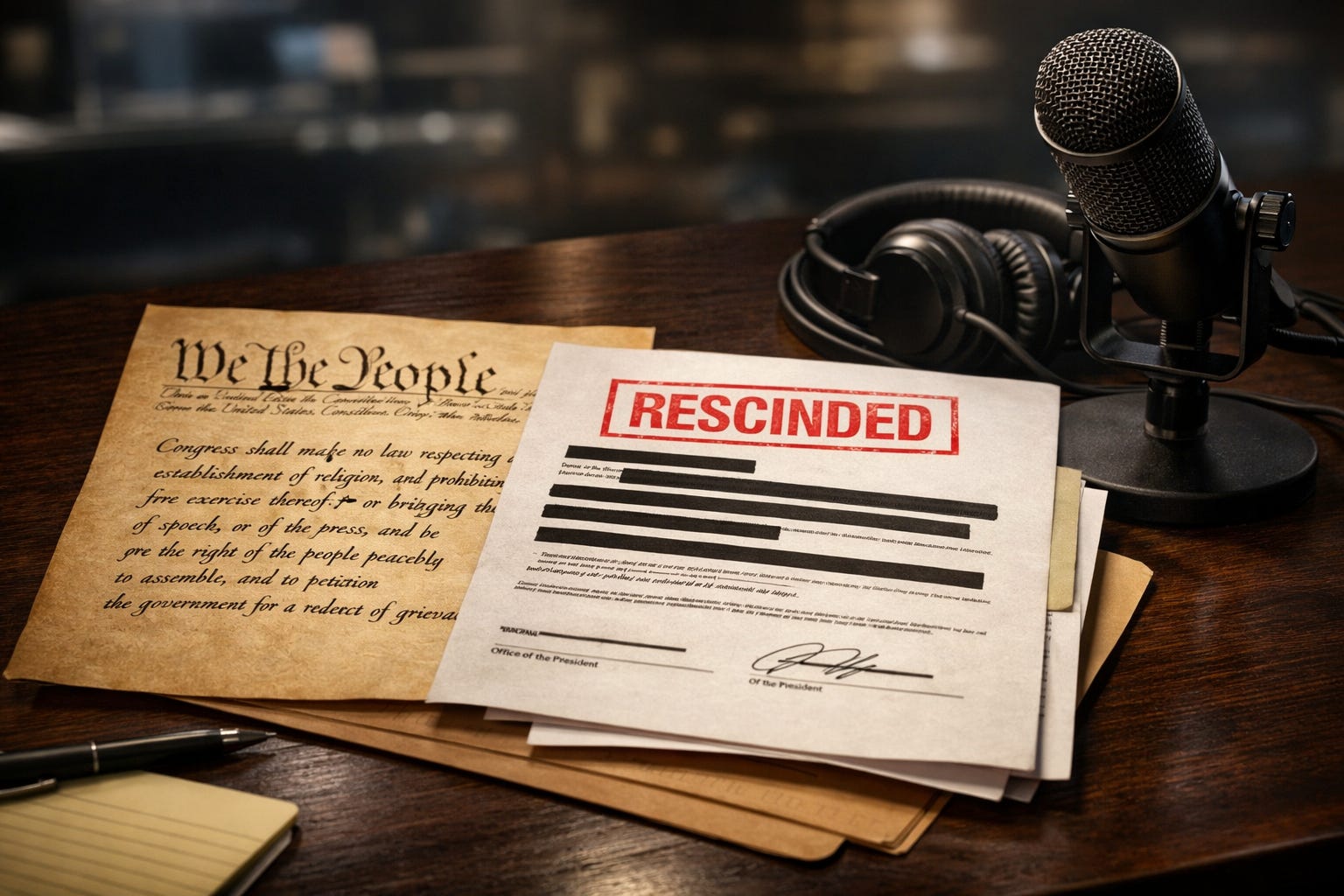
The constitutional line the court drew
What made this ruling important was not simply that a judge disagreed with Trump’s policy preference. It was that the court identified a constitutional boundary that the administration had crossed. U.S. District Judge Randolph Moss held that the order targeting NPR and PBS was unlawful because the government cannot use its power to retaliate against protected speech or discriminate against viewpoints it dislikes.
That matters because the case was never just about whether public broadcasting deserves taxpayer support in the abstract. Presidents and members of Congress can argue over pending priorities all the time. What they cannot do is single out institutions for punishment because they object to the viewpoints those institutions express. That distinction is the legal heart of the story. Disagreement over policy is one thing. Retaliatory state action against disfavored speech is another.
The ruling says there are still constitutional limits on how far political grievance can be converted into government action. A president can complain, attack, posture, and rage against coverage he hates. But once he tries to use federal authority to financially squeeze the speakers themselves because of what they have said, he runs into the First Amendment. That is the line the court drew here, and it drew it in direct terms: viewpoint discrimination and retaliation.
That is why the decision matters beyond public media. It reaffirms a principle that should be obvious but is increasingly being restated: government power is not a lawful weapon for settling political grudges against independent institutions. If that principle weakens, the danger is not limited to a single broadcaster or a single president. It extends to any organization whose independence becomes inconvenient to the people in power.
And that matters precisely because it had to be said. In a healthier political culture, it would be unthinkable that a president would need to be told by a federal court that he cannot use public authority to retaliate against media organizations for their past speech. The fact that this had to be litigated at all is part of the warning.
Why this was bigger than a fight with the press
The easiest way to misunderstand this case is to treat it as just another ugly chapter in Trump’s long war with the media. That is part of it, but it is not the most important part. The deeper issue is whether the government can translate political hostility into institutional punishment. That is why Moss’s ruling matters so much. He said the order crossed that line by targeting NPR and PBS for viewpoints the president disliked.
That changes the whole story. If this were only a debate over whether public broadcasting deserves federal support, it would be a normal political fight. Governments argue about budgets all the time. Congress can cut programs. Presidents can campaign against them. But that is not what made this order constitutionally suspect. What made it dangerous was the attempt to use federal authority against specific institutions because of their speech. That is retaliatory power, not ordinary policymaking.
And once you see it that way, the target almost becomes secondary. Today it was NPR and PBS. Tomorrow, it could be universities accused of ideological bias, nonprofits that criticize administration policy, watchdog groups that expose corruption, or local institutions that depend on grants, licenses, or federal partnerships. The warning is broader than public media: if political leaders can make institutional survival contingent on obedience, independence itself starts to look like a liability.
This is also why the piece should not ask readers to love NPR or PBS in order to care. It does not matter whether a reader listens every day, never tunes in, thinks public broadcasting is indispensable, or thinks it is flawed. The constitutional principle does not depend on affection for the target. It depends on whether the government gets to punish protected expression by squeezing institutions it sees as politically hostile.
So this was never just a media story. It was a power story. Public broadcasting happened to be the target, but the underlying question was whether the presidency can turn grievance into punishment and make an example out of independent institutions. When that happens, the immediate blow lands on one organization, but the chill spreads much farther.
Download a FREE Pocket Constitution NOW →

The illusion of a win
This is where the story gets darker. Judge Randolph Moss’s ruling was real, and it mattered. But it did not restore the world that existed before the attack. What the court blocked was Trump’s retaliatory executive order, which Moss said violated the First Amendment by targeting NPR and PBS on viewpoint grounds. What the court did not do was reverse Congress’s separate decision to rescind major public-broadcasting funding. That distinction is the heart of the problem. The executive action was unconstitutional retaliation. The legislative funding cut, however damaging, sits on a different legal footing because Congress generally controls appropriations.
That means the ruling was both important and narrow. It said the president cannot use executive power to punish disfavored media outlets for their speech. But it did not say NPR and PBS have a guaranteed constitutional right to continued federal funding, and it could not simply recreate money that Congress had already taken away. So even after the court stepped in, the public broadcasting system remained weakened by losses that the injunction could not undo.
That is the illusion at the center of the case. A court can stop an unconstitutional act yet remain powerless to make the target whole again. It can bar one retaliatory mechanism. It can reaffirm a First Amendment principle. But it cannot automatically restore lost appropriations, reverse layoffs, or erase the instability political actors have already set in motion. In practical terms, the broadcasters can win the constitutional argument and still emerge more vulnerable than they were before the fight began.
And that is often how institutional hollowing works. The goal does not have to be total destruction in a single move. Sometimes it is enough to hit the institution from multiple directions at once: an unlawful retaliatory order from the executive branch, a separate funding squeeze from Congress, public delegitimization from partisan media, and months of uncertainty that force the target into survival mode. Even when one piece of that campaign fails in court, the larger weakening project may still succeed in part.
That is the piece too many “court blocks Trump” headlines miss. The judiciary can still draw constitutional lines, and that matters. But legal limits do not function like time machines. They do not rewind fear, restore staff positions, or rebuild institutions already marked for punishment. Congress’s funding cuts did not legalize Trump’s retaliatory order. They just made the court’s victory narrower and the damage harder to reverse.
How institutional hollowing actually works
What happened to public broadcasting shows that institutional weakening rarely comes in one dramatic blow. More often, it arrives as a sequence: a retaliatory executive action, a separate legislative funding squeeze, public attacks that frame the target as illegitimate, and a long enough period of uncertainty that the institution starts bleeding capacity before the final legal questions are even resolved.
That is why “the court stopped it” is true but incomplete. Courts can block one mechanism of punishment. They can say the president crossed a constitutional line. What they are much less able to do is restore confidence, staffing, institutional stability, or lost infrastructure after the attack has already landed. In this case, the injunction did not undo the congressional rescission, and the broader operational damage was already part of the picture. A legal victory can therefore coexist with a weaker institution.
That is the logic of hollowing out. You do not always have to abolish an institution outright to make it less effective. You only have to make it spend more time defending its existence, more money surviving political assault, and more energy adapting to instability than carrying out its mission. The result is an organization that still exists on paper but operates under greater fear, greater scarcity, and greater pressure to avoid provoking those who can hurt it.
And that is what makes retaliatory politics so corrosive, even when it falls short of total victory. The point is not always to win every legal battle. Sometimes it is to make independence costly enough that other institutions start absorbing the lesson on their own. Universities watch. Nonprofits watch. Local affiliates watch. Regulators, grant recipients, and civic institutions all watch the same demonstration of power: even if you eventually win in court, you may still come out smaller and more cautious.
Why this should matter beyond public media
Even people who never watch PBS or listen to NPR should understand what this case signals. The danger was never confined to public broadcasting itself. The danger was the attempted use of federal power to punish institutions for speech the president disliked. Once that principle is on the table, the category of potential targets gets much larger than two broadcasters.
That is because modern institutions do not have to be directly censored to be pressured. Many of them depend in some way on public money, federal approvals, contracts, licenses, or regulatory goodwill. Universities rely on grants and research funding. Nonprofits depend on public partnerships and tax treatment. Local stations and civic institutions often depend on government-linked support structures. If political leaders can treat those dependencies as leverage against disfavored speech, then formal freedom of expression remains on paper while practical independence starts to narrow.
That is why this case should be read as a warning rather than a niche media dispute. Public broadcasting was a useful target precisely because it allowed retaliation to be dressed up as budget discipline or anti-bias reform. But the constitutional problem identified by the court was not really about accounting. It was about whether the state can financially pressure speakers because those in power object to their viewpoints. If that logic becomes normal, every independent institution gets the message that survival may depend less on serving the public than on avoiding political offense.
And once institutions start internalizing that lesson, the damage spreads quietly. The first target absorbs the immediate blow, but everyone else watching learns to calculate risk differently. They become more cautious, less confrontational, and more aware that even a successful court fight may come after layoffs, disruption, and reputational assault. That is how democratic systems can keep elections, courts, and formal rights while still becoming more fragile in practice.
The court did its job here, and that matters. Judge Randolph Moss drew a constitutional line, holding that the president could not use executive power to punish NPR and PBS for speech he disliked. That ruling is important not because it saved everything, but because it confirmed that viewpoint-based retaliation by the executive branch is still illegal. In a political climate where that principle had to be restated in federal court, even that much carries weight.
But the ruling also exposed the limits of legal wins in the face of coordinated institutional pressure. Congress’s prior rescission of CPB funding remained in place, the broader public-media system had already been pushed into instability, and the court could not rewind that damage. It could block Trump’s retaliatory order. It could not undo the separate legislative squeeze.
That is the real lesson of this fight. The most dangerous abuses of power are not always the ones that end in total victory for the aggressor. Sometimes they are the ones that weaken the target, narrow its margin for independence, and teach every other institution what resistance may cost. Public broadcasting was the immediate target here, but the warning reaches much farther. When the government tries to make independence expensive, even a court victory can arrive after the lesson has already been delivered.
Support Independent Media: The Coffman Chronicle
The Coffman Chronicle exists to follow power, expose the pattern, and tell the truth about what gets broken when political retaliation becomes public policy. If that kind of independent journalism matters to you, and you can afford to support it, please consider becoming a paid subscriber.
Sources:
“Citing First Amendment, Federal Judge Blocks Trump Order to End Funding for NPR and PBS.” Associated Press, March 31, 2026.
“Corporation for Public Broadcasting to Shut Down After Being Defunded by Congress, Targeted by Trump.” Associated Press, August 1, 2025.
National Public Radio, Inc. et al. v. Trump et al., No. 1:25-cv-01674 (D.D.C. Mar. 31, 2026), memorandum opinion. Justia.
“Trump Administration Plans to Ask Congress to Defund PBS, NPR.” PBS NewsHour, April 16, 2025.
“Judge Blocks Trump’s Executive Order to End Federal Funding for PBS and NPR.” PBS NewsHour, March 31, 2026.
“Trump Signs Order That Aims to Cut Funding to NPR, PBS.” Reuters, May 2, 2025.
“US Senate Passes Aid, Public Broadcasting Cuts, in Victory for Trump.” Reuters, July 17, 2025.
“US House Republicans Pass Trump Plan to Cut Foreign Aid, Public Broadcasting.” Reuters, July 18, 2025.
“Corporation for Public Broadcasting, Gutted of Federal Funds, Votes to Dissolve.” Washington Post, January 5, 2026.
“Judge Rules Trump Order Eliminating NPR, PBS Funding Is Unconstitutional.” Washington Post, March 31, 2026.
Thank you for your work in pulling together this excellent piece. Look, large swaths of America already know that Trump is a crook. We also know that his fat cat tech supporters put him in power. The world has seen his cruelty, his constant grifting, his blatant disregard for our laws and constitution, his frequent personal attacks on citizens, non-citizens, members of the press, members of congress, other world leaders, etc. We all know he has a severe personality problem that could extend to pedophilia. We all know he was unfit for the highest office in the land, and we all expected he would lead us down the road to perdition. What we all don’t know is how to quickly remove him and his entire corrupt cabinet from office, and then we can spend years and years trying to undo the damage he has created around the world. The longer we wait to act, the longer people suffer, the deeper the hole he digs, and the longer the road away from perdition.
The essay was thorough and clear. Very convincing and helpful, because overcoming t's R majority in congress must be a high priority for all who see how corruption works. DOGE, to cite another example, was not simply t's policy but it was central to Project 2025, which dominated the R party.