


On its face, the latest fight over surveillance law in the House of Representatives should have been routine. Section 702 of the Foreign Intelligence Surveillance Act (FISA) has come up for reauthorization before, and each time, despite some noise, Congress has ultimately moved to extend it.
This time is different.
On April 18, 2026, roughly 20 Republican lawmakers broke with their party’s leadership and joined Democrats to block both a 5-year and an 18-month extension. The result was not a clean renewal, but a short-term stopgap, an extension only through April 30, forcing Congress to revisit the issue almost immediately.
For a law long treated as essential to national security, such bipartisan disruption is not normal. It is a signal. But of what?
This Community Is Powered by You
What started as a small circle has grown into something much bigger, and it’s all because of readers like you.
Every time you forward this email, post it on socials, or bring someone new into the fold, you’re helping build one of the most passionate, independent political communities out there.
Want to keep the momentum going?
Share this newsletter with someone who should be part of this conversation.
Thank you for being here. It means everything.
This Is Not a Conspiracy Story
There is a temptation, especially in the current media environment, to treat any disruption in intelligence policy as evidence of something hidden or nefarious. Considering the current upheaval and political climate, such news would not be particularly surprising. However, that is not what is happening here.
This is not a conspiracy story. It is a convergence story.
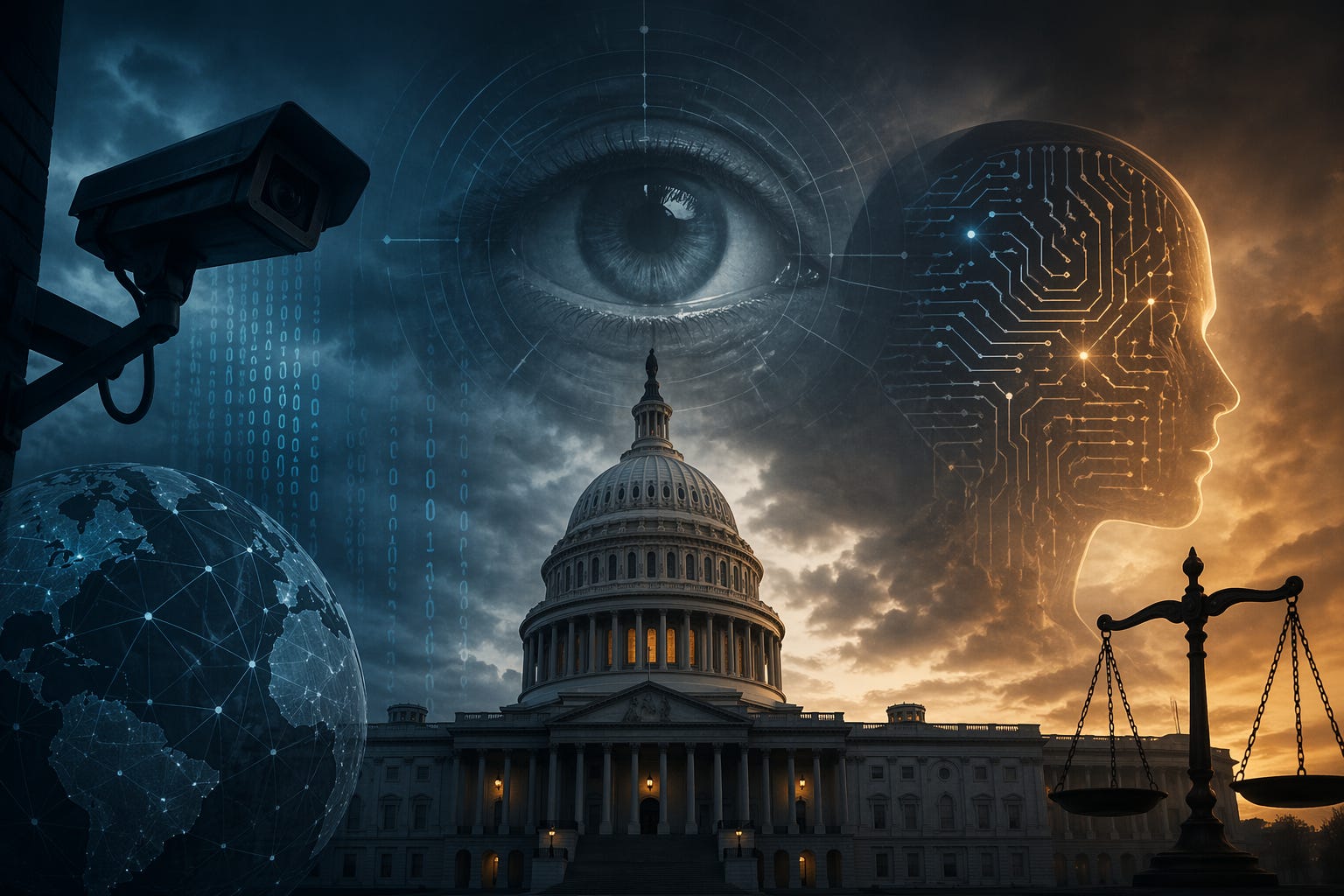
Several long-developing forces—post-9/11 surveillance expansion, the absence of a comprehensive federal privacy law, and the rapid rise of artificial intelligence in government—are colliding at once. The result is a moment where lawmakers across ideological lines are asking whether the existing framework still makes sense.
To understand why this moment feels different, it helps to start with the basics.
What Is FISA, and Why Does It Matter?
The Foreign Intelligence Surveillance Act was passed in 1978, in the aftermath of the Church Committee investigations and the Watergate era. Those inquiries revealed that U.S. intelligence agencies had conducted widespread surveillance of civil rights leaders, anti-war activists, and political opponents.
FISA was designed as a corrective. It created a legal framework for conducting foreign intelligence surveillance while imposing judicial oversight. At the center of that framework is the Foreign Intelligence Surveillance Court (FISC), a secret court that reviews and approves surveillance requests related to national security.
The original model was straightforward in principle. If the government wanted to surveil someone inside the United States for foreign intelligence purposes, it needed to go to court and obtain a warrant.
That changed in 2008.
In the wake of the September 11 attacks and the broader expansion of national security powers that followed, Congress passed the FISA Amendments Act. This law added Section 702, which allows the government to collect communications of non-U.S. persons located abroad without obtaining an individualized warrant for each target.
Section 702 is now one of the government’s most powerful intelligence tools. It is used to monitor terrorism suspects, foreign adversaries, and cyber threats. However, because global communication networks are deeply interconnected, Americans’ communications can be incidentally collected when they interact with those foreign targets.
Unlike the original FISA framework, Section 702 operates through program-level approvals rather than case-by-case warrants. The court approves general procedures, not individual targets.
Crucially, Section 702 is not permanent. It includes a sunset provision, meaning Congress must periodically vote to reauthorize it. That requirement is what brings the issue back into public debate and into the headlines.
Download a FREE Pocket Constitution NOW →

What Is Happening in Congress Right Now?
The current standoff reflects an unusual coalition.
On one side are lawmakers, in both parties, who argue that Section 702 is indispensable. Intelligence officials have repeatedly said the program is critical for tracking terrorist plots, monitoring foreign governments, and defending against cyber threats. Many establishment Republicans and centrist Democrats fall into this camp, along with leadership figures who prefer a clean, long-term reauthorization.
On the other side is a more eclectic group.
Some Republicans, particularly those with libertarian leanings or deep skepticism of federal law enforcement agencies, object to what they see as unchecked surveillance power. They point to past controversies involving the Federal Bureau of Investigation (FBI) and argue that existing safeguards are insufficient.
At the same time, a number of Democrats, especially those aligned with civil liberties concerns, have long criticized Section 702 for allowing warrantless searches of Americans’ communications. They argue that the current framework creates a “backdoor” for accessing domestic data under the guise of foreign intelligence.
These groups do not agree on everything. In many cases, their motivations differ significantly. However, in this instance, they overlap in outcome: resistance to a clean reauthorization without reforms.
The result is the current impasse, where short-term extensions replace long-term certainty.
See our recent shorttake reporting on this story here:

How We Got Here: The Legacy of Post-9/11 Governance
To understand the deeper tension, it is necessary to go back to 2001.
The September 11 attacks triggered a rapid expansion of government authority. Congress passed the USA PATRIOT Act within weeks. Intelligence agencies were granted broader surveillance powers, and new systems were built to collect, analyze, and share information.
These changes were reactive in the most literal sense. They were designed to prevent another catastrophic attack in a moment of national trauma and urgency.
That urgency justified speed and lowered the threshold for granting authority.
What never fully followed was a comprehensive response phase, a slower, more deliberate reassessment of those powers once the immediate crisis had passed.
Some reforms did occur. Some provisions expired or were modified. However, the broader architecture remained largely intact. Section 702, added in 2008, became a cornerstone of that architecture.
Now, more than two decades later, Congress is still operating within a system built during that reactive period. The question lawmakers are beginning to ask is whether the guardrails have kept pace.
The Missing Piece: No Comprehensive Federal Privacy Law
Layered on top of that surveillance framework is another reality. The United States still does not have a comprehensive federal privacy law.
Instead, the country relies on a patchwork system. There are sector-specific laws governing health data, financial information, and children’s privacy. Some state-level laws, most notably in California, exist. There are constitutional protections that apply in certain contexts.
What does not exist is a single, unified standard defining how personal data can be collected, stored, shared, and used across the economy.
In a system with strong baseline privacy protections, surveillance authorities operate within clearer boundaries. In the United States, those boundaries are more fragmented. Data flows freely between private companies, large datasets are routinely collected and retained, and the line between commercial data and government access can be porous.
This does not mean that surveillance is unregulated. It means the broader data environment is less structured, which can amplify concerns about how government authorities are applied.
The Accelerant: AI Changes the Equation
If post-9/11 governance explains how we got here, and privacy law explains what is missing, artificial intelligence explains why this moment feels urgent.
The capabilities of modern AI systems fundamentally change what can be done with data.
Surveillance is no longer just about collection. It is about analysis, inference, and connection. AI systems can identify patterns across vast datasets, map relationships between individuals, and extract insights that would have been impossible to detect manually.
Data that once sat unused can now be mined for meaning. Information that seemed insignificant in isolation can become revealing when combined with other data points.
This does not require new laws to become more powerful. It requires new tools applied to existing authorities. And this administration has made clear that it wants to see AI integration in every federal system, while also attempting to block state-level regulation.
That is the shift lawmakers are grappling with. A surveillance framework designed in an earlier technological era is now being paired with tools that dramatically increase its reach and effectiveness, and the hand at the wheel is stepping on the gas.
Why the Bipartisan Stall Makes Sense
Seen through this lens, the current breakdown in Congress is not surprising. This is not necessarily a rebuke of Trump, nor is it a new era of bipartisan cooperation.
Instead, this is the product of multiple concerns converging at once: A surveillance system built in a reactive moment. A missing privacy baseline. A technological leap that amplifies existing powers.
Add to that a broader erosion of trust in institutions, and it becomes easier to understand why lawmakers from very different ideological backgrounds are arriving at similar conclusions about the need for caution.
This is not a stable, long-term coalition. It is a moment of temporary overlap. Libertarian skepticism of government power intersects with progressive concern for civil liberties. Distrust of intelligence agencies meets unease about technological change.
The result is friction where there was once largely consensus.
An Overdue Response Phase
Few are offering a serious argument that the United States should abandon foreign intelligence gathering, nor that AI has no role in national security.
The question is whether the country should continue to renew its surveillance authorities as if the world has not changed.
A short-term extension, a pause, or a push for reform is not necessarily a failure of governance. It may be a sign that Congress is finally entering the response phase that never fully occurred after 9/11.
That phase is harder. It requires lawmakers to look beyond immediate threats and consider long-term consequences, accept limits even when those limits constrain one’s own side, and design systems that can withstand not just today’s leaders but tomorrow’s as well.
That work is overdue, and importantly, it is the crux of constitutional democratic governance.
The current impasse over FISA is not evidence that the system is broken, at least not on its own. It may be evidence that, after years of reacting, it is finally beginning to respond. Honestly, there has never been a better time for Congress to step up and do the hard work of governing with foresight and restraint.
If you found this helpful, subscribe for clear, grounded analysis of the political stories shaping the moment without the noise and without the spin.
Sources:
“House GOP rebellion derails FISA renewal” — Axios, April 17, 2026
“Senate clears short-term FISA extension” — Axios, April 17, 2026
“US Congress punts on surveillance powers after failing to authorize a long-term extension” — Reuters, April 17, 2026
“Senate extends surveillance powers until April 30 after votes in House” — Associated Press, April 17, 2026
“Trump signs bill extending controversial surveillance powers until April 30” — Associated Press, April 18, 2026
“Fisa surveillance vote sparks fierce debate as Congress splits on warrantless monitoring” — The Guardian, April 15, 2026
“What is Fisa, and why does it allow no-warrant surveillance?” — The Guardian, April 17, 2026
“Foreign Intelligence Surveillance Court and Court of Review, 1978-present” — Federal Judicial Center
“Senate Select Committee to Study Governmental Operations with Respect to Intelligence Activities” — U.S. Senate, official Senate history page
“America’s AI Action Plan” — The White House, July 2025
“Four New State Consumer Privacy Laws Are Slated to Take Effect in 2024” — Pillsbury Law, March 4, 2024
FISA 702 needs absolute reform. I am an American Citizen that is being targeted under this false guise.
No oversight, no warrants and letting government agents go absolutely rogue with this program. What could possibly go wrong ?!😂
We need warrant requirements, closing the third party data loophole and making sure AI has no place under this.
Hope that will resolve things