


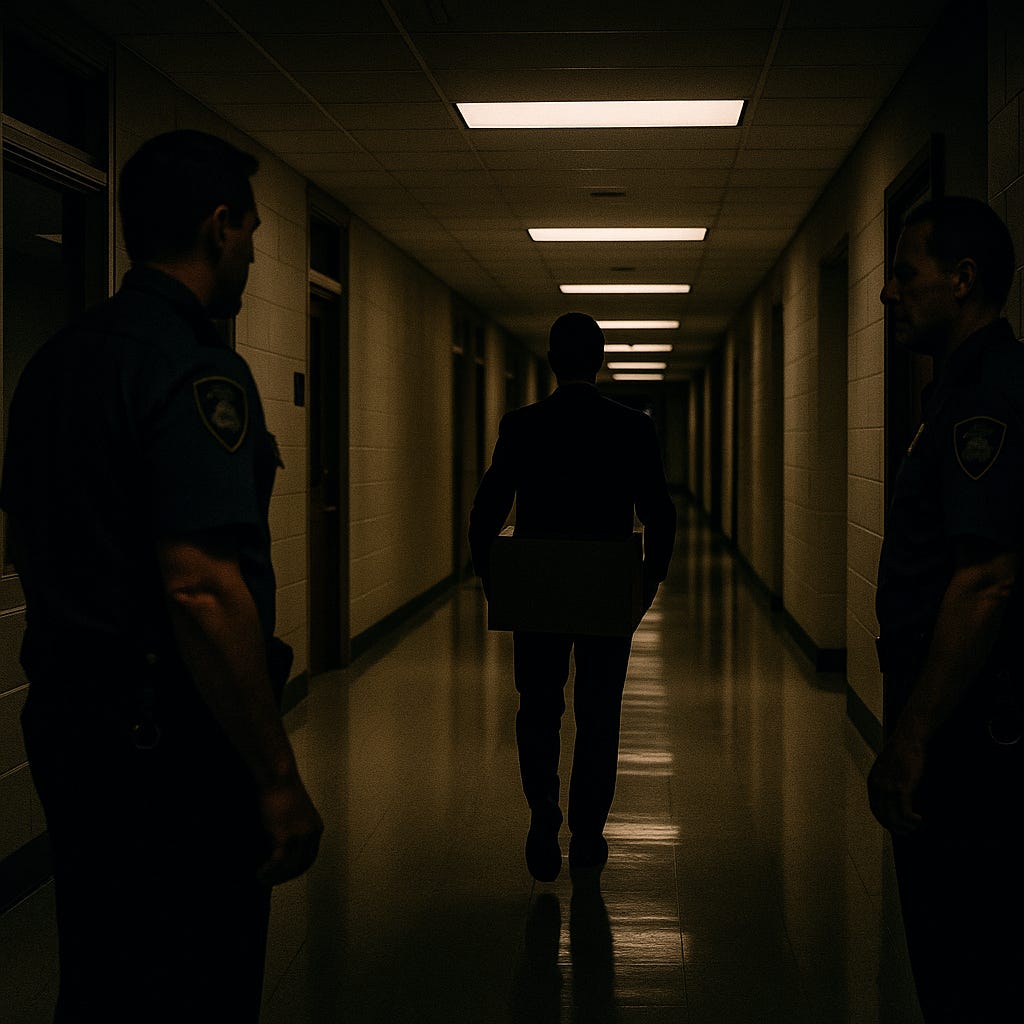
It happened quietly, the way power grabs often do.
At 8:47 p.m. Eastern on January 24, 2025, inboxes across Washington lit up with the same blunt subject line: “Termination of Appointment.”
By midnight, at least 17 inspectors general — the independent watchdogs embedded in the federal government’s most powerful agencies — were out of a job.
Defense. State. Energy. Housing and Urban Development. Agriculture. Veterans Affairs. Transportation. All stripped of their top internal investigators in a single coordinated sweep. Some were political appointees. Many were career professionals who had served under Republican and Democratic administrations alike.
A few refused to leave their offices that night. At least two were physically escorted out by security, a spectacle more at home in a corporate coup than a functioning democracy. By dawn, the administration had named “acting” replacements in nearly every post. Notably, several of these replacements had political ties to Donald Trump’s campaign or inner circle.
No public announcement was made that night. The news trickled out the next morning on a Saturday, buried under the weight of a carefully managed weekend news cycle. By then, the damage was done: one of the last remaining guardrails inside the executive branch had been ripped out.
This wasn’t a reshuffling of bureaucrats. It was a controlled demolition of oversight. And if you think that sounds alarmist, you don’t understand what an inspector general is, or why gutting them matters.
What Inspectors General Do & Why They Matter
Every major federal agency has an inspector general, an independent, nonpartisan official tasked with finding and exposing fraud, waste, abuse, and violations of the law inside the government. They are not loyal to the president. They are not beholden to Congress. They answer to the facts, to the law, and ultimately, to the public.
Think of them as the government’s internal affairs division. They audit the agency's spending. They investigate misconduct by senior officials. They issue reports that can embarrass political leaders, halt billion-dollar contracts, and force policy changes. And they do all this with legal protections designed to shield them from political retaliation.
When they work, they save taxpayers billions. The Defense Department IG alone has uncovered procurement fraud, botched weapons programs, and illegal contracting schemes worth hundreds of millions. The State Department IG has exposed corruption in foreign aid programs and violations of security protocols.
By law, inspectors general operate with a degree of independence rare in Washington. Presidents can remove them, but only after giving Congress 30 days’ notice and a written explanation. That safeguard exists for one reason: to prevent the very thing that happened on January 24, 2025.
The people who were fired that night weren’t faceless bureaucrats. They were the thin line between a functioning republic and a free-for-all for corruption.
On January 24, that line was cut in one coordinated strike.

The Purge Step by Step
The sweep began late in the evening on January 24, 2025, a Friday night, when fewer reporters are paying attention and fewer members of Congress are in town. One by one, termination emails went out to inspectors general across the federal government. There was no warning. No prior conversation. No official explanation beyond the boilerplate language: “Your services are no longer required.”
By the time the clock hit midnight, the administration had removed the top internal watchdogs at:
Department of Defense — overseeing the largest discretionary budget in the federal government.
State Department — monitoring foreign policy spending and security protocols.
Department of Energy — responsible for safeguarding nuclear materials and overseeing billion-dollar energy contracts.
Department of Housing and Urban Development — investigating corruption in housing grants and disaster relief funds.
Department of Agriculture — monitoring massive farm subsidies and food safety enforcement.
Department of Veterans Affairs — overseeing healthcare and benefits for millions of veterans.
Department of Transportation — auditing infrastructure projects and safety enforcement.
Plus the Environmental Protection Agency, the Department of Labor, the Department of Education, and others — bringing the total to at least 17 agencies stripped of their top watchdog in a matter of hours.
For some, the purge was more than an email.
At least two inspectors general who attempted to remain in their offices were met by federal security officers. They were ordered to collect their belongings and leave immediately. One longtime IG, who had served under four presidents, described the scene as “a government version of a midnight eviction.”
By sunrise, acting replacements had already been named. The pattern was impossible to miss: these were not neutral caretakers. Many were drawn from the ranks of Trump’s political allies, campaign staff, or individuals with prior loyalty tests on record. A former campaign fundraiser was tapped to oversee HUD’s internal investigations. A political consultant with no investigative experience was placed at the Department of Education.
The sheer speed was the point. By moving in one coordinated strike, the administration left no time for Congress to intervene, no time for the press to build momentum, and no time for the public to even grasp what was happening before the deed was done.
And for the first time in modern history, nearly every major cabinet-level agency in the United States was without its independent internal watchdog, all at the same time.
We’ve been reporting on this since the beginning. See some of that coverage here:
Note: This article is more than 45 days old and now lives in our archive. Consider becoming a paid subscriber for exclusive perks including full access to our more than 850 articles.

The Legal Breach
The Inspector General Act of 1978 was written for moments exactly like this, moments when a president decides to get rid of the people inside the government whose job is to investigate him. It doesn’t make IGs untouchable, but it builds a speed bump high enough to slow down an abuse of power.
The law is crystal clear:
The President shall communicate the reasons for removal to both Houses of Congress at least 30 days before such removal or transfer becomes effective.
Two requirements. Both broken.
First, the 30-day notice never happened. These 17 terminations were immediate, delivered via email, and enforced in some cases within hours. There was no chance for congressional oversight, no period for lawmakers to question the move, no opportunity for the public to react.
Second, there was no meaningful written explanation. The law requires the president to give Congress the reasons for each removal. In this case, the notices that did go out were pure boilerplate, offering no specific cause, not even the usual fig leaf of “loss of confidence.”
That’s not just bad governance. It’s a violation of federal law.
Already, several of the ousted inspectors general have filed lawsuits arguing the president acted unlawfully. Their cases rest on straightforward statutory language: the law sets the process, and the president ignored it. Legal scholars across the political spectrum, from progressive watchdog groups to conservative oversight advocates, have said the same thing: this was a direct hit on a statute designed to protect the public’s right to an honest government.
Defenders of the purge point to the phrase “serve at the pleasure of the president”, a political talking point that doesn’t hold up under the weight of the statute. Yes, a president can remove an IG. No, he cannot do so in secret, without notice, and without cause. That’s not presidential discretion. That’s lawbreaking.
And when that guardrail falls, history stops being a warning and starts being a how-to manual for unchecked power.
Unchecked Executive Power: The Constitutional Stakes
History is full of presidents who pushed the boundaries of their office. Lincoln suspended habeas corpus during the Civil War. FDR tried to pack the Supreme Court. Nixon ordered the firing of the special prosecutor investigating him in the “Saturday Night Massacre.” All of those moves sparked public outrage, congressional resistance, and lasting political damage.
But until January 24, 2025, no president had ever moved to erase nearly every major internal watchdog in the federal government in one coordinated sweep. Not Nixon. Not Reagan. Not Clinton. Not Bush. Not Obama. Not even Trump in his first term.
This is the crucial difference:
Nixon’s massacre targeted external investigators, people already coming after him.
Trump’s purge eliminates internal watchdogs before they can even start.
It’s not just playing defense against oversight. It’s preemptively stripping the government of the ability to police itself.
And these aren’t token positions. The inspectors general removed that night had jurisdiction over trillions in federal spending, nuclear material security, military procurement, foreign aid, housing programs, veterans’ healthcare, and infrastructure funding. Their absence isn’t symbolic; it’s operational.
This is how power consolidates.
You don’t need to abolish Congress. You don’t need to fire every civil servant. You just remove the people who are legally required to blow the whistle when the president’s allies break the rules. And you replace them with loyalists whose first loyalty is to the man in the Oval Office, not to the law.
The framers of the Constitution feared this. They designed a system where ambition would check ambition, where no branch could dominate without resistance. The modern inspector general system, created in the 1970s after Watergate, is one of the few tools left that works as intended. Destroying it isn’t reform. It’s regression to an era before the public had any right to know what their government was really doing.
And the purge isn’t a one-off; it’s just the clearest example of a playbook already in motion.
Part of a Bigger Pattern
If the “Friday Night Purge” were an isolated event, it would still be alarming. But it isn’t. It’s part of a systematic, well-funded strategy to strip the federal government of anyone who can say “no” to the president and to replace them with people whose careers depend on saying “yes.”
The same week the inspectors general were fired, the American Accountability Foundation (AAF) — a right-wing group aligned with Trump’s political operation — expanded its online watchlists of federal employees. The list names, photographs, and profiles more than 175 career civil servants, many of them women and people of color, accusing them of promoting “woke” policies like diversity, equity, and inclusion. The message to the MAGA base is clear: these people are “subversive” and should be purged.
It’s the same playbook used against the IGs — delegitimize, remove, replace.
Delegitimize by framing watchdogs as partisan actors.
Remove them in one coordinated strike.
Replace them with “acting” loyalists who don’t require Senate confirmation.
This approach has a name in political science: authoritarian capture. You don’t dismantle institutions outright. You hollow them out, keep the shell intact for appearances, and fill them with people who will use the office to advance a political agenda instead of the public interest.
The pattern is already visible across the Trump administration’s second term:
Justice Department — senior leadership stacked with personal loyalists, some with open conflicts of interest.
Agency “acting” heads — appointed in ways that sidestep Senate confirmation, limiting legislative oversight.
Whistleblower retaliation — protections weakened through executive orders and agency directives.
Information control — the removal of thousands of government web pages and data sets, limiting what the public can see.
The inspector general purge is simply the most blatant move yet, but it fits neatly into a broader, coordinated project to dismantle independent oversight.
And if we treat it as an isolated “controversy” rather than part of a governing philosophy, we’re already behind the curve.
Voices from Inside & Expert Warnings
Patricia Kramer had worked as an inspector general for more than a decade. She’d served under presidents from both parties. Her office had uncovered multimillion-dollar contracting fraud and exposed senior officials for misusing public funds. On January 24th, she was halfway through preparing a report on bid-rigging in a federal housing program when the termination email landed in her inbox.
“They didn’t even wait until the report was done,” she told a small group of reporters days later. “That’s the point — they didn’t want it done.”
Another ousted IG, speaking on condition of anonymity, said he wasn’t shocked by the firing, but by the speed and brutality of it. “We’ve all been replaced before, eventually,” he said. “But never like this. No notice. No conversation. Just a badge deactivated and security at your door.”
Their experiences match what oversight experts have been warning for months: if the Trump administration can erase 17 watchdogs in a single night without consequence, the independence of the inspector general system collapses.
Walter Shaub, the former director of the Office of Government Ethics, put it bluntly:
“This isn’t just about these 17 people. It’s about sending a message that no one in government is safe if they get in the president’s way. That’s how you destroy a system from the inside out.”
Even Senator Chuck Grassley, a Republican who has long championed inspectors general, sounded the alarm.
“The law must be followed,” he said in a rare joint statement with Democratic Senator Dick Durbin. “Inspectors general serve the American people, not the president’s political interests.”
Inside the agencies, the purge has already created a chilling effect. Staff who once flagged potential fraud to the IG’s office now hesitate, unsure whether new “acting” inspectors will treat whistleblowers as allies or enemies. Several investigations, including probes into defense contracting overruns, foreign aid misuse, and environmental enforcement failures, have reportedly been paused or reassigned.
And if the people who speak up are silenced now, the next purge won’t need to fire anyone, because no one will dare to challenge the president again.
What Happens if This Stands
If the Friday Night Purge goes unchallenged, it won’t just be a bad chapter in the history books — it will become the blueprint for every president who follows.
From now on, any president will know they can remove every major internal watchdog in a single night. They won’t need a scandal as an excuse. They won’t need to prove cause. They won’t even have to wait until Congress leaves town. Just one coordinated order, and the guardrails are gone.
Oversight will become a performance, not a safeguard. The people in charge of rooting out corruption will be chosen for their willingness to look the other way. Investigations that threaten the White House will die quietly in draft form. Whistleblowers will learn that “protected disclosure” is a legal term, not a reality.
And once the inspector general system is gutted, other checks will fall in line:
Independent prosecutors replaced with loyal enforcers.
Congressional oversight starved of information until hearings become theater, not accountability.
Courts slowly packed with judges who see executive power as limitless.
The public won’t see it happening in one dramatic moment. The shift will be gradual — a little less transparency here, a few fewer investigations there — until the machinery of accountability exists in name only.
By then, it won’t matter who sits in the Oval Office. The presidency itself will have evolved into something the framers feared: a single, unaccountable executive who can control not just policy, but the very flow of truth about how the government operates.
And when that day comes, it won’t take a purge to cement power. The purge will have already happened.
Call to Action: Stopping the Slide Now
The Friday Night Purge is not just another Washington scandal. It is a stress test of whether the public will defend the last internal checks on presidential power. If we fail, the precedent is set — and it will be used again.
Here’s what you can do right now to fight back:
1. Demand Congressional Action
Call your senators and representatives. Tell them to:
Hold immediate public hearings on the mass removal of inspectors general.
Subpoena the administration’s written justifications for each firing.
Strengthen the Inspector General Act to make illegal removals enforceable by the courts.
Capitol Switchboard: (202) 224-3121
2. Support Whistleblowers
Project on Government Oversight (POGO): https://www.pogo.org
Government Accountability Project: https://www.whistleblower.org
3. Protect the Facts
Sunlight Foundation: https://sunlightfoundation.com
MuckRock: https://www.muckrock.com
4. Keep It Public
Share credible reporting, correct disinformation, and push candidates to make oversight a priority.
The truth is simple: If we don’t push back now, we’re not just watching the guardrails come off — we’re helping take them off. The Friday Night Purge is not the end of the story. It’s the start of a dangerous new chapter. Whether it becomes the norm or the cautionary tale is up to us.
Stay Informed. Stay Loud.
Subscribe to The Coffman Chronicle for no-BS political analysis, action guides, and daily truth bombs you won’t get from corporate media.
Bibliography:
“Trump Fires More Than a Dozen Independent Inspectors General at a Series of Agencies.” AP News, January 25, 2025.
“Firings, Freezes and Layoffs: A Look at Trump’s Moves Against Federal Employees and Programs.” AP News, January 28, 2025.
“Some Senate Republicans Defend Trump’s Firing of 17 Inspectors General.” Reuters, January 26, 2025.
“Trump’s Firing of Independent Watchdog Officials Draws Fire.” Reuters, January 25, 2025.
U.S. Senate Committee on the Judiciary (Sens. Chuck Grassley & Dick Durbin). “Grassley, Durbin Seek Presidential Explanation for IG Dismissals.” Press release, January 28, 2025.
Grassley, Chuck. “Letter to President Trump Regarding IG Removals,” January 28, 2025.
Wilhelm, Ben. Removal of Inspectors General: Rules, Practice, and Considerations for Congress (In Focus IF11546). Congressional Research Service, January 27, 2025.
Lucas, Kevin M., and Kathryn A. Francis. Statutory Inspectors General in the Federal Government: A Primer (R45450).
The Inspector General Act of 1978 (as amended). U.S. Department of Transportation OIG (official compilation), updated December 20, 2022.
“Pro-Trump Group Wages Campaign to Purge ‘Subversive’ Federal Workers.” Reuters, August 7, 2025.
“Obama Fires Bush-Appointed IG Overseeing AmeriCorps.” GovExec, June 12, 2009.
“Lessons Learned from Obama’s Removal of CNCS Inspector General.” POGO, June 15, 2009.
“Saturday Night Massacre.” Miller Center Encyclopedia, accessed August 2025.
Like the old saying goes, "You get what you pay for!" And, in the case of felon, you'll paid "bargain basement!" So, yeah, he's trying to dismantle every aspect of the legal and legal-adjacent systems that will help him avoid being held accountable for his crimes, but, then again, you already knew!!
In the meantime, do something that pays real dividends. Order apparel and accessories from Beaconwear on Walmart. We design and sell items that inspire, uplift, and empower. And, boy could all of us use that now! Just click to browse and order!
https://www.walmart.com/search?q=beaconwear
Have a better day!
RJ of Beaconwear
It is old news, but it is still vital. It’s astounding that this was ignored by the mainstream media. A harbinger of the autocracy we now face with the militarization of our nation’s capital. Shameful