


When Missouri voters leaned 58% for Trump in 2024, they likely expected Republican strength in their congressional delegation. However, with new maps passed this week, Republicans are now positioned to take 7 out of 8 U.S. House seats, accounting for 87.5% of the state’s representation, in a state where Democrats regularly win more than 40% of the vote.
Missouri isn’t an outlier. In Texas, after new lines were approved in August, Republicans are projected to hold 25 or 26 of the state’s 32 House seats, despite receiving just 56% of the statewide vote in recent elections. That’s roughly 79% of the delegation.
And in Florida, where Republicans already hold 20 of 28 House seats, or 71% of the total, lawmakers are preparing redistricting committees five years in advance, laying the groundwork for new maps well ahead of the 2030 census, despite garnering only 56% of the vote. In all three states, the GOP's share of seats far exceeds its share of the vote. It’s not a coincidence. It’s design.
These are not isolated anomalies. They are part of a deliberate, multi-state playbook redefining how power is mapped, in many cases, before voters can even respond.
Stay Informed. Stay Loud.
Subscribe to The Coffman Chronicle for no-BS political analysis, action guides, and daily truth bombs you won’t get from corporate media.
Missouri’s Sit-In: A Warning, Not a Footnote
Last week, inside the Missouri State Capitol, three first-term Democratic lawmakers—Representatives Ray Reed, Elizabeth Fuchs, and Jeremy Dean—camped out on the House floor for more than 100 hours beginning Thursday night. They brought sleeping bags, blankets, and takeout meals. Former Vice President Kamala Harris sent them fried chicken and words of support. They weren’t staging a stunt. They were sounding an alarm.
The protest was timed to stop or at least slow the state’s Republican-controlled legislature from approving two major power grabs in a special session: a new congressional map designed to erase a Democratic district centered around Kansas City, and a rule change to make it dramatically harder for voters to pass statewide ballot initiatives.
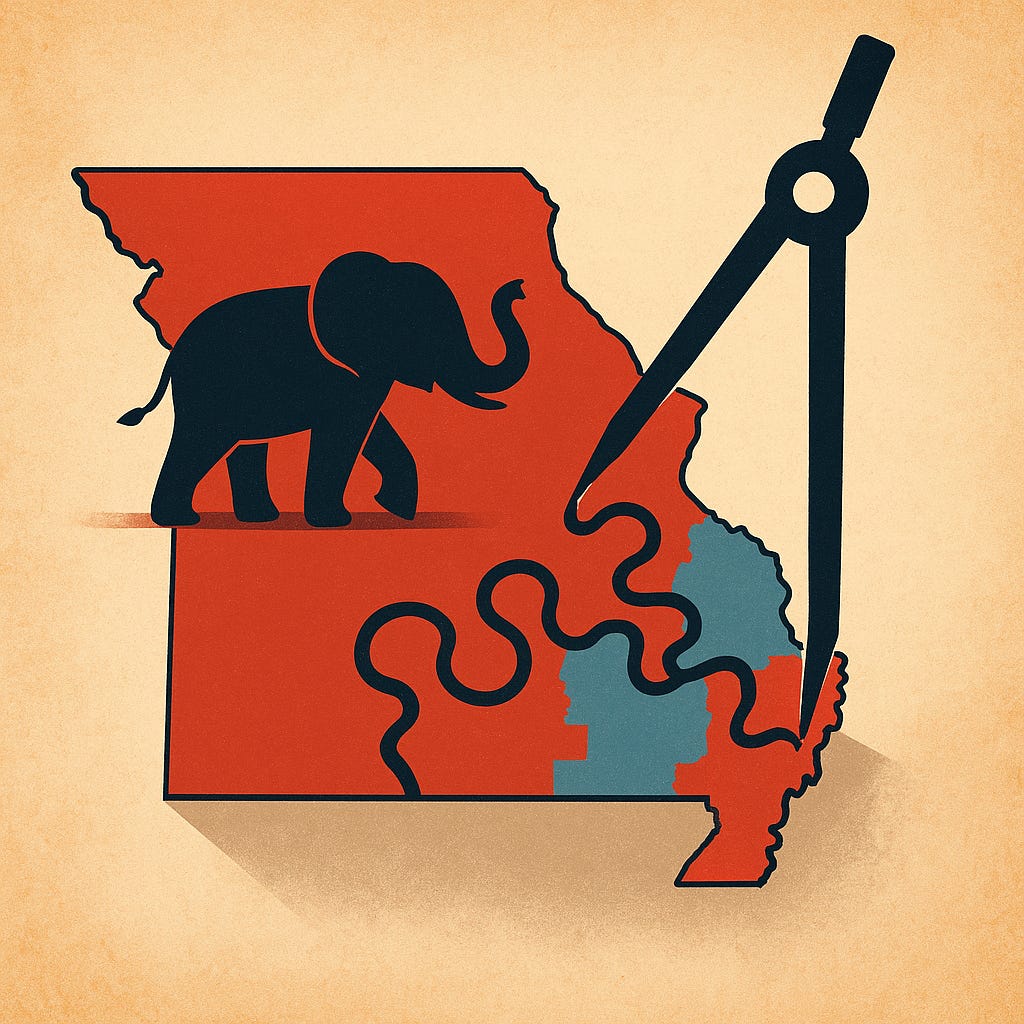
Early this week, the GOP majority pushed through both. The new map turns Missouri into a 7–1 Republican stronghold, breaking up Democratic-leaning communities in and around Kansas City and fusing them with heavily rural counties.
Reed, Fuchs, and Dean knew they couldn’t stop the vote, but by refusing to leave the floor, they made clear this is what democratic backsliding looks like in real time. It doesn't arrive with tanks or bans. It comes in the form of maps and technicalities.
Sound familiar? It should. We reported on a similiar effort in Texas last month. See that reporting here:

Redistricting 101: What It’s Supposed to Be
In American politics, redistricting is supposed to follow the census. The Constitution requires a count of the population every ten years. That count forms the foundation for how seats in Congress are apportioned and how districts are drawn.
It’s not just tradition. It is the structure established by the Constitution in Article I, Section 2: “Representatives and direct Taxes shall be apportioned among the several States… according to their respective Numbers...” The Fourteenth Amendment further clarified this in Section 2 by stating: “Representatives shall be apportioned among the several States according to their respective numbers, counting the whole number of persons in each State...”
While the Constitution doesn't prescribe how states must draw their internal congressional or legislative district lines, federal courts have interpreted "one person, one vote" to mean that congressional districts must be nearly equal in population.
That interpretation comes from the Supreme Court's 1964 ruling in Wesberry v. Sanders, which held: “As nearly as is practicable, one man's vote in a congressional election is to be worth as much as another's.”
What’s Different Now: Timing and a Mandate
Historically, mid-decade redistricting has occurred only a handful of times, and each instance has been met with controversy and, often, bipartisan pushback. It is rare for a reason. It throws out the basic framework that makes representative democracy function. It undermines public trust, destabilizes the electoral process, and renders the census—a constitutionally mandated process—effectively optional for those in power.
The current efforts are strategic and intentional, aiming to secure additional safe seats for Donald Trump ahead of the 2026 midterms, with the goal of preventing a repeat of his first term, in which the House flipped halfway through, especially as polling shows increasingly poor approval ratings.
He hasn’t been shy about his demands. In addition to ordering the Commerce Department in August to create a new census excluding “immigrants”, Trump has stated that he won some states, such as Texas, by so much that he is “entitled” to more seats.
The result is distorted maps that no longer reflect the people they claim to represent—if they ever did. The numbers above make it clear that even previous maps failed to accurately reflect the will of the electorate, highlighting just how long this imbalance has been embedded. States considered reliably red, like Texas, may only narrowly vote Republican in statewide elections, yet their congressional delegations remain overwhelmingly and disproportionately conservative.
That’s not reflective democracy. That’s engineered dominance.
The National Pattern: State by State, Seat by Seat
This isn’t just Missouri, Texas, and Florida. It’s not just a few maps or a few seats. What’s happening is broader, more strategic, and more dangerous than most national headlines are catching.
Across the country, Republican-led legislatures are using control over the redistricting process to entrench political dominance, not by persuading more voters, but by choosing which voters count, and how. And it isn’t new. They’ve been doing it all along.
In Georgia, GOP lawmakers passed a mid-decade redraw in 2005 that broke decades of precedent and re-carved Democratic strongholds into Republican-safe zones. That map helped Republicans secure control of the state House, Senate, and governorship, and set the precedent for today’s efforts.
In Ohio, courts struck down the legislature’s original 2021 maps for violating the state’s constitutional amendment requiring fair redistricting, but Republican lawmakers repeatedly submitted nearly identical maps until the court relented under deadline pressure. The result is a gerrymandered map functionally preserved through legal brinkmanship.
In North Carolina, redistricting has become a recurring constitutional crisis. Maps passed in 2021 were blocked, redrawn, reinstated, and re-contested, all while control of the state Supreme Court shifted from left to right. Voters haven’t changed. The lines have—over and over again.
And now, more states are announcing their plans to follow Texas and Missouri’s lead in redistricting. In Florida, redistricting committees are forming again. Indiana has also started the conversation.
These are not isolated power grabs. They are part of a coordinated national strategy:
Redraw early.
Tilt districts just enough to flip or secure key seats.
Repeat the process wherever public opinion begins to shift.
It doesn’t take massive gerrymanders in one state. A few seats in a few states, compounded, can be the difference between a House majority and a minority in 2026. And that’s exactly what this is about: controlling the national outcome by manipulating the local mechanics.
The Legal Loophole
On the surface, gerrymandering appears to be a constitutional issue. The idea that politicians can redraw maps to guarantee their own power before a single vote is cast feels like a direct violation of democratic principles.
And yet, in case after case, the U.S. Supreme Court has allowed it, not because the Court believes gerrymandering is fair, but because it has drawn a sharp line between what’s unfair and what’s unconstitutional.
Here’s how that line works:
If a map is drawn to hurt voters because of how they vote, that’s partisan gerrymandering.
If it’s drawn to hurt voters because of who they are, that’s racial gerrymandering.
The first is considered legal, the second is not.
How the Supreme Court Opened the Door
This legal distinction comes from the 2019 case Rucho v. Common Cause. In that case, the Court reviewed maps from North Carolina so blatantly partisan that the state’s Republican lawmakers openly admitted their goal. One said on the record that the map was drawn to ensure a 10-to-3 advantage for Republicans, because 11-to-2 “wasn’t possible.”
Still, in a 5–4 decision, Chief Justice John Roberts wrote that partisan gerrymandering—even when extreme—is a “political question,” not one federal courts can fix:
“Excessive partisanship in districting leads to results that reasonably seem unjust. But the federal judiciary has no authority to reallocate political power between the two major parties.”
In short, it’s unfair, but not unconstitutional. The Court’s majority admitted it was a problem and then walked away from it.
But Race Is Different, At Least On Paper
Four years later, in Allen v. Milligan (2023), the Court ruled that Alabama’s congressional map violated the Voting Rights Act of 1965 by diluting Black voting power.
Alabama had drawn just one majority-Black district despite Black residents making up more than a quarter of the state’s population. The plaintiffs argued that Black voters could easily have been grouped into two districts, allowing them to elect candidates of their choice in both.
In a surprising 5–4 decision, the Court agreed. Roberts again wrote the majority opinion, this time joined by Justice Brett Kavanaugh and the Court’s three liberals:
“We find that the plaintiffs demonstrated a discriminatory effect... and that the map as drawn likely violates Section 2 of the Voting Rights Act.”
It was a rare moment of judicial restraint and a win for voting rights, but it was also the exception, not the rule.
Where the Loophole Lives
The Court will step in to block a map when race is the primary reason for drawing districts, but it won’t act when lawmakers say they’re drawing maps based on politics, even when race and politics are often inseparable.
That’s the loophole, and Republicans are walking straight through it.
In states like Missouri, Texas, and Florida, it’s no secret that urban voters—especially Black and Latino voters—overwhelmingly lean Democratic. By splitting those communities and pairing them with sprawling rural districts, Republican mapmakers achieve two goals: they reduce Democratic representation, and they dilute the voting power of communities of color.
But as long as they claim they’re targeting Democrats—not Black voters specifically—the map is likely to stand.
Even when the outcome is clear, the courts want intent. They want proof. They want an email, a memo, a confession—something that says race, not party, was the driving motive. Without it, the burden of proof falls on the very communities being pushed out of power.
Hello, Hypocrisy
Meanwhile, earlier this week, the Court handed down another revealing decision, this time on immigration enforcement. In a 6–3 ruling, the Court upheld broad discretionary powers for ICE agents, allowing them to detain individuals based on racial profiling concerns that many legal experts argue run afoul of the Fourth and Fourteenth Amendments.
See our reporting here:

Think about that.
The same Court that says it cannot intervene to stop mass-scale, vote-diluting map manipulation because it’s “not the judiciary’s job,” is now actively authorizing race-based enforcement powers by the executive branch. One part of the government receives a blank check to target individuals based on their identity. Another washes its hands when states redraw maps to eliminate their voices, unless someone left the smoking gun in the files.
In Missouri, Texas, and Florida, lawmakers are rigging the maps under the cover of “partisan” strategy. Communities of color are being carved apart. Voters are being split, packed, silenced—not with force, but with lines on a map.
The Courts Move Slowly By Design
If the last few years have taught us anything, it’s that the courts do not move at the speed of power grabs. In the event that the courts do intervene, the glacial speed of the judiciary ensures the game can play on for years, impacting multiple elections.
When a state legislature passes a gerrymandered map or rewrites its election rules, the effect is immediate. The lines change. The rules shift. The next election will run on the new system, even if it’s under legal challenge.
Court cases, on the other hand, can take years, and that delay isn’t a flaw in the system, but a feature being exploited.
In Texas, lawsuits were filed just weeks after the 2021 congressional map was signed into law. Civil rights groups argued the new lines violated the Voting Rights Act and intentionally reduced the power of Black and Latino voters. But as of now—four years later—those maps are still in place. The case is unresolved. In the meantime, Texas has passed a second round of redistricting in 2025, further solidifying the GOP’s hold on its congressional delegation.
Even in Alabama, where the Supreme Court ultimately ruled that the state’s map violated federal law, the timeline tells the real story:
The map was enacted in 2021.
The lawsuit was filed almost immediately.
The Supreme Court ruling came in 2023.
The corrected map didn’t take effect until the 2024 election.
That’s three full years under a map the Court later ruled was discriminatory.
The situation in Louisiana highlights the effectiveness of this delay. In Louisiana v. Callais, the Supreme Court was expected to rule on whether the state must draw a second majority-Black congressional district, as lower courts had ordered. Instead, SCOTUS delayed the decision, pushing it into the next term. That means the state will likely hold yet another election using a map a federal court already found discriminatory.
See our reporting on that case here:

The parallels to Alabama are striking, but this time, the Court’s delay may tip the balance in the 2026 midterms. The game is clear: stall the ruling, run the election, and let the damage stand.
In Missouri, lawsuits are expected over the new congressional map. However, the GOP has done its math. Even if it takes just two years for a case to reach a decision, the 2026 midterms will be run under the new, gerrymandered lines. If the case drags on longer, 2028 could be as well. By then, another census will be just around the corner, meaning the state can argue it’s time to draw new maps again anyway.
This is how the system is being gamed. It’s not just about what the courts eventually decide. It’s about how long it takes to get there, and how many elections can be run under an illegal—or at least unfair—map before anything changes.
This strategy has now gone national. In state after state, the pattern is the same:
Redraw the maps early.
Enact the laws quickly.
Let litigation crawl.
Win the elections while you wait.
Even if the courts eventually strike down the maps, the power they have already delivered is in place.
If you move fast enough, the Constitution can’t catch you.
The only real check on this system now is awareness, pressure, and turnout. Voters must know what’s happening. They must see the pattern. They must understand that this isn’t politics as usual.
It’s democracy in retreat. And nothing illustrates how much the regime knows this is unfair as clearly as their response to the idea of Democrat-leaning states proposing their own mid-decade redistricting.
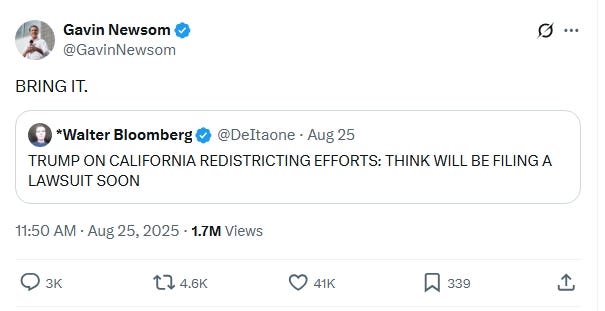
If we have to play the stupid, rigged game, we must have access to the same mid-game-changing, crooked rules that the other side is playing by. In addition to making sure everyone understands what they are doing and why it is wrong, we must win the damn game.
Stay Informed. Stay Loud.
Subscribe to The Coffman Chronicle for no-BS political analysis, action guides, and daily truth bombs you won’t get from corporate media.
Sources:
“How closely do congressional delegations reflect how people vote? Not very” — AP News
“Trump hands down new demand for Republicans amid redistricting battle” — Newsweek (via MSN)
“Trump orders 'new' census that excludes undocumented immigrants” — CNBC
"Missouri House approves Republican-drawn congressional map" — Reuters
"Missouri state House passes Trump‑backed congressional map" — The Washington Post
"Missouri Republicans advance Trump-backed plan to redraw US House districts" — AP News
"Missouri House advances bill to make it harder for voters to amend state constitution" — Missouri Independent
"Missouri House passes gerrymandered congressional map, limits on initiative petitions" — Missouri Independent
"Missouri House advances plan to make it harder for some amendments to pass" — STLPR
"Republicans’ next redistricting target: Missouri" - Politico
"Trump says Missouri is next in GOP push to redraw U.S. House map" - The Telegraph
"Missouri court upholds voter approval of minimum wage and paid sick leave initiative" — AP News
Rucho v. Common Cause (2019) — Supreme Court
Rucho v. Common Cause (Case Overview) - Oyez
Allen v. Milligan FAQ (2023) — Legal Defense Fund
Allen v. Milligan — Wikipedia
Allen v. Milligan (Post-Ruling Developments) - The American Redistricting Project
“Court rules Alabama violated Voting Rights Act in drawing congressional lines” - AP News
“Federal Court Orders Use of Fair Map Through 2030” - AP
This is the last grasp of the oligarchy - and if they win, it could well be the end of democracy - the solution: vote. Vote Dem. Flip the seats. Turn the fuck out.
Perhaps it would be better to divide up the USA in ablue country and a red one after all ? I have no idea how else the trenches can be closed again.