


On the first Thursday in August, Tessa Harper stood in the school-supply aisle.
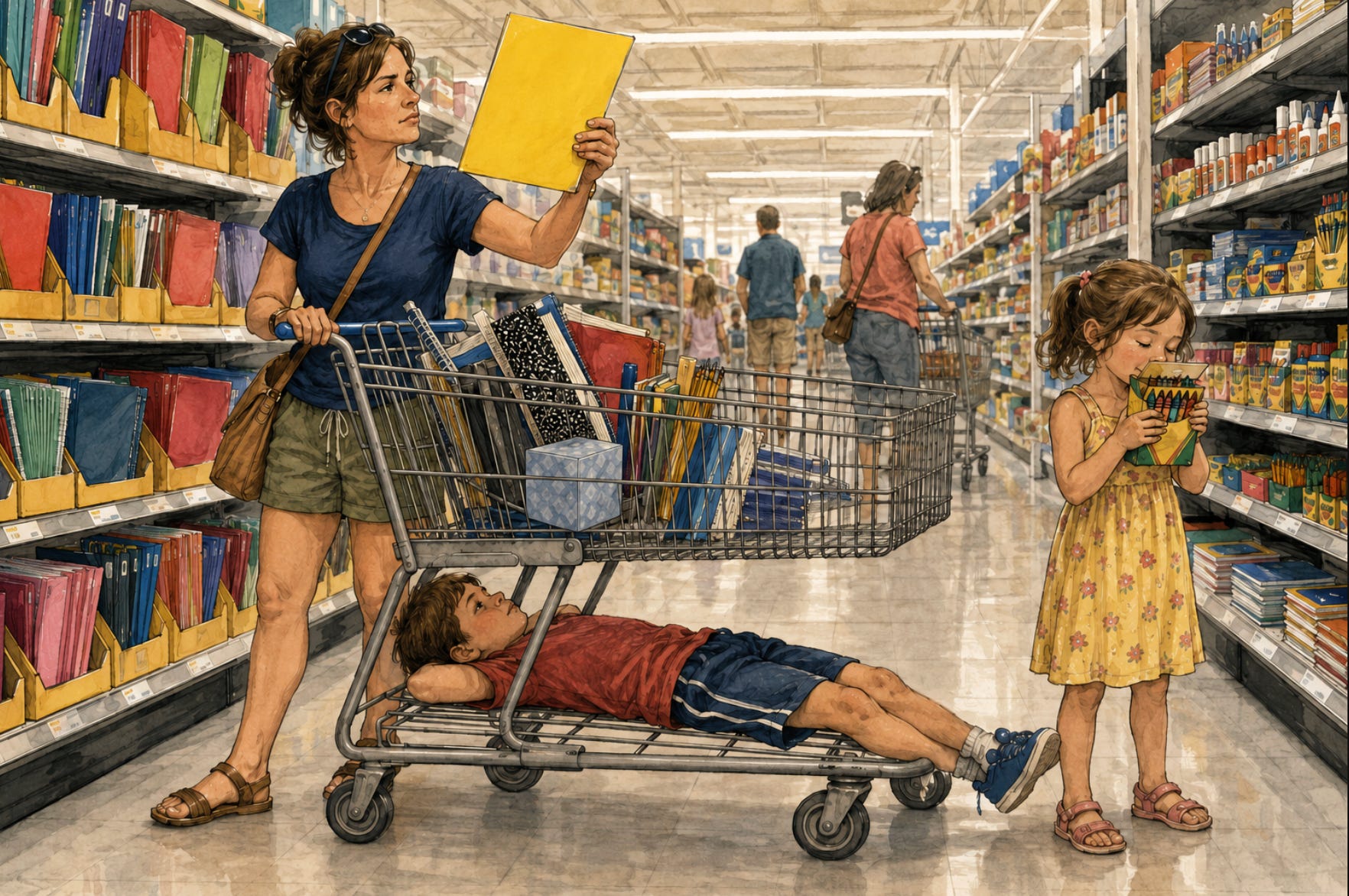
She held a yellow plastic folder up to the fluorescent lights as though she were checking it for counterfeit currency.
The folder had pockets. It had prongs. It was plastic. Unfortunately, it was lemon yellow. Owen’s third-grade supply list specified golden yellow. Tessa placed it in the cart anyway.
“If Mrs. Vega rejects it,” she told Owen, “tell her the lighting in our house is deceptive.”
Owen lay across the bottom rack of the cart, one sneaker dragging on the tile. His younger sister, Lucy, had abandoned the cart entirely and was smelling boxes of crayons. “They smell better when they’re new,” she explained.
They did. The aisle smelled of wax, pencil shavings, plastic packaging and the cinnamon pretzel stand near the entrance.
Outside, the heat shimmered above the parking lot. Inside, parents were competing for the last packs of washable glue sticks.
Between third grade and kindergarten, Tessa’s children required twenty-four. She had done the math twice because the first answer seemed like enough adhesive to attach a modest shed to its foundation.
At the display, Tessa reached for the last two six-packs at the same moment as a woman in blue medical scrubs who looked as though she had finished a twelve-hour shift and been rewarded with a scavenger hunt.
“How many children?” Tessa asked.
“Three.”
“Take them.”
“No, you take them.”
“My youngest probably eats paste anyway.”
“Mine thinks glue sticks are lip balm.”
They each took one pack and agreed their children would simply have to develop weaker attachments.
By the time Tessa reached the register, her cart held backpacks, tissues, notebooks, folders, dry-erase markers, headphones, disinfecting wipes, storage bags, pencils, crayons, colored pencils, scissors, glue, sanitizer, and one pink rubber eraser Lucy had named Strawberry.
The scanner chirped. Beep. Beep. Beep. Each sound removed another small piece of Tessa’s paycheck.
The cashier read the total. “One hundred eighty-four dollars and sixty-seven cents.”
Tessa stared at the screen. “Does that include tuition?”
The cashier did not laugh. It was early August. She had heard everything.
This Community Is Powered by You
What started as a small circle has grown into something much bigger, and it’s all because of readers like you.
Every time you forward this email, post it on socials, or bring someone new into the fold, you’re helping build one of the most passionate, independent communities out there.
Want to keep the momentum going?
Share this newsletter with someone who should be part of this conversation.
Thank you for being here. It means everything.
The Price of ‘Required’
In the parking lot, Tessa took a picture of the receipt and posted it to the third-grade parent group. **Is my child going to school or opening an office-supply store?**
By dinner, it had become a movement. One parent wanted to know why every child needed four boxes of tissues. “Are they teaching fractions by blowing their noses?”
Another said she would provide one tissue per sneeze, provided the school submitted appropriate documentation.
A father named Brent calculated that if every student brought forty-eight pencils, Mrs. Vega’s classroom would contain 1,248 pencils. “No classroom needs 1,248 pencils,” he wrote.
Someone called Mrs. Vega “Miss Amazon Wishlist.” Someone else pointed out that teachers already spent hundreds of dollars of their own money.
Tessa read the comments over boxed macaroni. Her annoyance grew, although she was no longer certain whom she was annoyed with. Mostly, she was annoyed that she had spent nearly two hundred dollars and was still six glue sticks short.
Across town, Marisol Vega read the post in the checkout line of another store. Her cart held glue sticks, pencils, crackers, name tags, replacement headphone cushions, a pencil sharpener, folders for children who arrived without them, plastic bins, Band-Aids, bulletin-board paper, and a small fan for the reading corner, where the air conditioner never quite reached.
Her district classroom allowance was $175 for the year. The cashier gave her the total. “Four hundred thirteen dollars and eighty-two cents.”
Mrs. Vega looked at the cart. Then she looked at Tessa’s post. She typed three replies and deleted them all.
The List Meets the Classroom
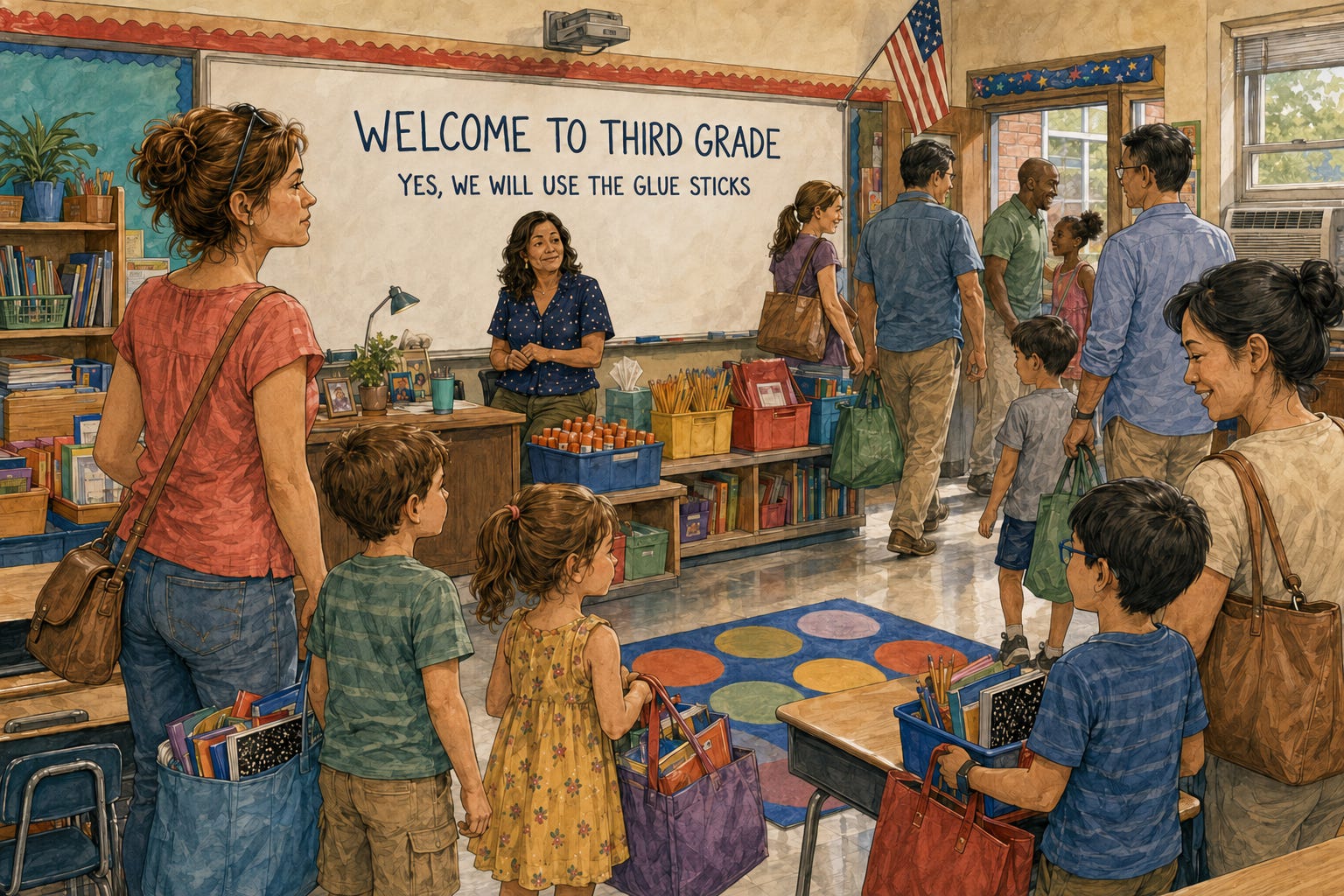
The following Tuesday was back-to-school night. Mrs. Vega’s classroom smelled of lemon cleaner, construction paper, and freshly sharpened pencils. The air conditioner rattled in the window.
On the whiteboard she had written: WELCOME TO THIRD GRADE
Underneath: YES, WE WILL USE THE GLUE STICKS
Tessa noticed immediately. So did everyone else.
Brent had labeled each of his son’s forty-eight pencils individually.
“You labeled the erasers?” Tessa asked.
“They detach,” Brent said.
At seven o’clock, Principal Lyle stepped into the room wearing a school polo and an expression of administrative hope. “I understand there have been questions about this year’s suggested supply list.”
“Required,” Tessa said.
“Strongly suggested.”
“The word ‘required’ is printed at the top.”
“That may be a formatting issue.”
“It’s in bold.”
“A bold formatting issue.”
Tessa had rehearsed an angry speech. Then she noticed the dark circles beneath Mrs. Vega’s eyes and asked the least angry version of the question. “Why does every child need forty-eight pencils?”
“Because children use pencils,” Mrs. Vega said.
“That’s 1,248 pencils.”
“Yes.”
“Where do they all go?”
Mrs. Vega looked around the room. “Last year, one was pushed through a window screen. Fourteen became drumsticks. At least six were traded for snacks. One was planted in a cup because a student believed pencils were made from trees and could grow into trees.”
“Did it?” Owen asked.
“No, but we watered it until Thanksgiving.” A few parents laughed. “By October,” Mrs. Vega said, “I will be able to find six pencils. One of them will be green.” Even Brent laughed.
Tessa picked up the supply list. “What about the tissues, wipes, and storage bags? Those aren’t for individual students.”
“No,” Mrs. Vega said.
“Then why isn’t the school buying them?”
Principal Lyle shifted his weight. “The district provides essential instructional materials.”
“Are pencils essential?”
“Yes.”
“Does the district provide them?”
“Some.”
“How many?”
Mrs. Vega opened a cabinet.
Inside were two boxes of pencils, one package of notebook paper, eight dry-erase markers and a gallon jug of institutional hand sanitizer. “That’s what I received,” she said.
“For the year?”
“For the year.”
The room went quiet.
What the List Couldn’t See
A small boy entered late with his grandmother. He carried his supplies in a paper grocery sack darkened with sweat. Inside were three notebooks, one box of pencils, and colored pencils.
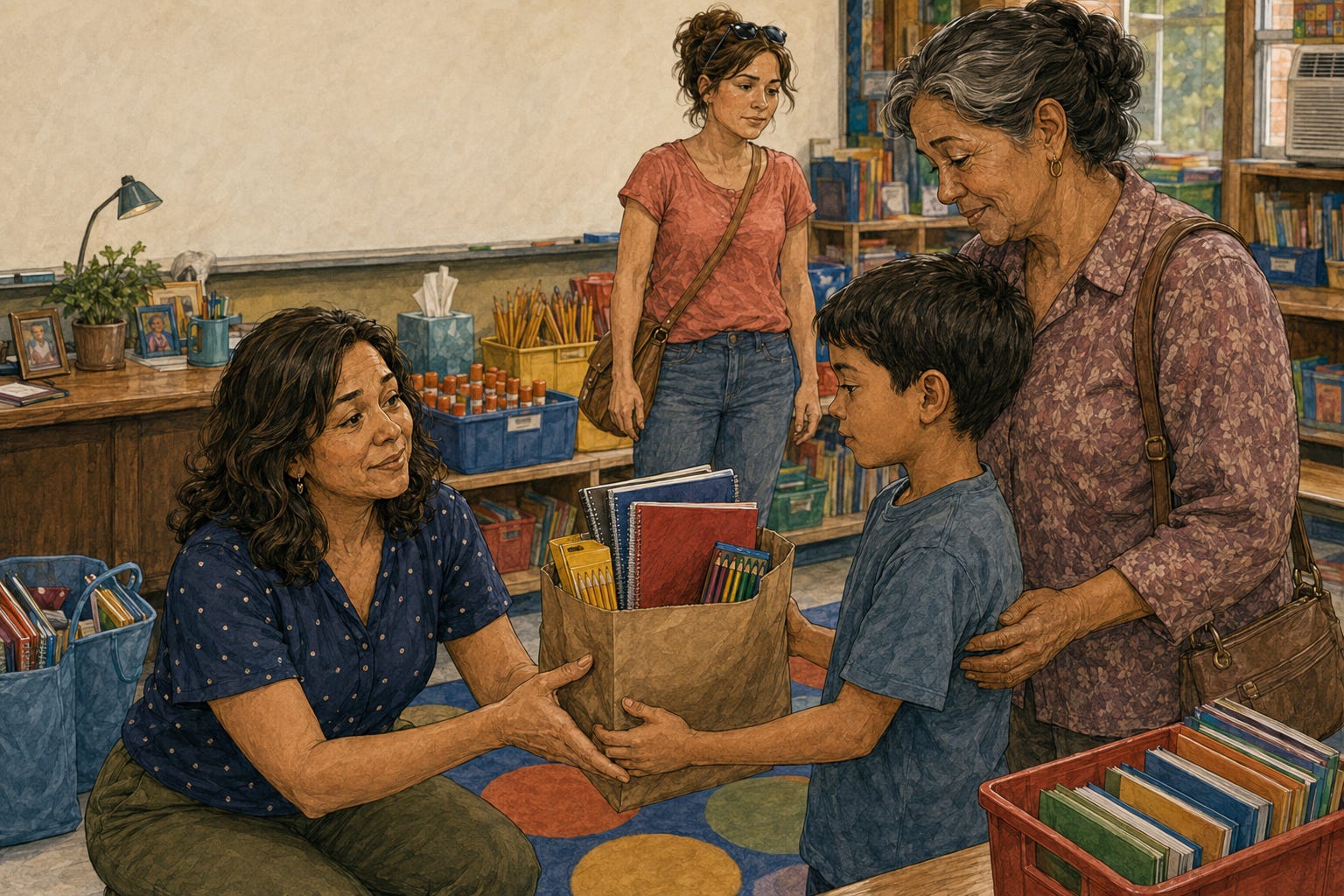
His grandmother spoke quietly. “I’ll get the rest after Friday.”
Mrs. Vega took the sack as if it contained everything on the list. “This is plenty,” she said. “We have what he needs.” She did not say it loudly enough to turn kindness into a performance. She simply showed the boy his desk.
Tessa looked at the communal bins again.
For the first time, they did not look like a teacher taking things from her children.
They looked like a way for one paper grocery sack to resemble every other bag in the room. “How much classroom money do you get?” Tessa asked.
“One hundred seventy-five dollars.”
“For the month?”
“For the year.”
Brent stopped guarding the pencil bin. “How much did you spend?”
Mrs. Vega hesitated. “Four hundred thirteen dollars and eighty-two cents last week.”
Nobody spoke. “Not counting June.”
Tessa felt her anger move. It did not disappear. It simply crossed the room and sat down somewhere else. She looked at Principal Lyle. “So the school gives her $175. She spends more than $400. We spend another hundred or two each, and then we all argue about who stole whose crayons.”
Principal Lyle loosened his collar. “When you say it like that, it does sound inefficient.”
“It is inefficient,” Brent said. “We bought 1,248 pencils at retail.”
Whose Part Was Whose
The next half hour did not become pleasant, exactly, but it became useful. They divided the list into three groups: Things each child personally needed, things the classroom needed, and things families could contribute if they wanted to.
The parents were not wrong to believe they should provide for their own children. Mrs. Vega was not wrong to expect a classroom stocked well enough to teach them. The mistake was pretending those were the same obligation.
A backpack belonged to a child. Tissues used by twenty-six children belonged to the classroom. Extras could be contributions. The problem was not that nobody wanted to do their part, but that nobody had decided whose part was whose.
Brent made a spreadsheet because Brent had apparently been waiting his entire life for this moment.
Tessa calculated what twenty-six families were spending separately. Mrs. Vega calculated what the same supplies would cost if the school ordered them in bulk.
Principal Lyle called the district purchasing office and discovered the school already had access to bulk pricing. No one had used it for classroom supply lists because classroom supply lists had always been handled by the classrooms.
This explanation satisfied no one. “You mean we already had a cheaper way to buy this stuff?” Tessa asked.
“Yes.”
“And instead we sent every parent into stores separately?”
“That appears to be what happened.”
Brent looked up from his spreadsheet. “I would like the record to show that the government has discovered Costco.”
By nine o’clock, the children were sprawled across the reading rug. Tessa’s stomach growled loudly enough that Owen offered her a mint from Mrs. Vega’s desk. She took it. It tasted like peppermint and administrative reform.
What Belonged to Everyone
They did not solve school funding that night. They did not discover a forgotten vault of tissue money beneath the gymnasium, or agree that a public classroom should not depend on private guilt.
Parents could reasonably provide what belonged to their own children, teachers could choose to buy something extra, and families could contribute more when they were able, but those choices could not disguise a public obligation.
If twenty-six children needed a basic supply for a public classroom to function, the school had to treat that supply as part of the cost of operating the classroom. Generosity could add to the system, but it could not be the system.
The PTA created a confidential fund for extras and emergencies. Families who could contribute did. Families who could not were not asked to explain why. The school placed one bulk order for basic shared supplies at district prices.
The district increased the classroom allowance modestly and adopted a new elementary supply policy for the following year. Individual supplies would be separated from shared classroom materials. Basic communal supplies would be budgeted and purchased in bulk whenever possible. Voluntary contributions would be labeled voluntary. The promise was written down, which Tessa had learned was the difference between a promise and a sound made in a meeting.
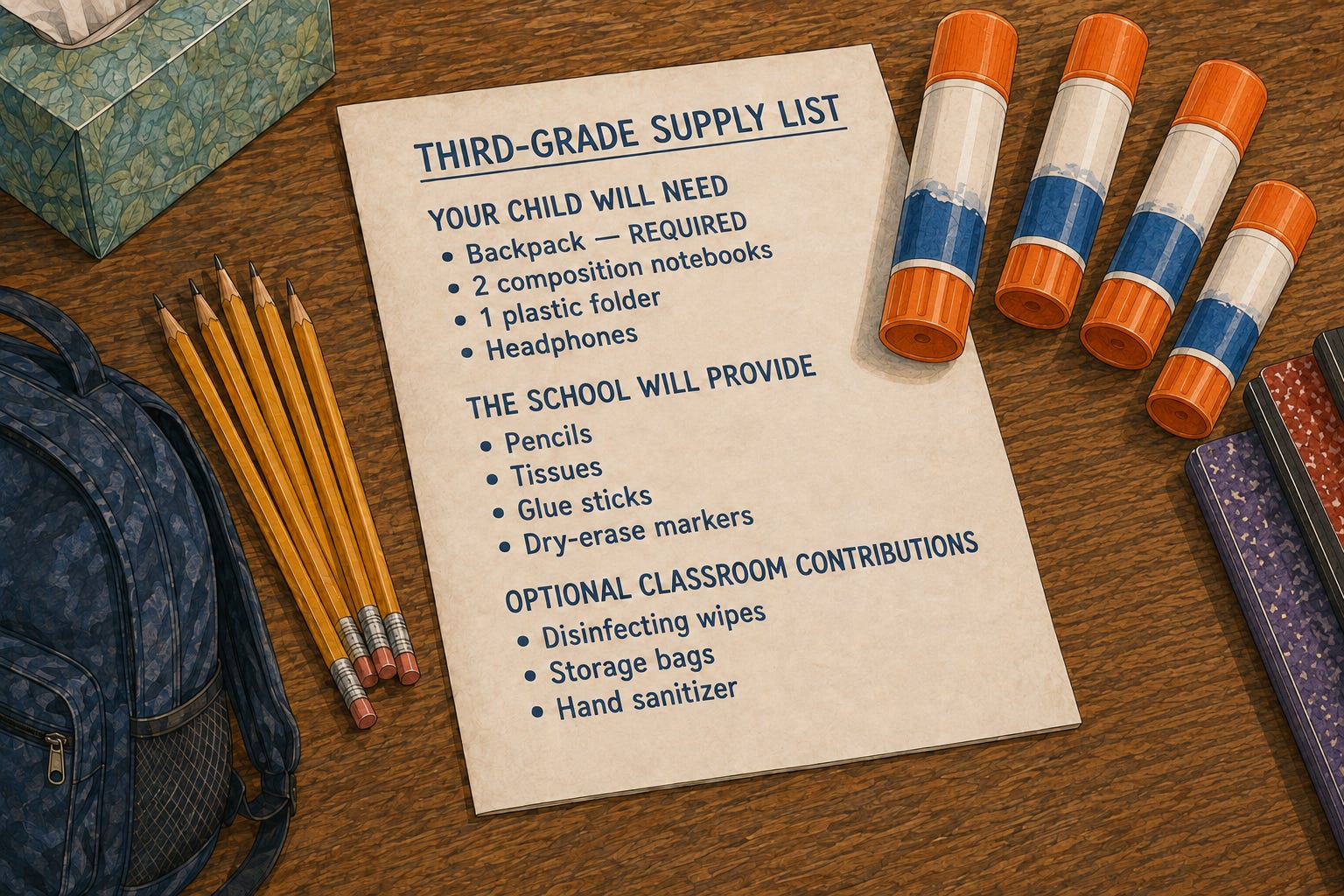
Mrs. Vega’s revised list had three headings: **YOUR CHILD WILL NEED**, **THE SCHOOL WILL PROVIDE**, and **OPTIONAL CLASSROOM CONTRIBUTIONS**.
The word **required** appeared only once. It was next to **backpack**.
On the first morning of school, the classroom buzzed with nervous voices, zippers, and chair legs scraping against tile. The pencil sharpener growled near Mrs. Vega’s desk, releasing the clean woody smell of cedar.
In the supply cabinet sat tissues, wipes, glue sticks and 1,248 freshly sharpened yellow pencils. By Friday, Mrs. Vega could find six. One of them was green.
When I went to school there was no list of supplies we had to have. We got to choose our own supplies. Crayons and paste were supplied at school.
Teachers are not paid enough. Somehow, students' and teachers' needs are the last things considered nowadays. It seems administration officials like school boards, superintendents and accountants, take up most of the school budget, as well as the office buildings for those people.