


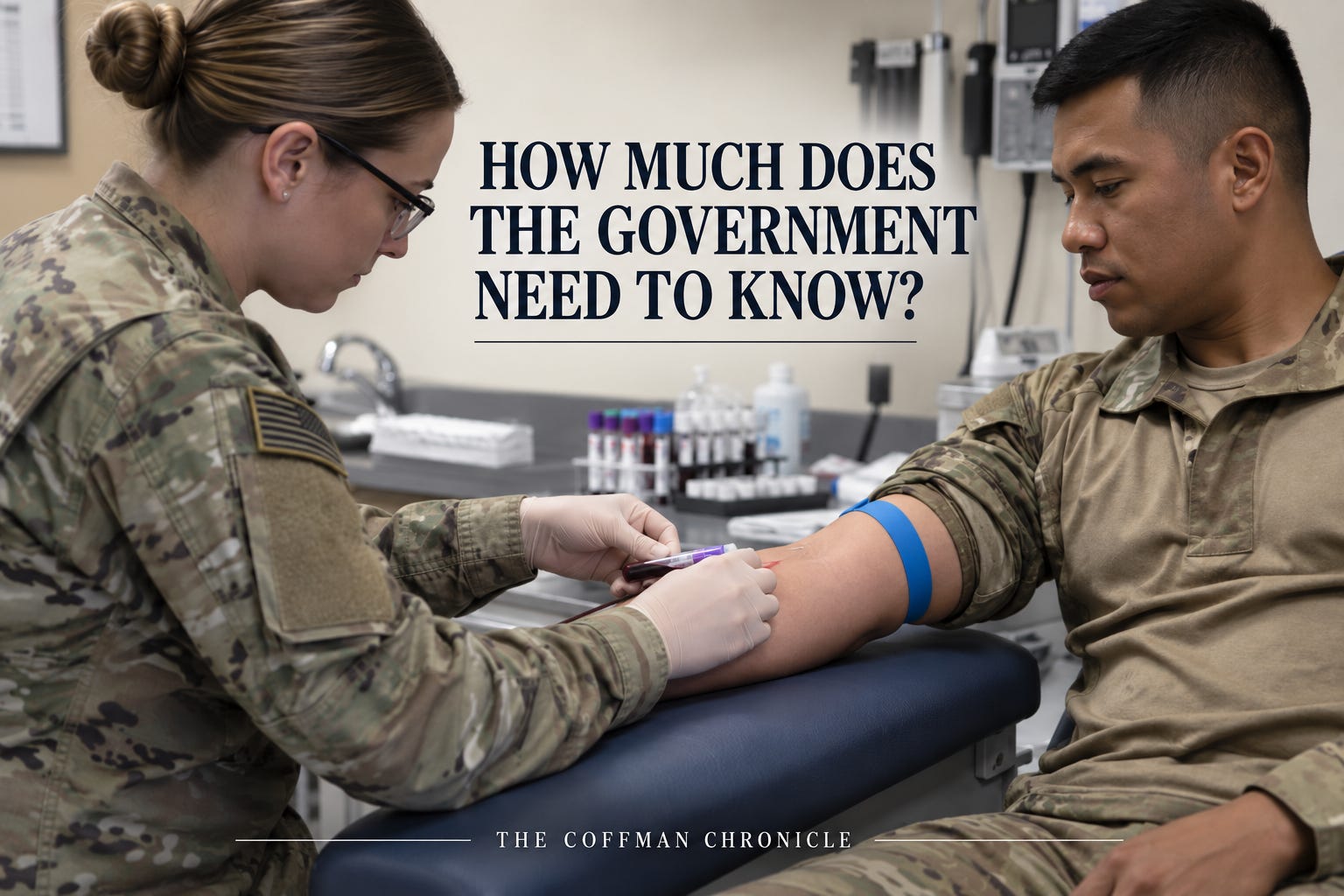
The Physical Got More Personal
For years, the annual military health assessment has been part of the bargain. A service member answers questions about injuries, medications, and health, and undergoes examinations meant to determine whether he or she is medically ready to serve. Military service does not carry the same privacy expectations as a civilian desk job.
This year, for some service members, the physical was supposed to get more personal. A man over 30 would face testosterone-deficiency screening during his Periodic Health Assessment. A woman could be asked about changes in her menstrual patterns as part of an annual hormonal-health screen, with further evaluation possible if her cycle became unusually long or irregular.
Neither finding automatically means something is wrong, leads to treatment, or results in lost deployment status, but a test stops being abstract once the result belongs to you. A low number can mean another blood draw and appointment. A changed menstrual cycle can raise questions about nutrition, stress, endocrine health, or bone health. Testosterone treatment can also raise fertility questions for a family considering another child.
Washington may see a readiness initiative. At home, it may look like a lab result sitting between the salt shaker and the mortgage bill.
The military has a legitimate responsibility to know whether the people it may send into danger are medically capable of doing their jobs. But somewhere between checking whether a soldier can carry a rucksack and asking how many days pass between a woman’s periods lies a harder question: How much does the government need to know about your body before it can decide whether you are ready to serve?
This Community Is Powered by You
What started as a small circle has grown into something much bigger, and it’s all because of readers like you.
Every time you forward this email, post it on socials, or bring someone new into the fold, you’re helping build one of the most passionate, independent communities out there.
Want to keep the momentum going?
Share this newsletter with someone who should be part of this conversation.
Thank you for being here. It means everything.
The Pentagon Has a Real Job Here
The military is not an ordinary employer. Service members may have to carry heavy equipment, function after broken sleep, tolerate extreme heat, deploy on short notice, and perform while responsible for other people’s lives. Medical readiness is part of whether a unit can do what the country asks it to do.
That gives the Pentagon a legitimate interest in identifying health problems that could interfere with service. If military doctors miss treatable hormonal conditions that affect health or performance, the government should not ignore them simply because the information is personal.
There is a difference between examining someone who reports symptoms and building a recurring screening program, just as there is a difference between information a doctor needs and information the military needs for readiness.
The Square New Deal requires government to perform necessary work competently, narrowly, and with enough evidence to justify the power it uses. Military readiness is necessary government. That does not make every readiness policy necessary.
Then the Pentagon Went Looking for Hormones
On July 15th, the Pentagon announced mandatory testosterone-deficiency screening for service members 30 and older during their Periodic Health Assessments, with optional screening for younger service members. The clinical guidance posted on September 2nd created separate pathways for men and women.
For male service members 30 and older, the guidance laid out screening followed, when indicated, by blood testing, further evaluation, and potentially voluntary treatment. The female pathway instructed providers to screen women annually for hormonal dysregulation, including fatigue, musculoskeletal pain, and changes in menstrual patterns. A cycle longer than 35 days could prompt assessment for Relative Energy Deficiency in Sport, a condition tied to inadequate energy availability and risks to bone health, endocrine function, and readiness.
That is where the headline about the Pentagon “tracking women’s periods” came from. The guidance described recurring clinical screening of menstrual patterns; it did not establish a system in which commanders would keep menstrual calendars or require women to report every period through the chain of command.
Correcting an exaggeration should not require minimizing what the government proposed, however. A female service member’s menstrual pattern was being made an explicit part of recurring military medical screening. The government still has to explain why it needs that information, how it would be used, and what safeguards apply.
Then the Instructions Disappeared
On September 2nd, the Pentagon publicly said the new Defense Health Agency guidance was “effective immediately” and established uniform screening and treatment pathways. By September 3rd, the document had been removed and temporarily rescinded for updates. The interim testosterone-screening policy remained in effect, and the Pentagon said it would issue final clinical guidance shortly.
Then the explanation changed. On September 4th, Tim Parlatore, a senior adviser to Pete Hegseth, said the document had been a draft, had not been approved for release, and had been posted inadvertently. He said it needed more input to ensure that it reflected current medical science rather than antiquated protocols.
While that does not prove the underlying policy is medically unsound or that anyone acted in bad faith, it does create an obvious accountability problem. The Pentagon’s September 2nd statement said comprehensive clinical guidance had been issued and was effective immediately. Two days later, a senior adviser called it an unapproved draft that should never have been posted.
For a policy involving testosterone screening, menstrual patterns, treatment pathways, and medical readiness, the government should be able to explain how those two accounts fit together.
If the document was an unapproved draft on September 4th, why did the Pentagon tell the public on September 2nd that it was effective immediately?
A Lab Result Doesn’t Stay at the Clinic
A screening program looks clean on a policy memo. A service member experiences it differently.
The Endocrine Society recommends against starting testosterone therapy in men planning fertility in the near term, and it says a diagnosis of testosterone deficiency should involve symptoms along with consistently low laboratory measurements, not merely one low result. That does not mean a service member who screens low will automatically receive treatment. It means broader screening can lead to repeat tests, medical decisions, and questions that follow someone home.
An irregular or unusually long menstrual cycle can likewise lead to evaluation for energy-availability, reproductive, bone-health, or performance concerns. Identifying those problems may be good medicine, but good intentions do not make the consequences abstract.
A service member may leave an appointment wondering whether something is wrong. A spouse may wonder what another round of testing means. A couple trying to have a child may suddenly have questions about treatment and fertility. An abnormal result does not automatically mean treatment, nondeployability, lost promotion, or a threatened career, and we should not claim consequences the policy does not establish.
Once government begins looking for a medical condition, however, it assumes responsibility for what happens after it finds one. The next question is who gets to know the answer.
What the Doctor Knows Is Not Necessarily What the Commander Needs to Know
Military medicine has always lived with a tension civilian healthcare usually does not. A doctor has a duty to the patient. The military also has a duty to know whether that patient can perform the mission.
A physician may need symptoms, laboratory results, menstrual history, medications, fertility concerns, and treatment options. The military health system may need enough information to make a readiness determination. A commander may need to know whether someone can deploy or perform a particular assignment. Those needs are related, but not identical.
Defense Department privacy rules permit disclosure of some protected health information to command authorities for fitness-for-duty and mission purposes. The Military Command Exception is not blanket access, however. Providers are supposed to disclose only the minimum necessary information, and commanders do not receive direct access to an entire medical record simply because they are commanders.
We have not established that the rescinded guidance would have given commanders individual testosterone readings or detailed menstrual histories. There is a meaningful difference between telling a commander that a service member cannot perform a particular duty and giving the commander every intimate medical detail that led a doctor to that conclusion. The government may need the readiness answer without needing the entire medical story.
Why Screen Everybody?
The strongest argument against the Pentagon’s approach is not that testosterone screening is inherently bad medicine, but that routine screening of asymptomatic people is not the ordinary medical standard.
The Endocrine Society recommends against routine testosterone-deficiency screening in the general male population and said again in July that evidence is insufficient to support population-level blood testing of asymptomatic men. The American Urological Association similarly says a clinical diagnosis requires low testosterone measurements combined with symptoms or signs, confirmed through two separate early-morning tests. The Pentagon chose a broader starting point for military screening.
That does not settle the policy against the Pentagon. Military medicine is not civilian medicine with camouflage painted on it. Troops expected to deploy, carry heavy loads, and withstand extreme stress may have needs civilian screening guidelines were never designed to measure.
However, a different standard requires evidence. If broad screening improves military readiness, the Pentagon should show how. Does it reduce injuries, identify significant conditions that symptom-based screening misses, reduce lost-duty time, or improve deployability? The female pathway deserves the same scrutiny. If recurring questions about menstrual patterns identify health risks early enough to improve health and readiness, that is a serious argument for doing it.
Military necessity can justify medical rules that would make little sense for a civilian office worker, but military necessity should be supported by evidence, not invoked as a substitute for it.
The Power to Ask Creates a Duty to Protect the Answer
Government sometimes has a legitimate reason to ask people for information they would rather keep private. Military service is one of the clearest examples. The power to ask, however, creates a duty to protect the answer.
If the Pentagon routinely collects information about testosterone levels, menstrual patterns, fertility concerns, or other intimate medical details, government becomes steward of what it has required people to reveal.
The Square New Deal offers a straightforward test. Is government performing a legitimate duty? If yes, is the intrusion necessary? That requires evidence that broad screening accomplishes something narrower screening cannot. Is the power narrowly designed? Government should collect no more information than it reasonably needs and move it no farther than the mission requires. Are service members protected once government has the information? That requires clear privacy rules, medical review, procedures for correcting errors, and limits on unnecessary disclosure.
Congress should be able to examine the evidence, costs, outcomes, false positives, adverse effects, readiness benefits, and privacy safeguards. National defense should not make a program immune from oversight.
The Square New Deal does not require government to do less than its duty. It requires government to justify the power it uses to perform that duty.
A Uniform Does Not Make the Body Government Property
Putting on a uniform means accepting obligations most Americans will never be asked to carry. The government can tell a service member where to live, what physical standards to meet, whether to deploy, and whether a medical condition makes a particular assignment unsafe. In the most extreme circumstances, it can order that person toward danger on behalf of the rest of us. Extraordinary authority should produce extraordinary stewardship.
The Pentagon may ultimately demonstrate that broader hormone screening identifies serious health problems earlier, reduces injuries, improves readiness, and leaves service members healthier. If the evidence supports that conclusion, the government should make the case plainly.
However, service members are not equipment inventories. A testosterone level is not a maintenance code, nor is a menstrual history a readiness box to be checked without regard for the person answering the question. Behind every laboratory result is someone who may have to talk with a spouse, make a medical decision, reconsider family plans, or wonder whether a finding will affect the work that pays the mortgage.
If the Pentagon needs this information, it should explain why. If some portion must reach a readiness system or chain of command, it should explain what travels and why. If the military departs from ordinary civilian screening practices, it should show the military evidence that justifies the difference.
None of those requirements weakens readiness. They are part of competent government.
A service member can owe the country extraordinary duties without surrendering the government’s obligation to exercise its authority carefully. Military service does not turn the human body into government property. When the government needs to know something about a citizen’s body, it should be able to explain exactly why, and if an unapproved draft could be publicly described as effective immediately, the Pentagon should explain how that happened before it asks service members to trust the final version.
Support Independent Media
If you believe government should be strong enough to do its job, restrained enough to know its limits, and accountable enough to explain the power it uses, please share this article with someone who might not agree with you on everything.
And if you can afford to support independent journalism like The Coffman Chronicle, consider becoming a paid subscriber. It helps us keep asking the questions power would rather answer on its own terms.
Sources
American Urological Association. “Testosterone Deficiency Guideline.” Accessed September 5, 2026.
Endocrine Society. “Statement on Testosterone Replacement Therapy.” July 16, 2026.
Endocrine Society. “Testosterone Therapy for Hypogonadism Guideline Resources.” March 19, 2018.
Health.mil. “Military Command Exception.” Last updated June 9, 2025.
Health.mil. “Periodic Health Assessment.” Accessed September 5, 2026.
Martinez, Luis. “Pentagon ‘Temporarily Rescinds’ New Testosterone Guidelines.” ABC News, September 4, 2026.
Oliverio, Natalie. “Pentagon Expands Hormone Screening Guidance to Include Female Service Members.” Military Times, September 3, 2026.
Reuters. “Doctors Question Evidence Behind Pentagon Plan for Testosterone Screening.” July 18, 2026.
Reuters. “Pentagon Temporarily Rescinds Guidance on Testosterone Screening for US Troops.” September 3, 2026.
U.S. Department of War. “Statement by Chief Pentagon Spokesman, Sean Parnell, on Enhanced Screening Protocol to Optimize Warfighter Performance and Enhance Force Readiness.” July 15, 2026.
U.S. Department of War. “Statement by Chief Pentagon Spokesman, Sean Parnell, on the Clinical Guidance for Health and Human Performance Optimization.” September 2, 2026.
And the VA is still badly underfunded and badly failing to serve our veterans, and now that much more likely to not serve them well.
It seems clear from other material I've read that the testosterone testing is because Hegseth wants to root out anyone with low testosterone - a pure vendetta on his part against any who might not be suitably masculine - this is clearly inappropriate.