


Rep. Mark Green isn’t resigning in scandal or protest. He’s leaving Congress for a private-sector job, quietly stepping off the legislative hamster wheel (he hopes) after helping pass a Trump-backed spending and border bill. There were no grand declarations, just a man exiting stage right, as if to say: I’ve done my part. Let someone else deal with the mess.
Green isn’t the only one. He’s just the latest in a growing list of public officials walking away from the parties they once called home. Some are switching affiliations. Some are getting pushed out. Some are simply giving up. Whatever the method, the message is the same: the party tents are collapsing, and not everyone is willing to be buried underneath them.

We just hit 15,000 subscribers—thank you!
Get exclusive access for just $1/week or $52 a year.
Get exclusive analysis and fearless reporting you won’t find in corporate media.
The Cracks Are Widening
In just the past few weeks, we’ve seen a string of political figures either walk away from their parties or be pushed to the margins. What once might have looked like isolated acts of defection now feels like a pattern: a quiet but growing exodus from institutions that no longer reflect the values or identities of their own members.
Green’s resignation wasn’t theatrical. It was a whisper of surrender, a subtle signal that the system isn’t just dysfunctional; it’s inhospitable.
On the other side of the aisle, former Biden Press Secretary Karine Jean‑Pierre stunned political watchers by leaving the Democratic Party entirely. Touting her memoir’s insights into internal dysfunction and partisan paralysis, her departure speaks volumes: even those closest to power feel unmoored by partisan rigidity.
Joe Walsh, a former Tea Party firebrand turned anti-Trump conservative, has now officially embraced the Democratic Party. His shift feels less like conversion and more like survival: a political refugee choosing the only remaining harbor after being ejected by the populist right.
Meanwhile, Georgia Republicans moved to block Brad Raffensperger from seeking re-election under the GOP banner. His crime? Being loyal to the democratic process over party allegiance. In Alabama, Sen. Tommy Tuberville has announced he’s leaving the Senate to run for governor, a move that may reflect where political opportunity and relevance now live.
They’re not alone. Others like Reps. Josh Gottheimer, Nancy Mace, and Mikie Sherrill are eyeing gubernatorial bids. Former Rep. David Jolly flipped his party affiliation for a potential state run. Detroit’s mayor is going independent. Whether for ideological reasons or political calculus, the message is the same: federal office has become inhospitable, and the traditional party tents no longer offer shelter.
These aren’t just news cycles. They’re symptoms. Across both parties, loyalty is being policed, orthodoxy is being enforced, and dissent is being punished. When the only choices are “toe the line” or leave the building, more and more are choosing the door.
But it’s not just politicians leaving the parties. They’re just the visible tip of something more profound: a quiet mass of voters who’ve already checked out emotionally, even if they still show up on Election Day. Their exits don’t make headlines, but they’re just as real.
Section 2: What It Means to Be Politically Homeless
It’s Not Apathy—It’s Alienation
To be politically homeless isn’t apathy. It’s not disengagement. It’s the quiet ache of watching a system you want to believe in become unrecognizable.
It’s showing up to vote and feeling like you’re choosing between two strangers in borrowed costumes. It’s watching a party platform shift under your feet, chasing polls, donors, or the loudest voices on cable news. It’s knowing the party you were raised in no longer speaks your language, and the one you’re told to “settle for” doesn’t understand your values either.
For some, political homelessness is ideological. You believe in fiscal responsibility and strong public programs. You support civil liberties and national security. You think identity matters, but reject identity as a wedge. And yet, the major parties increasingly demand that you choose between caricatures: pick a team, wear the jersey, and don’t ask too many questions.
For others, it’s emotional. Exhaustion from endless outrage cycles. The creeping suspicion that everyone in office is more interested in power than policy. That's what gets rewarded in Washington: obedience, not ideas.
See our previous article about political homelessness and the failure of the elected listening to their constituents here:
Note: This article is more than 45 days old and now lives in the archive. Consider becoming a paid subscriber for all 600+ articles, exclusive content, and occasional early access.

Voting Against, Not For
And still, many stay in these parties. Not because they believe—but because they’re afraid. Afraid to be the outlier in their family, their community, their feed. Fearful of “wasting” their vote. Afraid that stepping outside the tent means surrendering the field to worse actors.
So we vote, not with hope, but with resignation. We mark the box not for someone who inspires us, but for the one who terrifies us less. We tell ourselves we’re choosing the lesser of two evils, even though that framing itself reveals the rot: Why is evil our baseline? Why is compromise always on the side of conscience, and never on the side of power?
This is the quiet cost of political homelessness, not just being unrepresented, but being trapped in a system that punishes conviction and rewards calculation. A system where the best you can hope for is to delay the worst.
But something is changing. In this hyper-connected, hyper-alienated age, we are seeing signs of quiet courage. People—public figures and everyday voters—are beginning to admit out loud what they’ve long felt in silence: this doesn’t fit anymore. And maybe, it never really did.
The System Is Built to Prevent Alternatives
It’s Not Apathy. It’s Design.
The system is built to absorb discontent without giving an inch. The people haven’t failed democracy. The system has failed the people, and then blamed them for it.
A Two-Party System That Never Asked You
Winner-take-all elections mean third-party candidates are framed as spoilers. The Electoral College amplifies narrow state wins into total electoral sweeps. Closed primaries block independents from influencing candidate selection.
This isn’t about voter choice. It’s about party control.
Barriers to Entry Are the Point
Running as an independent or third-party candidate means overcoming seemingly insurmountable hurdles: gathering thousands of signatures, navigating arcane filing rules, and navigating legal obstacles. Even primary access is limited in many states.
It’s not incompetence. It’s intentional exclusion.
Democracy for Sale
After Citizens United, elections became auctions. Super PACs drown out public voices. Public financing exists but barely. Most candidates never make it to the ballot unless they’re pre-approved by money.
And If You Break Through? You’re Silenced.
Outsiders who survive all this are excluded from debates, media coverage, and legitimacy. Even algorithms work against them. The system doesn’t just resist change; it’s immune to it.
Rigged by Design, Not Dysfunction
This isn’t gridlock. It’s architecture, and it’s working exactly as intended for those who built it.
So What Now?
Rebuilding the House—Not Just Complaining About the Walls
It’s easy to feel defeated. That’s by design, too. But reform isn’t a fantasy. It’s happening—in pieces. In cities. In states. In classrooms. And it can happen nationally.
Vote Smarter With Better Tools
Ranked Choice Voting removes the spoiler effect and ensures majority support. It’s already the law in Maine and Alaska, and it's spreading.
Expand the Electorate, Don’t Shrink It
Automatic Voter Registration, mail-in voting, and making Election Day a holiday are proven turnout boosters. These aren’t radical; they’re practical.
Take Money Out of the Microphone
Public campaign financing and stronger disclosure laws can make elections about voters, not billionaires. Some cities are already doing it. States can too.
When the Center Collapses, the Noise Gets Louder
Parties once had clear platforms. Now they drift, reacting more than leading. The GOP formally has no platform. The Democratic Party’s goals are often set aside in favor of donor-friendly messaging. What’s left is noise, and that noise creates a vacuum for extremism.
Teach the System. Decode the Noise.
Civic and media literacy must be national priorities. Voters need to know how to:
Read a bill
Track a vote
Spot propaganda
Understand lobbying
Recognize misinformation
One simple starting point? Take a political alignment quiz. It sounds basic, but it’s illuminating. You may be further from your “team” than you think.
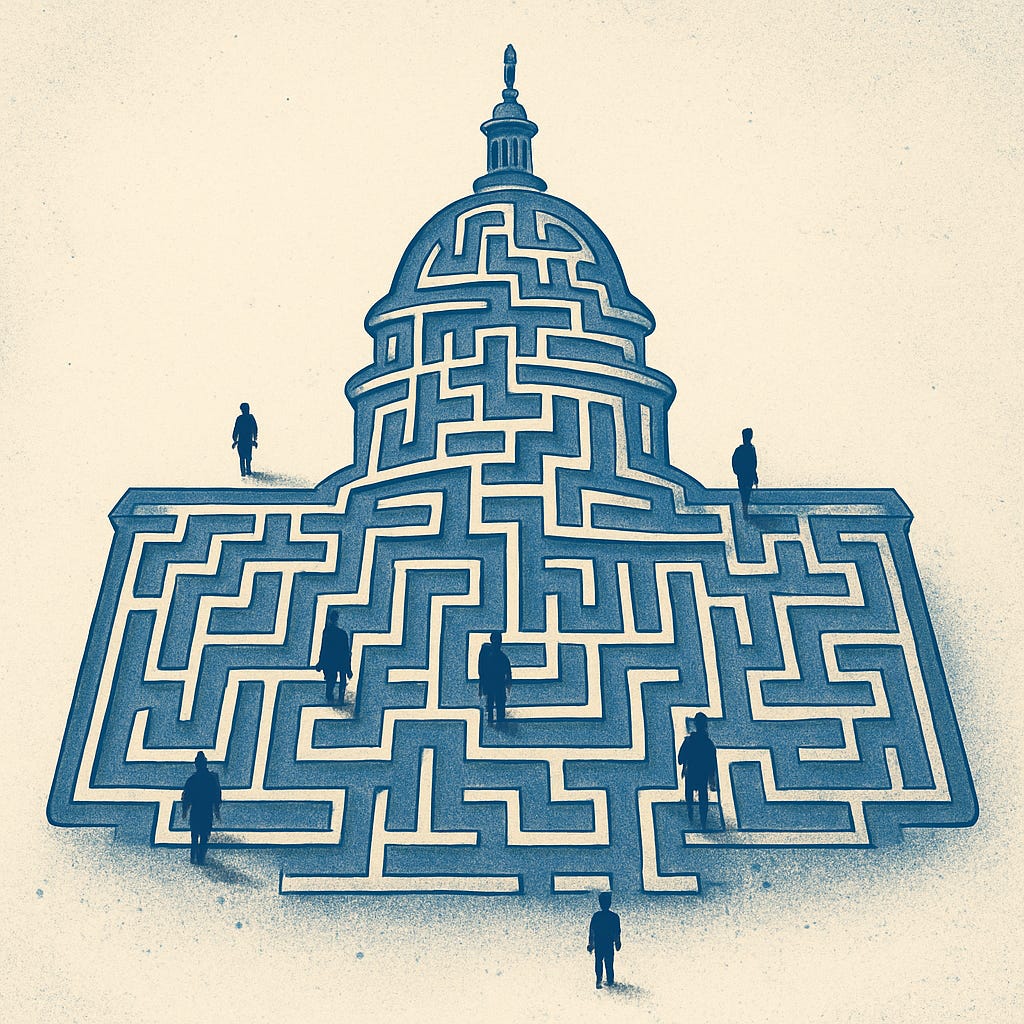
Political homelessness isn’t a personal failing. It’s a rational response to a system that has drifted so far from the people it claims to serve, but detachment doesn’t have to mean disengagement. If anything, it can be the start of something far more honest: a refusal to keep pretending this is working.
You don’t need to burn it all down. You just have to stop pretending it can’t be rebuilt.
Call to Action
Here’s where to start:
Take a political alignment quiz to clarify your values and challenge assumptions:
Ballotpedia Candidate Connection
Pew Political Typology Quiz
Discover how your local elections operate and who finances your local representatives.
Support reform efforts in your state: ranked choice voting, automatic voter registration, open primaries, and public financing.
Talk about it. Share this piece. Start conversations. Challenge the idea that cynicism is intelligence or that change is naïve.
Vote when it counts most, not just in November, but in primaries, propositions, school boards, and city councils.
Political homelessness may be real, but you are not alone, and if we start acting like it, that changes everything.
We just hit 15,000 subscribers—thank you!
Get exclusive access for just $1/week or $52 a year.
Get exclusive analysis and fearless reporting you won’t find in corporate media.
Bibliography:
“GOP Rep. Mark Green to Resign After Tax Bill Vote.” Reuters, June 9, 2025.
“GOP House Homeland Chairman Green to Retire from Congress Early.” Associated Press, June 9, 2025.
McIntire, Mary Ellen. “Tennessee Rep. Mark Green Will Resign After Next Budget Vote.” Roll Call, June 9, 2025.
“Ex–White House Press Secretary Karine Jean‑Pierre Left the Democratic Party, Publisher of Her Book Says.” Associated Press, June 4, 2025.
Vazquez, Maegan, and Yasmeen Abutaleb. “Karine Jean‑Pierre’s Ex‑Colleagues Pan Her Book About a ‘Broken’ White House.” Washington Post, June 4, 2025.
“Former Biden Press Secretary Karine Jean‑Pierre Becomes Independent.” Axios, June 4, 2025.
Kapos, Shia. “Joe Walsh Might Run Again — as a Dem.” Politico, June 5, 2025.
“Georgia GOP’s Attempt to Block Brad Raffensperger from Running as a Republican May Go Nowhere.” Associated Press, June 10, 2025.
“Republican Sen. Tommy Tuberville Announces Bid for Alabama Governor.” Reuters, May 27, 2025.
“U.S. Sen. Tommy Tuberville to Run for Alabama Governor.” Alabama Reflector, May 27, 2025.
Outstanding recaps and insights. Thank you for a different perspective which provokes thought and alternate consideration on what is occurring politically in today’s world.
None of us fit perfectly in either of the two major parties. Its true that we pick the one closest to our values. It is too bad that elected officials fail to live up to thise ideals so very often.