


He doesn't campaign. He doesn't legislate. He doesn't even tweet.
But if the foundations of American democracy are being quietly dismantled and replaced with a new, autocratic framework, Curtis Yarvin is the unseen hand guiding the transformation.
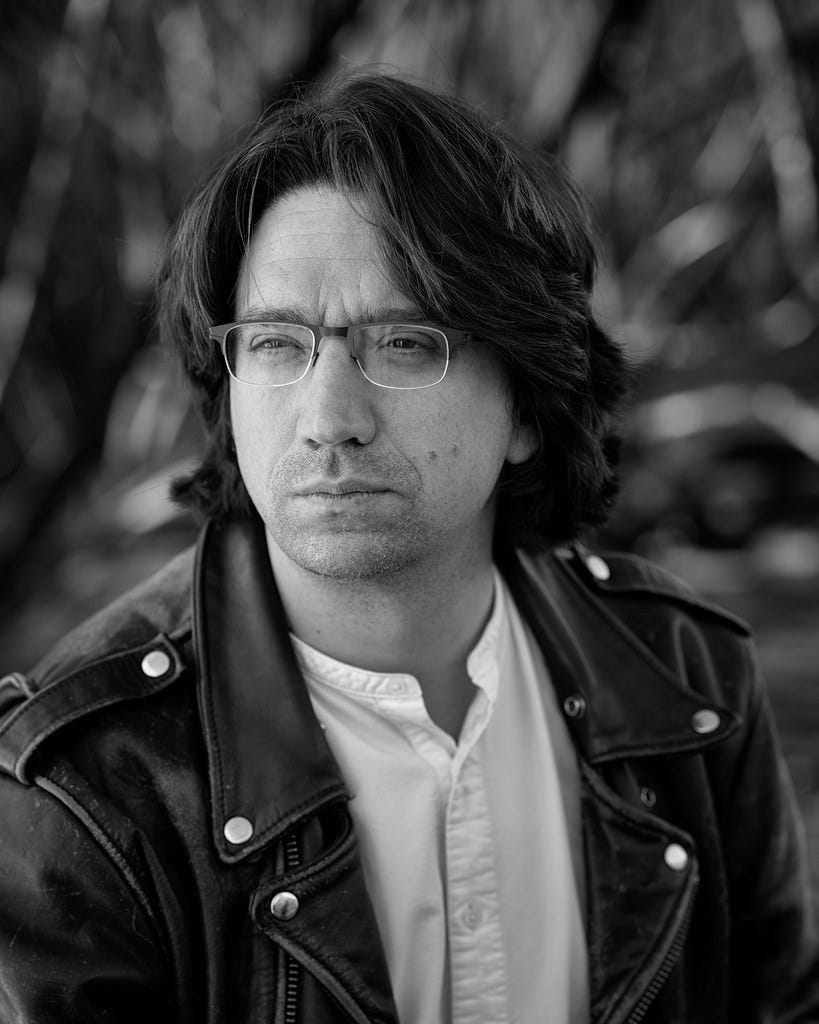
Operating under the pseudonym Mencius Moldbug, Yarvin has spent the past two decades crafting a philosophy that challenges the very core of liberal democracy. His vision? A society governed not by elected officials but by a CEO-like figure wielding absolute power, a "neocameralist" state where efficiency trumps representation.
We just hit 13,000 subscribers—thank you! We’re offering full access to The Coffman Chronicle at 50% off to celebrate.
Get exclusive analysis and fearless reporting you won’t find in corporate media.
From Code to Creed
Born in 1973 to a liberal, secular family, Yarvin was a prodigious talent. At the age of 12, he entered Johns Hopkins' Study of Mathematically Precocious Youth. He later attended Brown University and began a Ph.D. program at UC Berkeley before leaving to pursue a career in software development.
In 2002, Yarvin founded Urbit, a decentralized computing platform aimed at overhauling the internet's infrastructure. Backed by venture capitalists like Peter Thiel, Urbit was more than just a tech project; it manifested Yarvin's political ideology, envisioning a digital society structured around hierarchical, feudal principles.
To Yarvin, software wasn't just a profession but a metaphor. Just as legacy code needs refactoring, he argued, so too does the American political system. Fixing isn't enough. You need a clean slate. A new stack. This logic—ruthless, elegant, and devoid of sentiment—pervades his politics as much as his code.
The Cathedral and the Red Pill
Through his blog, Unqualified Reservations, which he wrote from 2007 to 2014, Yarvin introduced the concept of "The Cathedral," a term he uses to describe the intertwined institutions of academia, media, and government that perpetuate progressive ideology and suppress dissent. He continued his philosophy in his new blog, Grey Mirror, which he began in 2020.
He advocates for a "red pill" awakening, urging readers to reject the prevailing democratic norms and embrace a return to hierarchical governance. His writings have influenced a segment of the tech elite, including figures like Thiel and, indirectly, Elon Musk.
In Yarvin’s framework, The Cathedral is not just powerful. It’s invisible to those within it. It rewards conformity, punishes dissent, and masks ideology as expertise. His “red pill” wasn’t about awakening to truth but about awakening to control. To read Yarvin is to be told that you’ve been programmed. And your only escape is to opt out, intellectually, politically, spiritually.
Influence Without Office
Yarvin holds no official position in the current administration, yet his ideas have permeated its policies. The Department of Government Efficiency (DOGE), spearheaded by Musk, echoes Yarvin's earlier proposal, RAGE ("Retire All Government Employees"), aiming to dismantle the federal bureaucracy in favor of a streamlined, corporate-like structure.
While Yarvin has criticized DOGE's execution, likening it to "an orchestra of chimpanzees trying to perform Wagner," the ideological underpinnings remain unmistakably his.
JD Vance, now Vice President, has praised Yarvin’s critiques of the administrative state, even if he stops short of endorsing monarchy. Yarvin isn’t a footnote to Project 2025. He’s the intellectual mood board. Where Heritage provides the memos, Yarvin provides the moral permission to think in post-democratic terms.

Authoritarianism with a Mandate
But Yarvin is more than the ghost in the machine. He has been open about his authoritarian bent and advice to the far-right movement.
In a 2021 conversation with conservative scholar Michael Anton, Yarvin offered a disturbingly candid roadmap for how a president could seize and consolidate power. He argued that a president could “gain power lawfully through an election, and then exercise it unlawfully.” Except, in Yarvin’s mind, it wouldn’t be unlawful at all.
“You’d simply declare a state of emergency in your inaugural address,” he said. “You’d actually have a mandate to do this. Where would that mandate come from? It would come from basically running on it, saying, ‘Hey, this is what we’re going to do.’”
And then, he delivered the real blueprint: any true Caesar would need to eliminate the old regime’s reality-makers—its press, universities, and narratives.
“You can’t continue to have a Harvard or a New York Times past... the start of April,” Yarvin said. “The idea that you’re going to be a Caesar and take power and operate with someone else’s Department of Reality in operation is just manifestly absurd. Machiavelli could tell you right away that that’s a stupid idea.”
This wasn’t satire. This wasn’t speculative fiction.
This was a manual. And we are all now living in his game.
Echoes in the Code: Cultural Resonance
Curtis Yarvin’s reach isn’t confined to think tanks or bureaucratic schematics. It pulses through the culture of the New Right like a background process, subtle but ever-present.
His term “The Cathedral” has become shorthand in far-right and post-libertarian circles for a liberal establishment conspiracy, invoked on X (formerly Twitter) and Substack like scripture. It's a meme now, ironic and reverent all at once. If you know it, you're in the club. If you don't, you're part of the problem.
YouTube philosophers, podcast intellectuals, and anonymous Twitter accounts use Yarvin’s terminology to position themselves as enlightened outsiders. His ideas are referenced by figures ranging from Bronze Age Pervert acolytes to Silicon Valley techno-authoritarians. Even those who’ve never read a word of Unqualified Reservations speak in his tongue: elite rule, managerial state, shareholder governance.
This is how ideology becomes infrastructure, not through elections, but through culture. He doesn't need to spread it. His followers embed it in the code.
And now, the cultural current he helped ignite flows freely into the bloodstream of American power.
You may be interested in our other coverage of the cast of characters in this story. Each will be linked to the person below.

The Villain Reveal
If Elon Musk is Lex Luthor, the Chaos Agent,
Peter Thiel is Ozymandias, the Architect of elite control,
Stephen Miller is Gríma Wormtongue, whispering cruelty in the king's ear,
Chris Rufo is Dolores Umbridge, policing purity in the halls of culture,
Russell Vought is The Calculator, the Engineer, ticking off his spreadsheet,
Leonard Leo is Ra’s al Ghul, Master of the Order and purifier of institutions,
Then, Curtis Yarvin is The Architect, the Designer of the Illusion, and the Philosopher of the Post-Democratic Matrix.
He is not the enforcer. He is the equation.
He doesn’t storm the gates. He reprograms them.
He doesn’t pass orders. He embeds them into the operating system.
Where others rally, he theorizes.
Where others fight, he calculates.
And where others fall, he endures because the system still runs on his logic.
Like The Architect, he believes chaos must be contained through design.
That freedom is noise.
That democracy is disorder.
And that is what the world needs is not choice, but structure.
He doesn’t seek a throne. He builds the architecture of who gets one.
He doesn’t code software anymore. He codes ideology.
And the system, broken, hollowed, authoritarian-curious, still speaks his language.
Curtis Yarvin doesn’t need to be seen.
He only needs to be obeyed.
We just hit 13,000 subscribers—thank you! We’re offering full access to The Coffman Chronicle at 50% off to celebrate.
Get exclusive analysis and fearless reporting you won’t find in corporate media.
Bibliography
Encyclopedia MDPI. "Curtis Yarvin." Accessed May 14, 2025.
Wikipedia. "Curtis Yarvin." Accessed May 14, 2025.
Wilson, Jason. "He's anti-democracy and pro-Trump: the obscure 'dark enlightenment' blogger influencing the next US administration". The Guardian. December 21, 2024.
The Verge. "Elon Musk's new DOGE plans are actually old ideas about mass deregulation." November 22, 2024.
The Washington Post. "Curtis Yarvin helped inspire DOGE. Now he scorns it." May 8, 2025.
Unqualified Reservations. "Unqualified Reservations by Mencius Moldbug." Accessed May 14, 2025.
Urbit. "Urbit." Accessed May 14, 2025.

That precocious brat needs a time-out, and go back to school to study the Constitution. He may be a genius, but obviously has no concept of Free Speech, individual liberty, and the right to dissent. Sounds like he wants a country called “ The United States of Stepford.”
He should also read “A Wrinkle in Time.”
After 249 years of life under the constitution, even during a declared emergency there are laws that define how things must be done. According to the law, one does not get to run rampant while totally ignoring the law. Unfortunately, the supreme court has ruled that the president cannot be charged with a crime for ANY rampant running he does as president. So he is pushing boundaries to see how far he can go. It is up to the courts and congress (yeah right) to limit his actions.