


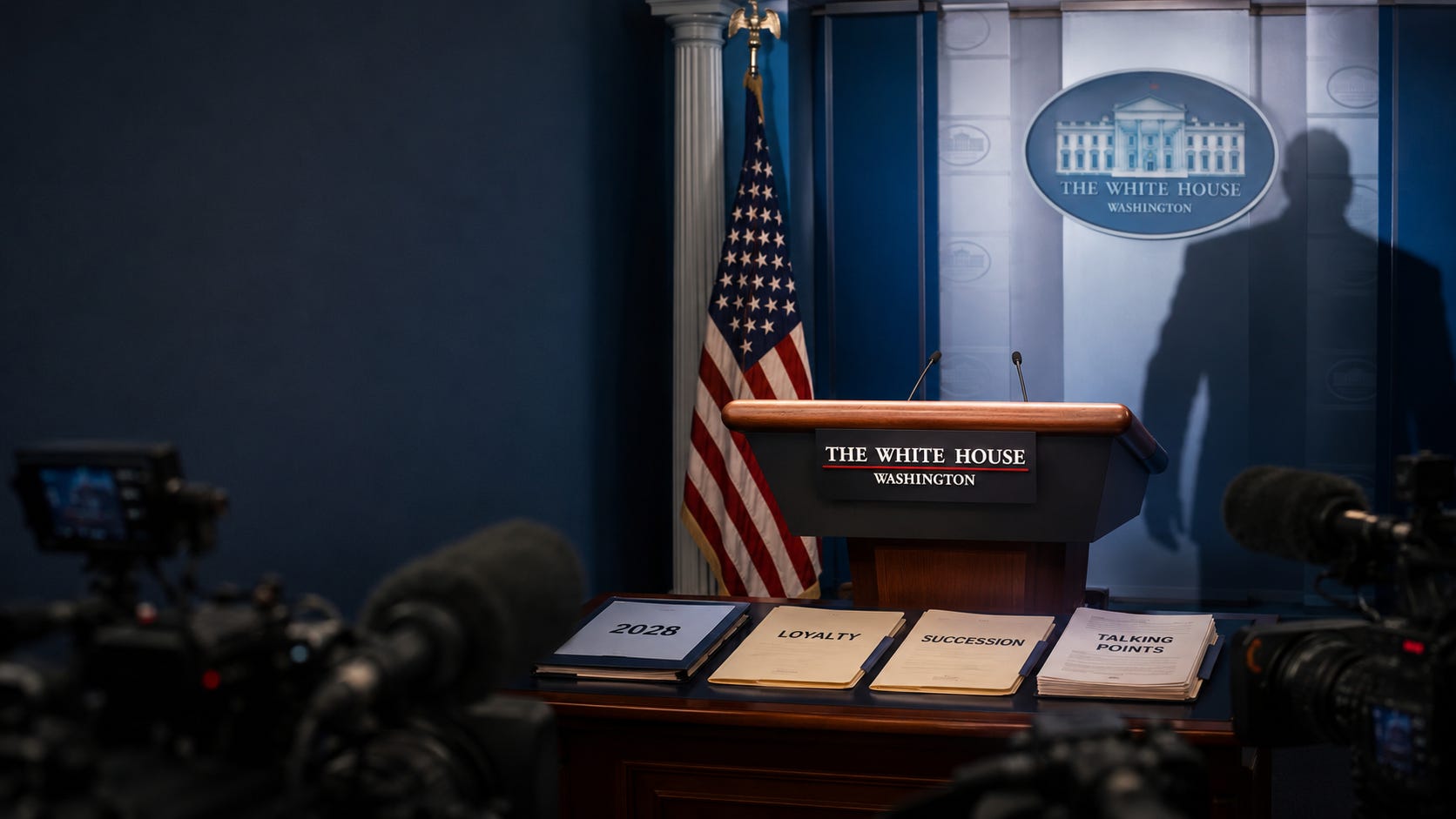
JD Vance is not stealing Donald Trump’s power. He is showing us why Trump’s power cannot be easily inherited.
That is the real story beneath the early 2028 positioning, the White House briefing room appearances, the loyalty performances, and the quiet competition to become the next face of Trumpism. Vance is not staging a coup. He is auditioning for the future of a movement that still belongs to one man.
Trump did not build a normal political coalition that can be passed from one leader to the next through ideas, institutions, or governing records. He built a loyalty structure around himself. His power comes from personal command, grievance, spectacle, media gravity, and the belief among his supporters that he alone speaks for them.
So Vance is trapped in the strange position of every would-be heir to concentrated power. He has to look strong enough to lead the movement after Trump, but loyal enough not to appear to be reaching past him.
That is not succession. That is dependency.
When a party concentrates power around one man, the next generation does not compete over who can govern best. It competes over who can best demonstrate loyalty.
Trump can name an heir. He cannot hand over the spell.
This Community Is Powered by You
What started as a small circle has grown into something much bigger, and it’s all because of readers like you.
Every time you forward this email, post it on socials, or bring someone new into the fold, you’re helping build one of the most passionate, independent political communities out there.
Want to keep the momentum going?
Share this newsletter with someone who should be part of this conversation.
Thank you for being here. It means everything.
This Is Not a Coup. It Is an Audition.
The mistake would be to treat Vance’s rise like a palace coup. That gives him too much credit and misses the more revealing story. Vance is not storming the throne room. He is standing just outside it, trying to look like the natural heir without appearing eager for the king to leave.
Trump has already encouraged the speculation. In August 2025, he said Vance was “most likely” his heir apparent for 2028 and suggested Vance and Marco Rubio could join forces on a future Republican ticket. Vance, meanwhile, has tried to brush aside talk of 2028 and insist that he is focused on governing. However, politics does not wait for permission to become obvious. A vice president standing at the center of Trump’s administration, defending Trump’s agenda, and being publicly discussed as Trump’s successor is not just doing the job. He is also being measured for the next one.
The White House briefing room makes that clear. The early Republican race to succeed Trump is already playing out in one of Washington’s most public forums, with Vance and Rubio taking high-profile turns at the podium while press secretary Karoline Leavitt is away. AP described the appearances as part of the early “shadow primary” for 2028.
Yet that stage comes with a trap. Vance cannot look too ambitious, because ambition directed at Trump can appear disloyal. He cannot look too passive, because passivity makes him seem less like a successor and more like staff. He has to project strength while signaling submission. He has to show he can carry Trumpism while making clear that Trump still owns it.
In a healthy political party, future leaders compete over vision, competence, coalitions, and records. In a movement built around one man, they compete over proximity. Who has Trump’s blessing? Who can defend him most aggressively? Who can inherit the base without offending the man who still commands it?
Vance is not stealing Trump’s power. He is trying to prove he can be trusted near it.
Concentrated Power Does Not Transfer Cleanly
This is the deeper problem Vance is running into. Concentrated power looks permanent until someone else tries to use it.
Trump’s power inside the Republican Party is not ordinary party power. It is not built primarily on a policy platform, a governing philosophy, a legislative record, or a durable institutional structure that another politician can simply inherit. It is built around Trump himself: his instincts, his insults, his enemies, his grievances, and his ability to turn every investigation, criticism, and defeat into proof that he is being persecuted on behalf of his supporters.
That kind of power is powerful, but it is also personal.
A normal political party can transfer leadership through institutions: records, coalitions, continuity, and ideas. Trumpism is different because loyalty to Trump became the organizing principle.
That is what makes Vance’s position so difficult. He is not just trying to inherit a voter base. He is trying to inherit a permission structure. The question is not only whether Republican voters like him. The question is whether they believe Trump has allowed them to like him. The question is not only whether Vance can carry the message. The question is whether the message sounds authentic coming from anyone other than Trump.
Once a movement becomes inseparable from one person, succession becomes unstable. The next leader has to be loyal enough to the man who built it, aggressive enough for the base that expects constant combat, and independent enough to appear capable of governing on his own. Those demands pull in different directions. If Vance sounds too much like Trump, he comes across as an imitation. If he sounds too different, he risks looking like a betrayal. If he defends Trump too aggressively, he inherits Trump’s baggage. If he creates distance, he threatens the relationship that gives him power in the first place.
That is not strength. That is dependency dressed up as succession.
Concentrated power may look efficient because everyone knows who commands the room. However, over time, it weakens everything around it. The party becomes less capable of independent thought. Lawmakers become less willing to check abuses. Future leaders learn to wait for permission.
That is why Vance’s rise is worth discussing. He is a test case for whether Trumpism can become something larger than Trump. The movement has slogans, donors, media allies, congressional loyalists, and voters deeply attached to its message. Yet ultimately, the emotional center of the movement is still Trump himself. The power Vance wants is not sitting in the vice president’s office waiting to be claimed. It is still attached to the man who concentrated it.
Vance Wants to Look Like the Future, But He Keeps Defending the Present
That is why Vance’s briefing room appearance was so revealing. It was supposed to show command, authority, and a preview of the future. Instead, it showed the burden of borrowed power.
Vance did not walk into that room as a free-standing political figure. He walked in as Trump’s vice president, Trump’s defender, and Trump’s possible heir. Reuters described the briefing room as an informal audition stage in the race to succeed Trump, with Vance and Rubio using high-profile appearances to raise their national profiles while Trump remains the dominant figure in the party.
But Vance’s task was harder than simply looking presidential. He had to defend the administration’s current controversies while trying to project the movement’s future. His briefing drew questions about Trump’s Iran war, a compensation fund for Trump allies who say they were politically prosecuted, January 6-related compensation questions, troop issues, and Trump’s stock dealings.
That is the trap. Vance wants to appear as the next leader of Trumpism, but every major test pulls him back into the role of Trump’s cleanup crew. He cannot simply lay out his own vision because his current political value comes from defending Trump’s. He cannot fully separate himself from the controversies because his claim to the future depends on his loyalty to the man creating them.
That is how concentrated power works. It not only elevates loyalists. It binds them.
The closer Vance gets to Trump’s power, the more he has to carry Trump’s baggage. The more he tries to look like an independent successor, the more carefully he has to avoid looking disloyal. He can attack the press, speak the language of grievance, and project calm confidence in front of the cameras. However, he still has to answer for decisions he does not fully own and defend a political brand he does not fully control. That is not leadership in the normal sense. It is custodianship.
Vance is trying to become the future of Trumpism while serving as the public defender of Trump’s present. He is not carrying a torch. He is carrying someone else’s flame and trying not to get burned.
The Rubio Problem Shows the Weakness Even More
Marco Rubio’s presence in this shadow contest makes the weakness clearer. If this were only about Vance, it would be easier to dismiss it as one ambitious vice president positioning himself for 2028. Rubio’s role shows that this is not just a Vance problem. It is a Trumpism problem.
Rubio may sound more polished and practiced in the language of institutions and foreign policy. Vance may sound closer to the populist combat style that defines the MAGA base. Both are still orbiting the same sun.
Neither Rubio nor Vance can fully claim the future unless Trump allows it. Neither can build an independent lane without risking backlash from the voters they need. Neither can simply say, “This is my party now,” because the party has spent years proving that it still belongs to Trump.
That is not a normal succession fight. It is a permission contest. Concentrated power does not produce a bench of leaders. It produces a line of contenders waiting for permission to step forward.
The question is not who leads the party next. The question is who gets permission to perform Trumpism next.
Loyalty Theater Replaces Governance
This story is larger than JD Vance, Marco Rubio, or the 2028 Republican race.
The danger of concentrated power lies not only in making succession awkward. The greater danger is that it changes what politics is for. A party organized around one man eventually spends less time asking who can govern and more time asking who can prove loyalty. The public gets fewer serious debates over policy, competence, corruption, war, wages, healthcare, housing, schools, or infrastructure. Instead, it gets performances designed to answer one question: who is closest to the leader?
That is how governing turns into theater.
In a normal political party, future leaders have to explain what they believe, what they have done, and how they would improve people’s lives. In a movement built around concentrated personal power, the question becomes who can defend the leader most aggressively, repeat the slogans most convincingly, and inherit the emotional bond without appearing to challenge the person who still owns it.
That has consequences far beyond campaign strategy. When loyalty becomes the currency of power, institutions get weaker. Lawmakers become less willing to check abuses. Party leaders become less willing to challenge bad decisions. Future candidates become less willing to offer an independent vision.
The country pays for that.
Ordinary people do not need more loyalty theater. They need hospitals that stay open, schools that are funded, roads that get repaired, disaster aid that arrives on time, wages that keep up with costs, and leaders who care more about accountability than proximity to power. However, when a party becomes organized around one man, those kitchen-table issues are pushed behind the constant drama of defending him, flattering him, excusing him, and auditioning to inherit his audience.
That is the real democratic warning inside the Vance story. If he wants the future, he has to keep proving loyalty to the present. If he wants to lead, he has to first show he can submit. If he wants to inherit the movement, he has to convince Trump’s voters that he is both strong enough to carry it and obedient enough not to betray it.
That is not a healthy model of democratic leadership. It is a warning sign.
Concentrated power does not just weaken institutions. It turns governing into an audition, and once it does, the public is no longer the central audience. The leader is.
Trump Can Name an Heir. He Cannot Hand Over the Spell.
Vance’s position matters, not because he is stealing Trump’s power, but because he is exposing the flaw inside it. Trumpism may have candidates, donors, media allies, slogans, congressional loyalists, and a base deeply attached to its message, but its central force is still personal. It still runs through Trump’s approval, Trump’s grievances, and Trump’s ability to make millions of people believe that loyalty to him is loyalty to them.
That is not easy to transfer.
Vance can stand at the podium, defend the administration, attack the press, speak the language of grievance, and position himself as the next vessel for the movement, but every step toward the future reminds everyone that the movement still belongs to the man behind him.
That is the trap of concentrated power. It looks strongest when everyone is obeying. It looks invincible when rivals fall in line, institutions bend, and the party organizes itself around one commanding figure. However, the moment succession begins, the weakness becomes visible. What looked like unity was dependency. What looked like strength was submission. What looked like a movement was, in many ways, a permission structure.
That is not just Vance’s problem. It is the problem of every political movement that trades institutions for personality and principles for obedience.
Trump can name an heir. He cannot hand over the spell.
Support Independent Media-The Coffman Chronicle
If this article helped clarify what is really happening beneath the 2028 speculation, consider supporting Coffman Chronicle.
Independent media matters because these stories are rarely just about one politician, one press briefing, or one campaign cycle. They are about power: who holds it, who bends to it, who benefits from it, and who pays the price when institutions are weakened in the process.
That is the work we are committed to doing here, cutting through the spectacle, following the pattern, and connecting Washington’s loyalty games to the kitchen-table consequences felt by ordinary Americans.
If you can afford it, becoming a paid subscriber helps keep that work going.
Sources:
“Trump Declines to Take Sides between Vance, Rubio in 2028 Successor Debate.” Reuters, February 5, 2026.
“Vance-Rubio Split Screen Offers 2028 Clues.” Reuters, May 7, 2026.
“Trump Suggests Vance Is His Likely Heir Apparent in 2028.” Reuters, August 6, 2025.
“Vance or Rubio for 2028? The White House Briefing Room Edition.” Reuters, May 20, 2026.
“For Vance and Rubio, the Road to 2028 Takes a Turn through the White House Briefing Room.” AP News, May 19, 2026.
“Rubio’s and Vance’s Differing Postures on Iran War Highlight Their Challenges Ahead of 2028 Election.” AP News, April 1, 2026.
99 times out of a 100, the cult falls when the leader dies.
This cult has a lot of money and power behind it, and it may not fall easily - so it's vital to stop giving them money and attack their power whenever possible.
Let’s get real… to the bottom line… Vance watches Trump grift and get away with it… Vance wants to be next in line… he already knows that he needs to buddy up and pay back Peter Theil.