


On November 24, 2025, a federal judge ruled that Lindsey Halligan, a Trump-appointed interim U.S. Attorney overseeing high-profile investigations, had been unlawfully serving in her role. Halligan, best known as a political loyalist and on-air defender of the former president, had never been confirmed by the Senate, had never been nominated for the position, and, most strikingly, had never even met the legal qualifications required for the job. Yet there she was, at the center of politically sensitive prosecutions, including one involving former FBI Director James Comey.
To many, this seemed like the end of a story, just another overreach blocked by the courts, yet another unqualified Trump appointee shown the door. However, in truth, Halligan’s removal wasn’t the end of a scandal. It was just the latest iteration of a dangerous legal experiment, one that’s being repeated, refined, and scaled.
She was the third such prosecutor ruled unlawful this year, and by the time the courts stepped in, the damage was already done. And perhaps, that is the point. Somewhere in a dark, musty corner, Stephen Miller is smirking.
Want to Know Your Rights?
Download a free digital copy of the U.S. Constitution—the same document Trump is trying to bulldoze. Learn exactly what he’s breaking… and how to fight back.
75,000+ strong — and counting.
In honor of this Black Friday and Cyber Monday, become a paid subscriber for just $1 a week and help us keep the truth alive.
Join The Coffman Chronicle — $1/Week Early Access
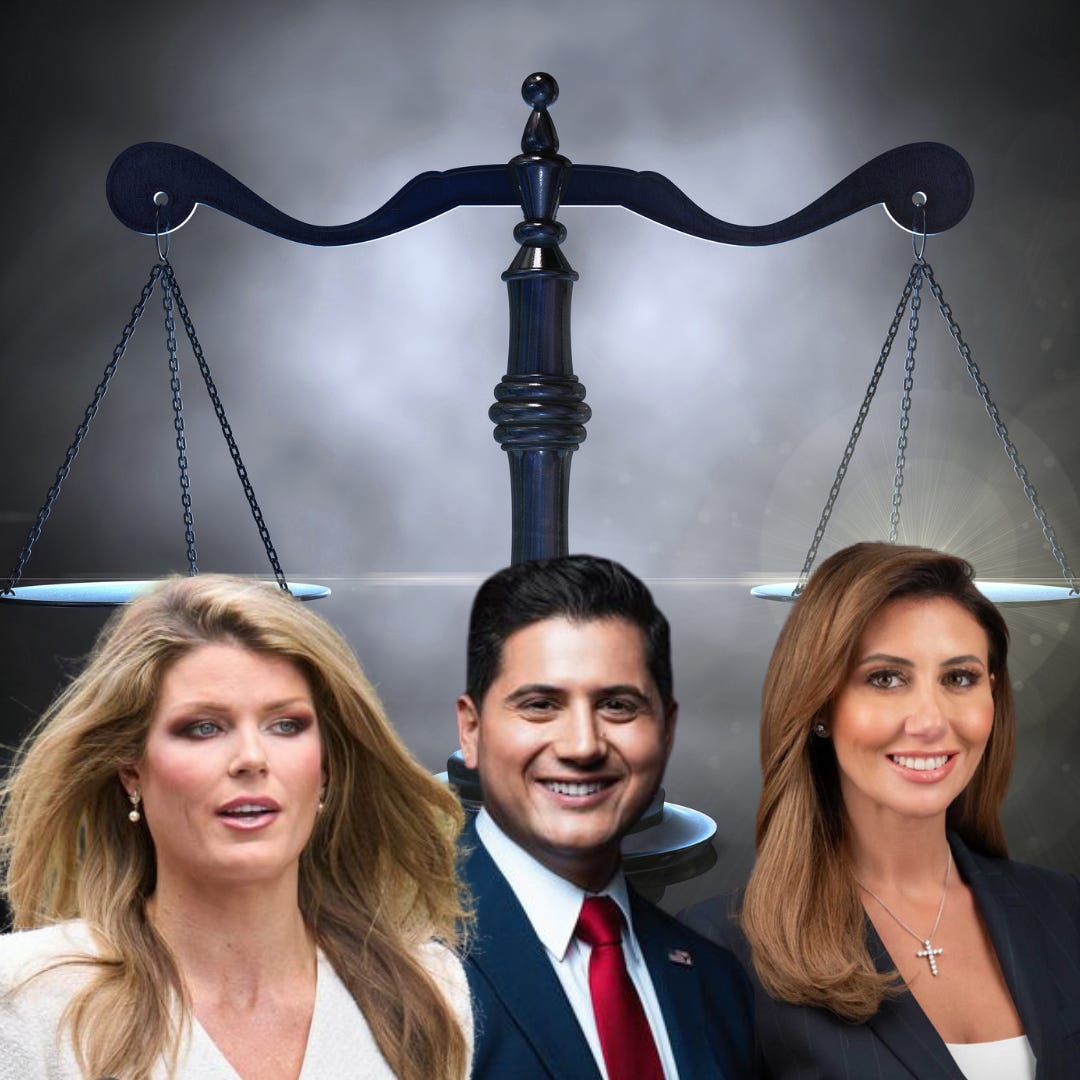
Before Halligan, There Was Essayli and Habba
Halligan’s appointment may have been the most overtly unlawful, but it wasn’t the first, nor was it the first to end in disqualification by a federal court.
Before Halligan, there was Alina Habba, the former Trump attorney whose appointment as interim U.S. Attorney for New Jersey in March 2025 drew immediate scrutiny. She was formally nominated for the permanent role, but after facing resistance from the legal community and even members of the Senate, her nomination was quietly withdrawn. That’s when the legal maneuvering began.
Rather than allow her 120-day interim term to expire on July 1, as required by law, the administration fired the court-appointed successor who was set to replace her. Habba was then reinstalled through a bureaucratic sleight of hand. She was named a “special attorney” and acting U.S. Attorney in defiance of statutory limits. On August 21, a federal judge ruled her continued service unlawful. The Third Circuit Court of Appeals upheld the ruling on December 1.
Following Habba, there was Bilal Essayli, who was appointed interim U.S. Attorney for the Central District of California in early April 2025. Like Habba, he was never confirmed by the Senate. Unlike Habba, he was never formally nominated. When his interim appointment expired at the end of July, he, too, was quietly redesignated. He was named both “First Assistant U.S. Attorney” and “Special Attorney” to allow him to continue serving in an acting capacity without Senate approval. His appointment was ruled unlawful by a federal court on October 28.
In each case, a Trump-aligned attorney was installed into a federal prosecution role, retained through a legal workaround, and eventually struck down by the courts, but only after they had already taken action from behind the seal of federal authority.
The Playbook: Bypass, Install, Test
The method is striking in its consistency and in its escalation. First, an interim appointment is made. Then, rather than seek Senate confirmation or allow the lawful succession process to play out, the administration either redesignates the appointee to an “acting” role or assigns them a new title, such as “First Assistant” or “Special Attorney,” to give the illusion of legality. The result is a loyalist with prosecutorial power, operating outside normal channels and immune to congressional scrutiny.
This maneuver was first trialed with Habba. It was refined with Essayli, who avoided the nomination step entirely, perhaps to minimize scrutiny. Then it was scaled to Halligan, who, despite lacking even basic qualifications for the job, was assigned to politically radioactive prosecutions.
Enter Stephen Miller, stage left. Known for his “creative” legal interpretations and maneuvers, Trump’s advisor, Deputy Chief of Staff, and Homeland Security Advisor is likely the architect of these complex efforts. Each ploy bears his signature.
See our previous reporting on Miller and the DOJ here:
Note: As articles age, they move to our archive. Consider becoming a paid subscriber for exclusive perks including occasional early access, special content, and full access to our full 1300+ article archive.


This wasn’t improvisation. It was iteration. Each appointment tested a different version of the same tactic. Push hard. Watch the resistance. Adjust. Try again.
A Test of the System & of Us
This isn’t about a single illegal appointment. It’s about a system under stress, and a political movement studying where it breaks.
By the time Halligan was disqualified, she had already initiated multiple cases. By the time Habba was removed, she had overseen indictments that are now facing challenge. And although Essayli’s tenure was ruled unlawful, courts initially declined to dismiss indictments issued under him, creating a dangerous gray area in which illegally appointed prosecutors are allowed to shape the justice system, even if their authority is later revoked.
The damage isn’t always immediate. It accumulates slowly through institutional fatigue, legal ambiguity, and public distraction.
What Comes Next
There’s no reason to believe this strategy is over. In fact, there’s every reason to believe it’s evolving. All three of the disqualified attorneys will need to be replaced. The same administration that deployed this playbook three times in a row may try again, perhaps in a lower-profile district, or perhaps even more brazenly.
That’s the gamble. Go quiet, and you might get away with it. Go bold, and you might rally your base with a narrative of persecution when the courts intervene.
Either outcome works in their favor.
Behind the scenes, there may already be new acting appointees in motion, possibly in rural districts, smaller DOJ subdivisions, or task forces where confirmation isn’t required. Meanwhile, calls to appoint unconfirmed “special counsels” to investigate political enemies are getting louder. At the same time, expect a surge in rhetoric targeting so-called “activist judges,” a preemptive strategy to delegitimize the very courts that have, so far, stopped these illegal appointments from becoming permanent.
This Isn’t About Winning Cases.
It’s important to understand that these maneuvers are not failures of strategy. Even when the courts step in, these appointments serve a purpose. They allow the administration to test the boundaries of the law, to build narratives of victimhood, and to undermine trust in oversight institutions.
If the appointment sticks—even briefly—they gain control. If it’s struck down, they gain a talking point. Either way, the end goal is the same: to consolidate power inside the executive branch, bypassing the checks that define a democratic system.
That’s why the Halligan case may have been more than just overreach. It may have been a calculated failure. The high-profile prosecutions she led against figures like James Comey and Letitia James were already facing questions about legal viability. Career prosecutors reportedly refused to move forward. Statutes of limitations were looming. The cases may have been doomed from the start.
However, bringing them anyway under a legally vulnerable appointee creates a different kind of win, one that lives not in a courtroom, but in the headlines. When the cases are struck down, it’s not because they were weak or politicized, they’ll say. It’s because “activist judges” or “deep state bureaucrats” wouldn’t let the truth come out.
In that framing, failure becomes fuel, loyalty becomes the only qualification, and the rule of law becomes just another enemy to defeat.
The goal isn’t justice. It’s precedent, narrative, and power.
They’re testing, right now, to see if anyone will stop them.
Don’t let the bastards sneak anything past you. Subscribe and get your daily dose of rage and receipts delivered fresh, before the spin doctors can scrub it.
Sources:
US judge tosses case against ex‑FBI chief Comey, rebuking Trump prosecutor — Reuters, Nov 24, 2025.
US judge dismisses criminal charges against James Comey, Letitia James — Al Jazeera, Nov 24, 2025.
What comes next in the James Comey and Letitia James cases? — The Washington Post, Nov 25, 2025.
James Comey and Letitia James to challenge validity of Trump‑era charges — The Guardian, Nov 13, 2025.
Court disqualifies Trump ally Habba as top New Jersey federal prosecutor — Reuters, Dec 1, 2025.
Appeals court rules Trump prosecutor appointment violates law — The Washington Post, Dec 1, 2025.
Judge rules Trump’s U.S. attorney in Los Angeles is serving unlawfully — The Washington Post, Oct 28, 2025.
Court disqualifies acting U.S. attorney in California from overseeing multiple criminal cases — WTOP News, Oct 28, 2025.
Bill Essayli Disqualified as Los Angeles Acting US Attorney — Bloomberg Law, Oct 28, 2025.
Full list of Trump appointees found to be serving illegally — Newsweek, Oct 30, 2025.
Judge tosses James Comey, Letitia James cases, rules prosecutor was illegally appointed — PBS NewsHour, Nov 24, 2025.
It sounds really dangerous. Actually, it is.
This is all out of Putin's playbook - and the damage will be long-lasting.