



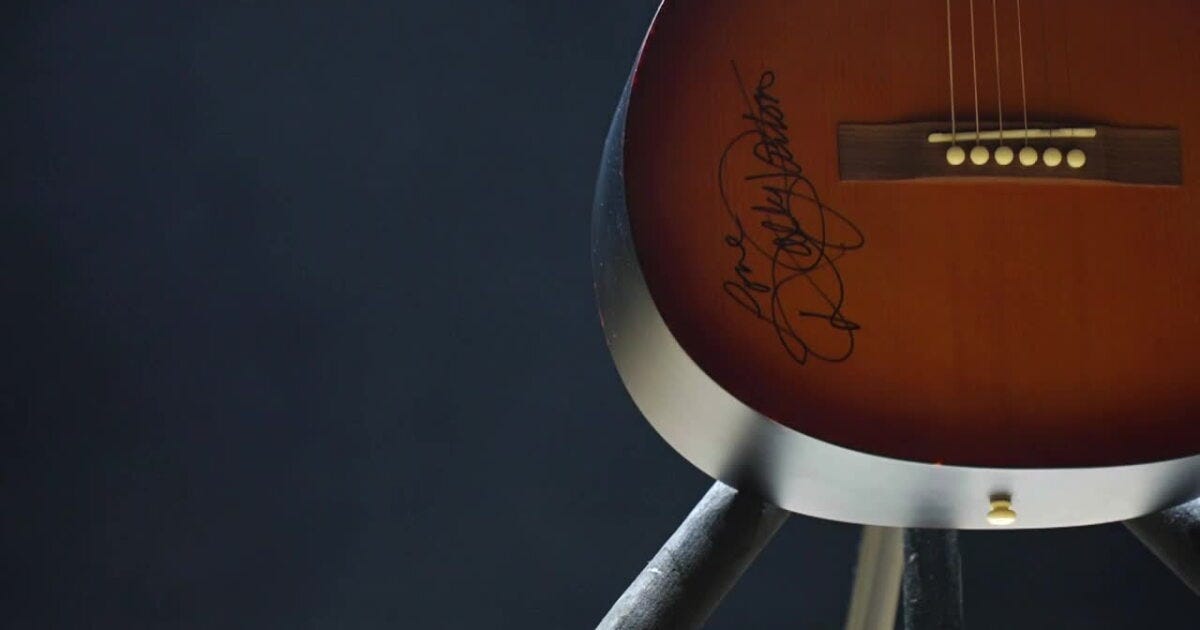
Every year or so, another instrument arrived bearing Dolly Parton’s signature, and a little proof that she had actually played it. The tradition began in 2012, at the first Voices for Children fundraiser for Williamson County CASA in Franklin, Tennessee. A connection between organizer Molly Robinson and Dolly’s sister, Rachel Parton George, led to an unusual auction donation from the country music star. It would not be the last.
Nearly every year for more than a decade, Dolly contributed another instrument, including guitars, banjos, mandolins, ukuleles, and dulcimers. Before signing each one, she would strum it herself, turning an autographed keepsake into something more personal: an instrument that had briefly been in Dolly Parton’s hands.
The organization then auctioned it to raise money for children most people would never hear about. CASA stands for Court Appointed Special Advocates. Its trained volunteers work with children involved in abuse and neglect cases, learning about their circumstances and advocating for their interests as they move through the court system. For some children, a CASA volunteer may be the one consistent adult who remains with them until their case is resolved and they reach a safe, permanent home.
Dolly’s instruments helped support that work year after year. A signed mandolin appeared in the organization’s 2014 auction, a signed ukulele in 2023. The guitar she contributed for the 2026 event raised $4,000.
It was not her largest charitable project. It did not distribute hundreds of millions of books like the Imagination Library or generate the attention of her major disaster-relief efforts. It was simply one local organization receiving one thoughtful gift, again and again. That may be what makes the story so revealing.
Dolly understood that generosity did not always require creating something enormous. Sometimes it meant recognizing what you already possessed, an instrument, a signature, a little celebrity, and placing it into the hands of people who could turn it into something useful.
Williamson County CASA will no longer be able to look forward to the next instrument from Dolly, but the gifts she kept sending have already been converted into something more lasting: trained advocates, steadier voices in courtrooms, and help for children who needed someone firmly on their side.
The instruments went home with the highest bidders. What they paid for stayed in the community.
A Note About Tomorrow
I have spent a great deal of time writing about what is wrong with America.
There has certainly been no shortage of material. Every morning brings another argument, another outrage and another person eager to explain why the people on the other side are responsible for everything that has gone wrong.
But somewhere along the way, I began wondering whether we might learn more about America by looking at the things that still hold it together.
Not the politicians or the television personalities. Ordinary people. The ones who go to work, raise families, keep promises, make mistakes, repair what they have broken and occasionally find themselves responsible for something they never intended to disturb.
That question led me to a fictional Missouri town called Coffman’s Landing.
It has a courthouse square, a bait shop, a church bell and a few front porches where people sit long enough to notice what their neighbors are doing. It is populated by people who will sometimes disappoint us, sometimes surprise us and frequently remind us of someone we have known.
The town is fictional, but it comes from real places. There is some Eldon in it, some Miller County, some Lake of the Ozarks and more than a little of the rural Missouri I remember.
The details are Missouri, but the questions are American.
What do we owe one another?
What happens when a small mistake becomes everybody’s business?
What makes a community more than a collection of houses and roads?
What does citizenship look like when it is brought down from the marble buildings and practiced at human scale?
Those are the questions beneath Five Minutes in America, my new weekday series beginning Monday.
The first week contains five stories. Each is a complete five-minute story, but together they begin introducing us to the people, places and character of Coffman’s Landing.
We begin with a crooked town sign, a boy with a rock and a great deal of trouble over one missing letter.
From there, the town will begin revealing itself.
I don’t know exactly what Coffman’s Landing will become. That is part of the adventure. We will discover its people, its history and perhaps something about ourselves, one story at a time.
Beginning next Friday, I will use this space to write a personal note about the stories we heard during the week. I’ll tell you what I was thinking about while writing them, where certain details came from and what larger question I believe the people of Coffman’s Landing were wrestling with.
But this Friday, there are no old stories to look back upon.
There is only a town waiting for us to arrive.
Members of The Coffman Chronicle will receive all five stories from the first week tomorrow. Everyone else can hear them one at a time beginning Monday.
If you would like to spend the weekend in Coffman’s Landing before the public week begins, I’d be glad to have you join us.
Become a member and hear the complete first week tomorrow.
Stay free,
Tony Michaels
Sources: NewsChannel 5 Nashville, Franklin Theatre, and Justice for All Tennessee.
Coffman Landing…What a needed antidote to the daily upheaval we are washed in each morning. It makes you want to turn away, to grumble (or mourn) “I don’t even recognize America anymore…” and get mired in loss. One cannot turn away from the destruction—it must be witnessed, resisted, opposed— else the robber barons would truly run amok amongst us. But we need the balance of sanity, of the recognizable daily lives of rest of us glossed over folks who keep keeping on. So I applaud your project. Yet I am also reminded that the population of just greater Los Angeles county surpasses the population of 45 other states (only CA, TX, FL, NY and PA each have more than 12.7 million people) and that those in our urban areas are also the backbone of America, and in great measure are good people just trying to live their lives, raise their families, make their memories, create their familiar neighborhoods and keep on contributing to the country. (I may have the tenor and purpose of your stories all wrong not having seen any yet, but I certainly don’t want us to inadvertently become yet more divided …)
Can't wait for the stories! I love learning what goes on in different towns and cities. That's one of the reasons I do my leisure traveling in my state of MI. Different people, different cultures. But it's the small towns, the Mom and Pops town where, I think, true growth and understanding is. I've traveled to many different states for business, but it's at home, you really learn.