


On Monday, February 16, 2026, viewers of The Late Show with Stephen Colbert were supposed to see something fairly standard for an election year: a candidate interview. Stephen Colbert had taped a segment with James Talarico, a Democratic state representative running for the United States Senate in Texas. The interview was booked as part of the usual late-night mix of jokes, cultural commentary, and politics.
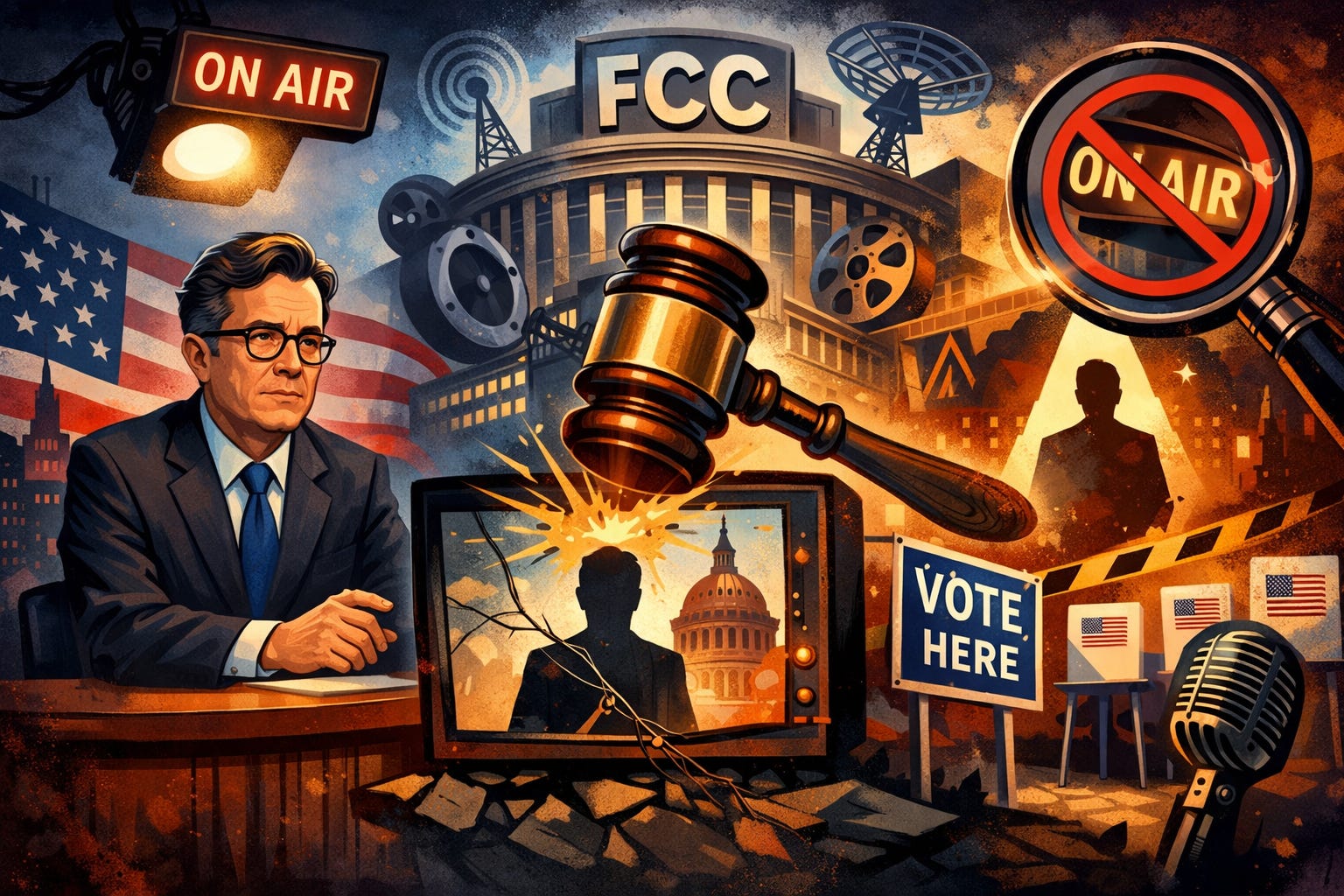
Instead, Colbert walked out and told his audience that the interview would not air on CBS that night after all. He said network lawyers had stepped in and ordered the segment pulled from the broadcast schedule and had even instructed him not to mention it on air, citing fears that airing a candidate interview in the middle of a live primary might violate the Federal Communications Commission’s “equal time” rules. The interview did go up later on YouTube, where the FCC’s broadcast rules do not apply, but it never reached the national audience that still comes with a network slot at 11:35 p.m.
CBS, for its part, offered a softer description. The company said that its lawyers had simply provided legal guidance about equal time and that the show had made its own editorial decision to release the Talarico interview digitally rather than on CBS’s broadcast signal. Colbert’s version and CBS’s version are not quite the same story, although they overlap in the crucial point. Either way, a candidate for federal office lost a high-profile broadcast platform on one of the few remaining mass audience political stages, just as early voting for the March 3 Texas Democratic Senate primary opened on February 17.
Commentators have been quick to reach for familiar explanations. CBS is caving to pressure from the Trump administration. Colbert’s long-running feud with Donald Trump finally caught up with him. The network is hiding behind legalese to justify corporate cowardice. Each of those theories captures a piece of the mood around this story. None of them fully explains why this particular interview with this particular candidate on this particular week became too hot to broadcast.
To understand that, you have to step back from the feud and look at three quieter forces that converged on the same week in February.
This Community Is Powered by You
What started as a small circle has grown into something much bigger, and it’s all because of readers like you.
Every time you forward this email, post it on socials, or bring someone new into the fold, you’re helping build one of the most passionate, independent political communities out there.
Want to keep the momentum going?
Share this newsletter with someone who should be part of this conversation.
Thank you for being here. It means everything.
CBS, Trump, and Colbert: The Obvious Story
There is a straightforward narrative here that is tempting to stop at. CBS has a long and complicated history with Trump. He has sued CBS properties, attacked programs like 60 Minutes as “fake news,” and treated the network as part of a hostile media establishment that deserves punishment rather than criticism. Colbert, meanwhile, has been one of Trump’s most consistent and cutting critics on broadcast television. His monologues for years have mocked Trump’s policies, rhetoric, and legal troubles. Trump has responded with insults and the kind of very public resentment that presidents usually reserve for foreign adversaries.
See our previous reporting here:
Note: Articles move into our archive after 45 days. Become a paid subcriber for full access to our extensive catalog.


All of that is in the air when viewers hear that a Colbert interview with a Texas Democrat has mysteriously been killed by CBS lawyers. It is not irrational for people to assume that a mix of corporate unease and Trump-world pressure is at work. When you then layer on the news that Colbert’s show will not continue on CBS beyond this May, it gets even easier to read the network’s choices as political rather than legal.
However, that context does not completely answer the key questions. CBS and Trump have been at odds for years. Colbert has been taking shots at the president since before 2016. If this is simply about feuding, why now? Why this guest, and not any of the other political figures Colbert has interviewed? Why this particular week? For that, you have to look at what the FCC did on January 21 and what happened next.
The January 21 Memo That Flipped the Mood
On January 21, 2026, the FCC’s Media Bureau released a document called “Guidance on Equal Opportunity Issues.” In plain language, the Bureau was reminding television stations that there is a federal rule, often called the “equal time” rule, that limits how broadcast outlets can host candidates for public office.
The equal time rule says that if a legally qualified candidate for office “uses” a broadcast station’s facilities, meaning they appear on air in a way that the candidate’s campaign controls, other candidates for the same office have the right to request comparable opportunities. Equal time does not force a station to invite opponents in advance, and it does not automatically trigger anything just because someone appears on television. It simply means that if a station gives Candidate A a non-exempt appearance and Candidate B asks for equal opportunities, the station must treat Candidate B fairly.
The rule has never been absolute. The Communications Act and FCC rules carve out several exemptions. If a candidate appears on a bona fide newscast, or on a bona fide news interview program, or in a news documentary where their appearance is incidental, or in live coverage of a news event, that does not count as a “use” that triggers equal time. The idea is that stations should be free to cover news without having to provide campaign infomercials to every candidate in the race.
One of the more important precedents in this area came in the mid-2000s, when the FCC decided that the interview segment of The Tonight Show with Jay Leno with then-California Governor and candidate Arnold Schwarzenegger counted as a “bona fide news interview program” for equal time purposes. In that case, the Commission concluded that the way Leno’s interviews were structured, with regular scheduling, editorial control by the broadcaster, and guests chosen for newsworthiness rather than partisan favoritism, was enough to meet the exemption. That ruling meant that Schwarzenegger’s appearance on Leno did not obligate NBC to hand equal time to his opponents. For roughly twenty years, no one at the FCC went back and said that decision was wrong.
Television producers, understandably, treated that Leno decision as a model. If you were running a late-night show with a regular schedule, real interviews, and editorial control in the hands of the host and the network rather than the campaigns, you could make a good-faith argument that you were a bona fide news interview program, too, at least for equal time. No one issued a blanket rule that said, “All late-night shows are now news.” However, in the absence of contrary rulings, the path of least resistance for lawyers and producers was to assume that if your show looked like Leno in structure, you were probably safe.
The January 21 memo is where that long-standing expectation begins to wobble. In its guidance, the Media Bureau explicitly cites the Leno precedent and says broadcasters have “overread” it. The document stresses that the 2006 decision was fact-specific and limited to that one program at that time. It goes on to say that the Bureau “has not been presented with evidence that the interview portion of any current late-night or daytime talk show” qualifies as a bona fide news interview program. In other words, it tells stations that they should not assume that Leno’s exemption automatically extends to the current crop of late-night and daytime shows.
The Bureau does not provide a detailed new checklist that would let a program know in advance whether it qualifies. Instead, it invites broadcasters to come in and seek case-by-case determinations. The message in practice is not, “here are the guardrails,” but something closer to, “we no longer presume you are exempt, and we are not going to tell you exactly what would make you exempt now.” For lawyers inside a network, that is not reassuring.
If that memo were the only thing that had changed, it would already be a reason for CBS’s attorneys to watch candidate bookings more closely. It was not the only thing.
The View, Talarico, and the First Investigation
On February 2, 2026, Talarico appeared on The View, the daytime panel show on ABC. He talked about his run for the Democratic nomination for the United States Senate in Texas. This is exactly the sort of daytime segment that has become increasingly common over the last decade, as politicians move through the talk-show circuit in search of name recognition and viral clips.
Five days later, on February 7, Reuters reported that the FCC had opened an investigation into whether ABC and The View had violated the equal time rule in connection with Talarico’s appearance. The Commission wanted to know whether The View qualified as a bona fide news interview program under the exemption, or whether Talarico’s segment created equal-time rights for his opponents in the Texas Senate race.
See our previous reporting on attacks on The View here:
Note: Articles over 45 days roll into our archive. Become a paid subscriber for full access to our extensive catalog.

This was not theoretical anymore. The January 21 memo discussed late-night and daytime shows in the abstract. The investigation into The View took that abstract warning and turned it into a concrete case file, with a real show and a real candidate attached. It also attached a name to the risk. The candidate whose daytime talk show appearance triggered the first high-profile equal time investigation under the new guidance was James Talarico.
From that moment on, any network lawyer seeing Talarico’s name on a booking sheet would not just see “candidate in a contested Texas race.” They would also see “the person whose last major broadcast appearance got another network hauled into an FCC investigation under a new, uncertain standard.” The risk was no longer general. It had a face and a precedent.
A Live Primary and an Awkward Calendar
There was one more factor that mattered to CBS lawyers in mid-February. Texas has a relatively early primary calendar, and the Texas Democratic Senate primary is scheduled for March 3, 2026. Under Texas law, early in-person voting begins well before Election Day. For the March 3 primary, early voting opened on February 17, the day after Colbert’s Talarico interview was originally scheduled to air.
Timing matters a great deal under the equal time rule. A candidate's appearance in an off-year, outside of an election season, is far less likely to trigger equal time requests than a segment that airs while ballots are being cast. When a race is live, the candidate is on the ballot, and voters are already voting, opponents have both a stronger incentive and a more credible basis to request equal opportunities.
On February 16, CBS had a taped interview with a candidate in an active primary that was entering its early voting phase. The FCC had just told the industry not to assume that shows like Colbert’s were exempt from equal time. The FCC had also just opened an investigation into The View for airing Talarico on February 2 without treating it as a bona fide news interview program. The Talarico segment on Colbert would have aired nationally, at a time when Texas voters were already making their choices.
Who is James Talarico? See our previous reporting here:
Note: Articles over 45 days roll into our archive. Become a paid subscriber for full access to our extensive catalog.

Seen from inside the CBS legal department, this is not a comfortable stack of facts. It is easy to imagine the internal conversation. On one side, there is the value of the interview, the editorial independence of Colbert’s team, and the importance of political speech. On the other side, there is a fresh FCC memo, a fresh FCC investigation into a similar show over the same guest, and a live election. If anything goes wrong, it is CBS’s broadcast license, not just Colbert’s YouTube channel, that is on the line.
That does not require any secret phone calls from the White House to explain why lawyers might err on the side of caution. The existing law and the new guidance already give them plenty to worry about.
To be clear, this is not an attempt to justify their decision. However, it is a look at the factors that may have contributed to it.
Equal Time, Exemptions, and What the Law Actually Says
To understand how much room the FCC has to create this kind of anxiety, it is worth looking briefly at the equal time rule itself.
The equal time rule is set out in Section 315 of the Communications Act. It applies to broadcast television and radio stations because the FCC regulates the use of the public spectrum by these licensees. The basic rule is simple in concept. If a station allows a legally qualified candidate for public office to “use” its facilities, that is, to appear on air in a way that the candidate’s campaign controls, then the station must afford equal opportunities to other candidates for that office who request it. Equal time does not mean identical time in the same program, but it does mean comparable exposure.
There are four important exemptions written into the law. If a candidate appears on a bona fide newscast, that appearance does not count as a “use.” If they appear on a bona fide news interview program, the same is true. If they are shown in a bona fide news documentary and their appearance is incidental to the subject matter, that is also exempt. Live coverage of bona fide news events, such as debates or conventions, is likewise exempt.
The definitions of “bona fide” in these categories have never been purely mathematical. Over time, the FCC has developed case law that considers factors such as whether a program is regularly scheduled, whether the broadcaster or host maintains editorial control, and whether guests are chosen for newsworthiness rather than partisan favoritism or hidden payment. Under that reasoning, the Commission has extended the news interview exemption to shows that most viewers would not instinctively think of as “news,” including daytime talk shows and late-night programs, so long as they meet those criteria.
The Leno decision was part of that line of cases. It signaled that the Commission was open to treating certain entertainment-flavored interview shows as news interviews for this narrow purpose, provided they met the standards. No one issued a formal regulation that carved late night into the rulebook, however, so the scope of the exemption remained a matter of interpretation and precedent rather than black letter detail.
That interpretive space is where the January 21 memo does its work. The law itself has not changed. The memo does not rewrite Section 315. It simply tells broadcasters that they should not rely on their understanding of prior cases, especially Leno, and that the Bureau does not currently view any of the current late-night or daytime talk shows as clearly qualifying. It offers no new checklist or safe harbor to replace the old expectations. It keeps the possibility of an exemption open while declining to say what a show would need to do, specifically, in 2026 to get there.
One Medium Squeezed, One Medium Spared
There is another wrinkle that helps explain why CBS’s decision has set off such strong reactions. The equal time rule, as written, applies to both television broadcasters and radio broadcasters. Both use the public airwaves under FCC licenses. On paper, the categories and exemptions apply to both.
The January 21 guidance, however, is written explicitly about television. It discusses “broadcast television programs” and uses examples from late-night and daytime TV. Initially, that could be chalked up to focus. Perhaps the Media Bureau was simply addressing the most obvious and current questions on the television side and did not feel the need to address radio.
In the days after the memo, that changed. Around January 29 and 30, Commissioner Brendan Carr told outlets including Politico Pro and radio industry publications that talk radio was not the target of the equal-time clarification. He said the notice was focused on television precedents and suggested that the Bureau did not see a similar problem with misuse or confusion on the radio side.
The effect of those comments is to create an explicit split in how the same statutory rule is being applied. On the television side, late-night and daytime talk programs are warned that they should not assume they are exempt. The first enforcement action that follows involves an investigation into The View over Talarico’s appearance. On the radio side, which is dominated by conservative and pro-Trump talk formats, broadcasters are publicly reassured that they are not the ones this is about.
When Carr told industry reporters he did not see talk radio “misconstruing” the equal time rule, that was a very careful choice of words. It may be true, in a narrow sense, that AM talkers have not been running around citing the Leno case to claim they are “bona fide news interview programs.” However, it is hard to hear that reassurance without thinking about what talk radio actually is. For decades, it has been one of the most openly partisan corners of the media ecosystem, home to hours of daily praise, attacks, interviews, and soft launches for candidates on the right. To suggest that there is nothing to worry about on the radio side, while warning and investigating television talk shows that skew liberal, is less a neutral reading of “misconstruction” than a choice about whose behavior the FCC finds concerning and whose it prefers not to see.
That is not a neutral application of an old rule. It is a choice about where to focus vague enforcement in ways that track political and ideological lines.
The Core Problem: No Clear Standards, Maximum Fear
It is easy to get lost in the personalities here. Talarico has his own rising profile. Trump and Colbert have a long and public feud. CBS has corporate interests that intersect with politics and regulation in complicated ways. All of that colors how people read the story.
Underneath all of that, though, is a simpler structural failure. The FCC is exercising power in an area that touches directly on political speech and election coverage, without providing clear, predictable standards for the people it regulates. That is what is driving the sense of whiplash and soft censorship, and it would be a problem even if the politics were different.
Anyone who has worked retail or service knows the feeling of the worst kind of performance review. A manager sits you down and says, “You are not doing enough.” You ask what “enough” looks like. They cannot or will not tell you. You ask if doing specific things, maybe X, Y, and Z, would count as improvement. The only answer you get is a vague “do better,” and the next time you get reviewed, you hear the same thing again. There is no standard, only judgment.
That is very close to what the January 21 memo does. The law says there is an exemption for “bona fide news interview programs.” Past FCC decisions, including the Leno case, have fleshed out how that applies to real shows. Over time, producers shaped their formats to align with those decisions. If the current Commission believes that earlier applications were too generous or that the media environment has changed enough to warrant a tighter standard, it can say so. However, that would mean actually articulating a new standard.
Instead, the memo tells broadcasters that they misread the one clear late-night precedent, announces that the Bureau does not see evidence that any current show qualifies, and invites individual stations to come in and argue for their own exceptions. It does not say, “if you have this percentage of public affairs content, maintain certain walls between your bookers and campaigns, and avoid particular practices, we will treat you as news.” It says, in effect, “we will know news when we see it, and at the moment we do not see it.” That is not a rule that anyone can design around.
When you couple that ambiguity with real enforcement, like the investigation into The View, you inevitably chill speech. Shows that might otherwise host candidates on broadcast television now have to weigh the risk that any segment could be the one that lands them in a case file. In practice, they often choose the safer path and push those conversations onto digital platforms beyond the FCC’s reach. That is exactly what happened to Talarico on Colbert. It is a rational response to uncertainty, but the public loses something in the process.
The lack of clear standards also creates invisible hurdles. A show that wants to comply cannot look up a simple “if you do A, B, and C, you are fine” rule. It has to guess at what the Bureau would consider “enough” to qualify as a bona fide news interview program. Each time someone guesses wrong, their show can be used as a cautionary tale for everyone else, without the Commission ever having to codify a general rule. That is how a single Texas Senate candidate booking can cast a shadow over an entire category of political speech.
In that environment, the downstream political effects are almost impossible to separate from the regulatory design. Even if no one at the FCC or CBS has consciously tried to help one side or hurt another in the Texas Senate primary, the pattern is clear enough. A candidate in a competitive race loses a national broadcast opportunity during early voting, not because the content is defamatory or obscene, but because the legal environment has become unpredictable. Other shows take note. The risk of sitting down with candidates like him increases, and the friction required to get that exposure increases. The playing field tilts in subtle but real ways, not through formal bans, but through vibes and fear.
A Simple Ask: Clear Rules, Even Hands
It is important to be precise about what a fix would look like here, especially for readers who are already skeptical of regulation in the speech space.
No one is asking the FCC to declare that late-night comedy is capital-N news. It is satire, commentary, performance, and politics all mixed together. No one is asking the FCC to police the content of jokes, or to decide which candidate interviews are too friendly or too harsh. No one is asking for more power to punish speech.
What is missing, and what a healthier system would provide, is clarity. If the law is going to treat some kinds of programs as exempt “bona fide news interview” shows and other kinds as non-exempt entertainment that triggers equal time, then those categories should be defined in terms that reflect the media landscape we actually live in. The Commission can and should publicly state the factors it will use to decide whether a program qualifies. It can and should apply those factors consistently across television and radio, rather than using old cases for one and new skepticism for the other.
That may mean acknowledging that some shows people experience as “infotainment” are, in fact, news interviews for legal purposes, and that some programs that call themselves news are not. It may mean drawing finer lines between segments within a show, something that is difficult but not impossible. What it cannot be, if we want a system that is fair and predictable, is a permanent invitation for broadcasters to “take their shot” in the dark and hope the Commission approves later.
The Colbert and Talarico story is a small one in the grand scheme of politics. One interview, one candidate, one night, when a segment that had already been taped wound up living on YouTube instead of broadcast TV. However, it is also a useful case study in how vague rules and selective enforcement create a chilling effect without anyone having to issue a direct gag order. The FCC did not ban Colbert from interviewing Talarico. It changed expectations about what counts as “news,” investigated a similar show with the same guest, and left the rest to CBS’s appetite for risk.
In other parts of life, we accept that regulation means clear guardrails. A restaurant cannot be told “be cleaner” without any written standard and then shut down for violating hygiene rules that no one would state. A workplace cannot fairly run on “do more” without describing what “more” entails. We should expect the same from agencies that sit between political speech and the public. Equal time, if it is going to exist at all, should be enforced through rules we can all read, not through vibes.
Final Thoughts
It is not incorrect to see this story as a conversation about free speech and free press. It is not wrong to view it as authoritarian pressure on opposing viewpoints. Both are valid. However, the mechanics used in this case are part of the story. The vagueness and inconsistency in FCC regulatory language were the tools exploited to achieve this end. The solution is cleaner tools, less room for bad-faith weaponization, and, of course, the preservation of democratic and constitutional norms. If we fail to fortify the systems, defeating one regime will do little to prevent the next one.
If you found this useful and want more coverage that looks past the outrage cycle and into the machinery behind it, you can subscribe to get future pieces in your inbox. I write about media, regulation, and democracy from a progressive perspective, with an emphasis on explaining how the rules really work—and who they quietly serve.
Sources:
“What to know about the ‘equal time’ rule Stephen Colbert says led CBS to pull his Talarico interview” – Associated Press, February 17, 2026
“Stephen Colbert says CBS pulled candidate interview ahead of early voting in Texas” – PBS NewsHour, February 17, 2026
“Stephen Colbert says CBS blocked interview with Texas Democrat over FCC concerns” – Washington Post, February 17, 2026
“Colbert accuses Trump administration of censorship after CBS pulls interview” – The Guardian, February 17, 2026
“Bureau Provides Guidance on Political Equal Opportunities Requirement” (Public Notice DA 26-68) – FCC Media Bureau, January 21, 2026
“FCC says US late-night, daytime talk shows must offer equal time to candidates” – Reuters, January 21, 2026
“FCC Issues Guidance Focused on Candidate Appearances on Talk Shows” – Covington & Burling / Global Policy Watch, January 29, 2026
“FCC Issues Guidance on Talk Show Compliance with Equal Opportunities Rules” – Lerman Senter, January 29, 2026
“US agency investigating if ABC’s ‘The View’ violated equal time rules for political candidates” – Reuters, February 7, 2026
“FCC Opens Probe Into ABC’s ‘The View’” – The Media Institute (reprinting The Hill), February 8, 2026
“Talk radio isn’t a target of FCC’s ‘equal time’ notice, Brendan Carr says” – Politico Pro, January 29, 2026
“Carr: Equal Time Rule Wasn’t Being ‘Misconstrued on the Radio Side’” – Talkers, January 30, 2026
“47 U.S. Code § 315 – Candidates for public office” – Legal Information Institute, Cornell Law School
“Equal-time rule” – Wikipedia
“Statutes and Rules on Candidate Appearances & Advertising” – FCC Media Bureau policy page, December 10, 2015
“The Equal Time Rule for Political Candidates” – Congressional Research Service, October 7, 2024
Maga politicians are terrified they're going to be tossed out on their fat butts and want to mitigate that from someone talking common sense. They keep blaming Democrats for all their problems, yet they've been in power in both the Governorship and State Congress for 27 years. They are running on, "We can fix it!" but fail to mention that, since they were in complete power for 27 years, the problems are the ones they caused and have had 27 years to fix and have only made them worse.