


Labor Day weekend always feels like the closing chapter of America’s summer. Crowded beaches, jammed highways, TSA bottlenecks—it’s a familiar, almost comforting kind of chaos. This year is no exception. Airports are seeing record volumes. Hotel check-ins are steady. Theme parks still smell like sunscreen and sugar.
But that familiar surface hides something far more uncertain underneath. Summer 2025 wasn’t the triumphant return many hoped for. It wasn’t even stable. It was fragile, shallow, and uneven, and the cracks we've seen over the past three months are the kind that don’t just close up with the season. They spread.
This Labor Day, invest in democracy, not distractions. Subscribe to The Coffman Chronicle today and save 40% on your yearly plan. Stay ahead of the chaos with urgent rundowns, fearless analysis, and independent commentary that refuses to stay silent.
📅 Hurry — this Labor Day sale won’t last long.
The Vanishing International Traveler
International travel to the United States continued its slide this summer. Inbound visitation fell 3.1 percent in July, marking the fifth straight monthly decline. Total visitor spending, once projected to exceed $181 billion this year, is now likely to come in at $169 billion or less. That’s a shortfall of at least $12 billion. Julia Simpson, CEO of the World Travel & Tourism Council, didn’t mince words: “Of 184 countries, the U.S. is the only one that's seeing an absolute decline in international visitor spending.”
The reasons are no longer just about COVID-era lag or global inflation. They're political, and they’re structural.
The Cost of Entry Is Rising Fast
This fall, the United States will begin implementing a $250 “visa integrity fee” on most foreign tourists. Add that to standard processing charges, and the cost of visiting the U.S. for many travelers rises to well over $400 in visa fees alone. Geoff Freeman, head of the U.S. Travel Association, called it what it is: “A cynical junk fee… The most likely action here is to simply go to another market where your business is more appreciated.”
That’s not just a prediction. It’s already happening. In March, Canadian travel bookings to the U.S. plummeted by more than 70 percent compared to the same time last year, driven largely by a grassroots boycott in response to what many Canadians view as hostile and discriminatory U.S. policies. Entire duty-free stores along the northern border have shuttered. In Europe, the UK, Germany, and Spain each posted double-digit declines in outbound travel to the U.S., even as those same travelers redirected their vacations to Japan, Portugal, or Canada.
Even Domestic Travel Is Showing Signs of Strain
If this were just about international visitors, the blow might be survivable. But the problem runs deeper. Even within the U.S., economic pressures are bearing down on domestic tourism. Tariffs on everyday goods have made everything from groceries to electronics more expensive. Rent and health care costs continue to outpace wage growth. Student loan repayments have resumed after a three-year hiatus. And Americans are carrying record levels of credit card debt at the highest interest rates in over two decades. Discretionary income, the lifeblood of travel, is drying up.
See our recent reporting on the discretionary spending issue here:

And yet, on paper, summer travel appeared strong. Air travel was high. National park attendance leveled off. Road trips bounced back. However, dig into the numbers, and the truth becomes clear: travel was propped up by wealthier Americans seeking discounts. Airlines slashed fares to fill seats. Hotels leaned on points programs. Regional tourism boards marketed to drive markets within four hours or less. The middle and working classes, once the backbone of America’s summer vacation economy, were largely absent. This wasn’t recovery. It was strategic patchwork.
Tourism-Dependent Cities Are Already Feeling It
The effects have been particularly painful in tourism-dependent cities. Las Vegas, despite a packed event calendar, saw international visitation drop 13 percent year-over-year. Hotel occupancy fell more than 7 percentage points. In Washington, D.C., a visible militarization of public spaces, including National Guard deployments, has pushed away not just casual tourists but major conferences and business travelers. The local hospitality sector is staring down $50 million in projected revenue loss for 2026 due to canceled bookings.
See our recent reporting on the militarization of D.C. here:

Fall May Hold, but Spending Will Falter
The outlook for fall isn’t better. Foliage season and football games will bring some traffic to small towns and stadium cities. Thanksgiving will still see packed flights and congested roads. However, spending will be lean as consumers struggle with tariff-related costs and general economic strain. The average traveler, according to AAA, is now shortening trips and choosing budget accommodations over premium ones. And that’s among those who can still afford to travel.
The Mega-Events That May Underwhelm
Looking ahead, the 2026 World Cup and 2028 Summer Olympics were supposed to be America’s global tourism showcases. Instead, they’re increasingly at risk of becoming over-policed, under-attended, and logistically disastrous. With visa fees rising, global perceptions souring, and the specter of ICE enforcement looming, many international fans and participants are quietly reconsidering their plans. The excitement that once surrounded these events is now tinged with apprehension, and for some, resentment.
Tourism Isn’t a Luxury. It’s a Signal
Tourism is often dismissed as fluff, a luxury sector, a feel-good indicator. But it’s not. It accounts for roughly 3 percent of U.S. GDP and generates more than 7 percent of total tax revenue in key states, such as Florida, Nevada, and Hawaii. More importantly, it’s a reflection of how the world perceives us and how we perceive ourselves.
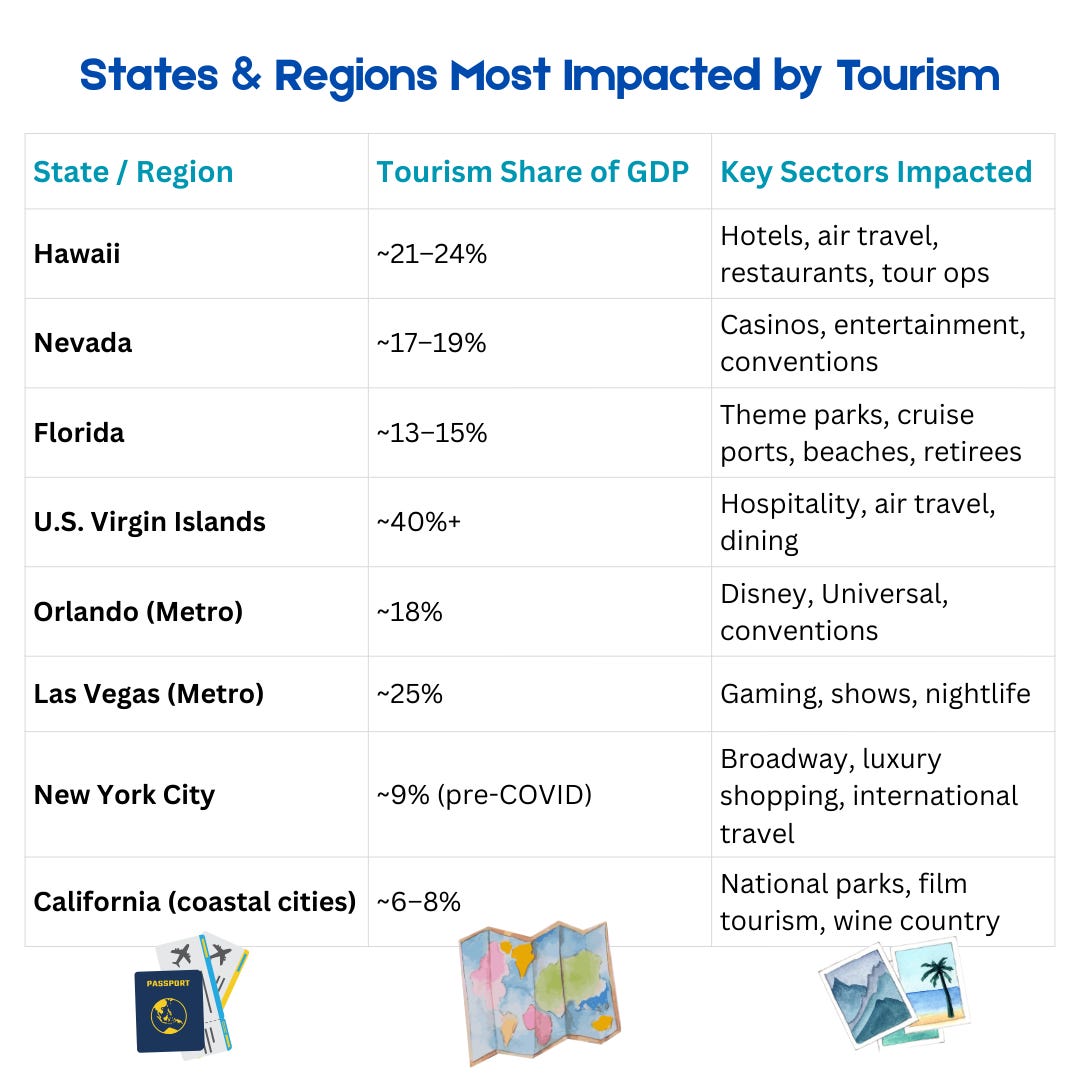
This summer told us something we didn’t want to hear. The U.S. is no longer the easy, joyful destination it once was. Economic policy, border control, and political rhetoric have created real-world consequences for restaurants, hotels, and entire cities. The infrastructure of American tourism is being held together by discounts and nostalgia, neither of which can last forever.
A Warning Wrapped in Familiar Ritual
Labor Day is supposed to be a moment of pause, a breath before the fall. However, this year, it feels more like a sigh of resignation. The planes are full, the beaches are busy, and yet everyone seems to know—whether they say it aloud or not—that something isn’t quite right.
This summer may be remembered not for what it delivered, but for what it foreshadowed. It didn’t feel like a collapse. But it didn’t feel like stability, either. It felt like a system running on fumes. And if nothing changes, this might just have been the last great American summer.
Stay Informed. Stay Loud.
Subscribe to The Coffman Chronicle for no-BS political analysis, action guides, and daily truth bombs you won’t get from corporate media.
Sources:
“New $250 visa fee risks deepening US travel slump” - Reuters
“Tourism Was Already Plummeting Under Trump. Now the U.S. Is Raising Visa Fees on Visitors” - Time
“Trump bill adds $250 fee for some foreign travelers. Here's how it works.” - Washington Post
“US imposes 'visa integrity fee': India, China, Mexico most affected; experts warn of tourism decline” - Times of India
“US International Inbound Travel Remains Weak for 2025” - Tourism Economics
“Some tourists and business travelers may face up to $15,000 bond to enter US” - The Guardian
“2025 Canadian boycott of the United States” - Wikipedia
“Tourism in the United States” - Wikipedia
“International Air Travel … Shows Mixed Trends in July 2025” - FTN News
“B visa” - Wikipedia

This is what a cruel & incompetent admininistration looks like when the love of money & greed sets in. We shall overcome all of this in a matter of Time. With a lot of HOPE and Work! Sooner than Later. Happy Labor Day!
The US tried isolationism and increased tariffs on imports in the past. It was a complete failure.