


Walter began working at the public library on a Tuesday without filling out an application.
By Wednesday, he had perfect attendance and no measurable output.
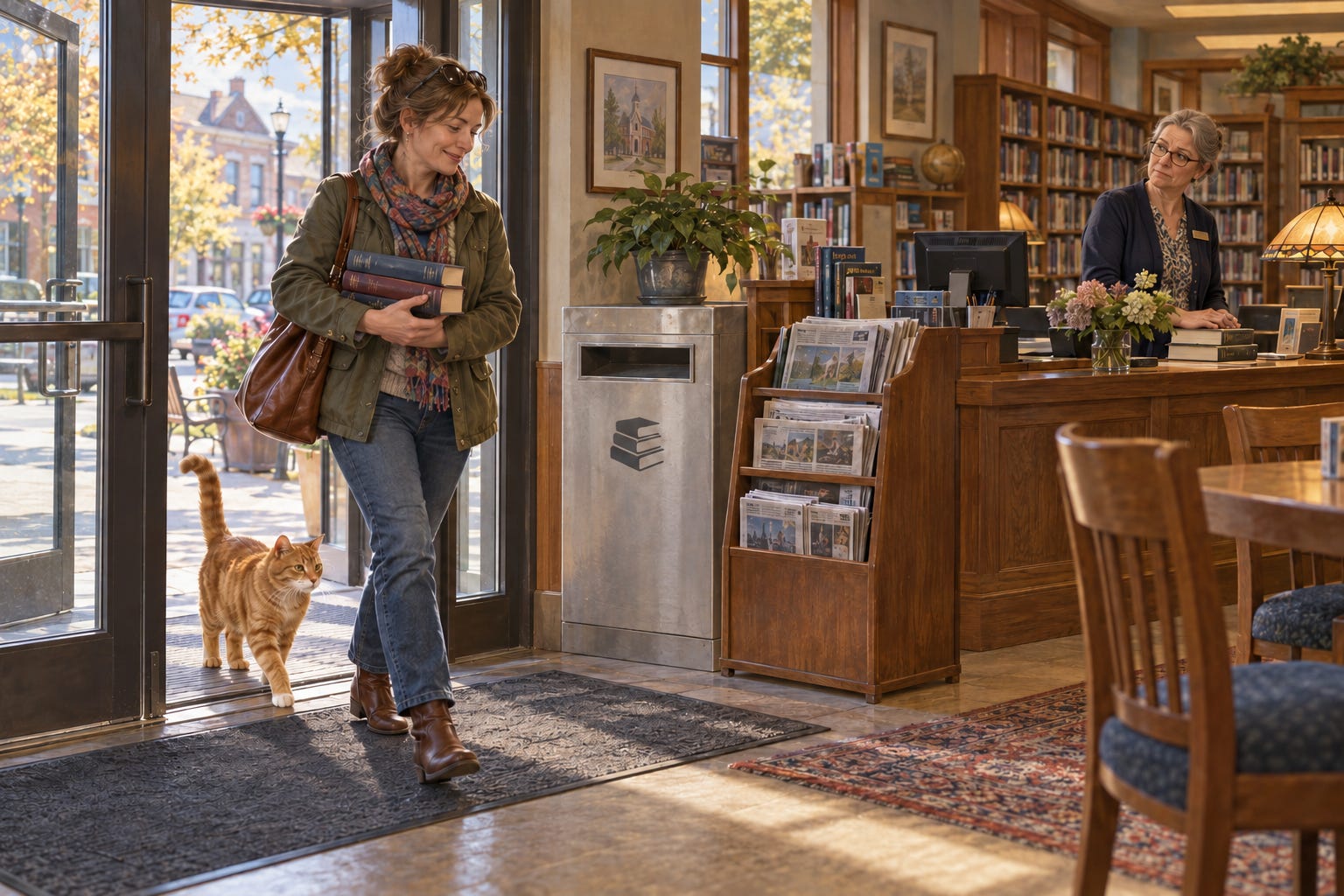
He was an orange cat with one white paw and the unhurried confidence of someone who had never received an urgent email. Each morning, he appeared outside the glass doors before opening, slipped in behind a patron, and settled beneath the newspaper rack.
At first, Head Librarian Marian Bell carried him back outside. Walter returned through the book drop.
Marian carried him out again. Walter waited beside a woman returning three mystery novels and walked back in as though they had arrived together.
“We cannot have a cat in the library,” Marian told Youth Librarian Tasha Green.
“Of course not,” Tasha said, placing a folded towel beside the radiator. The towel was not officially for Walter. It was simply warm, cat-sized, and in exactly the spot he preferred to sleep.
For several days, the staff insisted Walter wasn't the library’s cat. He was merely a cat who spent all day in the library, greeted patrons, occupied library furniture, and became visibly annoyed when the copier made noise. There was an important administrative distinction.
The children named him Walter because Tasha said he looked like a Walter. Nobody could explain what that meant, but everyone agreed.
This Community Is Powered by You
What started as a small circle has grown into something much bigger, and it’s all because of readers like you.
Every time you forward this email, post it on socials, or bring someone new into the fold, you’re helping build one of the most passionate, independent communities out there.
Want to keep the momentum going?
Share this newsletter with someone who should be part of this conversation.
Thank you for being here. It means everything.
The Employee Nobody Hired
Walter’s first regular visitor was a third grader named Eli, who hated reading aloud. During the after-school program, Eli whispered every sentence and stopped whenever he stumbled over a word. Walter climbed into the chair beside him, turned twice, and went to sleep.
Eli tried another sentence. Walter did not correct him. By Friday, Eli had read Walter most of a book about volcanoes. Walter slept through it all, which Tasha described as “a highly supportive listening style.”
Then Mr. Alvarez began coming every afternoon. His wife had died the previous winter. Before Walter, he came only on Thursdays to read the local newspaper. Now he sat in the armchair beside the radiator every day. Walter usually slept on his shoes.
“He likes me,” Mr. Alvarez said.
“He likes the heat vent beneath your chair,” Marian said.
Mr. Alvarez nodded. “We have an understanding.”
Other people began staying longer too.

Parents lingered after story hour. Teenagers came for the Wi-Fi and stayed to report Walter’s movements. A retired teacher brushed him every Friday. Two men who had argued for years about the editorial page began speaking again after Walter sat directly on the article they were disputing.
A Fourteen-Percent Problem
The electronic door counter showed visits up fourteen percent. This would have been uncomplicated good news if the annual budget review had not been approaching.
The library board wanted an explanation for every increase and justification for every expense.
Board Chairman Gordon Price studied the report through the lower half of his glasses. “Visits are up fourteen percent,” he said. “What new service did we introduce?”
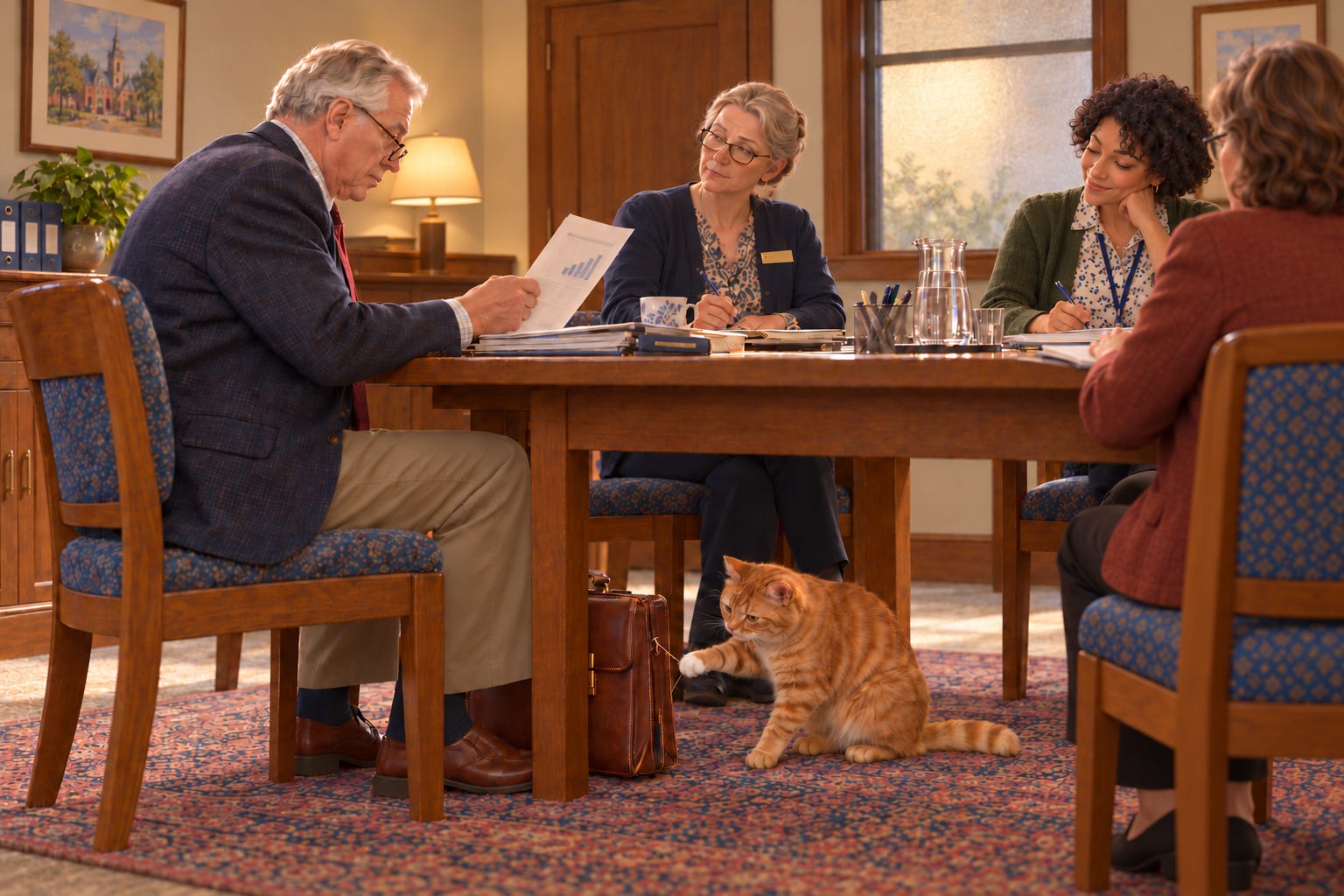
Marian looked at Tasha. Tasha looked beneath the conference table, where Walter was attempting to pull a loose thread from Gordon’s briefcase.
“We acquired a cat,” Marian said.
Gordon lowered the report. “With what funds?”
“We did not acquire him financially.”
“Was he donated?”
“Not in the traditional sense.”
Gordon looked under the table. Walter stopped pulling the thread and stared back. “Is he a volunteer?”
“He has not completed the paperwork.”
“Has he had a background check?”
“He has no background we can confirm.”
The board requested more information.
Walter’s Official Record
The next morning, Marian created a document titled RESIDENT ANIMAL SERVICE ASSESSMENT. Before Marian could print it, Tasha changed it to WALTER’S ATTENDANCE RECORD.
For three weeks, the staff recorded Walter’s activities. Hours present: 173. Books shelved: zero. Meetings interrupted: four. Children comforted: nine. Newspaper disputes prevented by occupying the newspaper: two. Patrons greeted: difficult to determine. Unauthorized naps: all of them.
One entry read: “Sat inside empty cardboard box from 10:14 until closing. Purpose unclear.”
Gordon returned the report with a yellow note. HOW DO WE KNOW THESE PATRONS WOULD NOT HAVE VISITED ANYWAY?
The librarians discussed creating a control group. That would require selecting patrons who were not allowed to see Walter, which everyone agreed would be difficult to enforce and unnecessarily cruel.
Tasha proposed a feline engagement survey. Marian rejected it after reading the first question: On a scale of one to five, how strongly do you agree that Walter acknowledges your contributions?
What the Numbers Couldn’t Hold
The question behind Gordon’s note remained. What, exactly, was the library supposed to prove? The circulation numbers mattered, as did program attendance, computer use, and help with tax forms or job applications. Public money deserved accounting. Marian believed that as strongly as Gordon did.
Some things, however, were harder to count. No column tracked the man using a library computer because his unemployment application existed only online. No easy unit measured the woman staying warm because her apartment heat had failed. No circulation statistic captured Eli trying “constellation” three times instead of giving up.
The library was not valuable because nothing there could be measured. It was valuable because measurement was supposed to help the town understand what the institution accomplished, not become an excuse to ignore everything that did not fit neatly into a box.
The board scheduled an official visit. On inspection day, Walter did nothing useful. He did not greet the board. He did not demonstrate increased circulation. He did not even wake up when Gordon entered.
Walter slept beneath a table while Marian showed the board the computer stations, children’s room, meeting space, and shelves of forms patrons needed help finding because more government services had moved online.
She explained that the library served as an office for people without offices, a classroom for people without quiet homes, and a place to get help without first proving they could afford it. That did not make every program necessary forever. Public institutions still had to show their work. Programs that failed should change. Waste should be found.
However, the test could not simply be whether every chair, hour, employee, or orange cat produced a unit of output. The test was whether the institution had enough capacity to do the work the community depended on it to do.
Gordon took notes.
Near the radiator, Eli was reading aloud from a book about the solar system. He reached the word “constellation,” stopped, and tried again.
Walter opened one eye. Eli sounded it out slowly. Walter climbed into the chair beside him and settled against his leg.
Across the room, Mr. Alvarez lowered his newspaper. “That’s right,” he told Eli. “Constellation.”
Eli repeated it. A teenager at the next table looked up from her laptop. The retired teacher smiled. Tasha added a small mark to Walter’s attendance sheet.
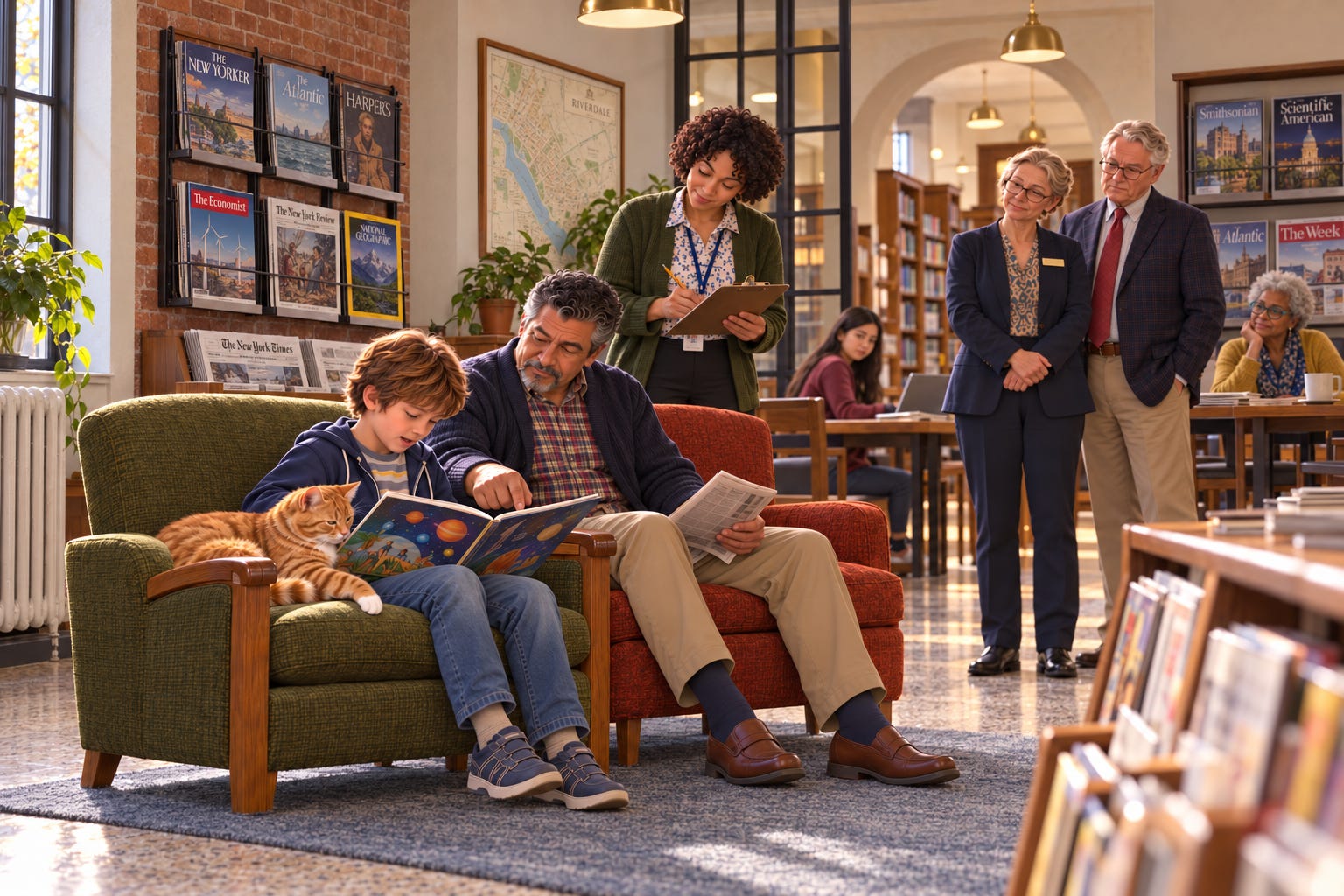
Gordon watched the room. “What service,” he asked Marian, “would you say the cat is providing right now?”
Marian looked at Eli, Mr. Alvarez, and the people who had begun talking to one another because an orange cat kept giving them a reason to stay. “Retention,” she said.
The board did not put Walter on the payroll. It did something more sensible. It approved a policy allowing a resident animal when consistent with public health, accessibility, and community use. The Friends of the Library paid for Walter’s vaccinations, neutering, food, and regular veterinary care. The town designated a cat-free reading room for people with allergies, service animals, or an entirely reasonable dislike of cats.
The town kept paying for what only the town could reliably provide: librarians, books, computers, heat, lights, and a public place where nobody had to buy anything to stay. The community handled Walter. That arrangement suited Walter, who had never expressed interest in working for the government.
At the next budget meeting, Gordon asked whether the library was still tracking his performance. Marian handed him the latest attendance record.
Walter had been present every day except one, when the library closed because of ice. His measurable output remained zero. Visits were still up fourteen percent.
Gordon studied the page, then wrote something in the margin. After the meeting, Tasha leaned over to read it. KEEP TRACKING ATTENDANCE. STOP TRYING TO MAKE THE CAT SHELVE BOOKS.
Walter spent the afternoon asleep in the cardboard box. His purpose remained unclear.