


In a hyper-partisan, chaotic era when Americans can’t seem to agree on anything—not even on whether government should function—two moments in the House of Representatives this week offered something rare: a glimpse of institutional memory. Two bills, originating in different corners of the Democratic caucus but finding support across the aisle, pointed quietly toward the same foundational idea. They are not a policy victory, not a partisan win, but a return.
The first was a bipartisan vote on Tuesday to repeal the 1991 and 2002 Authorizations for Use of Military Force, outdated legal justifications for war in the Middle East that have lingered like loose wires in the machinery of government. The second came just a day later, when Representatives Marcy Kaptur and Brendan Boyle introduced the Congressional Power of the Purse Act. This bill would strengthen Congress’s ability to enforce its constitutional authority over federal spending, curbing a president’s ability to withhold funds that have already been appropriated.
Each bill is distinct, but both point in the same direction: Congress, perhaps for the first time in a long time, is attempting to reassert its constitutional role.
That is no small thing. When the political system feels as fragmented and exhausted as the nation itself, when trust is eroded and cynicism has taken root in its foundation, the notion that Congress might still remember its structural purpose is worth noting. In a country that has become unrecognizable to many of its own citizens, the idea of returning to something original—to something built—can feel revolutionary.
But it isn’t. It’s not even radical. It’s foundational.
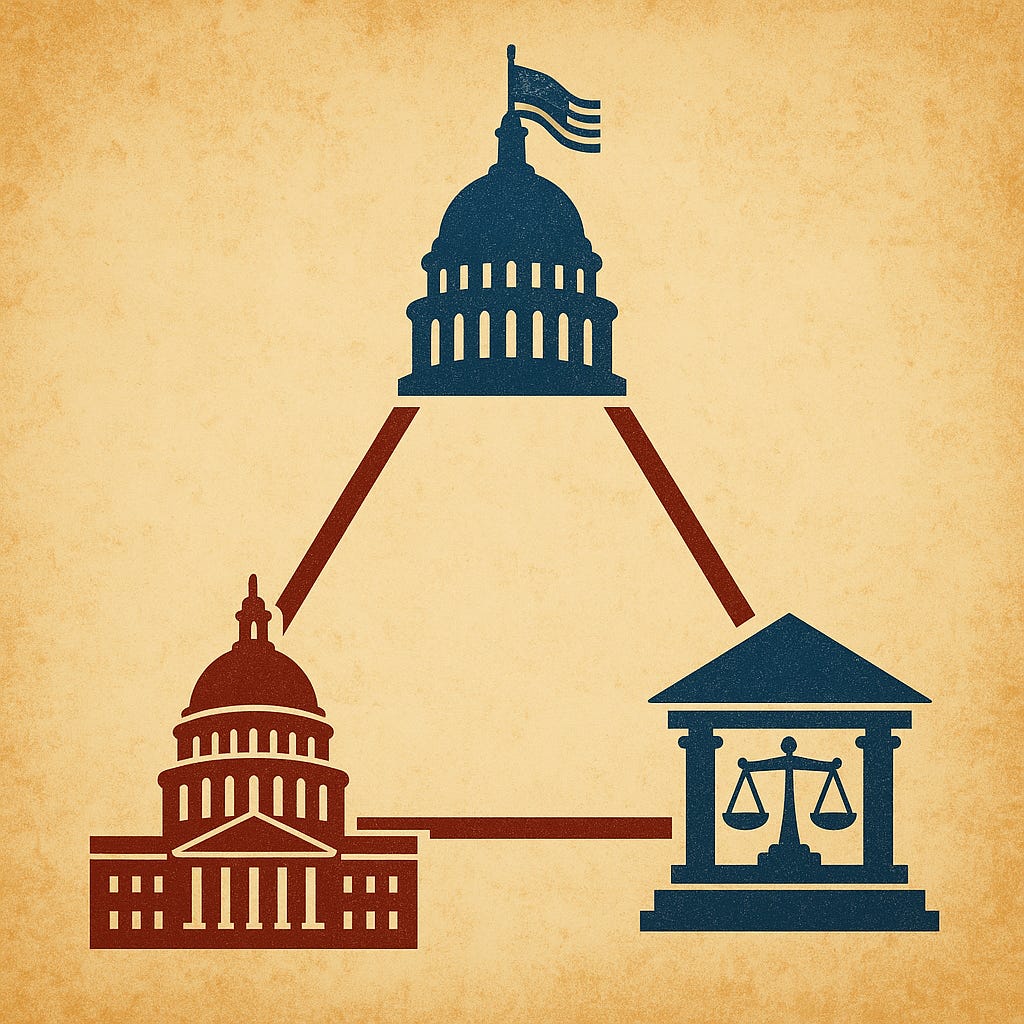
The framers didn’t draw a line of power. They built a triangle, three coequal branches, balanced by design. And like any triangle, it only holds if all three sides do their part. Pull one too far, or let another sag, and the structure begins to tilt, then to break.
Stay Informed. Stay Loud.
Subscribe to The Coffman Chronicle for no-BS political analysis, action guides, and daily truth bombs you won’t get from corporate media.
Two Bills, One Goal: Restoring Constitutional Ground
Repealing the AUMFs: A Quiet Vote with Loud Implications
On Tuesday, September 9, the House of Representatives voted 261 to 167 to repeal the 1991 and 2002 Authorizations for Use of Military Force, the laws that provided legal cover for the Gulf War and the Iraq War. The repeal was co-sponsored by Representative Gregory Meeks, a Democrat from New York and ranking member of the House Foreign Affairs Committee, and Representative Chip Roy, a Republican from Texas known for his constitutionalist and libertarian-leaning views.
The bipartisan nature of the vote was striking. Forty-nine Republicans joined every Democrat voting in support of repeal. Unlike most legislation that manages to bridge the aisle, this wasn’t framed as a compromise or a deal. It was framed as a correction.
“For decades, Congress has completely abdicated its constitutional duty to deliberate on matters of war and peace,” Roy said in a joint press release with Meeks dated February 21, 2025. “We can’t stop the cycle of endless wars unless Congress is willing to step up and do its job and ensure these authorizations can’t be abused in the future.”
Roy’s words were not softened for bipartisan comfort. They were sharp, direct, and grounded in the constitutional text itself, specifically Article I, Section 8, which grants Congress, and Congress alone, the power “to declare War.” That’s precisely what makes them so important. When a progressive Democrat and a firebrand Texas Republican can agree on the limits of executive war-making authority, it’s not about ideology. It’s about structure.
The repeal of these AUMFs would not halt ongoing military operations, nor would it rewrite American foreign policy. However, it would eliminate dormant legal weapons that future presidents could wield without requiring fresh congressional approval. It is, in that sense, not a retreat, but a reinvestment in the very mechanism of deliberation.
The Power of the Purse: Reclaiming the First Branch’s First Power
The day after the AUMF repeal vote, on September 10, Representatives Marcy Kaptur of Ohio and Brendan Boyle of Pennsylvania introduced the Congressional Power of the Purse Act. While the bill’s name may sound procedural, its intent is anything but. It’s a direct move to restore the most fundamental responsibility of Congress: control over federal spending.
Article I, Section 9 of the Constitution is explicit: “No Money shall be drawn from the Treasury, but in Consequence of Appropriations made by Law.” That clarity, however, hasn’t stopped successive presidents from pushing the boundaries of executive authority, most recently by delaying or withholding funds that Congress has already approved.
Kaptur and Boyle’s bill aims to tighten the statutory screws. It seeks to modernize the 1974 Impoundment Control Act and prevent future presidents from using what’s often called “backdoor budgeting”, the quiet, bureaucratic withholding of funds to kneecap programs they politically oppose.
In her official statement, Kaptur was direct: “We are fighting back against President Trump's power grab and working to protect essential services.” She framed the bill not as a partisan attack, but as a constitutional defense.
"The Constitution gives the power of the purse to Congress, not to the president." - Ranking Member Brendan F. Boyle
While the bill currently lacks vocal Republican co-sponsors, the principles it reasserts are not new. They are the same ones James Madison underscored in Federalist No. 58, when he wrote: “This power over the purse may, in fact, be regarded as the most complete and effectual weapon with which any constitution can arm the immediate representatives of the people.”
In a functioning constitutional order, Congress doesn’t beg the president to spend money. It commands it, and the executive obeys. This bill is an attempt to reestablish that hierarchy—not for a news cycle, but for the republic itself.
A Long Decline, Foretold
The slow unraveling of Congressional power didn’t start with this century, but it accelerated after 9/11. In the name of national security, presidents of both parties have claimed increasingly broad authority to act without congressional approval, whether through military action, surveillance, or fiscal maneuvering. Congress, for the most part, let them.
The post-9/11 AUMF of 2001 has become a blank check for presidents to conduct military operations in nearly 20 countries. Emergency declarations have become routine. Budget authority has been twisted through executive memoranda and funding deferrals. The people’s branch has been reduced, more often than not, to a reactive body, commenting on wars it no longer declares and critiquing spending it no longer controls.
We’ve reported extensively on the erosion of checks and balances, specifically Congress relinquishing it’s power. See some of that reporting here:
Note: These articles are more than 45 days old and now live in our archive. Consider becoming a paid subscriber for exclusive perks including full access to our nearly 1000 articles.


This decay did not go unnoticed by the Founders.
In his farewell address in 1796, George Washington warned that political parties, if left unchecked, would become “potent engines by which cunning, ambitious, and unprincipled men will be enabled to subvert the power of the people.” John Adams later wrote that “there is nothing which I dread so much as a division of the republic into two great parties,” calling it “the greatest political evil under our Constitution.”
Even Madison, who designed much of the system himself, knew where the danger would lie. “The accumulation of all powers, legislative, executive, and judiciary, in the same hands… may justly be pronounced the very definition of tyranny.”
That tyranny doesn’t always arrive as a crown or a coup. Sometimes it comes wrapped in precedent—quietly, gradually, through neglect.
Why the House Moved First
It’s not an accident that both of these efforts to reclaim Congressional authority—over war and over money—originated in the House of Representatives. That chamber was always meant to be closest to the people, most responsive to public will, and, not incidentally, most jealous of its own power.
Article I begins with the legislature for a reason. Within that structure, the House was granted specific tools: control over appropriations, the power to impeach, and the pressure of facing reelection every two years. It was designed to be loud, imperfect, and assertive. In recent years, it has been loud but less assertive.
In this case, it has acted before the Senate, which often operates at a slower pace and tends to defer more willingly to executive authority, particularly on matters of foreign policy and spending. Whether this dynamic will hold as the bills move forward remains to be seen, but the signal is clear: institutionalists in the House are stirring.
That these moves came from lawmakers like Chip Roy and Marcy Kaptur, who share little in common politically but a deep sense of congressional responsibility, is no small thing. It suggests that, beneath the performative polarization of cable news and social media, there are still members of Congress who remember their Article I duties.
They are acting not in opposition to the presidency, but in defense of the structure itself.
An Unlikely but Constitutional Coalition
What makes this moment worth more than a footnote is not just the bills themselves, but the constellation of lawmakers supporting them. This is not a coalition built around ideology, culture war, or party loyalty. It’s built around something far older: constitutional structure.
Progressive Democrats, institutionalist moderates, libertarian-leaning Republicans, and constitutional conservatives acting together. On these two bills, they’re not debating ideology. They’re defending the architecture.
When Representative Chip Roy said Congress had “completely abdicated its constitutional duty,” it echoed not only the frustration of his libertarian base but also the concerns of many progressives who have long criticized executive overreach. When Representative Marcy Kaptur warned of a “power grab” in reference to impoundment of funds, it wasn’t a partisan jab. It was a structural alarm.
For those of us who have spent years watching these factions clash over nearly everything, there is something grounding in this moment. The Constitution may not dictate what the tax rate should be or how to reform health care, but it is unambiguous about who decides when we go to war and who controls the money. That clarity creates space—however narrow—for agreement.
And in a time when Americans can’t seem to agree on anything, agreement on structure is notable.
As someone who counts themselves on the progressive edge of the spectrum, it’s not often I find myself nodding in unison with someone like Chip Roy, but when he calls out Congress’s surrender of its war-making authority, I agree full-throatedly. On this, he’s not speaking as a partisan. He’s speaking as a constitutionalist.
And that may be the best hope we have: that enough lawmakers, across enough factions, can remember that their first allegiance is not to a party, or even a president, but to the institution they were elected to uphold.
If we cannot all agree on the framework of the Constitution, what hope is there?
A Note of Caution
We’ve seen signs of realignment before, moments when Congress seemed poised to reassert its constitutional authority, only to hesitate at the edge of follow-through.
In June, the Sanctioning Russia Act drew overwhelming bipartisan support. With more than two-thirds of the Senate co-sponsoring the bill, Congress appeared ready to impose veto-proof sanctions that would curb executive discretion over foreign policy. Yet the moment stalled. President Trump signaled conditional approval—support, but only if he retained control over implementation. House leadership urged a delay until after Trump’s self-imposed diplomatic deadline with Russia had passed. In the end, what appeared to be a structural reassertion of congressional power gave way to a familiar deference.
The lesson is not that these moments don’t matter. It’s that they are fragile. Constitutional resolve is not a one-time vote. It is a habit that must be built, exercised, and defended.
See our reporting on that bill here:
Note: This article is more than 45 days old and now lives in our archive. Consider becoming a paid subscriber for exclusive perks including full access to our nearly 1000 articles.

A Ray of Hope, Just in Time
These bills alone won’t fix what’s broken. They won’t reverse decades of executive overreach, or cure Congress of its instinct to defer rather than decide. Yet they matter because they signal that at least some lawmakers remember the blueprint.
And timing matters. The United States will mark its 250th anniversary in less than a year, a quarter-millennium since a group of imperfect but visionary revolutionaries drafted a structure designed not to guarantee perfect outcomes, but to prevent tyrannical ones.
The framers didn’t draw a line of power. They built a triangle—three branches, interdependent, each meant to restrain the others. The only shape stronger than an arch is an equilateral triangle, and for it to stand, all three sides must hold.
In a moment when the very concept of truth feels contested, when politics has become performance, and when democracy itself feels increasingly brittle, the idea of returning to the structural integrity of the Constitution may be the only thing left we can agree on.
And that’s a place to start.
Despite everything—despite polarization, institutional decay, and cynicism—this much remains true: the Constitution still holds, but only if we do. And we must.
Stay Informed. Stay Loud.
Subscribe to The Coffman Chronicle for no-BS political analysis, action guides, and daily truth bombs you won’t get from corporate media.
Sources:
Meeks, Gregory W., and Chip Roy. “Meeks, Roy Introduce 1991, 2002 AUMF Repeal Bill.” House Foreign Affairs Committee, U.S. House of Representatives, February 21, 2025.
Kaptur, Marcy, and Brendan F. Boyle. “Kaptur Joins Boyle, Budget Democrats to Fight Back Against President Trump’s Power Grab and Protect Essential Services.” Press Release, Office of Congresswoman Marcy Kaptur, September 10, 2025.
“Protecting Congress’ Power of the Purse.” Democrats‑Budget.house.gov, Congressional Democrats Budget Committee, September 2025.
“House Votes to Repeal Iraq War Authorizations.” CBS News, September 10, 2025.
“Article 1 of the Constitution.” Constitution Online.
Washington, George. Farewell Address. September 19, 1796. Founders Online, National Archives.
Adams, John. “Letter to Jonathan Jackson, 1780.” In The Works of John Adams.
I'm all in for both of these bills. But what they really need to do is rein in the runaway bloated military budget.
Encouraging news!