


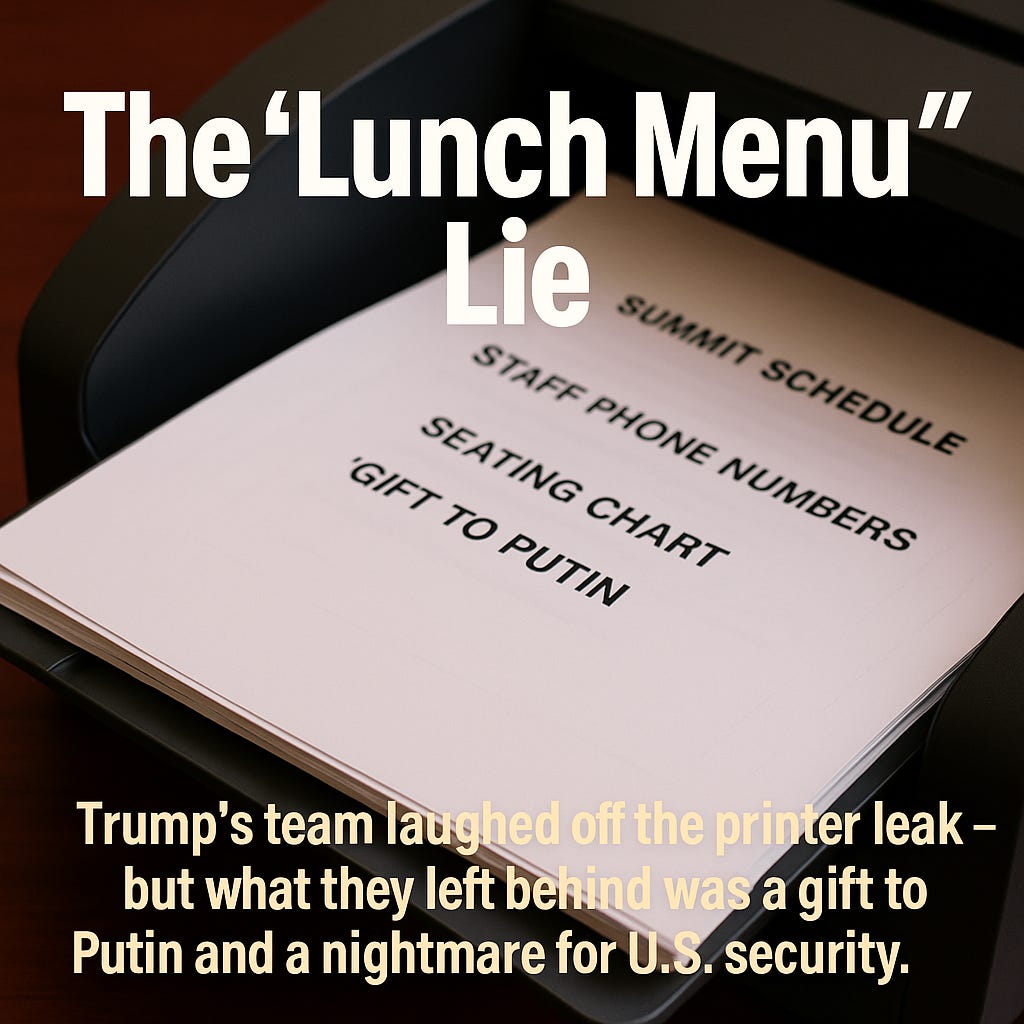
The Printer That Spilled State Secrets
Only Donald Trump could turn a hotel printer into a national security risk. Hours before his long-anticipated summit with Vladimir Putin, eight pages of U.S. State Department briefing materials were found sitting in a public printer at the Hotel Captain Cook in Anchorage.
They weren’t classified, and that’s exactly what makes the White House think they can shrug this off. But buried in those pages was a treasure map for anyone who knew how to use it: detailed schedules, the seating plan showing who would flank Trump and who would sit beside Putin, direct phone numbers of American officials, and even phonetic crib notes reminding Trump how to say “POO-tihn” without embarrassing himself.
The timing could not have been worse. This wasn’t a binder forgotten in a bar after the fact. This wasn’t an itinerary accidentally left on a plane. This was a live operations playbook for the most sensitive diplomatic meeting of Trump’s second term, abandoned in a printer where hotel staff, journalists, or foreign operatives could have walked away with it.
And what was the White House response? Laughter. Deputy press secretary Anna Kelly dismissed the eight-page leak as a “multi-page lunch menu.” As if exposing U.S. officials’ phone numbers and summit strategy hours before Trump sat down with Putin was no different than misplacing a takeout order.
That glib deflection is more dangerous than the papers themselves. It signals, once again, that under Trump, the rules don’t matter. Security doesn’t matter. Accountability doesn’t matter. What matters is spinning the scandal into a joke, mocking anyone who takes national security seriously, and banking on the country to forget before the news cycle moves on.
But this is not the kind of mistake America can afford to laugh off. When the president of the United States can’t even keep a summit briefing out of a hotel printer, the real joke is on us, and Putin is the one laughing loudest.
And while every president has faced their own embarrassing mishaps with sensitive documents, none have reached this level of danger.
Stay Informed. Stay Loud.
Subscribe to The Coffman Chronicle for no-BS political analysis, action guides, and daily truth bombs you won’t get from corporate media.
Why This Leak Was Different
To be clear, Trump is not the first president under whose watch sensitive papers were mishandled. Every administration has had its embarrassments: itineraries left on planes, binders forgotten in bars, redaction failures that exposed more than intended. But none of those past lapses carried the same live, real-time danger as Trump’s Alaska printer fiasco.
Take 1998, during the Clinton years, when a folder of White House travel documents was accidentally left on a commercial flight. The memos revealed some internal logistics, but by the time they were discovered, the president’s trip was long over. The risk was minimal, the embarrassment more than the substance.
In 2008, near the end of George W. Bush’s presidency, the Transportation Security Administration accidentally posted its counterterrorism screening manual online with botched redactions. Terrorists could have studied it to spot weaknesses in airport security — a serious systemic lapse — but it was still a static document, not a real-time operational playbook.
Even Barack Obama’s team wasn’t immune. In 2012, a contractor left behind a Secret Service binder at a Chicago bar during the NATO summit. The binder contained motorcade routes and evacuation plans — alarming, yes, but discovered after the fact and quickly contained. Officials were embarrassed, not actively compromised.
In other words, past presidents faced document mishandling scandals. However, the pattern is clear. Most of those lapses were either discovered after the events in question or involved static documents that did not hand adversaries a live window into U.S. strategy.
Trump’s printer episode was fundamentally different. These weren’t old notes. They weren’t travel itineraries from last week. They were the blueprints for a live summit with Vladimir Putin, left out in a public hotel printer hours before the meeting began. The exposure wasn’t hypothetical, but immediate. Anyone who picked up those papers before 9:00 a.m. that morning could have walked away with a front-row seat to U.S. strategy and personnel vulnerabilities.
That is what makes this leak not just another careless mistake, but the most dangerous of its kind in modern presidential history.
And that’s not by accident. Because if you step back, a pattern emerges.
A Pattern of Carelessness Under Trump
The printer fiasco in Anchorage wasn’t a one-off. It was just the latest entry in a long, ugly record of Donald Trump treating national security like scrap paper. This is the man who has made recklessness a governing style.
Think back to 2017, at Mar-a-Lago. North Korea launched a missile, and instead of retreating to a secure room, Trump turned dinner into a war room. He and his aides huddled over classified documents at a table in full view of wealthy club members, their phone flashlights illuminating America’s nuclear crisis response. Guests snapped photos. Foreign spies didn’t need to sneak in. They could have just bought a membership.
Or consider 2020, when drafts of the Afghanistan peace plan were reportedly left unattended on State Department printers. Once again, sensitive material was abandoned in plain sight. It wasn’t an accident; it was culture. Under Trump, security protocols were optional, the process was for the weak, and anyone who pointed out the risk was ridiculed.
And let’s not forget the Mar-a-Lago classified documents saga after he left office in 2021. Hundreds of pages of highly sensitive material — nuclear secrets, foreign intelligence, war plans — stuffed into cardboard boxes, hoarded in bathrooms and ballrooms, and only recovered after an FBI raid. That wasn’t sloppiness. That was contempt.
Put these incidents together, and a pattern emerges: Trump does not see national security as sacred. He sees it as disposable. A briefing binder is no different to him than a cocktail napkin. A classified war plan might as well be a personal souvenir. And when he’s caught, the response is always the same — denial, deflection, and mockery.
To understand just how reckless this is, you have to understand why even the smallest scraps of logistical data can be devastating in the wrong hands.
The Stakes of Leaking Logistics
It’s tempting to look at those eight pages and see only trivia — schedules, seating charts, names, and phone numbers. But in the world of intelligence, that is precisely the kind of information that adversaries crave. Logistics are not harmless. They are weapons.
Take the phone numbers. In an age of cyberwarfare, a direct line to senior U.S. officials is more than just a courtesy contact. It is a vulnerability. With those numbers in hand, Russian intelligence services could launch targeted phishing attacks, spoofed calls, or malware-laced messages designed to compromise personal devices. A single compromised phone could open a backdoor into U.S. government communications.
Then there are the seating charts. To the untrained eye, they look like nothing more than table arrangements. To a foreign intelligence analyst, they are blueprints of U.S. strategy. Who sits beside Trump? Who is relegated to the far edge of the room? These choices reveal hierarchy, influence, and the intended balance of power in the room. In a negotiation with Vladimir Putin — a master at exploiting weakness — that information is pure gold.
Even the menu matters. Not because anyone cares about filet mignon or crème brûlée, but because it confirms timing. If lunch was scheduled for 1:00 p.m., security perimeters, staff rotations, and communication schedules all had to adjust. That level of detail lets adversaries map vulnerabilities to the minute.
And finally, the schedule itself. In diplomatic terms, timing is everything. When the president enters a meeting, when aides come and go, when breaks are planned — all of this can be exploited. An adversary who knows the tempo of negotiations can disrupt, distract, or probe at exactly the right moment.
These are not hypotheticals. This is tradecraft. Intelligence services around the world spend years trying to piece together scraps of logistical data like this. Trump’s team printed it out and left it on a hotel machine, free for the taking.
That is the true danger of the Anchorage leak. It wasn’t just the words on the page. It was the access, the vulnerability, and the signal to adversaries that under Donald Trump, America cannot even keep track of its own playbook.
Downplaying the Danger: The Gaslighting Response
When the story broke, the White House didn’t scramble to reassure Americans. They didn’t apologize. They didn’t promise a review of procedures or even admit a mistake. Instead, they laughed.
Deputy press secretary Anna Kelly brushed off the eight pages of State Department briefing material as nothing more than a “multi-page lunch menu.” That was the official line. Hours before Donald Trump sat down with Vladimir Putin, U.S. government staff phone numbers, seating charts, and real-time schedules were sitting in a hotel printer, and the response was to smirk and call it a menu.
This wasn’t spin. It was gaslighting. And it was deliberate. Because if they can convince you this was no big deal — if they can get the press to print the words “lunch menu” enough times — then the story becomes something laughable instead of something terrifying. The playbook is simple: deny, diminish, mock. It doesn’t matter how reckless the reality is, as long as the narrative sounds ridiculous enough to shrug off.
But here’s the raw truth: there is nothing funny about exposing U.S. officials’ contact information and handing Putin a roadmap to the summit. There is nothing lighthearted about normalizing carelessness with national security. There is nothing “hilarious” about the president’s team mocking the very idea of safeguarding America’s secrets.
This is the rot at the core of Trumpism: the belief that nothing matters if you can laugh it off. That every scandal is survivable if you just sneer at the people who take it seriously. That a breach of national security can be spun into a joke, and the country will move on before the damage is done.
But security doesn’t move on. Adversaries don’t forget. And every time the Trump White House shrugs off another breach, the message to America’s enemies is the same: you don’t even have to steal our secrets. We’ll leave them in the printer for you.
To see how far we’ve fallen, it helps to measure Trump’s leak against those that came before.
The Ranking of Leaks: Why Trump’s Tops the List
Every administration has stumbled when it comes to protecting sensitive materials. But history shows a difference between accidents that embarrass and exposures that endanger. When we rank these incidents by their potential damage, the pattern is unmistakable, and Trump’s Alaska printer leak stands alone at the top.
1998 – Clinton administration (Risk Level: 1/5). A folder of White House travel documents was left behind on a commercial flight. Embarrassing, yes, but the information was already outdated by the time it was found. The damage was reputational, not operational.
2008 – Bush administration (Risk Level: 4/5). A TSA counterterrorism manual was accidentally posted online due to botched redactions. It revealed airport screening blind spots that terrorists could study. A systemic risk, but not tied to real-time presidential activity.
2012 – Obama administration (Risk Level: 4/5). A Secret Service contractor left a binder at a Chicago bar during the NATO summit. Inside: motorcade routes and evacuation plans. Dangerous, but discovered after the fact. The president was never actively compromised.
2017 – Trump’s Mar-a-Lago dinner (Risk Level: 3/5). As North Korea launched a missile, Trump reviewed classified documents in full view of paying club members, their cellphone cameras glowing over the table. Sensitive material was put on display, but the exposure was situational.
2020 – Trump’s Afghanistan draft (Risk Level: 3/5). Peace plan documents were left on State Department printers. A serious diplomatic breach if intercepted, but not tied to an ongoing summit.
2025 – Trump’s Alaska printer leak (Risk Level: 5/5). Live summit materials — including schedules, seating charts, and staff phone numbers — were abandoned in a public printer just hours before a face-to-face with Vladimir Putin. This wasn’t static, after-the-fact information. It was real-time intelligence, exposed in the middle of a hostile diplomatic engagement. No other administration has come this close to handing an adversary an open window into America’s strategy.
That is the difference. Clinton’s folder was an embarrassment. Bush’s TSA manual was a systemic vulnerability. Obama’s binder was an after-the-fact scare. Trump’s printer leak was a live, active threat.
For the first time in modern presidential history, America’s enemies could have gained direct insight into U.S. operations as they were unfolding. That is why the Anchorage incident isn’t just another careless leak. It is the most dangerous one yet.
What This Says About Trump’s Leadership
The Anchorage printer fiasco wasn’t a fluke. It was a window into how Donald Trump governs. And what it revealed is something more dangerous than a single stack of papers. It exposed a culture of contempt for security that starts at the top.
Other presidents treated document mishandling as an exception. When something was left behind — a folder, a binder, even a redaction error — it was treated as a failure to be contained, studied, and prevented. Under Trump, it’s different. Carelessness isn’t punished. It’s normalized. It’s even rewarded, so long as the president can wave it off with a smirk and a soundbite.
That is the essence of Trump’s leadership: disdain for the rules, disdain for the professionals who write them, and disdain for the very idea that protecting America requires discipline. To him, process is weakness. Expertise is elitism. Security protocols are red tape meant to be mocked.
And when things go wrong, the reflex is not to fix but to spin. Every scandal is a joke. Every breach is a punchline. His aides aren’t told to safeguard national security — they’re told to safeguard the optics, to make sure the headlines are about “menus” instead of vulnerabilities. The result is a presidency where recklessness isn’t an accident of leadership — it is the leadership.
This is why the Alaska printer leak is so revealing. Because it strips away the excuses. You can’t call it a misunderstanding. You can’t call it a mistake. It is a perfect snapshot of Trump’s governing style: careless with secrets, hostile to accountability, and quick to mock anyone who dares to sound the alarm.
And here’s the bitter truth: when a president treats national security as disposable, the country itself becomes disposable. That is what Trump’s leadership has always meant, and the Anchorage fiasco is just the latest proof.
The Bigger Picture: When Carelessness Becomes Complicity
At some point, the excuse of carelessness stops being enough. When the same mistakes repeat, when they always cut in the same direction, when they always weaken America and empower its enemies, we have to ask the question no one in power wants to say out loud: Is this still negligence, or is it something closer to sabotage by contempt?
Because look at the pattern. Trump has never treated national security with the seriousness it demands. He handled North Korea’s missile crisis at Mar-a-Lago like it was dinner theater. He stashed classified documents in bathrooms and ballrooms at his resort, then fought tooth and nail to keep them out of the government’s hands. He allowed sensitive drafts of peace plans to sit on printers. And now, in Anchorage, he presided over the most dangerous leak of modern history, summit blueprints with Vladimir Putin left in a hotel printer.
This is not random sloppiness. It is a culture. A system. A worldview where rules are optional, accountability is for suckers, and America’s secrets are props to be waved, flaunted, or discarded. Every time Trump mocks a breach as a joke, every time his team shrugs off a security disaster as a “menu,” it does not just cover for negligence — it normalizes it. It bakes vulnerability into the system.
And who benefits from that? Not Americans. Not our allies. But adversaries like Russia and China, who don’t have to lift a finger to pry secrets out of Washington when the president himself treats them as disposable.
Consider the timing: these Anchorage documents weren’t found months later. They weren’t remnants of a closed file. They were active, real-time instructions left on a public machine just hours before Trump sat down with Putin. If Russian operatives had scooped them up, would it have made a difference at the table? Would it have given Putin leverage, intel, or the ability to probe U.S. vulnerabilities? Absolutely. That’s not hypothetical; it’s the very reason professional staff guard these documents so tightly in every other administration.
So ask yourself: if the outcome of Trump’s negligence is always the same — America weakened, adversaries emboldened, rules mocked — at what point does it stop being an accident? At what point do we stop calling it sloppiness and start recognizing that Trump’s contempt for security is itself a threat to national security?
That is the uncomfortable truth the Anchorage printer fiasco forces us to face. Maybe it wasn’t intentional. Maybe no one on Trump’s team carried those pages to the printer with malice. But intent doesn’t matter when the result is the same as betrayal. If your leader repeatedly leaves the nation’s shield cracked and laughing, how long before you admit the cracks are the point?
That’s why this moment matters. We cannot shrug this off — we have to act.
Call to Action
Trump’s Anchorage printer fiasco is more than a punchline. It’s a warning flare. A president who laughs off leaving summit blueprints in a hotel printer is a president who cannot be trusted to safeguard America’s security or its future. And the White House’s gaslighting response makes it clear: they will not fix this. They will not hold themselves accountable. That leaves us.
Here’s what we can do:
1. Demand Oversight Loudly.
Congress has the power to investigate security breaches, but only if the public demands it. Call your representative and senator. The U.S. Capitol Switchboard is (202) 224-3121; it will connect you directly to your elected officials’ offices.
Sample Call Script:
“Hello, my name is [NAME], and I live in [CITY/STATE]. I’m calling to demand that Congress investigate the security breach at the Trump–Putin summit in Anchorage, where sensitive State Department materials were left in a public printer. This isn’t a joke or a ‘lunch menu’ — it was a real-time risk to U.S. security. I want to know what steps are being taken to hold the administration accountable and to prevent this from happening again. Please make sure my representative/senator treats this with the urgency it deserves.”
Keep it polite, keep it firm, and make sure your call is logged. Offices count these contacts, and numbers move politicians.
2. Refuse the Spin.
Don’t let “lunch menu” become the shorthand. Correct it every time. Share the facts — phone numbers, seating charts, summit timing. Make sure people understand this was not trivial. Language matters, and repeating the lie is how the lie wins.
3. Support Watchdogs.
Whistleblowers, inspectors general, investigative journalists — they are the only ones exposing the rot Trump tries to bury. Subscribe, donate, amplify. Keep their work in circulation so it can’t be drowned out by mockery.
4. Build Public Memory.
Trump survives by making us forget. Don’t. Write it down, talk about it, remind your circles that this happened. When the next scandal comes — and it will — the Anchorage printer fiasco should not vanish into yesterday’s news. It should sit in the ledger of Trump’s record of recklessness.
5. Treat Security as Sacred, Even When He Doesn’t.
From your local community to national debates, insist that security matters. Not as a partisan issue, but as the baseline expectation of leadership. Because if the president treats secrets as disposable, it falls to the people to insist they are not.
The bottom line is this: when Trump laughs off the exposure of American officials and strategy in front of Putin, he’s laughing at us. He’s betting we’ll shrug, forget, and move on. We can’t afford to.
Because this is not about one printer. It’s about a presidency that treats America’s defenses as a joke and leaves the nation weaker every time. If Trump won’t take our security seriously, then the responsibility falls to us to hold him accountable, to amplify the truth, and to refuse to let negligence pass as leadership.
The Anchorage leak was the most dangerous security lapse of its kind in modern presidential history. If we laugh it off now, the next one won’t just be dangerous. It could be catastrophic.
Stay Informed. Stay Loud.
Subscribe to The Coffman Chronicle for no-BS political analysis, action guides, and daily truth bombs you won’t get from corporate media.
Bibliography:
Rissman, Kelly. “State department papers left behind on Alaska hotel printer reveal sensitive Trump–Putin summit details.” The Independent, August 16, 2025.
“Details Of Trump’s Alaska Summit With Putin Left In Hotel Printer, Report Says—Including Meeting Times, Locations And Gifts.” Forbes, August 16, 2025.
“White House Shrugs Off Alaska Hotel Printer Fiasco as ‘Hilarious’.” The Daily Beast, August 17, 2025.
“Dumbest Leakers Reveal Trump’s Secret Plans to ‘Honor’ Putin.” The Daily Beast, updated August 17, 2025.
“Government papers found in an Alaskan hotel reveal new details of Trump–Putin summit.” GPB, August 16, 2025.
Dickey, Josh. “State Department Papers Found on Alaska Hotel Printer Include Sensitive Details of Trump’s Summit With Putin.” TheWrap, August 16, 2025.
“White House Responds to Trump–Putin Documents Being Found on Hotel Printer.” Newsweek, August 17, 2025.
“2025 Russia–United States Summit.” Wikipedia.
This is a major problem for all Republicans! It shows a trend of contempt for official secrecy and accountability. Both the “signal” fiasco where a reporter was added to the call and this action shows a lack of understanding the need for accountability.
The American government is now run by amateurs! They have no business being in charge of a lemonade stand!
That Trump didn't fire Hegseth after Signalgate was telling - this Trump 2.0 is all about daring America's institutions to stop him - and, so far, they haven't.