


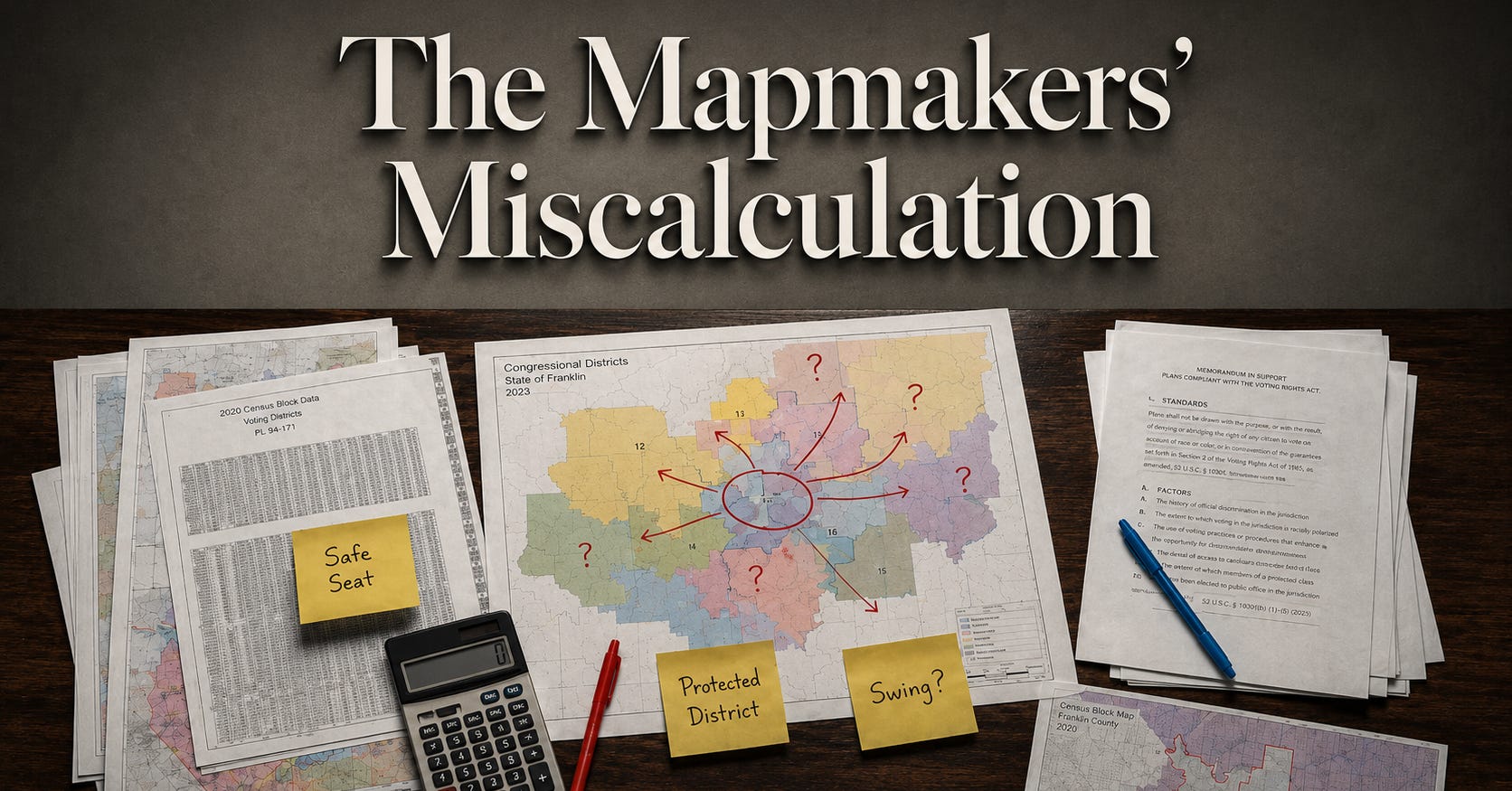
Redistricting is usually presented as technical work: lines, precincts, census blocks, court filings, district numbers. The kind of thing most people hear about only when a lawsuit is filed or an election suddenly becomes harder to understand. But a district map is not just paperwork. It is power drawn in ink.
Those lines decide whether voters choose their representatives, or whether representatives get to choose their voters first. They decide which communities are kept together, which ones are split apart, and which voices are made louder or quieter before a single ballot is cast.
For years, the political logic was brutally simple. Pack certain voters into one district, make the surrounding districts safer, and turn representation into containment. That was the old game. But what happens when voters no longer behave the way the mapmakers expected?
That may be the deeper story behind the latest redistricting fights. Republicans may believe they are weakening protected Democratic districts and locking in more power. But they may also be exposing something much larger: a country where race, class, geography, and party identity no longer move as neatly as the old maps assumed. The map was supposed to contain the voters. Instead, it may reveal how much the country has already changed underneath the lines.
This Community Is Powered by You
What started as a small circle has grown into something much bigger, and it’s all because of readers like you.
Every time you forward this email, post it on socials, or bring someone new into the fold, you’re helping build one of the most passionate, independent political communities out there.
Want to keep the momentum going?
Share this newsletter with someone who should be part of this conversation.
Thank you for being here. It means everything.
The Old Bargain
The old redistricting bargain was never as clean as the public language made it sound. On paper, the fight was about representation. Communities with a long history of discrimination needed a fair chance to elect candidates of their choice. That is the moral and legal foundation of the Voting Rights Act. In a country where political power was denied by law, violence, intimidation, poll taxes, literacy tests, and later by more sophisticated forms of exclusion, representation was not symbolic. It was protection.
But political actors learned how to turn that protection into a calculation. In many Southern states, majority-Black districts often functioned in two ways at once. They protected minority representation, but they also created heavily Democratic seats. For mapmakers trying to maximize Republican power, that created an opportunity: pack enough Democratic-leaning Black voters into one district, concede that seat, and make the surrounding districts safer for Republican candidates.
The public argument was civil rights. The political math was containment. A protected district could be defended as a necessary remedy for discrimination while also serving as a pressure valve for the rest of the map. One district became the place where representation was concentrated. The surrounding districts became places where competition was reduced.
The bargain depended on predictability: Black voters here, white rural voters there, suburban voters managed, working-class frustration divided by race and geography. It did not have to create fair representation everywhere. It only had to create predictable representation.
Now that bargain is under pressure. The courts are changing how race can be used in redistricting. Parties are trying to turn those changes into an advantage. But the voters underneath the map are not static. Economic pain is crossing county lines. Distrust of institutions is crossing party lines. Suburbs are shifting. Rural communities are angry. Urban communities are exhausted. The old bargain assumed voters could be sorted, contained, and counted in advance. A country in realignment does not always stay sorted.
The Court Changes the Terrain
The old bargain depended on the law allowing some use of race to remedy the long history of racial exclusion in voting. The Voting Rights Act was designed to stop states from diluting minority voting power, but the Constitution also limits how far government can go in sorting voters by race. Redistricting has lived inside that tension for decades.
Now the Supreme Court is narrowing that space. In Louisiana v. Callais, decided April 29, 2026, the Court considered whether Louisiana’s congressional map was an unconstitutional racial gerrymander. The case followed an earlier finding that Louisiana’s prior map likely violated Section 2 of the Voting Rights Act because it lacked an additional majority-Black district; Louisiana then drew a new map containing that district, which was challenged as racial gerrymandering. The Court’s opinion said Section 2 was designed to enforce the Constitution, “not collide with it,” and warned that lower courts had sometimes applied Section 2 in ways that forced states into race-based districting.
That decision did more than settle one Louisiana map. It sent a signal to every state legislature, voting-rights lawyer, partisan strategist, and court still handling redistricting cases: the legal ground under majority-minority districts has shifted. For civil-rights advocates, the fear is obvious. If states can argue that race-conscious remedies themselves violate the Constitution, then the very tools once used to correct racial vote dilution can become legally vulnerable. The NAACP Legal Defense Fund described Callais as a case about “protecting fair representation for Black voters in Louisiana and safeguarding the Voting Rights Act.”
Then Alabama showed how quickly doctrine can become power. On May 11, 2026, the Supreme Court set the stage for Alabama to eliminate one of two largely Black congressional districts before the midterm elections, creating a possible opening for Republicans to gain an additional U.S. House seat in the fight for control of a closely divided chamber, according to the Associated Press.
First, the Court narrows the legal space for race-conscious districting in Louisiana. Then Alabama moves toward a map that could reduce Black electoral opportunity and improve Republican odds. The result is not just a technical change in redistricting law. It is a shift in the terrain where representation, race, and partisan power meet.
Districts once defended as necessary protections may now be attacked as unconstitutional racial sorting. Maps blocked as discriminatory may get another chance. State legislatures that had been constrained by Voting Rights Act litigation may see new room to maneuver. Reuters reported after Callais that Republican governors in several states were already pursuing or weighing new congressional maps in the wake of the ruling.
Political parties will maneuver. They always do. The danger is not only that minority voters may lose representation. That danger is real and immediate. The larger structural danger is that the country may be entering a new map war with fewer guardrails, more partisan incentives, and less certainty about old outcomes. That creates an opening for power but also uncertainty.
The Miscalculation
The strategy assumes a simple chain reaction: weaken race-conscious voting protections, break apart protected Democratic districts, spread those voters across surrounding areas, and gain seats. On paper, that looks clean. If one heavily Democratic district can be dismantled, its voters can be dispersed into surrounding districts. If those surrounding districts are already Republican-leaning, the theory is that no single group of voters will have enough power to change the outcome. The protected district disappears. The surrounding incumbents get safer. The party drawing the map gains control before Election Day even arrives.
That is the theory, but voters are not static objects.
When a protected district is broken apart, the people inside it do not disappear. They are redistributed. Their political power may be diluted in one place, but it may also become newly relevant in several others. That is the risk for the mapmakers.
They may think they are breaking one Democratic district into pieces. But depending on geography, turnout, candidate quality, backlash, class anger, and coalition-building, they may end up creating several competitive districts rather than one safe seat. That would not just be a tactical mistake. It would be a sign that the old political formula is less reliable than it used to be.
A Black voter who was moved into a whiter district does not stop being politically relevant. A young voter in a suburban county does not necessarily vote like the older suburban voters who once defined that district. A poor rural white voter struggling with hospital closures, low wages, medical debt, and failing infrastructure may not share the same racial experience as an urban Black voter, but both may recognize the same pattern of neglect if someone is willing to name it clearly.
That is the danger of treating voters like blocks of concrete. The old strategy depended on containment. Pack enough voters here. Split enough voters there. Protect this incumbent. Sacrifice that seat. Keep this community isolated. Keep that coalition from forming. Use race as the dividing line. Use geography as the excuse. Use legal language as the cover.
However, once the lines are redrawn, the outcome is not fully controlled. Breaking that structure apart may benefit Republicans in the short term. It may allow legislatures to pursue maps they could not have defended a few years ago. It may weaken minority representation in ways that are immediate and serious, but the long-term effect may be less predictable.
When you attack the legal framework that made the map manageable, you may also weaken the framework that made your own strategy predictable. When you use race to divide voters, you are betting that those voters will never recognize shared material interests. When you dismantle a protected district, you are betting that the voters inside it will become less powerful, not differently powerful. That is a bet. It is not a guarantee.
The Realignment Is Bigger Than Party Switching
The Great American Realignment is often described as voters moving from one party to another. Some working-class voters drift right. Some suburban voters drift left. Some independents become harder to predict. This, however, is not the whole story.
The deeper realignment is happening inside the machinery that turns public will into political power. It is happening in the way voters are sorted, targeted, divided, represented, and counted. It is happening in the relationship between race and party, class and geography, culture and economics, constitutional principle and partisan loyalty.
That is why redistricting matters so much. A district map is not just a reflection of political reality. It is an attempt to organize political reality. It takes communities that are complicated, frustrated, divided, and changing, then tries to place them into clean boxes: safe seat, swing seat, majority-minority district, rural district, suburban district, urban district, Republican seat, Democratic seat.
The problem for the mapmakers is that America no longer fits neatly inside those boxes.
Rural voters are not only cultural voters. They are also hospital patients, utility customers, wage earners, renters, parents, small-business owners, and people living with the consequences of disinvestment. Urban voters are not only racial or partisan categories. They are workers, tenants, caregivers, commuters, students, veterans, and families trying to survive in the same economy from different addresses.
Suburban voters are not frozen in the politics of twenty years ago. Young voters are not waiting politely to inherit old party loyalties. Working-class voters are angry, but that anger can be directed in more than one direction. Independents may reject party labels while still caring deeply about corruption, democracy, affordability, and whether powerful people are playing by a different set of rules.
That is the realignment. It is not simply a partisan migration. It is a breakdown in the old sorting system. For years, political professionals treated demographic groups almost like fixed assets. They assumed geography could predict identity, identity could predict party, party could predict turnout, and turnout could predict power. Redistricting was built around those assumptions. When they weaken, the whole map becomes less predictable.
A rural district can still be conservative and also economically volatile. A suburban district can still have Republican habits and also become allergic to extremism. A majority-Black district can still be essential for representation and also become part of a broader working-class coalition. A heavily white district can still lean Republican and also contain voters who are tired of being used as cultural foot soldiers while their hospitals close, their wages stagnate, and their towns lose services.
That does not mean every district suddenly becomes competitive. It does not mean class automatically overcomes race. It does not mean that old divisions vanish when a new map is drawn, but it does mean that the old categories are becoming less stable. And instability is dangerous for anyone whose power depends on predictability.
Bigotry, Article I, and the Kitchen Table
Bigotry is not just prejudice. In this story, it is a governing technology.
Race is not only used to express hatred. It is used to organize power and to divide voters who might otherwise recognize similar injuries. It is used to make one struggling community believe another struggling community is the threat, while the people drawing the lines, writing the laws, funding the campaigns, and controlling the courts remain safely above the fight.
A poor rural white voter and a poor urban Black voter may live in very different places, with different histories and different relationships to police, schools, housing, health care, and political institutions. Those differences are real, but both may also live with the same basic political abandonment: hospitals closing, wages stagnating, rents rising, debt growing, schools struggling, and politicians showing up during campaign season before vanishing when the governing begins.
That is why division is so useful to power. If those voters see each other only through the lens of culture war, they are less likely to see the shared structure of neglect. If they are taught to blame one another, they are less likely to ask who benefits from keeping them divided. If race becomes the wall between communities, then class pressure, economic pain, and political abandonment can be managed instead of solved.
That damage is not only moral. It is also constitutional.
Article I comes first for a reason. Before the Constitution creates the presidency or the courts, it creates Congress. Representation comes first because republican government is supposed to begin with the people. However, manipulated maps undermine that promise before the vote even takes place.
If district lines are drawn to protect power rather than represent communities, the election is shaped long before voters enter a polling place. The ballot may still exist. The campaign signs may still go up. The candidates may still debate, but the field has already been tilted. The question is no longer simply who earns the public’s support. The question is how much of the public was allowed to matter in the first place.
That is how Article I gets hollowed out: quietly, district by district, map by map, lawsuit by lawsuit, until the branch of government that is supposed to be closest to the people becomes insulated from them. Then the kitchen-table consequences follow.
A manipulated district is a filter between people and power. It decides which communities are worth listening to and which voters can be safely taken for granted. When a hospital closes, when a town floods, when broadband never arrives, when veterans wait for services, when prescription costs rise, when roads crumble, and when working families are told to be patient by people whose seats were protected before the campaign began, the map is no longer abstract.
The same voters divided on the map often share the same daily pressures. The map teaches them to see each other as separate problems. The kitchen table reveals that many of the pressures are connected.
That does not erase race or history. Black voters have faced a specific and deliberate history of exclusion from political power, and any honest discussion of redistricting has to begin there. But that history can be acknowledged without ignoring the broader strategy at work: power often survives by keeping communities with overlapping interests from recognizing one another.
That may be the question the mapmakers fear most: who benefits when we are kept apart?
The Lines May Not Hold
The people redrawing these maps may believe they are securing control. They may believe the strategy is obvious: weaken race-conscious voting protections, break apart protected Democratic districts, spread those voters across surrounding areas, and convert legal change into political advantage. They may believe the map can still do what it has done for decades: sort voters into predictable containers before those voters ever have a chance to build something new.
However, control is not the same thing as stability.
A map can be drawn to protect power, but it cannot freeze the country in place. It cannot stop voters from changing. It cannot stop communities from noticing shared neglect. It cannot stop young voters from rejecting old loyalties or suburban voters from recoiling from extremism. It cannot stop rural voters from asking why cultural loyalty has not saved their hospitals, wages, schools, or towns.
When you dismantle a protected district, you are not erasing the voters inside it. You are moving them. You are changing the political chemistry of the surrounding districts. That may weaken representation in one immediate and dangerous way. But it may also create new political possibilities.
Some maps may do exactly what they are designed to do. Some protected districts may be weakened. Some incumbents may get safer. Some states may deliver the partisan advantage their legislatures intended. However, that is not the same as saying the strategy is durable.
The deeper risk is that the map war becomes too visible. The more aggressively politicians manipulate districts, the harder it becomes to tell voters that the system is fair. The more voters feel representation has been rigged before they ever cast a ballot, the more likely they are to look for explanations outside the official story. Those questions are not partisan trivia. They are the beginning of realignment.
That does not mean justice automatically follows. A weakened Voting Rights Act can do real harm. Minority voters can lose representation. Communities can be split apart. The immediate damage can be severe and should not be minimized, but power can still miscalculate while doing damage. That is the point.
The old machinery depended on predictability. It depended on voters staying sorted. It depended on communities staying separated. It depended on race dividing people more effectively than wages, hospitals, housing, schools, debt, and representation could connect them. It depended on the public not noticing that the same map that divided them also protected the people failing them.
That machinery may still work in places, but it is cracking.
The lines may still hold for one election. They may still protect some incumbents. They may still deliver short-term advantage. But they cannot permanently freeze a country in motion.
The mapmakers are still drawing yesterday’s America. The voters may already be living in the next one.
Support Independent Media-The Coffman Chronicle
Independent journalism matters most when power is trying to hide in the machinery.
Redistricting can sound technical. Court rulings can sound distant. District lines can look like paperwork. However, behind it all is the same basic question: do voters still choose their representatives, or has power learned to choose the voters first?
That is the kind of story Coffman Chronicle exists to follow — not just the headline, but the structure underneath it. Not just who won the day, but who is changing the rules, who benefits, and who gets left out.
If this work helps you see the pattern more clearly, consider becoming a paid subscriber. It helps keep this publication independent, reader-supported, and focused on the stories that connect constitutional power to kitchen-table consequences.
Because the mapmakers are counting on people not paying attention.
We are paying attention.
Sources:
“Supreme Court Halts Order for Alabama to Use US House Map With 2 Largely Black Districts.” AP News, May 11, 2026.
“U.S. Supreme Court Ruling Stokes Redistricting Battle in Several States.” AP News, May 1, 2026.
“Republican Governors Pursue New Congressional Maps after US Supreme Court Ruling.” Reuters, May 1, 2026.
“Supreme Court Hollows Out a Landmark Law That Had Protected Minority Voting Rights for 6 Decades.” AP News, April 30, 2026.
“US Supreme Court Clears Way for Alabama Republicans to Pursue New Voting Map.” Reuters, May 11, 2026.
NAACP Legal Defense Fund. “Louisiana v. Callais.”
NAACP Legal Defense Fund. “Louisiana v. Callais FAQ.”
Pew Research Center. “Party Affiliation Fact Sheet (NPORS).” July 23, 2025.
Pew Research Center. “Partisanship by Race, Ethnicity and Education.” April 9, 2024.
Supreme Court of the United States. Louisiana v. Callais, 608 U.S. ___ (2026). Slip opinion. April 29, 2026.
U.S. House of Representatives, Office of the Law Revision Counsel. “52 U.S.C. § 10301: Denial or Abridgement of Right to Vote on Account of Race or Color Through Voting Qualifications or Prerequisites; Establishment of Violation.” United States Code.
U.S. National Archives and Records Administration. “The Constitution of the United States: A Transcription.”
I wish every American voter could read these two sentences from today's post.
" If those voters see each other only through the lens of culture war, they are less likely to see the shared structure of neglect. If they are taught to blame one another, they are less likely to ask who benefits from keeping them divided."
It's always been a class struggle--the rich are never satisfied and want to own as much wealth as they can regardless of the consequences to people and the environment. Politicians and oligarchs have blinded the masses into blaming their fellow citizens instead of the predator class.
Change is coming, but it is sadly looking more and more like any positive change will be incredibly hard-fought - I dream of a future where humanity makes positive change because it's just better for everyone, not because people were backed into a corner or there was no choice but to make those changes.
White America has always been over-represented, whether by force or trickery/greed/stupidity/gullibility/etc., and I genuinely look forward to that shit ending.