


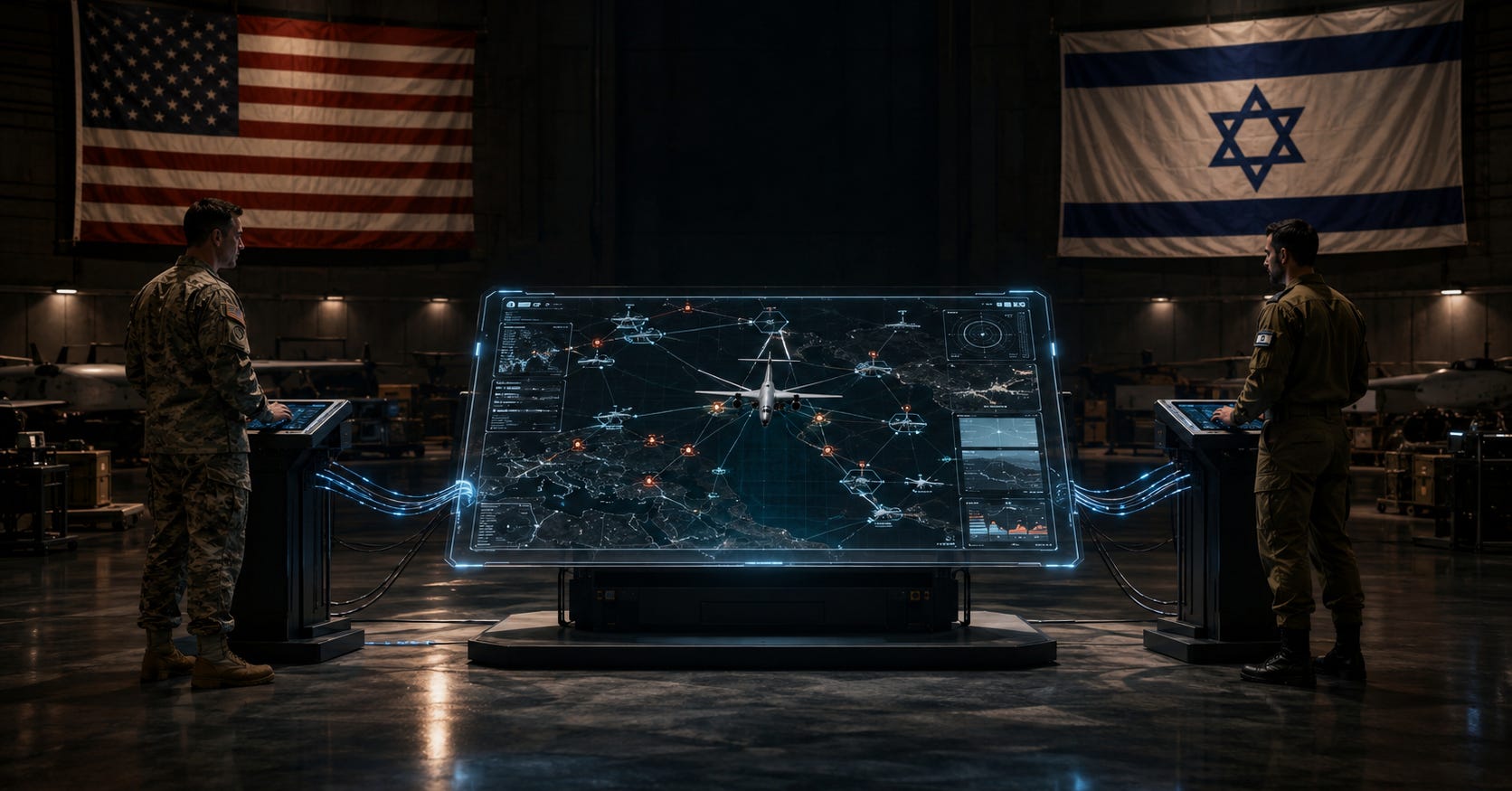
The Claim Arrived Before the Meaning
A country does not normally merge its military with another country in silence. There would be commanders to name, authorities to transfer, laws to rewrite, and constitutional questions too large to conceal inside ordinary legislation. The American people would expect hearings. Soldiers would need to know whose orders they were required to obey. Congress would have to explain whether it had changed the meaning of national command without first asking the nation. Yet the claim moved quickly: the United States had merged its military with Israel.
It was dramatic enough to travel before most people could ask what “merged” was supposed to mean. Some repeated it as proof that American sovereignty had already been surrendered. Others dismissed it as another piece of internet fiction and moved on. Both reactions made the same mistake. They treated the headline as the whole story.
The United States military still flies the American flag. Its officers still swear an oath to the Constitution. Congress has not created a combined army, transferred American troops to Israeli command, or erased the legal boundary between the two countries.
However, exaggerated claims do not always grow from nothing. Sometimes they gather around language the public has not seen and structures that have not been debated. A false description can obscure a real development just as effectively as it can invent one.
The question is not whether two flags have been lowered and replaced by one but rather what Congress has begun building beneath them.
This Community Is Powered by You
What started as a small circle has grown into something much bigger, and it’s all because of readers like you.
Every time you forward this email, post it on socials, or bring someone new into the fold, you’re helping build one of the most passionate, independent political communities out there.
Want to keep the momentum going?
Share this newsletter with someone who should be part of this conversation.
Thank you for being here. It means everything.
The Two Militaries Remain Separate
The merger claim fails at the most basic level. The United States Armed Forces and the Israel Defense Forces remain separate institutions belonging to separate sovereign countries. No American service member has been transferred into the Israeli military. No Israeli commander has entered the American chain of command. Congress has not created a combined general staff or authorized either country to issue orders to the other’s troops.
The proposed legislation concerns research, testing, technology transition, procurement, licensing, industrial production, training and information sharing. It does not establish shared command or transfer the constitutional authority governing American forces. The House and Senate bills propose defense-technology initiatives, not a combined military.
Countries can remain legally separate while their weapons systems, production lines, software, data, and training become increasingly interconnected. Sovereignty can remain intact on paper while the practical cost of exercising it rises.
The militaries have not become one. The line between them still exists. What matters now is what Congress wants to move across it.
Congress Wants One Office to Synchronize the Relationship
Section 219 of the House-passed defense authorization bill would require the secretary of defense to designate an American “executive agent” to synchronize cooperative efforts with Israel across defense research, development, testing, evaluation, and industrial cooperation.
Under Pentagon rules, an executive agent is a Department of Defense component head, or an official required by statute, assigned responsibilities involving two or more American defense components. It is not a joint commander, an Israeli representative inside the chain of command, or an official empowered to direct American troops.
The position would still be an important organizing office. The executive agent would identify jointly developed or Israeli-origin technologies for possible use in American systems, help move them from research into procurement, create frameworks for licensing and joint ventures, encourage United States-based co-production and coordinate activity across major Pentagon organizations.
The framework would also promote joint training and information sharing intended to improve readiness to deploy jointly developed technologies. The goal is not merely to invent something together. It is to move selected technology toward operational use.
Before final passage, the House adopted an amendment from Representative Anna Paulina Luna that removed “integration” from four specified places in Section 219. It struck the word from the initiative’s statement of purpose, changed “network integration” to “networks,” removed “integration into” from one update requirement, and removed “integration of” from the provision’s description of long-term joint capabilities.
The House deliberately narrowed the rhetoric. It did not remove the executive agent, the pathway into programs of record, procurement and acquisition, or joint ventures, licensing, co-production, training, or information sharing. Congress changed the word, but left the machinery.
A scattered collection of projects can rise or disappear with temporary priorities. A designated executive agent creates a center whose purpose is to align those projects, identify the next opportunities and keep the relationship moving through the acquisition system.
The office would not erase the boundary between the militaries. It would make activity across that boundary more organized, more continuous and easier to expand.
Has Congress adequately examined where that machinery is designed to go?
Bipartisan Does Not Mean Examined
The proposal did not originate in a single political camp. Republican Senator Ted Budd and Democratic Senator Kirsten Gillibrand introduced the United States–Israel Framework for Upgraded Technologies, Unified Research, and Enhanced Security Act, known as the FUTURES Act. Republican Representative Ronny Jackson and Democratic Representative Don Davis introduced its House companion.
The House language appears in Section 219 of H.R. 8800, while the Senate Armed Services Committee placed a closely related version in Section 1217 of S. 4784. The House passed its bill on July 22 by a vote of 216–212. The Senate has not passed its version. The initiative has institutional momentum, but it is not yet law.
The absence of a separate vote on Section 219 was not accidental. Representatives Thomas Massie, a Republican, and Ro Khanna, a Democrat, joined lawmakers from both parties in proposing an amendment to remove the section. The Rules Committee did not make that amendment eligible for floor consideration, and members ultimately voted on the enormous defense bill without receiving a direct vote on whether this particular initiative should remain inside it.
The House, however, did allow narrower changes. It adopted Luna’s amendments removing several uses of “integration” and extending the annual reporting requirement. Those changes improved the text, but they did not give lawmakers the direct up-or-down vote that the Massie-Khanna amendment sought.
The initiative’s supporters say it would accelerate innovation, strengthen the American defense industrial base and prepare both countries for emerging threats. The initiative is moving within defense bills that include military pay, weapons programs, and hundreds of unrelated decisions. A lawmaker can support the overall package while questioning this section, or oppose the package for reasons unrelated to it. Consequential policy gains protection from legislation Congress is expected to pass.
By the time the public discovers what one section contains, lawmakers can point to committee action or final passage as proof that it was considered. However, voting on a bill is not the same as examining every machine it creates.
Bipartisanship can show that lawmakers found common ground, but it can also mean that neither party has much incentive to ask where that ground ends. When both parties agree to build lasting machinery, scrutiny becomes more important, not less. A policy does not become accountable merely because both parties helped carry it through the door.
This Is No Longer Only About Missile Defense
American and Israeli military cooperation did not begin with this proposal. The countries have spent decades jointly developing missile-defense technology, including the Arrow and David’s Sling systems, as well as co-producing Iron Dome components.
Congress is not opening the first door between previously isolated defense establishments. It is taking a relationship built around identifiable threats and defined programs and constructing a framework capable of carrying cooperation much further.
The House and Senate proposals reach counter-drone systems, subterranean threats, and missile defense, but they do not stop there. They cover artificial intelligence, quantum technology, machine learning, autonomous systems, directed energy, advanced sensors, cyber defense, electronic warfare, biotechnology, networks, data fusion, contested logistics, manufacturing and co-production. They also leave room for other emerging technologies that the two governments later agree upon.
Those categories describe more than a collection of weapons. Artificial intelligence can influence how threats are identified. Electronic warfare can interfere with an adversary’s ability to see or communicate. Data fusion can combine data from separate sensors and networks into a single operational picture. Co-production can determine which companies and suppliers become necessary to keep a system working.
Not every project would become a battlefield system or create dependence. Some could produce genuine advantages for American service members. However, the breadth of the list changes the decision before Congress. A missile interceptor can be examined as a missile interceptor. A framework spanning software, networks, autonomous systems, industrial production and operational data can reach across several layers of the military at once.
Congress is no longer being asked only whether the United States should help build another shield, but also how much of the machinery behind modern war should be designed to work together.
The Pipeline Runs Into American Programs of Record
Military technology does not become permanent when someone invents it. It becomes permanent when the government organizes money, personnel, contracts, and future decisions around it.
Both congressional proposals would identify jointly developed or Israeli-origin technologies with operational utility for American systems and programs of record, and facilitate their transition from research and development to procurement and acquisition pathways. The Senate language uses “integration” directly. The House-passed version removed the word from several passages but retained the pathway into American military programs.
A program of record is not simply a laboratory experiment. It is a funded acquisition program, or one that has formally entered the acquisition system, built around an approved military need and years of planned spending.
The path can look technical from the outside:
Research. Testing. Acquisition. Production. Fielding. Training. Sustainment.
Inside the military, every stage creates another commitment. Factories purchase equipment. Companies hire workers. Software is connected to networks. Spare parts enter supply chains. Maintenance procedures are written. Personnel are trained. Commanders begin planning around the capability, and future budgets assume that it will remain available.
The legislation also anticipates joint ventures, licensing agreements, and United States-based co-production with Israeli industry. Required reports would identify technologies transitioned into American acquisition programs or fielded systems and recommend future opportunities involving long-term joint capabilities between the two countries.
The committee-reported House text described those opportunities as the “long-term integration of joint capabilities.” The House removed “integration of” from that sentence before passage. The Senate proposal retains integration language throughout its version.
That legislative history is now part of the story. The House recognized that the word carried meaning powerful enough to remove. But deleting it did not delete the office, the procurement pipeline, the fielded systems, the industrial partnerships, or the joint training contemplated by the section.
Congress is not describing a literal merger. It is creating conditions under which long-term interdependence could develop even after the most politically charged word has been taken off the page.
While none of this proves that every selected technology will become permanent, it shows that permanence is part of the pathway being built. Once a capability is embedded in weapons, networks, contracts and training, ending the relationship may require replacement technology, new suppliers, rewritten software and years of additional spending. The political decision may still belong to the United States, while the practical ability to carry it out becomes more expensive with every layer added to the system.
A research partnership can be reconsidered. A military architecture built around the partnership may eventually begin making the decision for us.
Who Owns the Code, the Data and the Dependency?
The most important part of a modern weapons system may never appear on a factory floor. It can be the software that interprets a sensor, the technical data needed to replace a component, the license that permits an update, or the source code that determines what a machine does when the battlefield changes. Possessing the equipment does not always mean possessing everything required to control it.
The initiative directs the Pentagon to create frameworks for joint ventures, licensing agreements and United States-based co-production. It does not itself determine who would own the intellectual property created through those arrangements, what technical information the United States must receive, or whether American personnel would possess everything needed to maintain and modify the resulting systems independently. Those questions cannot wait until after contracts are signed.
The Pentagon already operates under complicated rules governing technical data and software. It does not automatically acquire every drawing, algorithm, or manufacturing process. Acquisition officials must identify the government’s life-cycle needs and obtain the data, software and licensing rights necessary to meet them.
The danger is discovering too late that those needs were defined too narrowly. A 2025 Government Accountability Office review found persistent data rights problems in weapon system sustainment. In a Pentagon data call covering more than 200 programs, half reported deficiencies that obstructed competitive procurement or government maintenance. That weakness already exists before any other government, foreign companies, or jointly developed technology enter the arrangement.
If taxpayers finance a sensor, who owns the designs? If an Israeli company writes part of the software, can the Pentagon inspect the complete codebase and make urgent changes? If the governments later disagree, could maintenance, parts, or technical support be interrupted? These are not arguments against cooperation, but rather questions that responsible governments must ask before cooperation becomes reliance.
The same standard must govern information sharing. Technical data can reveal how a weapon functions and where it is vulnerable. Sensor information can expose what the military can see. Data used to train artificial-intelligence systems may influence their conclusions long after the original information was collected. “Sharing” does not answer the question of who retains control. Nor should co-production become a polite name for dependency. A factory in the United States can support American workers, but domestic assembly does not guarantee domestic control when essential designs, software, licenses or components remain elsewhere.
Each project should identify intellectual property ownership, American technical data rights, essential suppliers, and the steps required for independent maintenance. Critical software should be auditable, repair information should arrive before dependence, and contracts should preserve the government’s ability to change suppliers. American taxpayers should not purchase the shell of a capability while someone else retains the keys.
Israeli technology may contribute to American security, but the question is whether Congress will make American control a condition for allowing that technology in.
A Public Update Is Not Public Control
The original House text required an initial update within 180 days, annual reports only through 2030, unclassified reporting with possible classified annexes, and periodic public updates “to the maximum extent practicable.”
The House corrected part of that problem before passage. Luna’s Amendment 319 replaced the 2030 cutoff with a requirement for annual reporting for as long as an executive agent remains designated under Section 219. The amendment was included in an en bloc package adopted by voice vote. That is a meaningful improvement. Congress should receive reports for the life of the office, not merely for its first few years.
It is still not public control.
The reporting requirement does not require a separate vote by Congress before technology enters a program of record. It does not expressly require public disclosure of every participating company, contract value, intellectual property arrangement, technical data right, or foreign-controlled component. It also does not mandate recurring review of the initiative by the Government Accountability Office or the Department of Defense inspector general.
Legitimate secrecy protections may leave the public seeing only the broadest outline. A report can reveal that dependency is developing. It cannot guarantee that Congress will act before dependency becomes expensive to reverse.
The public deserves more than a Pentagon webpage explaining how the initiative advances military supremacy. It deserves to know who received the money, who owns what the money produced, what control the United States retained and what independence it may have traded away.
Transparency allows the people to watch power move. Control gives their representatives the authority to stop it.
Congress Must Write the Exit Before It Builds the Entrance
The initiative is written to identify opportunities, accelerate cooperation and move technology into American military programs. It is not written with equal precision about how those relationships would end.
That imbalance cannot be ignored because every entrance Congress builds into the defense system can become harder to close after money is spent, contractors are selected, and readiness begins depending on what came through it.
Every project should include an exit plan before entering an American program of record. That plan should identify foreign-controlled components, required licenses, replacement suppliers, and the costs and timelines for an independent transition.
The Pentagon should not adopt a critical system unless the United States has the technical information required to sustain it in the event of a political or commercial dispute. American personnel should be able to repair essential equipment and audit critical software. Congress should know whether withdrawal would interrupt operations, endanger service members, or require years of emergency spending.
The law should permit suspension when information is withheld, cybersecurity protections fail, technology is used contrary to American law or a participant creates an unacceptable conflict. Recurring reviews should examine costs, competition, data rights, foreign ownership, and supply chain exposure. The coordinating authority should also expire unless Congress votes to continue it after seeing how it was used.
A sunset would not make every existing contract or system disappear. It would require Congress to decide whether the machinery created to expand the relationship should continue. That is how the people’s branch preserves authority over institutions designed to outlast the lawmakers who created them.
An alliance should survive because both countries continue choosing it. It should not survive because one country can no longer afford to leave.
Congress is preparing a pathway into the American military system. It must write the way back out before the first dependency crosses the threshold.
Cooperation Is a Choice. Dependence Is a Condition
The United States and Israel have not merged their militaries. The American chain of command remains American, and Israeli forces remain under Israeli authority.
However, sovereignty is not protected only by keeping uniforms separate. It also depends on whether a nation can control the weapons it buys, inspect the software it uses, maintain the systems it fields and change course when its interests no longer align with those of an ally.
The structure could produce valuable technology and protect American service members. Those benefits do not excuse Congress from defining the limits.
Israel is an ally, not a branch of the American government. Its leaders answer to Israeli voters. Its military operates under Israeli law and follows decisions made through Israel’s political system. The American people do not elect those officials, control those decisions, or possess a constitutional remedy when Israeli policy conflicts with their national interest. That is not an accusation. It is the meaning of separate sovereignty.
The American military must remain capable of obeying an American decision even when that decision is inconvenient to a partner, costly to a contractor or disruptive to a system built through years of cooperation. A nation has not preserved meaningful independence if it retains the legal authority to say no but designs its defenses so that saying no becomes operationally impossible.
Congress may decide that deeper cooperation serves the United States. But it must tell the public what will be placed inside American systems, who will own it, what information will cross the boundary, and how the United States can withdraw without weakening its own forces. It must preserve technical control and the power to reconsider before cooperation hardens into permanent architecture.
The House removed “integration” from four places in Section 219. It did not remove the structure that could produce it. While the false merger claim deserves correction, the real plan also deserves examination. Americans should not be frightened by a combined military that does not exist. They should be informed about the military system their representatives are actually preparing to build.
Cooperation is a choice sovereign nations make. Dependence is the condition that remains when meaningful choice has disappeared. The people’s branch must preserve that difference before the machinery it authorizes becomes too deeply embedded to take apart.
Support Independent Media
The Coffman Chronicle is reader-supported.
If this work helps you see what power is doing before the consequences become permanent, please consider subscribing, sharing this article or supporting the publication financially—if you can afford to.
The machinery moves quietly. The public should not have to.
Sources:
Acquisition.gov. “DFARS Subpart 227.72—Computer Software, Computer Software Documentation, and Associated Rights.” Accessed July 26, 2026.
Missile Defense Agency. “Israel and U.S. Successfully Complete Series of David’s Sling Tests.” News release 26-NEWS-0001, February 11, 2026.
Office of the Clerk, U.S. House of Representatives. “Roll Call 278: On Passage, H.R. 8800.” July 22, 2026.
Office of U.S. Senator Ted Budd. “Budd, Gillibrand Introduce Bipartisan Bill to Strengthen Bilateral Defense Programs between the U.S. and Israel.” February 12, 2026.
Republican Cloakroom, U.S. House of Representatives. “H.R. 8800—National Defense Authorization Act for Fiscal Year 2027.” July 21–22, 2026.
U.S. Congress. House. National Defense Authorization Act for Fiscal Year 2027. H.R. 8800. 119th Cong., 2nd sess. Reported in the House June 15, 2026.
U.S. Congress. House. United States-Israel Framework for Upgraded Technologies, Unified Research, and Enhanced Security Act of 2026. H.R. 7540. 119th Cong., 2nd sess. Introduced February 12, 2026.
U.S. Congress. House. Committee on Armed Services. National Defense Authorization Act for Fiscal Year 2027: Report to Accompany H.R. 8800. H. Rept. 119-698. June 15, 2026.
U.S. Congress. House. Committee on Rules. Providing for Consideration of the Bill H.R. 8800 and Other Measures. H. Rept. 119-755. July 20, 2026.
U.S. Congress. Senate. National Defense Authorization Act for Fiscal Year 2027. S. 4784. 119th Cong., 2nd sess. Reported in the Senate June 15, 2026.
U.S. Congress. Senate. United States-Israel Framework for Upgraded Technologies, Unified Research, and Enhanced Security (FUTURES) Act of 2026. S. 3855. 119th Cong., 2nd sess. Introduced February 12, 2026.
U.S. Department of Defense. DoD Executive Agent. Department of Defense Directive 5101.01. February 7, 2022.
U.S. Department of State. Bureau of Political-Military Affairs. “U.S. Security Cooperation with Israel.” Fact sheet, April 25, 2025.
U.S. Government Accountability Office. Defense Advanced Research Projects Agency: Key Factors Drive Transition of Technologies, but Better Training and Data Dissemination Can Increase Success. GAO-16-5. Washington, DC, November 18, 2015.
U.S. Government Accountability Office. Weapon System Sustainment: DOD Can Improve Planning and Management of Data Rights. GAO-25-107468. Washington, DC, September 2025.
U.S. House of Representatives. Committee on Rules. “H.R. 8800—National Defense Authorization Act for Fiscal Year 2027.”
U.S. Senate. “Recent Floor Activity: Thursday, July 23, 2026.” July 23, 2026.
U.S. Senate. “Roll Call Vote 195: On Cloture on the Motion to Proceed to S. 4784.” July 14, 2026.
Shaking hands with the Devil. What could go wrong?
Israel and Netanyahu are guilty of massive War Crimes including but not limited to the Genocide of the Palestinians in Gaza.
STOP MAKING DEALS WITH THIS WAR CRIMINAL!