


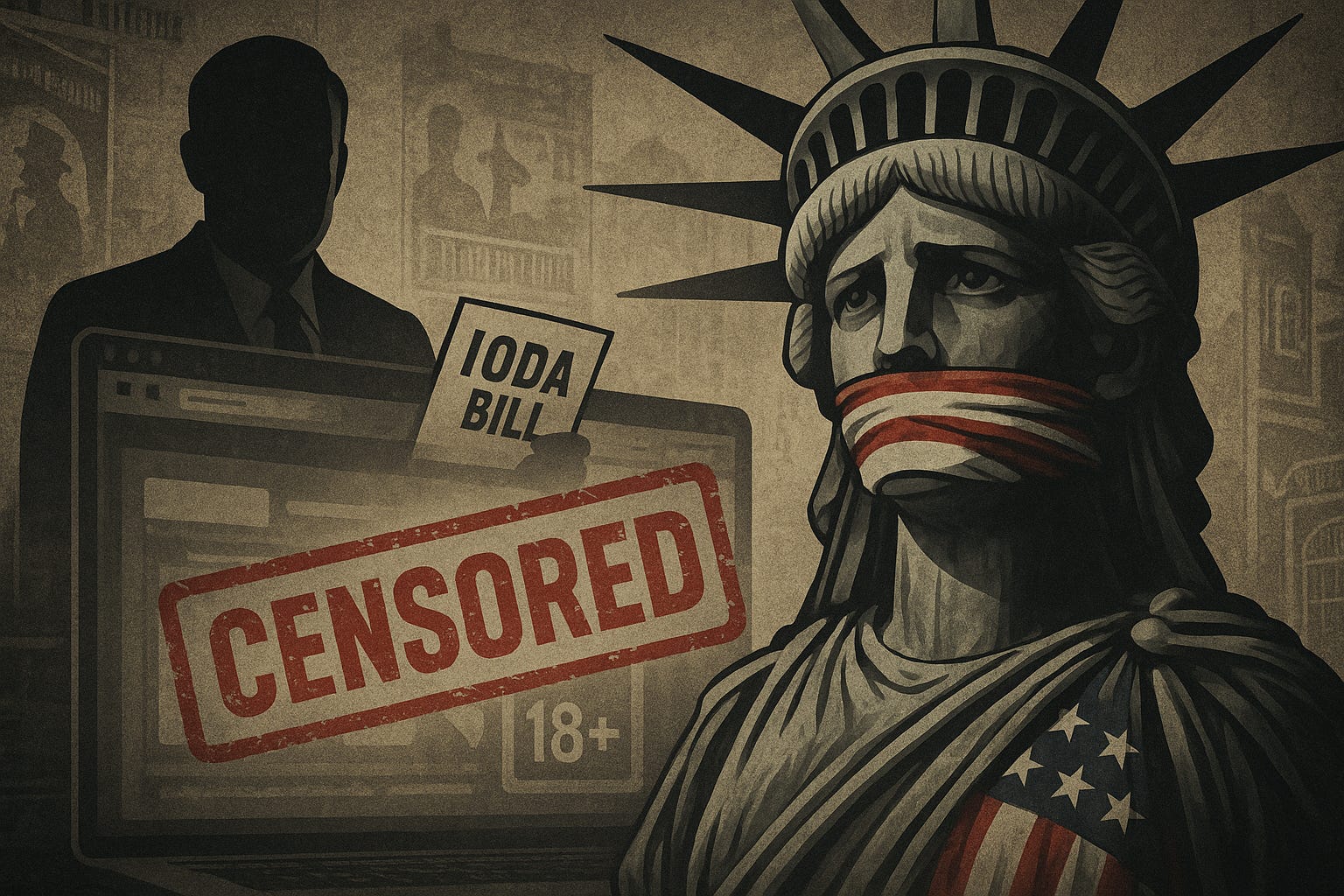
A new bill introduced by Senator Mike Lee (R-UT) could make millions of Americans criminals overnight. Called the Interstate Obscenity Definition Act, it aims to ban the creation and distribution of most online pornography at the federal level. Supporters claim it’s about protecting families and restoring morality, but a closer look reveals something much bigger and more dangerous.
This isn’t just about porn. It’s about control.
To understand the broader motivations behind this bill, it's important to step back and see how it fits into a larger political agenda. The bill follows the blueprint of Project 2025, a sweeping right-wing agenda crafted by The Heritage Foundation and supported by Donald Trump's allies. While Trump himself tries to keep his distance publicly, many of his former and current advisors are involved. The plan outlines an authoritarian vision of America, one where the government decides what you can say, watch, publish, and even desire.
Much like Prohibition a century ago, this crusade wraps itself in righteousness while setting the stage for widespread repression, black markets, and legal chaos. Porn is the target today, but the goal is bigger: a cultural crackdown on anything that doesn’t fit into a narrow, extremist view of what “American values” should look like.
We’ve seen what happens when the government tries to legislate morality. It doesn’t end well.
We just hit 13,000 subscribers—thank you! We’re offering full access to The Coffman Chronicle at 50% off to celebrate.
Get exclusive analysis and fearless reporting you won’t find in corporate media.
What’s in the Interstate Obscenity Definition Act
At first glance, the Interstate Obscenity Definition Act sounds like another piece of vague, moralizing legislation, but it’s far more aggressive than it appears. The bill would give the federal government a new, sweeping definition of “obscenity,” and with it, the power to prosecute a huge amount of online content, even in states where that content is legal today.
Here’s how the law defines obscenity: any material that depicts actual or simulated sexual acts with the “intent to arouse, titillate, or gratify the sexual desires of a person,” and that lacks “serious literary, artistic, political, or scientific value.” That wording isn’t just broad. It’s a legal landmine.
If passed, the bill would:
Make it a federal crime to create or distribute adult material that meets this definition.
Override state laws that currently protect legal adult content.
Give the Department of Justice the authority to prosecute adult websites, performers, and platforms across state lines.
Potentially open the door for criminal charges against users or subscribers.
The bill’s backers frame it as a way to protect children and families. But the language in the bill doesn’t limit itself to minors or non-consensual content. It targets all porn. And that’s not an accident. It’s the point.
Project 2025: The Ideological Blueprint
To understand where this bill is really coming from, you have to look at the engine behind it: Project 2025. This isn’t just a think tank idea. It’s a full-blown, battle plan for reshaping the federal government from the ground up, written by The Heritage Foundation and loaded with policy goals for a second Trump administration.
One notable and powerful architect of this plan? See our recent expose:

Project 2025 describes porn as a “public health crisis,” blames it for a range of social problems from divorce to depression, and claims it “destroys the soul of America.” That language isn’t just metaphor; it’s a mission.
Even though Trump tries to keep an arm’s length from Project 2025 in public, many of its contributors served in his first administration, and several now hold powerful roles in the current one. These aren’t fringe ideas. They’re creeping into policy decisions, one bill at a time.
The Interstate Obscenity Definition Act mirrors the playbook almost word for word. It’s not a coincidence but rather an implementation. It shows how quickly a blueprint can turn into law when the right people are in power and no one’s paying attention.
One powerful influence on Project 2025? See our recent expose:

A New Prohibition
If all this feels familiar, that’s because it is. America has seen this play before, and it didn’t end well.
In the 1920s, the government tried to wipe out alcohol with the same kind of moral zeal and legal force that’s now being aimed at pornography. The result? Organized crime, black markets, widespread lawbreaking, and a government increasingly seen as out of touch with its own citizens.
The Interstate Obscenity Definition Act threatens to do the same to adult content. It ignores public demand, seeks to erase a multibillion-dollar industry, and treats personal choices like criminal behavior. Like Prohibition, it relies on the fantasy that morality can be legislated and enforced by brute force.
Push porn underground, and it doesn’t disappear. Just like bootleggers and speakeasies flourished during Prohibition, adult content will simply migrate to riskier, less regulated spaces. It gets more dangerous for performers, consumers, and the rule of law.
What Americans Actually Think About Porn
Despite all the political noise, most Americans aren’t demanding a nationwide porn ban. In fact, public opinion has been steadily shifting toward tolerance and personal responsibility.
A 2018 Gallup poll found that 43% of Americans believe pornography is morally acceptable. That number continues to rise, especially among younger generations. Many support common-sense regulations like age verification or consent standards, but not federal censorship.
Most adults in the U.S. have viewed porn at some point. Banning it doesn’t eliminate the demand; it only criminalizes it. And it criminalizes the choices of millions of everyday people who engage with legal adult content in private.
Even many religious conservatives oppose total bans, seeing them as government overreach. This isn’t about protecting society. It’s about controlling it.
The Economic Fallout
The adult entertainment industry is worth over $65 billion globally, with North America accounting for nearly 40% of that market. It supports not just performers but also web developers, security staff, payment processors, editors, and legal teams.
“This isn’t just about porn—it’s about putting thousands of working-class people out of a job,” says Nina Hartley, performer and sex educator. “We pay taxes. We follow consent laws. We run businesses. The idea that we’re criminals just because we’re sexual is outrageous.”
Independent creators, especially women, LGBTQ+ people, and people of color, will be hardest hit.
“You take away our legal options, and people will get desperate,” says Riley Jean, a cam model. “That’s where people get hurt.”
“We’ve spent years building tools to make platforms safer and more transparent,” adds Aaron T., a digital safety consultant. “This would wipe all that out overnight.”
And the enforcement? While the exact mechanism hasn’t been revealed, it stands to reason that it would require massive surveillance infrastructure, the kind usually associated with authoritarian regimes.
We’ve documented this administration’s authoritarian leanings. Read more here:
Note: This article is more than 45 days old and now lives in the archive. Consider becoming a paid subscriber to enjoy all 500+ article archive, exclusive content, and occasional early access.

The Legal Minefield
The bill doesn’t just threaten the economy and personal safety. It defies the Constitution.
Miller v. California (1973) set the current legal standard for obscenity, requiring that content be utterly without serious value to lose First Amendment protection. Most porn today doesn’t meet that bar.
The IODA tries to rewrite this standard entirely, making obscenity easier to define, prosecute, and politicize.
“This bill is a constitutional grenade,” warns Erwin Chemerinsky, First Amendment scholar. “It invites selective enforcement and opens the door to censoring everything from sex education to literature.”
“There’s a long tradition in American law of protecting adult expression—even controversial or unpopular speech,” adds Catherine Ross, a constitutional law professor at George Washington University. “This bill would upend decades of legal consensus and open the floodgates to politicized censorship.”
It’s a slippery slope, and IODA is covered in grease.
Unintended Consequences and the Bigger Picture
Laws like IODA don’t kill the internet’s darkest corners. They drive people toward them. Performers lose safety. Consumers lose rights. Privacy becomes a casualty.
Enforcement would almost certainly be selective. Marginalized groups, especially LGBTQ+ creators and sex workers of color, would face disproportionate targeting.
This isn’t about porn. It’s about setting the precedent to control everything else, starting with surveillance and censorship, and extending to broader cultural suppression: books, drag shows, reproductive rights, and expression itself.
If you think it’ll stop here, you haven’t been paying attention.
We’ve reported extensively on censorship under this administration. See one example here:

The Real Obscenity Is Control
So what’s really at stake here? The Interstate Obscenity Definition Act isn’t about protecting children. It’s about erasing freedoms. It’s not a law; it’s a warning.
And it’s up to us to stop it.
What You Can Do
Call your representatives. The U.S. Capitol Switchboard is (202) 224-3121. Provide your ZIP code and ask to be connected to your Senators and House representatives.
Suggested statement:"I'm a constituent, and I strongly oppose the Interstate Obscenity Definition Act. This bill does not reflect the will of the people, and I expect my representative to defend free speech, personal privacy, and constitutional rights. Please vote NO."
Support civil liberties groups like the ACLU, Free Speech Coalition, and Electronic Frontier Foundation, who are already fighting back in court and in Congress.
Share the voices of those most affected. Performers, creators, tech workers, and advocates are already speaking out. Help amplify them.
Stay engaged. Watch for copycat bills in your state. These attacks on liberty rarely stay contained.
Freedom doesn’t disappear overnight. It erodes, law by law, silence by silence.
Don’t be silent.
We just hit 13,000 subscribers—thank you! We’re offering full access to The Coffman Chronicle at 50% off to celebrate.
Get exclusive analysis and fearless reporting you won’t find in corporate media.
Bibliography
Gallup. “Americans’ Moral Values: 2018 Poll.” Gallup News, June 1, 2018.
Heritage Foundation. Mandate for Leadership: The Conservative Promise. Project 2025. Washington, D.C.: The Heritage Foundation, 2023.
The Business Research Company. “Adult Entertainment Global Market Report 2024.” The Business Research Company, January 2024.
Times of India. “Pornhub and Other ‘Adult Content’ Websites Facing Ban in the US? New Bill Says Yes.” Times of India, May 2025.
Wikipedia contributors. “Miller v. California.” Wikipedia, Last modified May 2025.
They speak of morality yet they are the most immoral fascist corrupt people. All they "preach" is pure projection. Whatever they accuse or blame others of doing is basically them saying I do it. Think about it. Remember that GOP convention, where that dating site for gays ( if I'm not mistaken) went up the most in recent history. 😂😂😂 shows their hypocrisy! Eyeliner vance is a closeted gay formally outed gay.. little Johnson is also an alleged closeted gay. Lady Lindsey is also rumored to being a closeted gay. All these people commit more of what they accuse others of doing. It is all about controlling what they themselves most do. They also self-hate. They hate that others freely are comfortable in their own skin. They are absolutely 💯 PATHETIC. 🤷🏽♀️😒🙄