


Federal workers aren’t on strike. They’re not staging a walkout, nor demanding a raise or new benefits. They’re showing up — or would be — if the government would let them.
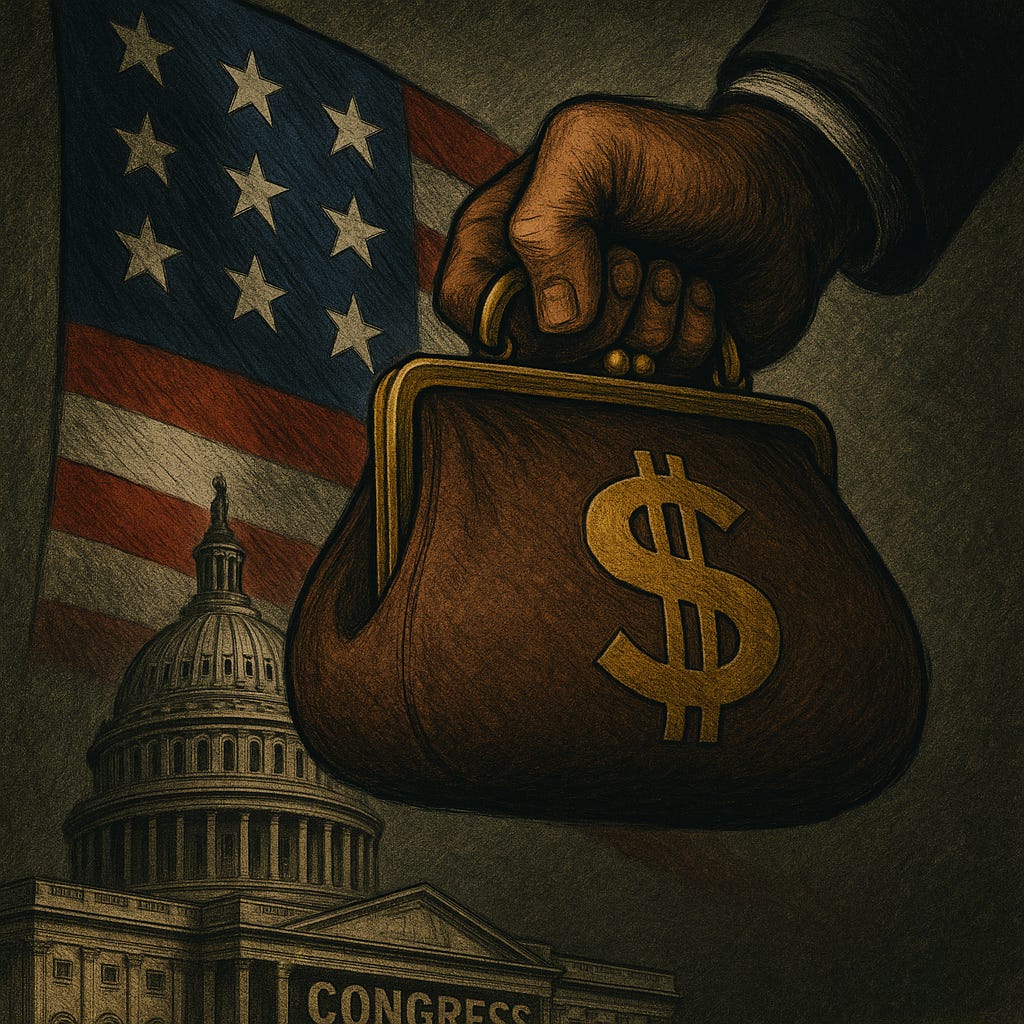
They’ve been forced off the job by a Congress that failed to pass a budget on time. Again. The shutdown that began on October 1, 2025, is just the latest chapter in a now-familiar breakdown of basic governance. But what’s happening now is different.
On October 5, the Trump administration issued a memo quietly circulated through Russell Vought’s Office of Management and Budget arguing that furloughed workers aren’t guaranteed back pay unless Congress explicitly approves it. That reinterpretation marks a dramatic break from decades of precedent, including a 2019 law (the Government Employee Fair Treatment Act) that had, until now, been treated as a firm guarantee of retroactive compensation. Trump signed that law himself during the 35-day shutdown of his first term.
Predictably, what followed were the public comments. Speaking on October 6, Trump said, “For the most part, we’re going to take care of our people. There are some people that really don’t deserve to be taken care of, and we’ll take care of them in a different way.” He offered no specifics about who, exactly, didn’t deserve to be paid for time they didn’t choose to miss.
However, the message was clear: loyalty, not law, would guide his decisions, and paychecks would become the leverage.
You helped us reach 25,000 readers. For a limited time, go paid at 20% off—just $64/year. Your support keeps us going! Be part of the resistance.
Breaking Precedent and Testing Boundaries
No president has ever threatened to withhold back pay from furloughed workers — not Reagan, not Clinton, not Obama, not even Trump during his first term. This is a first, and a new low. It turns an already punitive shutdown into something worse: a selective punishment aimed at the civil service, especially those Trump has long viewed as disloyal or resistant to his agenda.
The pushback was swift and surprisingly bipartisan.
Senator Thom Tillis, Republican of North Carolina, called the threat a “strategic mistake,” saying on October 7: “If I were one of those workers, I’d be looking for another job. I think that uncertainty is not a good message to send.” Speaker Mike Johnson told Axios flatly, “Of course, Congress would provide back pay once funding was restored.
The damage, however, may already be done. The memo is still on the books, and unless Congress acts to override it clearly and explicitly, the administration may follow through.
Unfortunately, if it does, there’s no guarantee the courts will stop it in time. Legal challenges take time, and standing requires actual harm. Until someone is officially denied pay, it’s all just theory.
Trump knows that. So does Congress.
The question is who will blink first.
A Clause, A Loophole, and the Danger of Assumptions
The language in the 2019 law seemed clear enough. Federal workers who are furloughed during a government shutdown “shall be compensated for the period of the lapse.” The only caveat? That it would occur “subject to the enactment of appropriations Acts ending the lapse in appropriations.”
That clause wasn’t written to create discretion. It was written to reflect the process. Of course back pay would be issued — once the shutdown ended and funds were approved. That’s how it had worked under every president — until now.
See our previous reporting on the shutdown here:


The OMB memo treats that language as an opening rather than a safeguard. The White House is arguing that, unless Congress spells it out each and every time, back pay isn’t guaranteed. The administration’s interpretation isn’t a clarification. It’s a provocation and a test.
And Congress has a history of failing those tests.
When Power Is Taken and Then Rewarded
In early 2025, Trump took a similar approach on the international stage. Without Congressional approval, he used his newly empowered Department of Government Efficiency (DOGE) to freeze more than $5 billion in foreign aid funding — aid that had already been appropriated by Congress. Programs were paused and contracts terminated. Longstanding U.S. diplomatic and humanitarian commitments vanished overnight.
Rather than confront this clear violation of spending authority, Congress did the opposite. They passed the Rescissions Act of 2025, canceling $8.3 billion more from international programs, legitimizing Trump’s initial grab, and expanding it. He moved first. They followed.
The lesson was clear: act boldly, claim power, and Congress might just back you up.
Now, he’s applying the same playbook to the civil service. Float a fringe interpretation. Threaten selective enforcement. See if Congress will stop him.
If they don’t, this isn’t just about furloughed workers. It’s about the presidency claiming ownership over compensation itself, over who gets paid, who doesn’t, and what loyalty is worth. And if Congress, which has the power of the purse, hands him this win? What role does it hold?
The Courts Can’t Save This — Yet
For federal workers looking to challenge the memo now, the legal landscape is bleak. That’s not because the law supports Trump’s interpretation — most legal scholars agree it doesn’t — but because no harm has been formally committed yet. As of this writing, no worker has missed a paycheck due to the memo. Until that happens, courts are unlikely to act.
There are real consequences to that delay. Workers are already living in fear of retaliation or exclusion. They’re already wondering whether the agency they serve, or the administration they work under, will decide their service doesn’t qualify for compensation. But fear, however justified, isn’t enough for legal standing.
Unions are preparing lawsuits. Legal advocacy groups are drafting filings. However, until there’s an actual denial of pay or a clear indication that the administration intends to follow through, those suits remain in limbo.
In the meantime, thousands of federal workers remain in an impossible position: barred from doing their jobs, threatened with the loss of their paychecks, and told that their value may be determined by political favor.
The Quiet Civil Rights Crisis
If these workers weren’t public servants — if they were contractors or workers in a private sector plant being shut down under the same conditions — the public would call this what it is: a hostile work environment.
Trump has spent years demonizing the federal workforce. He’s called them lazy, disloyal, and un-American. He has attempted to dismantle their unions, reclassify their jobs under Schedule F to make them easier to terminate, and implement loyalty tests throughout the executive branch. The memo is just the latest step in a long campaign to punish those who serve the government but not the man who leads it.
That’s not governance. It’s coercion. It creates a chilling precedent that the civil service itself is now subject to political control, not through law, but through fear.
Some legal experts believe a civil suit could still be brought, not over the memo itself, but over the environment it creates. Workers are already documenting internal emails, management statements, and OMB guidance that suggests agencies may use this moment to reward loyalty and punish dissent.
This isn’t just about one paycheck. It’s about whether federal employment is still protected by law or held hostage by politics.
What Congress Could Do and Why It Probably Won’t
Congress isn’t powerless here. In fact, it has all the tools it needs to shut this down. They could write explicit language into the next continuing resolution (CR) stating that all federal employees furloughed during this shutdown shall be paid in full, without exception. They could clarify once and for all that the Government Employee Fair Treatment Act of 2019 is not subject to OMB interpretation or executive whim. They could pass standalone legislation blocking the use of federal memos to override back pay norms. They could censure the president, hold hearings, or zero out OMB enforcement budgets tied to this memo.
But they likely won’t.
It is not because they agree with Trump’s position. Most don’t. However, codifying protections requires urgency, coordination, and political courage, and this Congress, like its predecessors, has shown little of these qualities.
They’ve watched this pattern before. They’ve seen Trump divert military funds for a border wall after Congress said no. They have watched him withhold Ukraine aid that was already appropriated, the very scandal that triggered his first impeachment. They’ve seen him cancel foreign aid and get rewarded with even deeper rescissions. Each time, they chose not to fight.
That’s why this memo isn’t just a legal threat but a referendum on whether Congress still believes in its own power. If they don’t act now — clearly, explicitly, and with teeth — then they’ve not only failed to stop this particular abuse. They’ve invited the next one.
The Constitutional Line and the Vacuum Where Congress Should Be
The power of the purse was never meant to be symbolic. It was foundational. The framers didn’t trust kings with money, and they didn’t trust presidents either. That’s why the Constitution gives Congress, and Congress alone, the authority to decide where, when, and how federal dollars are spent.
But that power only exists if it’s used.
For years, Congress has stopped using it. They haven’t passed a full budget on time in decades. They rely on continuing resolutions and omnibus packages patched together at the last minute. They’ve allowed shutdowns to become negotiating tactics. And when presidents like Trump push the limits — by reprogramming funds, canceling aid, or threatening worker pay — they respond not with pushback, but with compliance.
This is how power is lost. Not all at once, but in the quiet decisions not to act.
When Trump slashed $5 billion in foreign aid earlier this year, Congress didn’t fight it. They followed his lead and canceled more. That wasn’t just acquiescence. It was ratification. And now, he’s doing the same thing with federal worker pay, daring them to stop him.
“We Didn’t Think We Needed to Spell That Out.” — The American Problem
That’s how so much of this has happened. The memo. The wall funding. The attacks on civil servants. January 6. The slow collapse of checks and balances. Remember the Hatch Act? The Emoluments Clause? No one thought they needed to write it down. No one thought they needed to say, explicitly, “You can’t do that.”
We trusted that no president would do the unthinkable, that norms would hold, that the law would speak for itself.
But here we are, debating whether people forced out of work by their own government deserve to be paid, watching a president try to decide, one memo at a time, which public servants count and which don’t.
Here we are, watching every single political norm being not just ignored but incinerated.
This Should Be the Line. But It Won’t Be.
This should be the moment Congress acts, not just to override the memo, but to reclaim what it gave up, to stop treating the power of the purse like a forgotten relic and start wielding it again, to pass a CR with explicit language, to rewrite the law and close the loophole. This should be the moment to finally say enough.
But if the past is prologue, they won’t.
Because in America, we don’t draw lines for workers. We let them be punished, then forgotten, and we call that politics.
So no, this likely won’t be the turning point.
However, it can still serve as a marker, a record, a reminder that we saw it happening. Perhaps we will look back and say we knew what it meant, and that we said, in whatever voice we had, that this wasn’t normal.
It was power — stolen, ceded, and abused. And we refused to call it anything else.
Independent media is fueled by you!
Sources:
“Scoop: White House memo says furloughed federal workers aren’t entitled to back pay” — Axios
“Furloughed workers not guaranteed back pay after shutdown, OMB claims” — The Washington Post
“Trump administration threatens no back pay for federal workers in shutdown” — AP News
“Trump Says Some People ‘Don’t Deserve to Be Taken Care Of’ During Shutdown” — TIME
“Mike Johnson: ‘Of course’ we’d give back pay to federal workers” — Axios
“The law is the law: White House memo on pay for furloughed employees called into question” — Federal News Network
“Trump administration’s claims against automatic furloughed‑worker back pay lack legal, historical basis” — Government Executive
“IRS backtracks on back pay guarantee for furloughed employees” — Federal News Network
“’Horrible’ message: Republican slams White House threat” — Yahoo
“Labor unions sue OMB, OPM for ‘unlawful’ threats of mass layoffs ahead of shutdown” — Politico
“2025 United States federal government shutdown” — Wikipedia
“Government Employee Fair Treatment Act of 2019 (GEFTA)” — Wikipedia
“USAID hearings / misuse / rescissions” — Congress.gov

Recent estimates place the government shutdown costs at $7 billion per week. In addition, other estimates indicate a loss of 0.1 percent or more of GDP growth. Not to mention the domino effect of massive job losses such as credit card and mortgage loan defaults, farm and business bankruptcies through the economy.