


He doesn’t scream in hearings. He doesn’t post memes.
He doesn’t plot insurrections in war paint or threaten prosecutors on Truth Social.
Michael Anton simply writes. And when he writes, governments tremble.
You might not know his name, but if you’ve heard phrases like “the Flight 93 Election,” seen democracy framed as a burning plane, or felt the strange allure of submission cloaked in reason, you’ve felt his fingerprints.
He doesn’t swing the axe. He pens the justification for the chopping block.
He’s not a general. He’s not a strategist.
He’s the philosopher who assures the regime it is righteous, even as it rewrites the rulebook.
And he doesn’t dress the part of a populist.
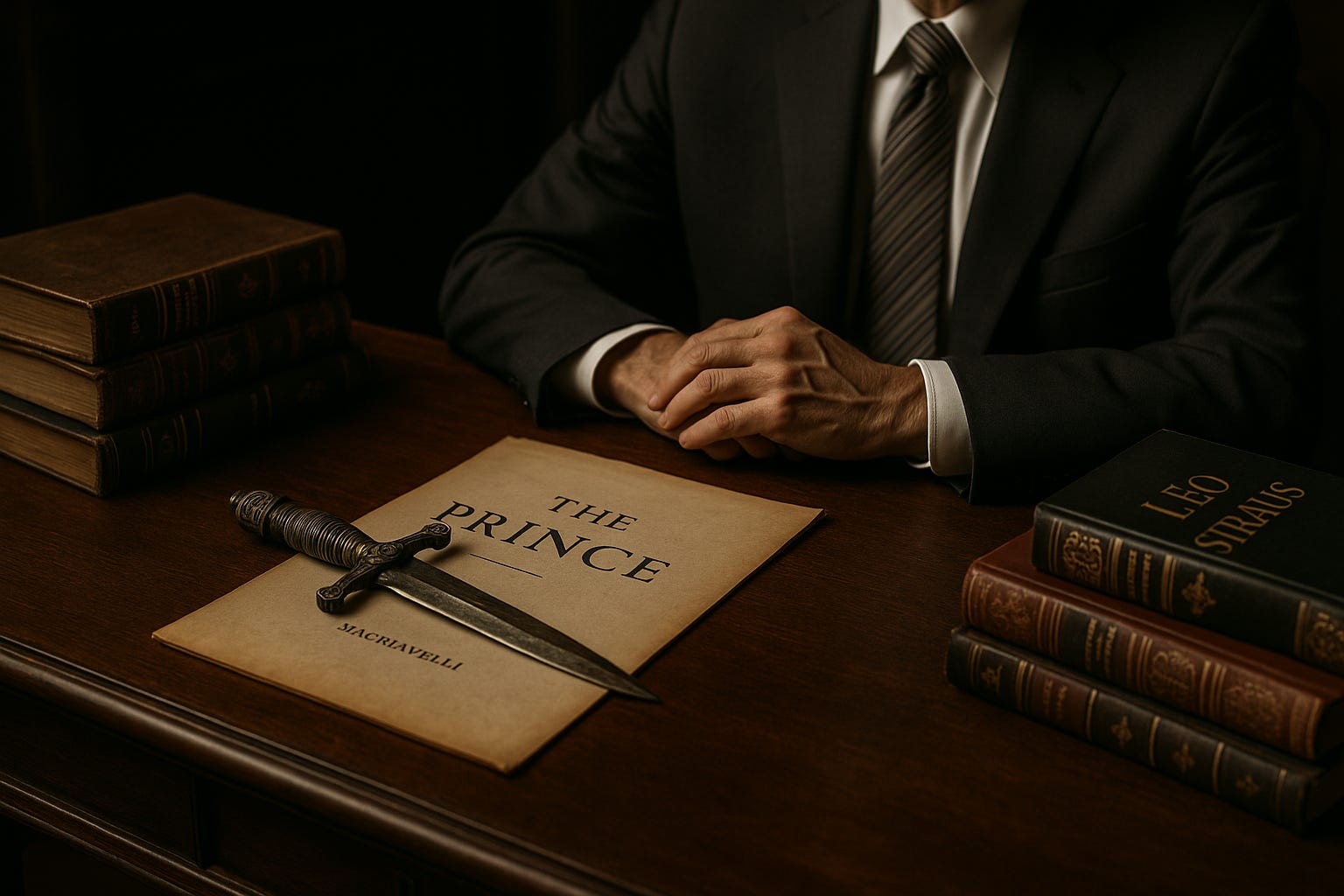
He’s all tailored suits, Machiavellian nods, and Latin pseudonyms.
He is what the new American authoritarianism looks like in its most polished form.
Not raw. Not cruel. Not loud.
Just inevitable.
We just hit 13,000 subscribers—thank you! We’re offering full access to The Coffman Chronicle at 50% off to celebrate.
Get exclusive analysis and fearless reporting you won’t find in corporate media.
The Convert in a Cufflink
Michael Anton didn’t arrive in politics from the trenches of activism or the coding dens of Silicon Valley. He arrived through books, philosophy, and the quiet conviction that America was decaying from within.
He earned degrees from UC Davis, St. John’s College, and Claremont Graduate University, studying under the likes of Harry Jaffa, a disciple of Leo Strauss, the political philosopher who believed that the truths of politics were too dangerous for the public and must be guarded by elites. To Anton, this wasn’t just intellectual tradition. It was a calling.
Leo Strauss, a German émigré philosopher, taught that liberal democracy depends on noble lies—shared myths and selective truths held aloft by a ruling class who understands the world as it is, not as it ought to be. Without those lies, democracy collapses into decadence. To save the system, Strauss argued, sometimes you must override it.
Anton took that lesson seriously.
He didn't just study Machiavelli. He idolizes him, so much so that he authored The Suit: A Machiavellian Approach to Men's Style under a pseudonym (“Nicholas Antongiavanni”), applying the prince’s lessons to fashion, politics, and public image.
Because for Anton, power isn’t just exercised. It’s performed. A crisp lapel. A sharpened argument. A perfectly plated dish. All part of the discipline.
And it isn’t just theory. He carries this worldview into every room he enters, from writing speeches for Giuliani, Condoleezza Rice, and Rupert Murdoch, to corporate stints at Citigroup and BlackRock. He speaks the language of power, and never stops thinking about how it might be restructured.
The Flight 93 Election: Justifying the Jump
In September 2016, under the pseudonym Publius Decius Mus, Michael Anton detonated a philosophical grenade inside the conservative establishment.
His essay, The Flight 93 Election, published in the Claremont Review of Books, compared voting for Donald Trump to storming the cockpit of a hijacked plane. The hijackers, in his metaphor, were the liberal establishment. The message was clear: Trump may crash the plane, but doing nothing guarantees death.
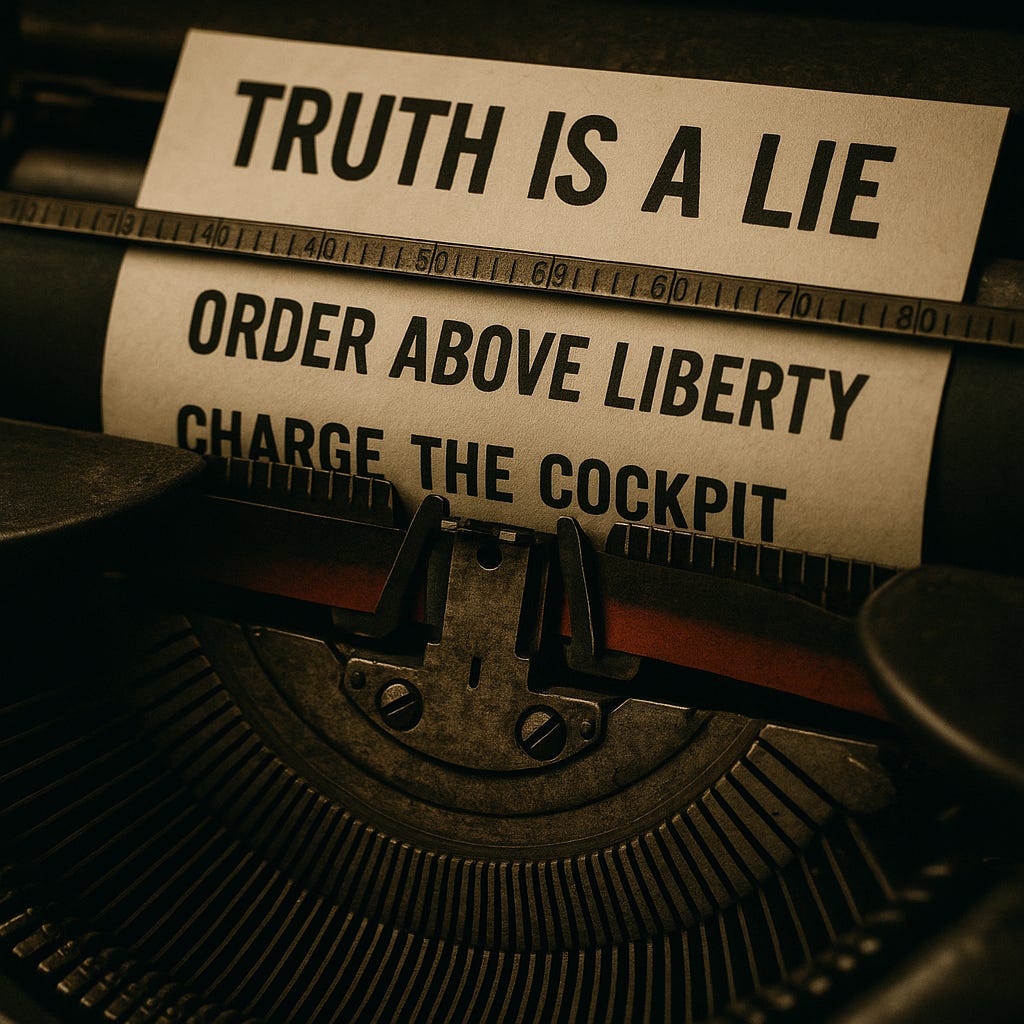
“Charge the cockpit or you die,” he wrote.
“You may die anyway. You—or the leader of your party—may make it into the cockpit and not know how to fly or not know how to land. There are no guarantees. Except one: if you don’t try, death is certain.”
It wasn’t just provocation. It was a redefinition of American conservatism from a movement of ideas to a movement of existential desperation.
And the stakes weren’t just political. Anton painted diversity, immigration, globalism, and moral relativism as existential threats. He suggested that the Constitution was not a suicide pact, and that saving the republic might require breaking its traditions.
The essay went viral and was devoured by Trump’s inner circle. When Anton was revealed as the author, he was brought into the administration as Deputy Assistant to the President for Strategic Communications.
He wasn’t just writing anymore. He was explaining the revolution as it happened.
Where most people saw the chaos of 2016, Anton saw opportunity: a moment to replace liberal democracy’s messy pluralism with a sharp, classical order.
One that didn’t apologize for hierarchy.
One that didn’t flinch from exclusion.
One that justified its power with philosophy, not popularity.
The Gentleman Inside the Machine
Anton didn’t lead rallies. He didn’t bark from podiums or promise to “lock her up.” He was never that guy.
But he was in the room. And sometimes, that’s where revolutions actually happen.
Following the success of The Flight 93 Election, Anton joined the Trump White House in 2017 as Deputy Assistant to the President for Strategic Communications at the National Security Council. His title sounded bland. His influence wasn’t.
He became a critical voice in shaping the administration’s tone on immigration, national identity, and American sovereignty. Anton helped intellectualize Trump’s nationalist posture, offering it not as xenophobia but as Republican renewal.
He left the administration in April 2018, just as John Bolton replaced H.R. McMaster as National Security Advisor. This shift brought a more hardline, interventionist flavor to Trump’s national security team. Anton, a theorist rather than a tactician, didn’t clash publicly. He simply exited quietly, transitioning to a writer-scholar role at Hillsdale College’s D.C. campus. No scandal. No headlines. Just a man who knew when the room had changed, and when to wait for the next one.
That wait ended in 2025.
Trump returned. So did Anton.
The Architect’s Classroom (and Waiting Room)
Michael Anton’s first departure from government in 2018 wasn’t a retreat. It was a repositioning.
He resurfaced almost immediately at the Claremont Institute and Hillsdale College’s Kirby Center in D.C., where he became something rarer—and arguably more influential—than a policymaker: a teacher of power.
From behind podiums and in the pages of the Claremont Review of Books, Anton shaped the minds of future staffers, operatives, and thought-leaders. His classrooms became incubators for post-liberal governance, filled with students who believed, like Anton, that America’s survival would require hard truths and harder decisions.
He didn’t just warn of democratic decline. He justified what would come next.
He trained not populists, but philosopher bureaucrats—calm, articulate, anti-democratic when necessary. The names on Sharma’s personnel lists? Many came from Anton’s classrooms.
And his influence wasn’t confined to lectures and essays. Anton also contributed directly to Project 2025, the Heritage Foundation-led blueprint to reshape the federal government. He helped author its sprawling Mandate for Leadership, embedding his vision—skeptical of democracy, worshipful of executive power—into the staffing and policy agenda now being executed across the administration. His ideas no longer linger in theory. They’re operational.
Now he sits at the State Department once more, not to preserve the world order, but to reorder it.
The Villain Reveal
If Elon Musk is Lex Luthor, the Chaos Agent,
Peter Thiel is Ozymandias, the Architect of elite control,
Stephen Miller is Gríma Wormtongue, whispering cruelty in the king's ear,
Chris Rufo is Dolores Umbridge, policing purity in the halls of culture,
Russell Vought is The Calculator, the Engineer, ticking off his spreadsheet,
Leonard Leo is Ra’s al Ghul, Master of the Order and purifier of institutions,
Curtis Yarvin is The Architect, the Philosopher of the Code,
And Saurabh Sharma is The Handler, selecting who gets to serve it,
Then Michael Anton is O’Brien, The Rationalizer. The Explainer. The Soft Dictator in a Suit.
He doesn’t seize power. He justifies it. He doesn’t threaten. He teaches.
He doesn’t say, “You must obey.” He explains, calmly, why you already are.
Like O’Brien in 1984, Anton doesn’t shout. He persuades.
He tells you democracy is noble but naïve.
That pluralism is beautiful but brittle.
That freedom is a story we tell until it stops working.
And when that moment comes, when the story collapses under its own contradictions, he is ready, not with slogans, but with citations, not with force, but with justification.
He believes the truth is too dangerous for the masses, that order is more important than liberty, and that some must rule quietly, wisely, and permanently.
He doesn’t light the fire.
He writes the manual that says why it had to burn.
We just hit 13,000 subscribers—thank you! We’re offering full access to The Coffman Chronicle at 50% off to celebrate.
Get exclusive analysis and fearless reporting you won’t find in corporate media.
Bibliography:
Anton, Michael. “The Flight 93 Election.” Claremont Review of Books, September 5, 2016.
Anton, Michael. The Suit: A Machiavellian Approach to Men's Style. New York: HarperCollins, 2006.
Baker, Peter. “Michael Anton, the White House’s National Security Council Spokesman, to Resign.” The New York Times, April 8, 2018.
The Guardian. “Michael Anton, Trump’s National Security Spokesman, Latest to Quit White House.” The Guardian, April 9, 2018.
Heritage Foundation. Mandate for Leadership: The Conservative Promise – Project 2025. The Heritage Foundation, 2023.
State Department. “Michael Anton – Director, Policy Planning Staff.” U.S. Department of State. Accessed May 2025.
Accountable.US. “Michael Anton’s Essays Promoted White Nationalist and Islamophobic Views.” Accountable.US, December 12, 2024.
Politico. “U.S. Names Michael Anton to Lead Technical Talks with Iran.” Politico, April 24, 2025.
Wikipedia. “Michael Anton.” Last modified May 2025.
The only real problems I see is that the implementations of the program were done by vehicles of chaos and cruelty, along with narcissistic greed. If Anton truly chose to rewrite and re balance the concept of democracy he has done so with knowledge of blood on his hands. When a patient is ill one does not remove the organs to determine the diseases that need to be corrected or excised. Sledgehammers, chainsaws, poisons, and annihilation is not the answer. That is unless one believes that complete destruction is better than learning to correct with compassion and knowledge. Anton and people of such ilk truly believe they are better than everyone else.
You know what‘s the worst, these ideas as a basis for politics also exist in Europe not only in the US.