


On August 22, the Director of the Defense Intelligence Agency, Lt. Gen. Jeffrey Kruse, was fired. It wasn’t quiet or bureaucratic. There was no scandal or failure. He was dismissed for the same reason so many others have been in recent months: he told the truth.
Kruse's offense was allowing an intelligence assessment to reach the top levels of the Pentagon that contradicted the administration’s narrative. The report in question, a classified but leaked DIA analysis, concluded that recent U.S. airstrikes on Iranian nuclear facilities had delayed, but not destroyed, Iran’s program. That conclusion, dry and data-driven, was fatal. The president had already declared the operation a complete success. Kruse’s job was not to analyze, it seems, but to agree.
This wasn’t a miscommunication. It was a message.
In the words of Sen. Mark Warner, vice chair of the Senate Intelligence Committee, “This is a purge based on politics, not national security.” A growing number of national security officials now face a version of the same decision: confirm the administration’s story or prepare for exile. The penalty for professionalism is removal. The reward for loyalty is survival.
Kruse’s firing is not an isolated event. It’s the latest move in a larger effort to eliminate friction between truth and power. More importantly, it’s part of a pattern that feels eerily familiar, not just to history buffs, but to anyone who’s studied how democracies weaken and how authoritarian movements tighten their grip.
Because democracy doesn’t defend itself, and neither does your sanity. Subscribe here to keep your eyes open and your sarcasm sharp.
A Pattern, Not a Fluke
Kruse is far from the first. Since January, at least fourteen high-ranking officials across the Department of Defense and the intelligence community have been removed, reassigned, or forced out. None were for incompetence or criminal behavior. Instead, they were shown the door for contradiction.
The list is long and accelerating: General C.Q. Brown, Chairman of the Joint Chiefs, was dismissed along with five other top military commanders just weeks after the inauguration. NSA Director Gen. Timothy Haugh was quietly removed. Multiple naval leaders, a colonel punished for criticizing Israeli policy online, nearly two dozen inspectors general fired in a single late-night purge, and entire Pentagon advisory boards dissolved and replaced, all because they did the unthinkable in Trump’s eyes. They were disloyal to his narrative.
Each of these removals is framed with the same official euphemism: “loss of confidence.” However, the pattern tells a more honest story. “Confidence,” in this administration, means agreement. And disagreement—even measured, principled, and professional—is not tolerated.
This is not about military readiness or efficiency. It’s about building a government that answers to one man, one narrative, one version of reality. And as the firings pile up, a more sobering realization begins to settle in: we’ve seen this strategy before.
Yes, we’ve read it in textbooks. But we have also seen it in living memory and existing monuments.
We’ve seen what happens when institutions built to serve a nation are reshaped to serve a leader.
We’ve Seen This Before
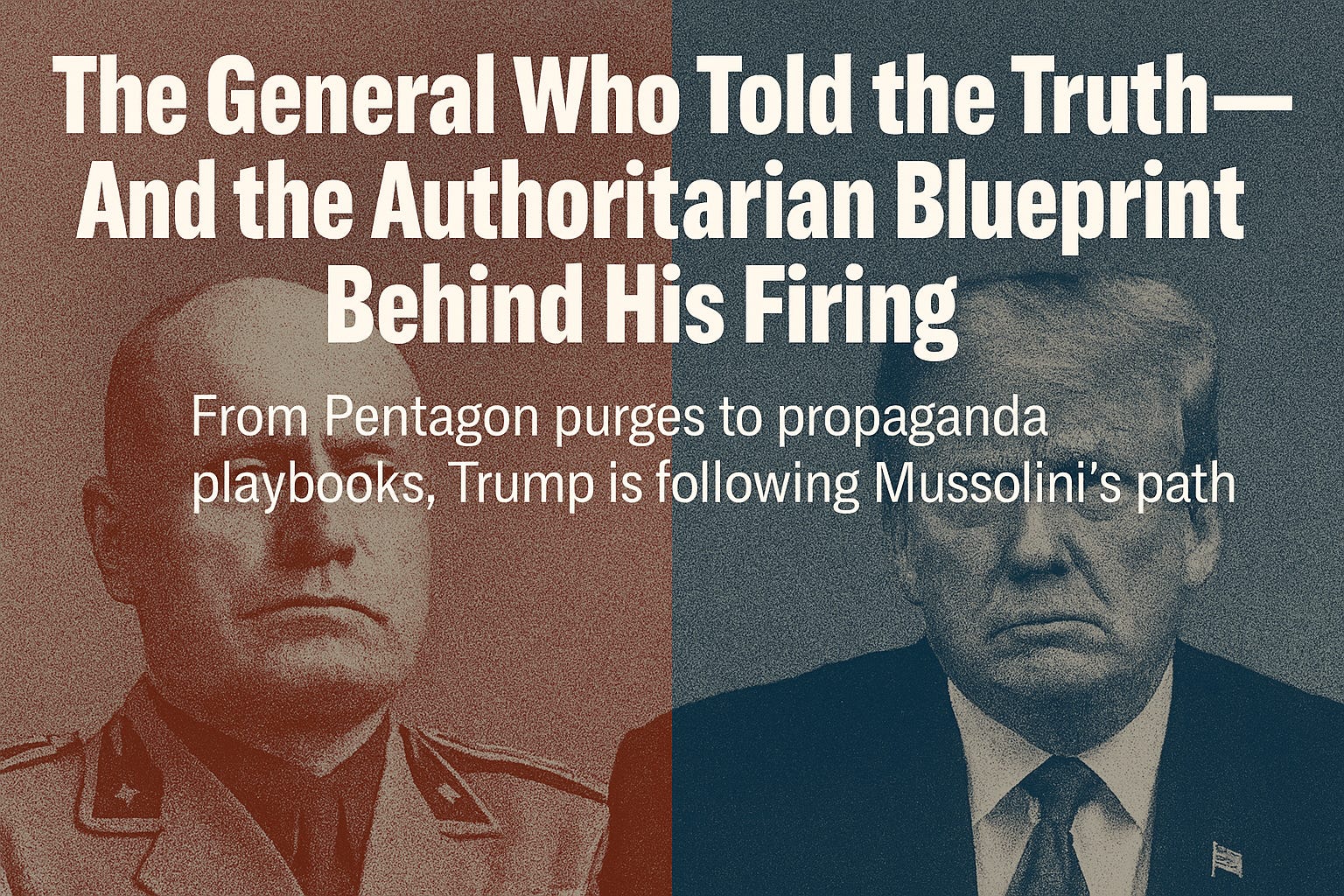
In 1922, Benito Mussolini came to power through a mix of spectacle, violence, and elite accommodation. He didn’t seize the Italian state with a coup. He walked into it through the front door, appointed by the king, and legitimized by a political class that believed they could control him. What followed wasn’t instant dictatorship. It was a slow, deliberate erosion of resistance.
One by one, Mussolini removed the people who could say no. Judges, editors, generals, and educators were removed and replaced with loyalists. He didn’t just take over ministries. He reshaped reality around himself.
Truth was redefined to suit the regime. Facts became suspect. Independent institutions were no longer trusted to speak for the public, only for the party. The press was overtaken, schools reprogrammed, and historical memory cleansed of contradictions. Mussolini wasn’t interested in governing Italy as it was. He wanted to recreate it in his own image, mythologized and permanent.
Sound familiar?
When Donald Trump fires an intelligence chief for reporting facts that contradict his narrative, or purges entire agencies of career officials who prize accuracy over allegiance, he’s not improvising. He’s repeating.
This isn’t a matter of temperament or style. It’s not about strong leadership or unconventional politics. It’s about method and power. And the method he's using has a name.
We’re not alone in drawing this parallel. A well‑known January analysis on Medium rated Trump’s traits nearly as aligned with fascism as Mussolini’s, while Spectre Journal argued in April that Trump is already governing with Mussolini‑level authoritarianism. In May, a Le Monde piece framed Trumpism as a close successor to early 20th‑century fascism. Even at Berkeley, historians warn we’re living echoes of the 1920s — and not the reassuring kind.
The Power to Reimagine a Nation
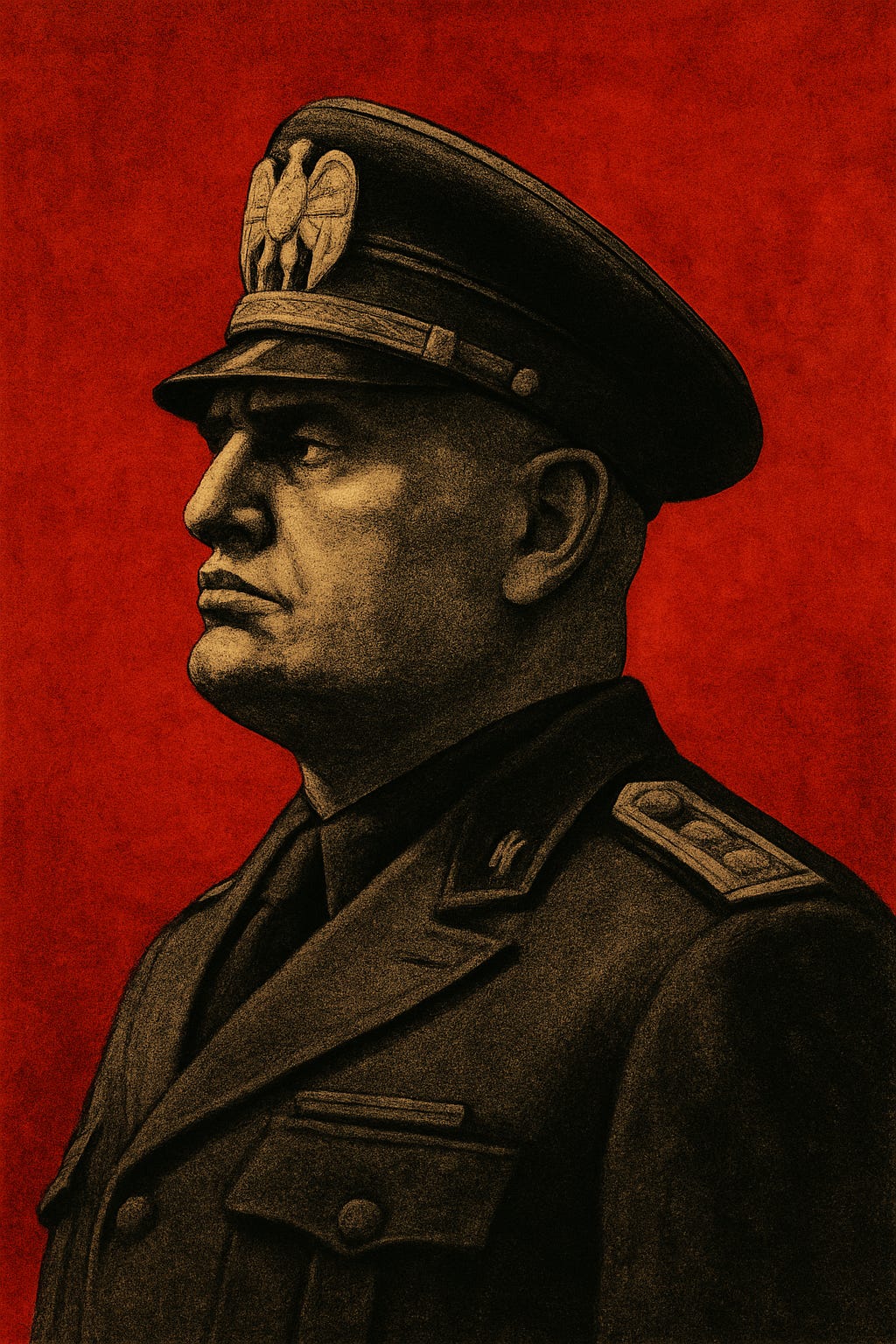
For Mussolini, rewriting reality meant more than controlling the news. It meant controlling what people remembered, what they saw in their streets, their museums, their textbooks. Culture wasn’t decoration. It was infrastructure for power.
In Rome, he ordered new roads cut through ancient ruins, aligning fascist Italy with the grandeur of empire. The Ministry of Popular Culture turned entertainment and education into propaganda. Schoolbooks were rewritten. Museums recast history into a myth of national unity and heroic struggle. Dissenting voices were erased not just from government but from public memory.
Trump hasn’t needed to build an Italian-style ministry. He’s done it with firings, lawsuits, executive orders, and the slow politicization of every federal touchpoint with culture.
Voice of America, once a symbol of nonpartisan global broadcasting, now echoes his talking points. The Smithsonian has been pressured to “uplift” rather than inform. The Kennedy Center was gutted and restaffed. National park signage is flagged for review if it makes visitors “uncomfortable.” Libraries are under siege, public education funding is tied to compliant curricula, and DEI programs — along with historical references to marginalized communities — are vanishing from government servers.
Even the White House itself has been transformed. Gilding that would make Liberace blush graces every surface of the Oval Office. An expansive ballroom is planned. Trump has pitched a “Garden of Heroes” meant not to reflect America’s complexity, but to impose a singular vision of its greatness, one that flatters power and flattens nuance.
Like Mussolini, Trump understands that lasting control doesn’t require convincing the public. It only requires surrounding them with symbols that make resistance feel irrelevant, or worse, unpatriotic.
The strategy is simple: rewrite the past, decorate the present, and you can define the future.
We’ve been covering all of this in real time. See our previous reporting in the embedded links above. Or visit the Coffman Chronicle to see our 900+ articles of warning.
The Future Is What They Say It Is
Mussolini didn’t fall because the public rose up. He fell because the war turned against him. Had he held power another five or ten years, there’s no telling how much deeper his regime would have gone — into genocide, into myth-making, into a reality too warped to untangle.
Trump still has time. That’s the difference, and the danger.
We’re not at the end of something. We’re at the middle. The intelligence firings, the institutional purges, the cultural rewrites — they aren’t the fallout of authoritarianism. They’re its construction phase.
This is what it looks like when the guardrails give way, when leadership becomes performance, when truth becomes optional, and when government becomes a stage and the audience is trained to cheer louder than they think.
What’s happening is not subtle, but it’s also not dramatic. There are no jackboots, no marches, no bonfires. Not yet. For now, there are just meetings, memos, executive orders, and people quietly disappearing from their posts, their names omitted from the next version of the story.
That’s why it works.
That’s also why it matters.
This is just the cultural parallels. We really don’t talk enough about Mussolini. However, as this latest version takes hold, perhaps we should. Before it is too late.
Don’t let the bastards sneak anything past you. Subscribe and get your daily dose of rage and receipts delivered fresh, before the spin doctors can scrub it.
Sources:
"In latest purge, Hegseth removes head of Pentagon intelligence agency, other senior officials" – Reuters
"Hegseth fires head of Defense Intelligence Agency, Lt. Gen. Jeffrey Kruse" – Washington Post
"Pete Hegseth fires intelligence boss over assessment of damage from Iran strikes" – ABC News
“Which Past Fascist Does Trump Most Resemble?” – New Republic
“A Comparative Analysis: Donald Trump, Benito Mussolini, and Adolf Hitler Through the Lens of Fascist Attributes” – Medium
“Trump, Fascism, and the Authoritarian Turn” – Spectre Journal
“Is Trumpism a form of fascism? Two historians debate” – Le Monde
“Fascism shattered Europe a century ago — and historians hear echoes today in the U.S.” – UC Berkeley News (Sept 2024)
"Trump targets the Smithsonian again, says it focuses too much on how bad slavery was" – Reuters
"Trump says Smithsonian should focus on America’s ‘Brightness,’ not ‘how bad Slavery was’" – ABC News
"White House announces new $200M ballroom as part of Trump’s latest makeover of ‘The People’s House’" – AP News
"‘Trump is a wrecking ball’: behind the president’s $200m plan to build a White House ballroom" – The Guardian
"Trump redesigning the White House" – The Week
"White House says Garden of American Heroes may not be complete until 2029" – Washington Post
"Executive Order 14253 – Restoring Truth and Sanity to American History" – WhiteHouse.gov
"National Garden of American Heroes" – Wikipedia
"Ministry of Popular Culture" – Wikipedia
"Propaganda in Fascist Italy" – Wikipedia
Previously reported by this publication:
Trump vs. the Smithsonian: When White Fragility Becomes Policy
Fired, Defunded, Deleted: How the Trump Administration Is Systematically Gutting America's Libraries
Erasing History: Pentagon’s Reckless DEI Purge Targets Holocaust Memories and Veterans’ Stories
The Presidency as Platform: How Trump Has Turned the White House Into a Personal Propaganda Machine
The Age of Obedience: Trump’s AI Orders, Thought Control, and the War on Reality
They may be behind the scenes, Mussolini was take out by his own people. Let hope this is happening 🙏
Threats, intimidation, extortion,along with lies slander and disinfranchising of your employment.These are the tools of a fascist bully.