


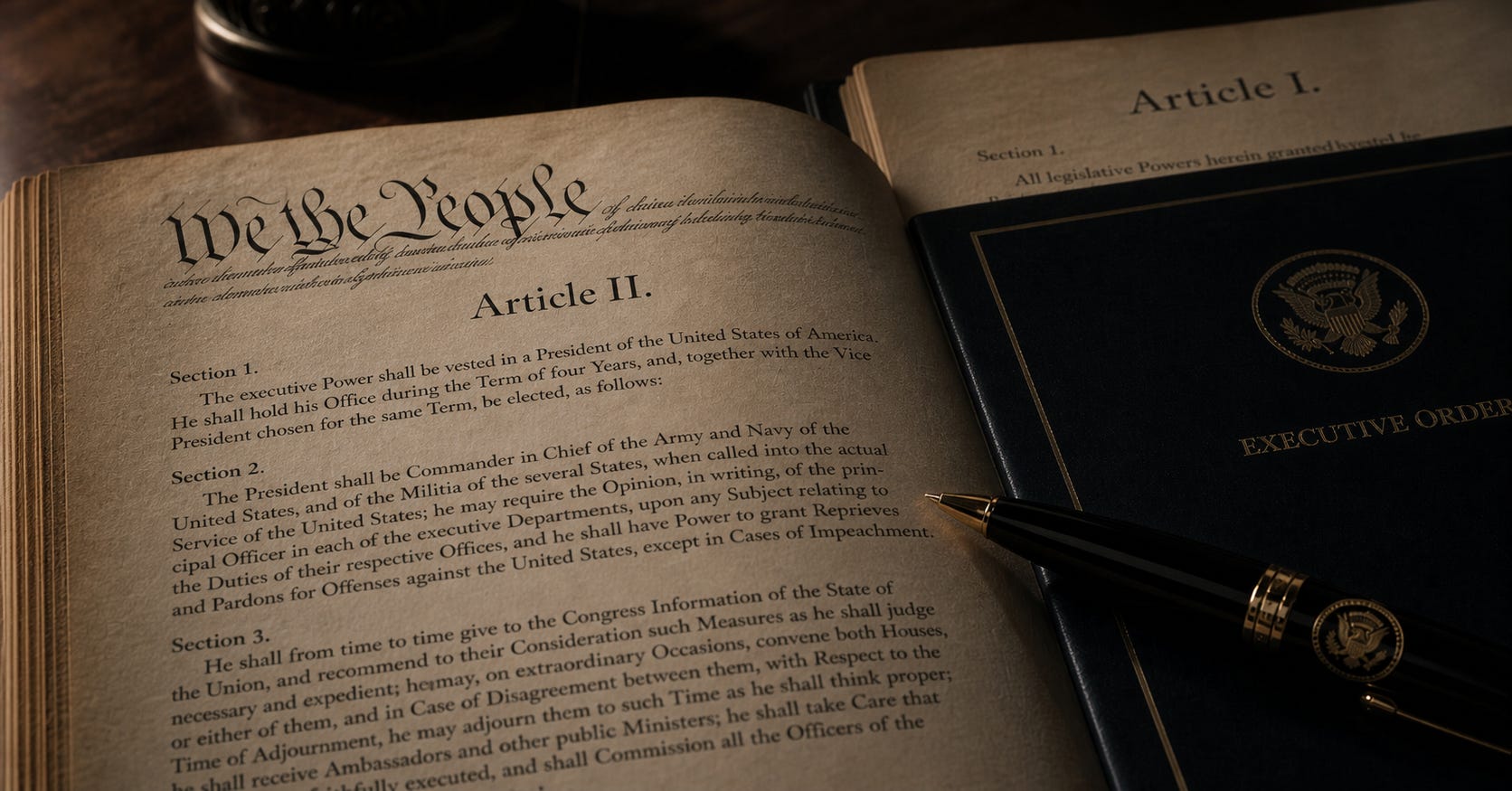
Donald Trump did not create America’s problem with unilateral executive power. He made it impossible to ignore.
The danger was already there, built over decades by presidents who learned to act when Congress would not, lawmakers who learned to avoid responsibility, and voters who grew used to expecting the White House to solve problems the legislative branch refused to touch. Some of those executive actions were popular. Some were defensible. Some may have been necessary in the moment. But the pattern was clear: when Congress failed to legislate, the presidency became the shortcut.
Trump exposed the weakness inside that shortcut.
He did not invent the imperial presidency. He inherited an office already swollen by emergency powers, agency discretion, national security claims, enforcement priorities, and congressional avoidance. But he treated that inherited power differently. He saw the limits of the office not as guardrails to be respected, but as boundaries to be tested.
That is the real warning. A democracy cannot depend on every president being restrained enough not to abuse power Congress should never have surrendered. The answer is not simply finding better presidents. The answer is to rebuild a system in which no president can govern by signature, since the Constitution gave lawmaking power to Congress.
Article I came first for a reason.
This Community Is Powered by You
What started as a small circle has grown into something much bigger, and it’s all because of readers like you.
Every time you forward this email, post it on socials, or bring someone new into the fold, you’re helping build one of the most passionate, independent political communities out there.
Want to keep the momentum going?
Share this newsletter with someone who should be part of this conversation.
Thank you for being here. It means everything.
Article I Came First for a Reason
The Constitution does not begin its structure of government with the president. It begins with Congress. That is not a technicality. It is the architecture of the republic.
The power to make law was placed in the legislative branch because lawmaking was intended to be the people’s power, carried out through elected representatives who debate, amend, compromise, and record their votes publicly. Congress was designed to be slow, frustrating, and accountable because law itself was supposed to be harder than command.
The president was given a different role. Article II vests executive power in one person, but that power was not meant to turn the White House into a second legislature. The president is supposed to execute the laws, not replace the branch that writes them.
That distinction is the heart of the problem. When presidents use executive authority to manage agencies, enforce statutes, or respond to genuine emergencies, they are operating within the normal machinery of government. But when presidents become the primary source of major national policy, the constitutional balance begins to tilt. The country starts looking less like a republic governed by laws and more like a system waiting for the next president to decide what the law will mean this time.
That is not stability. That is drift.
Congress is messy by design. It forces factions into the open. It requires lawmakers to defend their choices. It gives the public a record of who stood where. Executive action does not work that way. One signature can move faster than 535 lawmakers, but speed is not the same thing as democracy.
The presidency was never supposed to be America’s lawmaking machine. It became one because Congress let too much power slide down Pennsylvania Avenue, one crisis, one stalemate, and one avoided vote at a time.
Executive Orders Are Not the Villain
Executive orders are not automatically dangerous. That is important to say clearly, because the problem is not the existence of executive power itself.
Presidents need the ability to manage the executive branch. They need to direct agencies, set enforcement priorities, respond to emergencies, and carry out laws Congress has already passed. A president who could not give lawful instructions to the federal government would not be an executive at all.
There are moments when executive action is not only legal but necessary. A president may need to move quickly during a natural disaster, a national security threat, a public health emergency, or an administrative crisis. Presidents have also used executive authority to pursue policies many Americans supported: protecting workers, expanding access to benefits, enforcing civil rights, and directing agencies to use existing authority more aggressively.
That is why this cannot be a simplistic argument against every executive order. The danger is not the pen. The danger is when the pen replaces Congress.
Once executive action becomes the normal way to make major national policy, the country begins living under a temporary government. A policy created by one president can be narrowed by the next, frozen by a court, rewritten by an agency, or reversed with another signature. What looks like progress in one administration can become whiplash in the next.
That instability is built into the method. Executive action can be fast, but it is often fragile. It can reach people quickly, but it can also disappear quickly. It can provide relief, but not permanence. And when presidents rely on unilateral action because Congress will not legislate, the public gets a substitute for law instead of law itself.
That is the trap. Even when the goal is good, the precedent can be dangerous. A president using unilateral power for something popular teaches the country to expect presidents to solve problems on their own. Then the next president inherits the same machinery and uses it for something very different.
The issue is not whether executive power can ever be used responsibly. It can. The issue is whether a democracy should depend on responsible presidents to keep an already oversized presidency from becoming something worse.
Congress Created the Vacuum
The presidency did not grow this powerful by accident. It grew because Congress kept making room for it.
Every time lawmakers avoid a hard vote, the pressure does not disappear. It moves. Every time Congress fails to update outdated laws, settle major policy questions, or take responsibility for national problems, presidents are tempted to step in and act alone. That temptation is not limited to one party. It is built into the modern system.
Congress has incentives to duck responsibility. Passing laws is hard. Coalition-building is messy. Votes create records. Records become campaign ads. It is often easier for lawmakers to complain about executive action after the fact than to take the political risk of legislating before it happens.
That avoidance has consequences. When Congress refuses to act on immigration, presidents reshape enforcement priorities. When Congress cannot pass a durable climate policy, presidents lean on agency rules. When Congress fails to modernize labor law, civil rights enforcement, health care protections, student loan policy, or emergency powers, administrations stretch old statutes to meet new problems.
Sometimes that produces policies people support. Sometimes it produces abuses they fear. Either way, the branch that was supposed to make law becomes a bystander to the fight over how far the president can go.
This is how congressional weakness becomes presidential strength. The public often sees the executive order at the end of the process. What it does not always see is the failure that came before it: the bill that never reached the floor, the reform that died in committee, the compromise leadership refused to touch, the problem everyone campaigned on, but no one wanted to own.
That is the hidden bargain. Congress avoids accountability. Presidents gain flexibility. Courts inherit the lawsuits. Ordinary people experience uncertainty.
A functioning Congress would not eliminate the need for executive authority, but it would shrink the space where presidents can pretend that governing alone is the only option. Every time Congress refuses to do its job, the presidency becomes more tempting as a workaround.
Trump Was the Stress Test
Trump did not invent the imperial presidency. He tested how far it could go.
Long before Trump returned to power, presidents from both parties had already learned to use executive authority to circumvent congressional failure. They issued orders, declared emergencies, redirected agencies, stretched old laws, and used enforcement discretion to move policy when Congress would not. Trump inherited that machinery. He did not build it from scratch.
Yet he revealed something many Americans had not fully confronted: a system that depends on presidential restraint is only as strong as the president willing to show restraint.
That is where Trump changed the conversation. He treated the accumulated powers of the modern presidency not as tools to be used carefully, but as pressure points to exploit. He pushed emergency authority. He tested agency independence. He attacked oversight. He treated legal limits as obstacles to be challenged and institutional norms as weaknesses to be discarded.
The border wall fight made the danger visible. After Congress refused to give Trump the full wall funding he wanted, he declared a national emergency and moved to redirect billions in military construction funds. The argument was not just about border policy. It was about whether a president could use emergency authority to get around Congress’s power of the purse.
The civil service fight showed the same impulse inside government itself. Trump’s Schedule F order, later revived under a new name, aimed to give the president more power over career federal employees in policy-influencing roles. That was not just a personnel dispute. It was part of a larger fight over whether the executive branch serves the law, the public, or the president's personal agenda.
Earlier presidents often defended unilateral action as a necessity. Trump made clear how easily necessity can become pretext. He showed what happens when the office is occupied by someone who sees congressional paralysis not as a democratic failure to repair, but as an opportunity to act without Congress at all.
That does not erase the history that came before him. It sharpens it.
If the presidency had remained narrow, restrained, and clearly bounded, Trump would have had far less room to maneuver. Instead, he stepped into an office that had already grown larger through war powers, emergency powers, agency discretion, national security claims, and decades of legislative avoidance. The danger was already in the structure. Trump made the structure visible.
That is why this cannot be reduced to one man’s ambition. A healthy constitutional system does not depend on hoping the next president will be honorable. It does not trust any one person with power simply because previous presidents used it more politely. It builds limits strong enough to survive bad faith.
Trump is not the origin story. He is the stress test, and the lesson of that stress test is blunt: if Congress keeps surrendering power, the presidency will keep attracting people eager to use it.
The Whiplash Government Problem
This is where unilateral executive power stops being a civics problem and becomes a kitchen-table problem.
When a major policy is enacted by executive action rather than by law, ordinary people are forced to live under a temporary government. Rules change not because Congress debated them, amended them, and passed them into statute, but because a new president takes office with a different theory of power, a different set of priorities, and a different political base to satisfy.
That creates whiplash.
Student loan borrowers can be told that relief is coming, only to watch it get blocked, narrowed, rewritten, or reversed. Immigrant families can live under one set of enforcement priorities for four years, then wake up to a completely different system. Workers can gain protections under one administration and lose them under the next. Environmental rules can be strengthened, weakened, restored, and attacked again. Civil rights enforcement can expand or contract depending on who controls the Justice Department.
Health care protections, consumer rules, disaster response priorities, federal funding decisions, workplace standards, and climate rules can all swing with the presidency. That is not how stable rights are supposed to work.
The problem is not only that policies change. In a democracy, policies should be able to change when voters choose different leaders. The problem is that executive-made policy often changes without the full legislative process. It can shift faster than families, businesses, schools, agencies, states, and local governments can plan around.
People build lives around rules. They take out loans, accept jobs, hire workers, open businesses, enroll in programs, apply for permits, move across the country, and make long-term decisions based on what the government says the rules are. When those rules depend too heavily on one president’s signature, stability becomes conditional.
That is the cost of government by shortcut. It may feel efficient when the president is doing something a voter supports. It may feel urgent when Congress is frozen. But the same fragility that makes executive action easy to create also makes it easy to destroy.
The public gets relief without durability, protection without permanence, and policy without the accountability that comes from forcing Congress to put its name on the law. A right that depends on one president’s signature can disappear with the next president’s pen.
Courts Cannot Be the Whole Guardrail
When Congress refuses to legislate clearly, and presidents aggressively exercise executive power, the courts become the battlefield.
That is now a familiar pattern. A president announces a major policy through executive action. Opponents sue. A lower court blocks it, narrows it, or lets it proceed. Appeals follow. The issue climbs toward the Supreme Court. Months or years pass while millions of people wait to learn whether the policy shaping their lives is legal, temporary, or already dead.
The student loan fight is a clear example. The Biden administration tried to use existing statutory authority to cancel hundreds of billions in student debt. The Supreme Court rejected that approach, holding that the law did not authorize a program of that scale. Whatever one thinks of the policy, the structure of the fight was revealing: Congress had not enacted broad debt cancellation, the executive branch tried to act through existing authority, and the courts became the final gatekeeper.
That is not a healthy government. That is constitutional triage.
Courts have an important role. They can check illegal actions and enforce statutory limits. They can tell a president that Article II does not give him permission to do whatever Congress refused to do. However, courts cannot fix the deeper failure that created the fight in the first place.
Judges are not lawmakers. They cannot build a functioning immigration system. They cannot write a durable climate law. They cannot modernize emergency powers, rebuild labor protections, settle student loan policy, or create stable national rules for health care, civil rights, consumer protection, or federal funding. At best, they can decide whether a specific executive action crosses a legal line.
That means the country is increasingly asking courts to referee disputes Congress should have resolved through legislation. And while those cases move through the system, ordinary people are left in limbo. Borrowers do not know whether relief will survive. Workers do not know whether protections will last. Agencies do not know how far their authority extends. States do not know which rules to follow. Families do not know whether a policy they relied on today will still exist tomorrow.
That uncertainty is not a side effect. It is the predictable result of letting presidents stretch power while Congress avoids responsibility.
A democracy needs courts, but it cannot use them as a substitute for Congress. Lawsuits may stop abuses, but they do not create the stable, accountable lawmaking that the Constitution assigned to Article I. A democracy cannot outsource its lawmaking crisis to judges.
The Answer Is Not Just a Better President
The solution is not simply electing presidents who promise to use executive power more responsibly.
That may matter in the short term. Character, restraint, and respect for constitutional limits matter. A president who sees the office as a public trust is obviously less dangerous than one who sees it as a weapon. However, democracy cannot depend on personality as its main safeguard.
That is the deeper problem. If a president has too much room to act alone, the answer cannot be to hope that the next president uses that room wisely. The answer has to be shrinking the room. A healthy republic should not require voters to gamble every four years on whether one person will honor limits that Congress has failed to enforce.
This is where both parties have helped build the trap.
When a president uses unilateral power for policies that people support, supporters often defend the method because they like the outcome. When the other side takes power and uses the same machinery for opposite goals, the danger suddenly becomes obvious. Yet by then, the precedent has already been strengthened.
That is how executive power grows. Each side tells itself its emergency is different. Its cause is more urgent. Its president is more justified. Its use of power is more defensible. The machinery does not care who built the precedent. It only waits for the next person willing to use it.
That is why the real reform has to run through Congress.
Major national policy should be written into law whenever possible. Rights, benefits, protections, obligations, and enforcement standards should not depend on which president controls the agencies. If lawmakers want student debt reform, immigration policy, labor protections, climate rules, voting rights, health care safeguards, or civil rights enforcement to last, they need to put those commitments into statute.
That means taking hard votes. It means accepting accountability. It means doing the slow work that the Constitution assigned to the legislative branch.
The goal should not be finding presidents we trust with too much power. The goal should be taking too much power off the table.
Ending Government by Signature
Ending government by signature does not mean stripping the presidency of every useful tool. Presidents still need to manage agencies, direct federal operations, enforce existing law, and respond to genuine emergencies. But those tools have to return to their proper place.
Executive power should carry out the law, not become the place where the law is made because Congress is too divided, too afraid, or too captured to act. The president should not be able to turn national policy into a temporary command structure in which one administration builds rules, and the next tears them down.
That is not democratic stability. It is policy by pendulum.
Durable government requires ownership. If student debt policy matters, Congress should write it into law. If immigration reform matters, Congress should legislate. If labor standards, health care protections, civil rights enforcement, environmental rules, emergency powers, voting protections, and consumer safeguards matter, lawmakers should be forced to vote on them.
A president can sign an order and claim action. A member of Congress can issue a statement and blame the courts, the White House, the other party, or the process. Legislation forces ownership.
It requires lawmakers to say yes or no. It creates a record. It gives the public something more durable than a promise and more accountable than a press release.
That is why Article I matters. The Constitution did not put Congress first because Congress is efficient. It put Congress first because lawmaking was supposed to be public, representative, contested, and accountable. It was supposed to be harder than executive command because the consequences of law reach deeper than one person’s will.
Executive action may solve a problem for the moment. However, when the problem is large enough to shape people’s rights, bills, jobs, schools, benefits, health care, environment, or freedom, temporary power is not enough.
Durable policy requires democratic responsibility.
The System Cannot Depend on Restraint
The danger of unilateral executive power is not only what one president might do with it. It is what the system has already allowed the presidency to become.
Trump made that danger visible. He did not create every weakness he exploited. He exposed how fragile a constitutional system becomes when enforceable limits are replaced by personal restraint.
That is not a defense of Trump. It is the broader indictment.
A republic should not survive only when the person in the Oval Office chooses not to push too far. It should not rely on norms that can be ignored, traditions that can be discarded, or congressional authority that lawmakers are too afraid to reclaim. A constitutional system has to be built for the president who will test it.
That means Congress has to stop treating its own power as optional.
If lawmakers want stable policy, they have to legislate. If they want to limit emergency authority, they have to rewrite the rules. If they want to prevent presidents from governing by command, they have to reclaim the responsibility Article I gave them. Complaining about executive overreach after surrendering the field is not oversight. It is evasion.
The public should demand the same. It is tempting to cheer unilateral power when the president is using it for a cause we support. But democracy cannot be defended only when the other side holds the pen. The test is whether we are willing to limit power even when our side might benefit from it.
That is the lesson Trump forced into the open.
The presidency has become too large. Congress has become too comfortable avoiding accountability. The courts have become too familiar as the final referee. And ordinary people have been left living under policies that can appear, vanish, or reverse with every election.
Article I came first for a reason. If Congress keeps forgetting that, every presidency becomes another test of how much one person can get away with before someone stops him.
Support Independent Media
The Coffman Chronicle exists to follow the pattern beneath the headline.
This work takes time, research, and independence. If you value reporting and analysis that connects constitutional fights to kitchen-table consequences, consider becoming a paid subscriber. Your support helps keep this publication independent and allows us to keep digging where the official explanations stop.
If you can afford it, become a paid subscriber today. If you cannot, keep reading, keep sharing, and keep asking the question democracy depends on: Who benefits when power stops being accountable?
Sources
“A Guide to Emergency Powers and Their Use.” Brennan Center for Justice, December 5, 2018.
“Executive Orders: Issuance, Modification, and Revocation.” Congressional Research Service, April 16, 2014.
“Military Funding for Southwest Border Barriers.” EveryCRSReport.com, September 23, 2019.
“Creating Schedule F in the Excepted Service.” Executive Order 13957, 85 Fed. Reg. 67631, October 26, 2020.
“Declaring a National Emergency Concerning the Southern Border of the United States.” Proclamation 9844, 84 Fed. Reg. 4949, February 20, 2019.
“Youngstown Sheet & Tube Co. v. Sawyer, 343 U.S. 579.” Justia U.S. Supreme Court Center.
Library of Congress. “Article I: Legislative Branch.” Constitution Annotated.
Library of Congress. “Overview of Take Care Clause.” Constitution Annotated.
“FAQ’s About Executive Orders.” National Archives.
“The Constitution of the United States: A Transcription.” National Archives.
The American Presidency Project. “Executive Orders.” University of California, Santa Barbara.
U.S. Code. “10 U.S.C. § 2808: Construction Authority in the Event of a Declaration of War or National Emergency.” Office of the Law Revision Counsel, U.S. House of Representatives.
U.S. Code. “50 U.S.C. § 1601: Termination of Existing Declared Emergencies.” Office of the Law Revision Counsel, U.S. House of Representatives.
Biden v. Nebraska, 600 U.S. ___ (2023). Supreme Court of the United States, June 30, 2023.
Yeah, now we are being told to cough up $1billion for his ballroom because of “urgency” in some legal clause. First the “urgency” was national security which is why the did the “shooter” gig at the correspondents diner. Next we are told the “urgency” is because of the upcoming 250th Anniversary of our country. But the ballroom was supposed to be paid for by rich anonymous donors. Ohh… grift… the ancillary “no bid” contracts given to his ballroom friends… more grift… it will never stop until we stop it. Move for soft succession. He will not leave office voluntarily.
What did the founders expect by making a civilian sole commander in chief of the military, and able to do whatever he wants with it? If the CC is a mafia trained criminal It really doesn't matter what the other branches of our government or the people of this country think. In the final analysis, too many in the military will follow whatever orders are issued.