


On December 5, 2025, during the 2026 World Cup draw in Washington, D.C., the world’s largest soccer federation, FIFA, presented its very first “Peace Prize.” The recipient was not a diplomat, a humanitarian, or a Nobel laureate. It was the sitting President of the United States, Donald J. Trump.
The moment was surreal. A sports organization long ensconced in stadiums and club rivalries was suddenly stepping into the business of global diplomacy. The trophy is a gleaming depiction of the Earth elevated on reaching hands. The stage was a World Cup draw, designed for spectacle, not treaties. Thousands were watching, millions streaming. At its center was a man who has spent his presidency striking deals, but also launching strikes.
It wasn’t a peace process. It was a performance, a branding exercise, not a diplomatic milestone. By design, it was meant to shock, dazzle, and impress. And it did.
Want to Know Your Rights?
Download a free digital copy of the U.S. Constitution, the same document Trump is trying to bulldoze. Learn exactly what he’s breaking and how to fight back.
We just hit 75,000 subscribers, 1,000 articles, and 1,000 podcast episodes. To celebrate, paid subscriptions are 20% off for a limited time. That’s just $64/year, less than $1.25 a week.
It’s Not an Isolated Incident. It’s a Pattern
The FIFA prize didn’t emerge from a long tradition. It wasn’t rooted in diplomacy. It just appeared, sudden, strange, and gilded in spectacle. Recent reporting indicates that within the organization, murmurs of an investigation are being heard, questioning who authorized the selection.
This is only the latest act in a sequence, one seemingly orchestrated to recast a controversial presidency with a legacy of peace.
The Architect of Peace Award
On October 21, 2025, at a White House ceremony, President Donald J. Trump accepted the Architect of Peace Award, the Richard Nixon Foundation’s signature honor, created in 1995 to recognize “individuals who embody [Nixon’s] lifelong goal of shaping a more peaceful world.”
The list of past recipients reads less like a registry of peacemakers than a who's-who of controversial power players, including former presidents, Cold War strategists, and wartime secretaries of defense and state. Names like Henry Kissinger, Dick Cheney, Donald Rumsfeld, and John McCain mingle alongside the few genuinely peace‑oriented figures.
By invoking Nixon — a Cold War realpolitik president who presided over secret bombings, authoritarian crackdowns, and covert interventions — the award carries a distinct ideological framing. It suggests that “peace” means power, dominance, and order imposed from above, not diplomacy, justice, or reconciliation.
So when Trump accepted the Architect of Peace Award, the message was not humility or reflection. It was a statement. It reflected peace according to a worldview where might defines right, and medals rewrite memory.
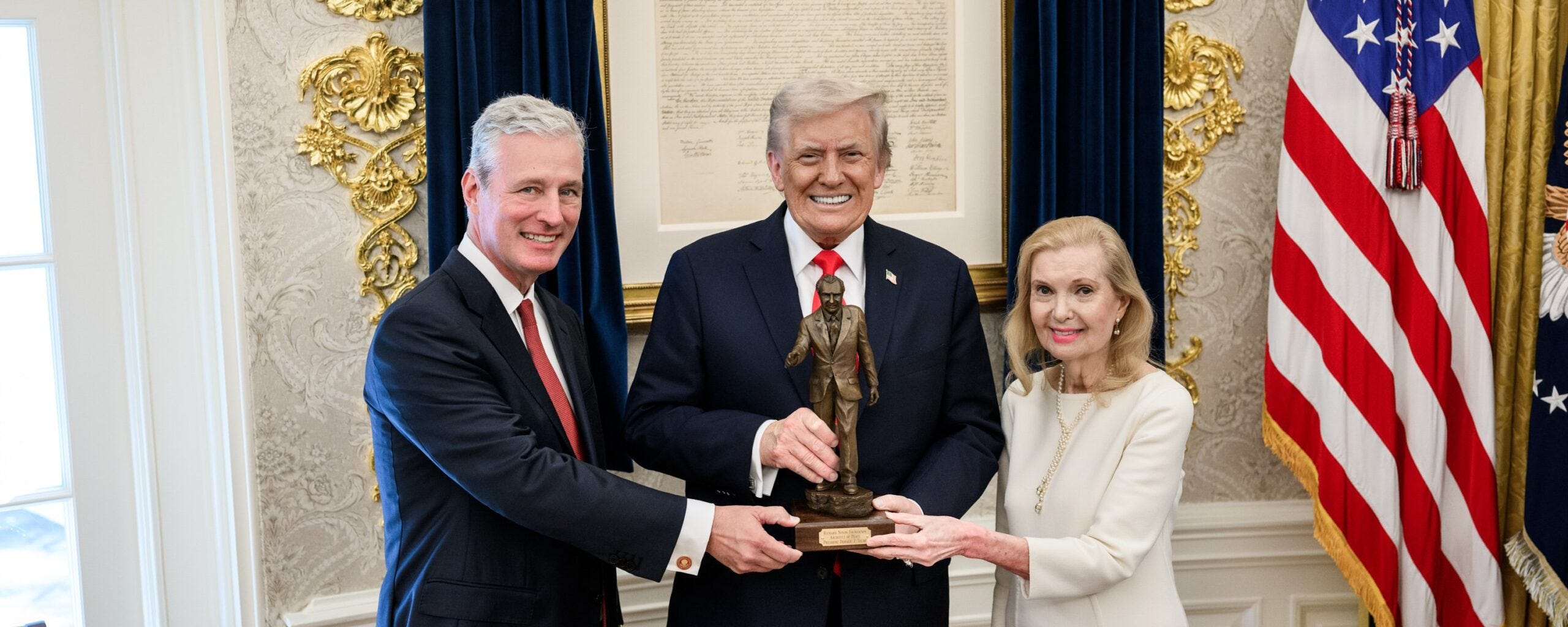
Nixon Foundation
Behind the Spectacle: The Rebranding of USIP
While the world watched a soccer draw, another transformation had played out quietly just two days earlier. On December 3, the U.S. administration, via the Department of State, quietly renamed a longstanding institution built to advance diplomacy and conflict resolution. The United States Institute of Peace, established by Congress to be nonpartisan, independent, and dedicated to easing war’s toll, had its name stripped. In its place was born “The Donald J. Trump Institute of Peace.”
Why It Matters
So far, there is no reporting regarding who proposed this change. In the end, that is immaterial. No sitting United States President has ever had an institution named after them. While private institutions may choose to rename a building or an entity to honor a former or sitting elected official, the same act by a federal entity is far more complicated. It often requires an act of Congress and is proposed by the legislature, not the person being honored. Even when authority lies with the GAO or another entity, it is met with controversy, limited to a building rather than an institution, and has never been used for a sitting President.
This was not charity. It was conquest. The building’s signage was changed. The institution’s identity recast. The message was unmistakable. This institute reflects peace, as defined not by diplomats or history, but by one man’s brand.
There’s a Good Reason for the Original Name
When Congress established the United States Institute of Peace, it could have given it a name tied to a famous American. It didn’t.
There are three powerful reasons why this would have been a controversial and complex decision.
First, no person is devoid of controversy. While the United States has historically mythologized the Founding Fathers, former Presidents, and other notable people, history demonstrates again and again that no one has clean hands. By design, the Presidency is a difficult position. Fraught decisions must be made, and they are never without controversy both in their own time and retrospectively. Further, they are often complicated by the larger set of decisions made by the office. All of our great Americans have legacies beyond their most significant achievements — slave ownership, personal scandals, and ideologies or beliefs that are no longer acceptable.
Second, tying an institute focused on an idea, such as peace, to a person chains it to their methods and ideology. Consider the Nixon Architect of Peace Award. The recipients reflect Nixonian politics, both the partisan bent and the preferred strategies. If the USIP were named after a person, it would be forever entrenched in their legacy and political habits. That would remove the opportunity to explore programs and efforts that run counter, preventing, in some cases, genuinely workable solutions.
The final reason is that a name implies a specific era. However, do we want our entity focused on peace to be limited to the past or even the present? Do we feel comfortable linking it to that ethos forever? Or do we want it centered on the evolving ethics and morals of the nation as a whole, focused not just on the past or the present, but also on the future? By naming it the United States Institute of Peace, Congress imbued it with timelessness, flexibility, and evolutionary potential.
Why Now?
The timing was no accident. The rename came one day before a high‑profile U.S.–brokered peace deal between Rwanda and the Democratic Republic of the Congo. Despite earlier deals, violence has continued in the region, and experts predict that the latest effort may be, at best, a step but not the finale.
Significantly, the renaming also came mere months after the same administration used the Department of Government Efficiency to gut the institute’s staffing, funding, independence, and, very nearly, the building itself. The court battle continues, despite an earlier ruling calling the action unlawful. This suggests intent, planning, and strategy. Perhaps most importantly, it signals an end to American commitment to peace as defined by the institute as founded.
Taken together, none of these are anomalies. They are the two sides of the same coin — spectacle and substance, showmanship and takeover.
A Legacy Measured in Trophies and in Obama’s Shadow
To fully understand the desperation behind this manufactured peace narrative, you have to go back years, back to Trump’s early political rise, when his fixation on President Barack Obama was not just rhetorical, but personal.
It began with the birther lie. It continued through his systematic effort to dismantle Obama’s legacy, from healthcare to diplomacy to climate accords. And it always circled back to one particular sore spot: Obama’s Nobel Peace Prize, awarded in 2009 during his first year in office.
Trump never let that go. He mocked the honor publicly. He demanded nominations of his own. He reportedly pressured allies and foreign leaders to advocate on his behalf. He has repeatedly claimed — without evidence— that he has ended eight conflicts. And when his name never appeared on the Nobel committee’s shortlist, he took it as an affront.
It was never about global peace. It was about personal parity. If Obama had it, Trump believed he deserved it too.
And when he couldn’t claim that prize, he went searching for others or made his own.
Why This Matters: Peace as Image, Not Improvement
What we are seeing is not peacemaking. It is image‑making.
For a sporting body like FIFA to suddenly declare itself arbiter of global unity and hand that honor to a leader with controversial policies and ongoing military actions is to confuse glitter with gravity. For a government to rename a nonpartisan institution after its leader, while that institution’s mission is in flux and its independence already compromised, is to sign off on self‑canonization.
The tragedy is not only symbolic. It is structural. It rewrites memory, reshapes institutions, and normalizes the idea that “peace” is a brand you cultivate rather than a responsibility you uphold.
Behind the Names and Trophies, There Is a Pattern of Insecurity
This is not just about policy or politics. It is about psychology. It is about the refusal to lose, the need to be seen as powerful, to be recognized, to be immortalized.
When recognition does not come — when institutions refuse to name you “peacemaker” — you rename the institution. When global bodies decline your claims, you wait for a body willing to grant them. While diplomacy demands patience, you seek spectacle instead.
It is childish and dangerous, a tantrum at the highest level, with consequences far bigger than any trophy.
What “Peace” Should Mean & What It’s Becoming
Peace is not a brand. It is not a title. It is not a “legacy.”
Peace is empathy. It is shared humanity. It is the willingness to accept difference, to protect the vulnerable, to refuse violence as a first resort, and to hold on to the belief that human life—even flawed, even dangerous—is worth dignity.
It doesn’t need a ribbon. It doesn’t need a plaque.
When peace becomes what you broadcast — a peak photo op, a shining trophy, a renamed building — you have lost the substance.
What we are witnessing is not peacemaking. It is ego-making, and that is not a legacy we should honor.
This President has demonstrated through word, deed, and policy that he does not believe in peace.
Postscript: One More Honor?
At the 2025 Kennedy Center Honors on December 7th, Trump hosted and again left open the possibility of the center being renamed in his honor. In fact, during one section, he referred to it as the Trump Kennedy Center. He also shared that, in his role as chair, he helped select the recipients, including Sylvester Stallone, Gloria Gaynor, KISS, and George Strait.
Despite the event being meant to celebrate artists, not officeholders, President Trump was asked whether he expects to receive the award himself next year.
“Yeah,” he said. “I think I’m going to nominate myself for next year.”
The Honors are intended for cultural contributions, artistic excellence, and for shaping the soul of a nation. Trump, of course, has done none of these, unless, of course, he expects recognition for tapdancing around the truth, or for cosplaying as a fascist and watching the crowd applaud anyway.
What’s next? Will he campaign for a Grammy? A Tony?
Sadly, the odds are not zero. He has previously been awarded by gaming, wrestling, and boxing organizations, not for his successes but for his influence, for owning casinos (some of which went bankrupt), and for offering his real estate holdings as venues.
And that says everything. Trump has grown accustomed to being acclaimed by groups simply for being famous and for profiting from them. It is no accident that FIFA is preparing for the 2026 World Cup in North America, and is facing the grim reality that Trump’s ICE agents could make those events difficult for many players, teams, and fans. Organizations must stop feeding ego with undeserved awards to curry favor. It undermines their institutions, their credibility, and the legitimacy of their awards. Most importantly for us, it encourages a would-be king.
Don’t let the bastards sneak anything past you. Subscribe and get your daily dose of rage and receipts delivered fresh, before the spin doctors can scrub it.
Sources:
FIFA launches annual Peace Prize with first to be awarded at World Cup draw — Reuters, Nov 5, 2025
“Great honors of my life”: Trump wins FIFA Peace Prize after Nobel snub — Axios, Dec 5, 2025
Trump awarded FIFA ‘peace prize’ at World Cup draw ceremony — Reuters video, Dec 5, 2025
Trump presented with first FIFA Peace Prize at 2026 World Cup draw — Associated Press / Daily Sabah, Dec 5, 2025
President Trump Receives Richard Nixon Foundation’s Architect of Peace Award — Nixon Foundation, Oct 22, 2025
Trump receives Architect of Peace Award from Nixon Foundation — CBS News, Oct 21, 2025
Trump receives Richard Nixon Foundation’s Architect of Peace Award — KOMO News, Oct 21, 2025
Trump’s name added to US Institute of Peace ahead of peace deal signing — Reuters, Dec 3, 2025
Trump added his name to the U.S. Institute of Peace building while fighting the organization in court — PBS, Dec 4, 2025
The renamed ‘Donald J. Trump Institute of Peace’ hosts first event — Washington Post, Dec 3, 2025
After firings and DOGE staff accesses headquarters, U.S. Institute of Peace board sues — PBS, Mar 19, 2025.
The Kennedy Center Honors gets a shakeup from its host: Trump — The Washington Post via MSN, Dec 7, 2025.
Kennedy Center Honors fete performers, but Trump takes spotlight — Reuters via MSN, Dec 7, 2025
In other words it’s a farce for the felon and his freaky friends. He is too dumb to realize it. His name will be removed from EVERYTHING once he is held accountable for so many corrupt dealings.
Look how stupid he is…. Who puts their own medal(?) around their own neck!!!? What an ignorant POS!