


When a politician tells you prices are down, check your receipt.
Want to Know Your Rights?
Download a free digital copy of the U.S. Constitution—the same document Trump is trying to bulldoze. Learn exactly what he’s breaking… and how to fight back.
30,000 readers strong. 1200 articles. 1,000 episodes. This community is growing — and so is the movement to defend democracy.
Donald Trump stood at a podium and told Americans, “Groceries are down. It’s all down.”
He said it with the same confidence he once used to declare a “perfect call” with Ukraine and “record job creation” during the first wave of COVID layoffs. But here’s the truth: nothing is “down” except trust in his words.
Let’s unpack what’s really going on — and bring the receipts.
The Grocery Lie
Trump’s claim that grocery prices are “down” is flat-out false. According to the U.S. Bureau of Labor Statistics (BLS), the Consumer Price Index for food at home rose 2.1% over the past year and remains 25% higher than before the pandemic. The price of essentials like bread, milk, eggs, and ground beef is still elevated, and while some items have stabilized, “down” isn’t the right word — “stuck high” is.
Let’s talk specifics:
Ground beef: up 6.5% year-over-year
White bread: up 4.2%
Cereal and bakery products: up 2.6%
Frozen vegetables: up 4.8%
Snacks: up 3.9%
And despite recent moderation, food inflation since 2020 remains the worst four-year stretch since the 1970s — a period Trump has falsely blamed on the “last administration,” even though much of it began during his own presidency when supply chains collapsed under COVID mismanagement.
The Inflation Distortion
Trump also told supporters that “the last administration had the greatest inflation in the history of our country.”
That’s another whopper.
The truth: Inflation hit a 9.1% annual rate in June 2022, but it has since fallen to around 2.8%, according to the latest BLS report. That’s below Trump’s own peak rate of 2.9% in 2018 — and far from “the greatest in history.”
For perspective, the U.S. faced 13.5% inflation in 1980 under Ronald Reagan’s first year — more than four times the current rate. Even under Trump, before COVID, inflation averaged 2.3%, but so did stagnant wages and an expanding deficit.
In other words: prices are not down, inflation is not “the greatest,” and Trump’s economic record isn’t the miracle he keeps selling.
The Forgotten Numbers
Trump loves to cherry-pick data like a man shopping with a broken calculator. Here’s what he doesn’t say:
Real wages (adjusted for inflation) fell during his term and only began recovering afterward.
Farm bankruptcies spiked by 20% in 2019, largely due to his trade war with China.
The national debt increased by $7.8 trillion during his first term — more than any president in history during a single term.
Unemployment surged to 14.7% in April 2020 — the highest since the Great Depression.
And yet, standing in front of cameras, he tells Americans everything’s “down.”
What’s really down is the credibility of a man who’s never met a number he couldn’t distort.
The Real Story Behind Grocery Prices
It’s true that some food costs — like eggs and pork — dropped briefly after post-pandemic spikes. But that’s not because of Trump’s policies. It’s due to global supply recovery, shipping stabilization, and lower energy costs, all trends driven by market correction, not political magic.
Moreover, major grocery chains like Kroger and Walmart have posted record profits, suggesting corporate price-padding, not presidential policy, is keeping your cart expensive.
When Trump says prices are down, he’s talking about shareholders, not shoppers.
Pattern of Deception
Trump’s latest line fits a pattern. Each time he reenters the economic conversation, he rewrites history:
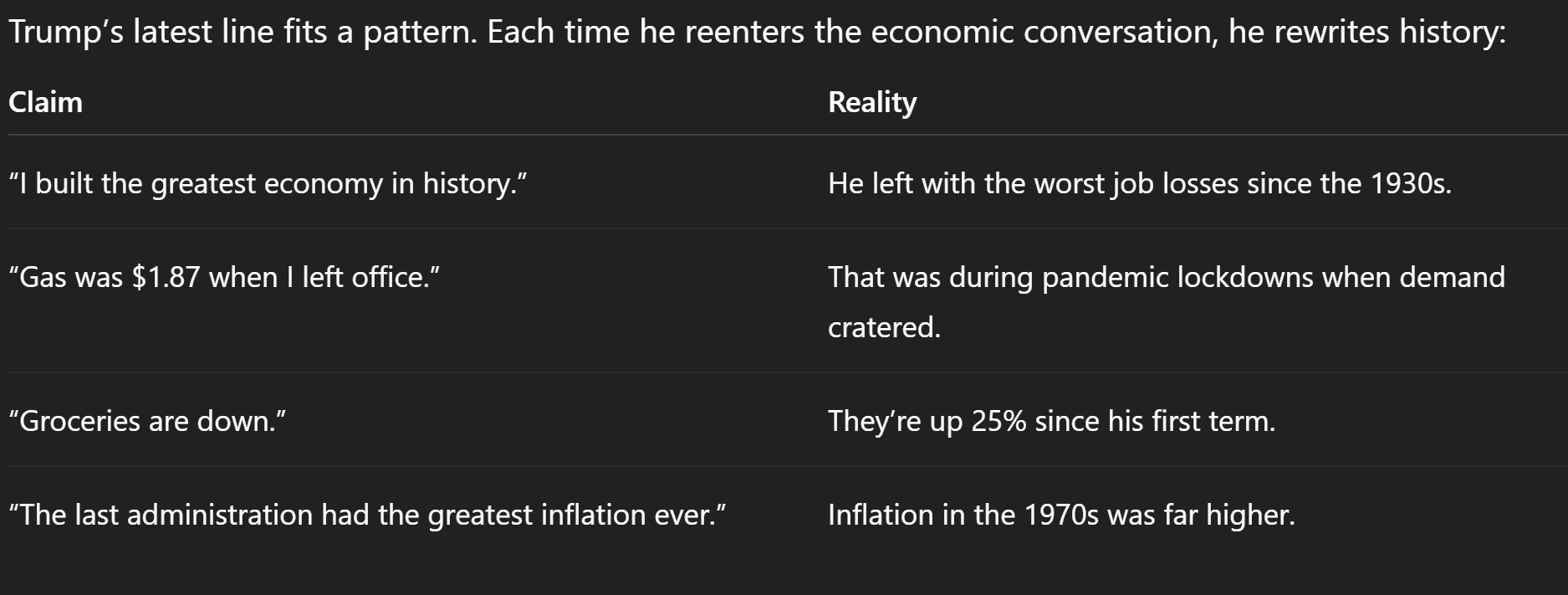
Every falsehood is calibrated to feed nostalgia — a political strategy that trades truth for sentiment. The same strategy once used to sell “morning in America” now sells “remember when it was cheap?” even when it never was.
Why This Matters
Lies about the economy aren’t harmless. They shape public perception, warp policy debates, and let the powerful off the hook while working families pick up the tab.
When Trump tells voters “it’s all down,” he’s not talking about your grocery bill — he’s talking about your standards for truth.
He wants you tired, confused, and nostalgic enough to stop checking the math.
But kitchen-table America is smarter than that. We live the receipts.
Support Independent Media
The networks won’t fact-check Trump’s grocery lies. They’ll just replay them for clicks. That’s why independent media matters. When journalism is funded by readers — not corporations or political campaigns — truth can’t be bought.
If you value this kind of reporting, consider becoming a paid subscriber. It keeps stories like this alive, unfiltered, and accountable to the only people who matter — you.
Bibliography
Bureau of Labor Statistics. “Consumer Price Index Summary.” U.S. Department of Labor. https://www.bls.gov/news.release/cpi.nr0.htm
Federal Reserve Bank of St. Louis. “Inflation, CPI (All Urban Consumers).” https://fred.stlouisfed.org/series/CPIAUCSL
USDA Economic Research Service. “Food Price Outlook.” https://www.ers.usda.gov/data-products/food-price-outlook/
Reuters. “Fact Check: Trump Misleads on Grocery Prices.” October 2025. https://www.reuters.com/fact-check/trump-grocery-prices-2025
CNN Business. “Food Inflation Remains Sticky Despite Lower Energy Costs.” September 2025. https://www.cnn.com/business/food-inflation-2025


