


Election reform has a complexity problem. Alaska is living through that debate right now. Its voters currently participate in a nonpartisan primary in which candidates run together and the top four advance. In the general election, voters rank those candidates rather than simply choosing one. On November 3rd, Alaskans are scheduled to vote on Ballot Measure No. 2, which would end that system, restore partisan primaries and single-choice general elections, and repeal certain campaign-finance provisions adopted with the current system.
Serious arguments surround systems like Alaska’s. Supporters emphasize broader participation and additional voter choice. Critics raise concerns about complexity, political parties, and whether voters should have to learn a different way of casting a general-election ballot.
Perhaps the most interesting question is not whether Alaska chose the right system, but whether election reform is trying to fix too much at once.
If the problem is that voters have too little influence while the candidate field is still open, why redesign November? Why not concentrate the experiment where the narrowing actually happens?
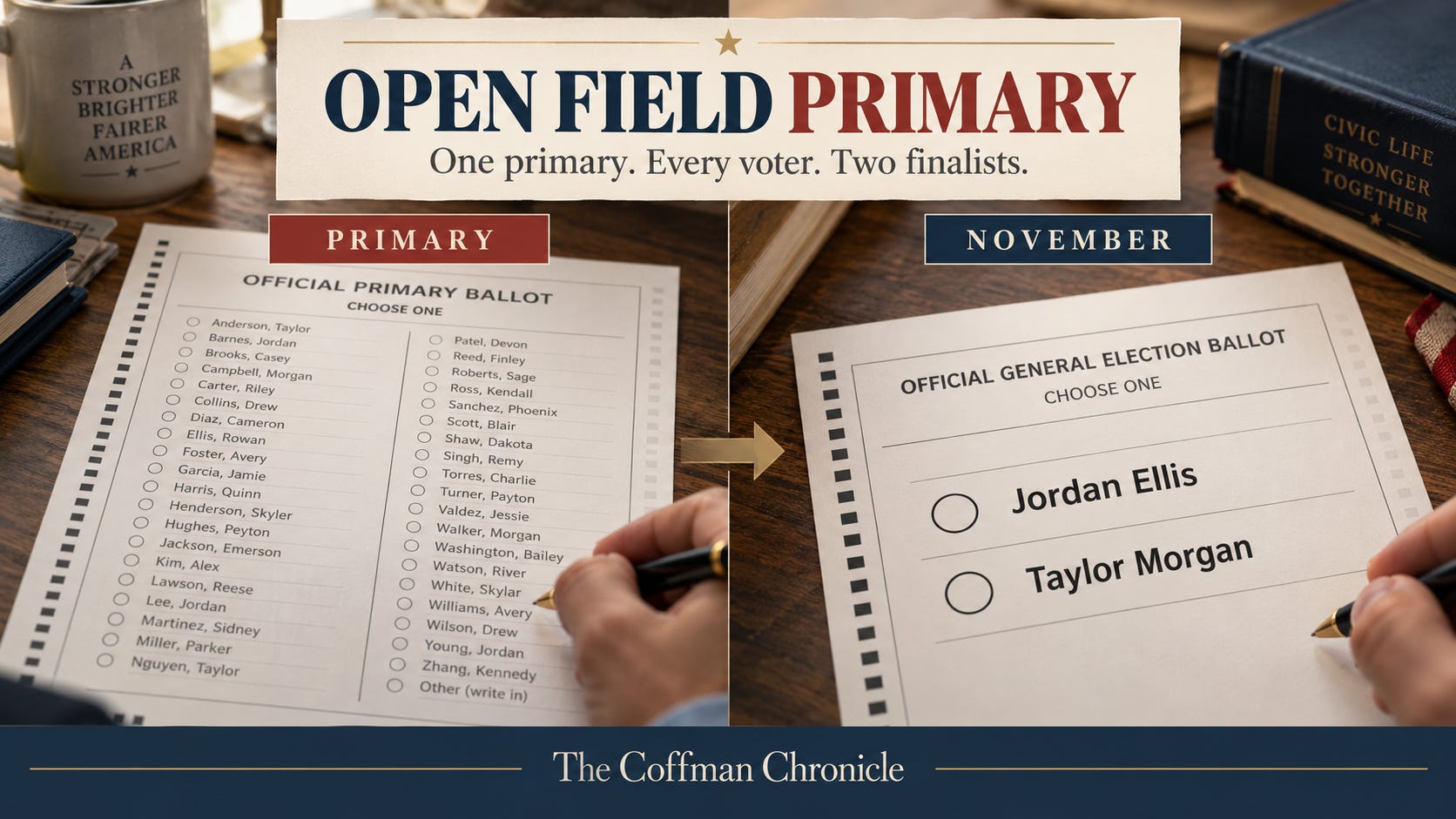
Imagine a primary in which every qualified candidate appears on the same ballot. Democrats, Republicans, independents, Libertarians, Greens, and other qualified candidates compete before the same electorate. Party registration does not determine which group of candidates a voter is permitted to consider.
Instead of ranking them, voters could mark every candidate they believe would be an acceptable finalist. The primary elects nobody. Its job is to reduce a crowded field to two candidates.
November then returns to a familiar rule: two finalists appear on the ballot, every voter chooses one, and the candidate with the most votes wins.
The concept could be called an Open Field Primary. It is not proportional representation. It does not eliminate political parties. Under the approval-style version examined here, it is not ranked-choice voting. Nobody places candidates first, second, third, and fourth.
If November belongs to the entire electorate, what would happen if the entire electorate also participated while the field was still open? The primary should narrow the field. It should not narrow the voter.
This Community Is Powered by You
What started as a small circle has grown into something much bigger, and it’s all because of readers like you.
Every time you forward this email, post it on socials, or bring someone new into the fold, you’re helping build one of the most passionate, independent communities out there.
Want to keep the momentum going?
Share this newsletter with someone who should be part of this conversation.
Thank you for being here. It means everything.
By November, Most of the Sorting Has Already Happened
The November ballot feels like the moment when voters choose who will represent them, but much of the choosing has already occurred before voters reach it.
Candidates have raised money, built organizations, survived filing requirements, won endorsements, and, in most partisan races, competed for a political party’s nomination. The general election determines who receives the office, but the primary often determines which choices the broader electorate will actually receive.
Pennsylvania makes that structure particularly easy to see. It uses a closed primary system. Registered Democrats choose Democratic nominees, and registered Republicans choose Republican nominees. Voters registered outside those parties generally cannot participate in those nomination contests, although all registered voters may participate when certain ballot questions or special elections also appear on the primary ballot.
There is nothing mysterious about why political parties want their own members choosing their nominees. A party is an organization built around political goals, and its members have legitimate associational interests in determining who speaks for it.
A public election presents another interest. The people who win those party contests do not exercise public power only over Democrats or Republicans. If elected in November, they represent everyone in the district.
That produces an unusual sequence. Parts of the electorate participate in separate contests that narrow the field, and then the broader electorate arrives after much of the sorting has already occurred.
A voter outside the major parties can study every candidate and live under the laws passed by whoever eventually wins while having no regular role in deciding which Democratic or Republican candidate reaches November in Pennsylvania.
Many such voters could legally register with one of those parties, but that does not settle the institutional question: Should a citizen have to join a political organization to participate meaningfully while the public candidate field is still being narrowed?
A Complicated Idea Led to a Simpler Question
The Open Field Primary did not begin with the primary. It began with an article about proportional representation.
Best Democracy proposes what it calls Hybrid Proportional Representation. Its model combines multi-member districts, party votes, candidate votes, ranked preferences, Single Transferable Vote, and additional leveling seats intended to make legislative representation more closely reflect the overall vote. Its author argues that the design could reduce wasted votes, expand candidate and party choice, and produce more proportional representation. The site also acknowledges that vote counting and seat allocation would be more complicated than under conventional majoritarian elections.
I found the problem it was trying to address more compelling than the amount of machinery required to solve it. That led to a narrower question. What if we left congressional districts alone, left the November election alone, and left political parties free to organize, endorse, campaign, and persuade? What if reform concentrated instead on the moment when a large candidate field becomes a small one?
The useful principle I took from the proportional-representation proposal was not its seat formulas, party lists, or leveling seats. It was the idea that a voter confronting a crowded field may have more political judgment to express than one mark beside one name can communicate. Maybe there is a simpler way to capture some of that information.
What an Open Field Primary Would Actually Do
The working model begins with one rule: Every qualified candidate runs in the same primary, and every qualified voter receives the same ballot. Candidates would not surrender their political identities. Democrats could identify as Democrats, Republicans as Republicans, independents as independents, and candidates associated with minor parties could identify those affiliations as well. Party identification would give the voter information about the candidate without determining which voters were permitted to consider that candidate in the public primary.
For this version of the proposal, the ballot would use an approval-style method rather than ranking.
Suppose eight candidates are running. The instruction could be: Vote for every candidate you would consider acceptable for the November election. One voter might support only one candidate. Another might support three. Someone else might support candidates associated with different parties. Nobody has to rank them, and no second-choice vote is transferred after another candidate is eliminated. Each candidate receives an approval total, and the two candidates with the broadest support advance to November.
An Oregon Unified Primary proposal developed in 2014 used a similar structure: all candidates would appear together, voters could support multiple candidates, and the two receiving the most support would advance. The proposal was not adopted, so it shows the concept has been explored, not how a statewide system would perform in practice.
Approval voting is not automatically the correct answer. Voters and campaigns can behave strategically under it, just as they do under other systems. The point is that it provides a coherent method worth examining without requiring ranked-choice voting.
The primary and the general election also perform different jobs. A crowded primary asks which candidates deserve to continue. A two-person general election asks which finalist should hold the office. Those two decisions need not use identical ballots.
Political Parties Do Not Disappear
Opening the public primary does not require eliminating political parties. Parties could continue recruiting candidates, raising money, developing platforms, organizing volunteers, holding conventions, issuing endorsements, and telling voters exactly whom they support. What changes is the purpose of the state-administered primary.
Washington already provides an example of that institutional separation. Under its top-two system, voters may choose any candidate regardless of party preference. Candidates may state a party preference, but Washington expressly warns that the designation does not mean the party nominated, endorsed, approved of, or associates with that candidate. The two highest vote-getters advance even when both state a preference for the same party.
The Open Field Primary examined here would differ because Washington still gives each voter one candidate choice in the primary. However, Washington demonstrates that a public winnowing election does not necessarily have to function as a collection of party nominating contests.
A political party could still continue to do most of the functions it normally does. What it would not receive automatically from the state is a separate electoral lane that guarantees its nominee an opportunity to reach November.
The consequences could be uncomfortable for parties. Two Democrats could advance. Two Republicans could advance. An independent could advance while a major-party candidate did not. A party-endorsed candidate could lose to someone its leadership opposed. None of those outcomes, by itself, would prove that the system was functioning well or badly. They would show that the public primary's purpose had changed.
Pieces of This Already Exist, and So Do the Warnings
No state currently uses exactly the Open Field Primary described here, but several pieces of it have real-world precedents.
Washington has used its top-two primary for partisan offices since 2008. Its voters consider one field of candidates, and two advance regardless of party preference. The Supreme Court rejected a facial First Amendment challenge to that system in Washington State Grange v. Washington State Republican Party. The decision concerned Washington’s particular system and the claims before the Court. That said, it should not be treated as automatic constitutional approval for every variation of an open primary.
California’s top-two system also provides evidence of potential consequences. Same-party general elections have become a regular feature, and research from the Public Policy Institute of California has found that minor-party and independent candidates have had considerable difficulty reaching the general election under the system. In a 2016 review, only two of fifty minor-party or independent candidates advanced, both in races against otherwise uncontested Democrats. An Open Field Primary should not be judged only by what its designer hopes will happen.
Any election reform looks cleaner on a whiteboard than it does after millions of voters, candidates, parties, donors, consultants, advocacy organizations, and election lawyers learn how to use it.
Start with the most obvious question: Why only two finalists?
If the purpose is to expand political choice, narrowing November to two candidates may recreate the limitation the system was designed to address. Advancing two preserves a simple general election. Advancing three or four preserves more candidate choice but may require another method in November to prevent vote splitting. That tradeoff has to be confronted rather than hidden.
Minor parties present another concern. An open field gives their candidates access to the same primary electorate, but primary access does not guarantee access to November. California’s experience shows that risk.
Approval voting creates strategic questions too. A voter could sincerely support every candidate they consider acceptable, while another might approve only one candidate to avoid helping a competitor. Campaigns would almost certainly develop advice for supporters about how to use the ballot.
Money would not disappear. A unified ballot does not give an unknown candidate the resources of a well-funded campaign. Primary participation would remain important. Opening the ballot to everyone does not guarantee that everyone will vote.
Ballot access may be the most easily overlooked problem. The phrase “every qualified candidate” sounds neutral until government decides what qualifies a candidate. Signature requirements, filing fees, deadlines, residency rules, withdrawal procedures, and write-in rules can narrow the field before anyone receives a ballot. An Open Field Primary with badly designed ballot-access rules could simply move the gatekeeper.
A responsible proposal therefore has to ask how recounts would work, what happens when a finalist withdraws or dies, whether coordinated groups could manipulate approval voting, whether two finalists provide enough November choice, and whether voters can understand exactly how their marks became the final result.
Stewardship is not designing a rule around the outcome we hope it produces, but asking how the rule can fail before we entrust it with public power.
Article I Tells Us Who Has Responsibility for Congressional Election Rules
If an Open Field Primary were considered for congressional elections, its mechanics could not simply be improvised. Article I, Section 4 gives state legislatures initial authority over the “Times, Places and Manner” of congressional elections while allowing Congress to make or alter those regulations. Constitution Annotated explains that this authority extends broadly across congressional-election administration, including procedures for primaries and recounts.
That authority is not unlimited. Political parties retain First Amendment associational rights, and voters and candidates have their own constitutional protections. As such, any serious federal proposal would therefore require actual statutory detail. Congress would have to address ballot standards, tabulation, recounts, ties, candidate qualifications, withdrawals, audits, deadlines, and party identification.
Those are not technical details hiding underneath the policy. They are part of the policy. The people’s branch should write the people’s election rules clearly enough that voters, candidates, courts, and election officials know how the system works before the first ballot is cast.
The Ballot Belongs to the Citizen
This is where the Open Field Primary intersects with the Square New Deal, not because it promises to elect more independents, weaken Democrats, weaken Republicans, or guarantee better politicians. A neutral electoral rule should not be designed around producing any of those outcomes.
The Square New Deal asks what relationship should exist between citizens and the public systems through which power is exercised. Government writes election rules. Parties organize and advocate. Candidates compete. Citizens exercise judgment.
An Open Field Primary would rearrange where those functions meet. Government would administer one public primary. Parties would remain free to identify and support preferred candidates. Candidates would make their cases to the same electorate. Citizens would participate while the field was still open. Two finalists would then face the broader electorate in November.
Whether that arrangement would work better than existing systems requires more than a theory. It requires evidence, modeling, legal analysis, voter testing, and serious attention to unintended consequences. Approval voting may prove inadequate. Two finalists may prove too few. Another method may solve the problem better. That is what examination is for.
The Square New Deal asks, “What kind of citizen are you?” A meaningful answer requires institutions that give citizens a meaningful place to exercise judgment. It also requires enough humility to recognize that expanding participation on paper does not necessarily produce better representation in practice.
Reading an extraordinarily complicated proportional-representation proposal led me to a much narrower question. Maybe election reform does not always have to begin by rebuilding the entire system. Maybe the useful place to start is determining whether reform is being applied at the right point in the process.
The general election chooses the officeholder. The primary narrows the possibilities. The question is how much of that narrowing should belong to political parties and how much should belong to the citizens who will ultimately be represented.
The Open Field Primary is one possible answer, but not necessarily the best one. Until we find the right answer, how can we ensure the primary narrows the field rather than the voter?
Support Independent Media
If this kind of work is worth having in your inbox, consider becoming a paid subscriber if you can afford it. If you cannot, reading, sharing, and joining the conversation still helps. The goal is to keep asking who our institutions serve—and whether the rules of the republic still give citizens a meaningful voice in how they are governed.
Bibliography
Alaska Division of Elections. “Election Information.” Accessed September 28, 2026.
Alaska Division of Elections — Election Information
Alaska Office of the Lieutenant Governor and Division of Elections. “2026 General Election—Ballot Measure No. 2—24ESEG—Initiative Hearings.” Alaska Online Public Notices. July 16, 2026.
Alaska Ballot Measure No. 2 — Official Notice
Baldassare, Mark, and Eric McGhee. “California Voters and the Top-Two Primary.” Public Policy Institute of California. May 20, 2026.
PPIC — California Voters and the Top-Two Primary
Congress.gov. “Congress and Elections Clause.” Constitution Annotated: Analysis and Interpretation of the U.S. Constitution. Library of Congress. Accessed September 28, 2026.
Constitution Annotated — Congress and Elections Clause
Kumin, Jesse. “Hybrid Proportional Representation.” Best Democracy. January 28, 2021. Updated October 19, 2021.
Best Democracy — Hybrid Proportional Representation
McGhee, Eric. “Assessing the Top Two Primary.” Public Policy Institute of California. June 9, 2016.
PPIC — Assessing the Top Two Primary
Oregon Legislative Information System. “Unified Primary Initiative.” 2014.
Oregon Legislature — Unified Primary Initiative FAQ
Pennsylvania Department of State. “Department of State Shares Important Information Ahead of Tomorrow’s Primary Election.” May 18, 2026.
Pennsylvania Department of State — 2026 Primary Information
Washington Secretary of State. “Top Two Primary: FAQs for Voters.” Accessed September 28, 2026.
Washington Secretary of State — Top Two Primary FAQs
Washington State Grange v. Washington State Republican Party, 552 U.S. 442 (2008). United States Reports, vol. 552. U.S. Supreme Court.
GovInfo — Washington State Grange v. Washington State Republican Party
I have never seen such smear campaigns as I have in this election! Political PACS are tell outrageous lies about Democrats. There are out right lies and exaggerations. They have the facts wrong. They are hoping Democrats will just panic, but not me. I have a good memory and think about what was said instead of merely reacting. I have yelled at the TV, though. They are accusing Democrats of wanting to raise taxes on the working and middle class, when it is the ultra wealthy we want to tax.
Yesterday, I helped my neighbor fill out her absentee ballot, because she was not familiar with all of the candidates, especially in the local races. I told her who Tom De Napoli and Letitia James were. We have to assume all of the Republicans candidates are under the thumb of The Fapweasel (Trump).