


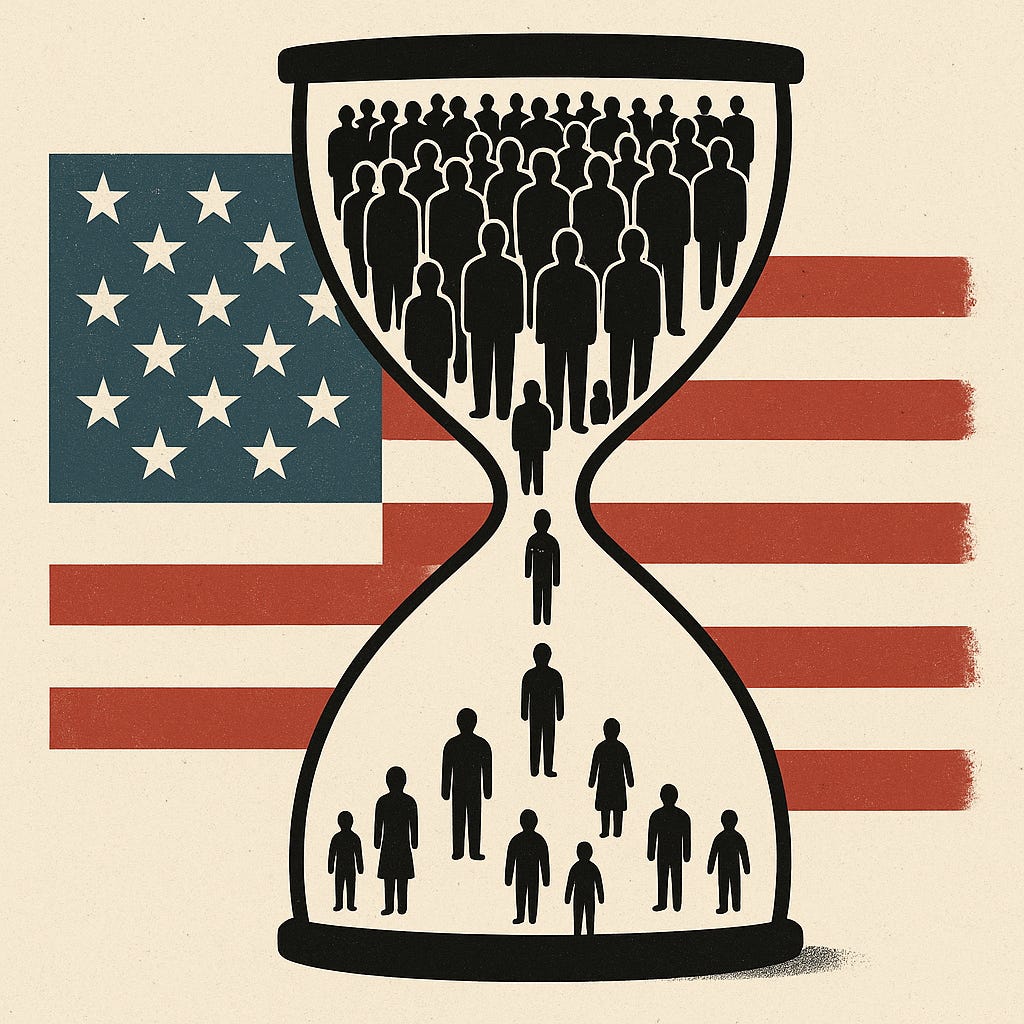
Earlier this week, the Congressional Budget Office quietly released a report that should have set off alarm bells nationwide. If current immigration and demographic trends continue, they warned, the United States could reach a critical tipping point as early as 2031, the year when deaths will outnumber births in this country.
Even more striking: the CBO projects the U.S. population will be 4.5 million smaller by 2035 than previously forecast. This isn’t because of war, famine, or plague. It’s the consequence of policy choices — some already implemented, others planned.
These numbers are not speculative. They’re based on the laws already on the books, including a $150 billion tax and spending package that funds expanded deportation operations, ICE infrastructure, and border enforcement. And crucially, the report does not assume the Trump administration reaches its stated goal of one million deportations per year, a goal which, if realized, would likely make the demographic decline far worse than the CBO currently predicts.
This is the baseline, the best-case scenario.
Stay Informed. Stay Loud.
Subscribe to The Coffman Chronicle for no-BS political analysis, action guides, and daily truth bombs you won’t get from corporate media.
A Country That No Longer Replaces Itself
For years, demographers have warned that the United States is slipping below replacement-level fertility, the rate of 2.1 births per woman needed to maintain a stable population. Today, that number sits at 1.6, the lowest in modern history.
Fewer babies are being born. But this is not just a story about millennials or Gen Z “choosing” not to have children. It’s not even primarily about cultural shifts. This is about structural failure.
Childbirth in America is increasingly dangerous. Maternal mortality, especially for Black women, is rising sharply. Infant mortality increased in 2022 for the first time in two decades. In rural communities, hospitals are closing their obstetric units. Nearly one-third of U.S. counties now have no obstetrician or gynecologist (OB/GYN) provider at all. These “maternity deserts” are not isolated anomalies. They are spreading, and fast.
Then came the Dobbs decision, and a wave of state-level abortion bans. Far from leading to a baby boom, many of these states have actually seen fewer births, as women delay or avoid pregnancy entirely in the face of legal uncertainty and degraded medical care. Additionally, maternal mortality continues to rise in states with restrictive abortion bans, as women are denied medical intervention due to fears of legal backlash. Those who do survive the emergency may suffer loss of fertility.
What we are witnessing is not a moral revolution, but an infrastructure collapse.
Declining Fertility Isn’t Just a Choice. It’s a Symptom
In public debate, fertility is often treated like a lifestyle preference. However, beneath the headlines, researchers are raising deeper concerns: Are Americans becoming medically less fertile?
Studies show that sperm counts in Western men have dropped by more than 50% since the 1970s. Infertility now affects 1 in 6 couples globally, and the numbers are similar in the U.S. Miscarriages, endometriosis, and polycystic ovarian syndrome (PCOS) are increasingly common, while access to reproductive specialists remains limited outside major cities.
But even where medicine is available, affordability is not. Fertility treatment is expensive, rarely covered by insurance, and often inaccessible to working-class or uninsured people. And all of this is happening in a country where health outcomes are declining overall, a rare trend among wealthy nations.
Immigration Was Our Lifeline. We’re Cutting It Off.
For decades, immigration has been the one reliable engine of U.S. population growth. In a country where the birth rate has already fallen below replacement level, immigrants and their children have kept the economy afloat, filled labor gaps, and sustained our demographic momentum.
That lifeline is being cut.
By April 2025, the Trump administration had deported nearly 200,000 people, with publicly stated goals of reaching 1 million deportations per year. At the same time, asylum access has been sharply restricted, visa processing delayed or denied, and new travel bans imposed on entire categories of potential immigrants. The effect is measurable: The immigrant population declined by 1.4 million people in just six months, the first sustained drop in decades. This includes deportations, as well as voluntary departures, decreased migration, and non-renewed visas.
And again, the CBO’s alarming population forecast does not include this extreme scenario. Their projections assume a continuation of already aggressive immigration enforcement. If the administration meets its targets, the population shortfall could be significantly greater.
The loss is not just numerical. Immigrants tend to be younger, often of childbearing age, and more likely to start families in the U.S. Their exclusion accelerates the timeline for population contraction, and undermines the very economic growth that anti-immigrant policies claim to defend.
The Best and Brightest Are Looking for the Exit
While immigration slows, another problem accelerates from the other side: highly educated Americans are leaving the country.
A 2025 Nature survey found that three out of four U.S.-based scientists are actively considering moving abroad. These are not political stunts or speculative concerns. They are responses to real structural erosion: unstable federal funding, ideological attacks on research, reduced access to visas for international collaborators, and growing concerns about intellectual freedom.
See our reporting here:
Note: This article if more than 45 days old and now lives in our archive. Consider becoming a paid subscriber for exclusive perks including full access to our nearly 1000 articles.

The problem is not limited to researchers. Healthcare professionals, university faculty, tech workers, and international students — many of whom had previously sought to build lives in the U.S. — are now looking elsewhere.
Countries like Canada, France, and Germany are offering incentives to attract them. Some are succeeding. U.S. institutions, meanwhile, are slashing programs, freezing hiring, and watching their faculty leave.
The loss of talent not only weakens innovation but also undermines community infrastructure. Hospitals lose physicians. Universities lose instructors. Companies lose key workers. And the children of these families, many of whom would have contributed to America’s next generation, leave with them.
We Are Losing People To Violence, to Despair, to Fear
Population decline is often attributed to a decline in birth rates. However, it is also a death rate issue, and in the United States, people are dying who should not be.
Suicide has returned to record highs, with over 14 deaths per 100,000 people. Firearms remain the leading method, and disturbingly, gun suicides are rising fastest among young men. Economic anxiety, isolation, and inadequate mental health care all play a role, but so does easy access to weapons and a cultural machinery that increasingly alienates, rather than supports.
Gun violence also continues to devastate communities and children. In 2025, there have already been nine school shootings resulting in injury or death, as well as over 300 mass shootings nationwide. An average of 12 children are killed every day by guns in the U.S. Firearms are now the leading cause of death for children and teens.
The demographic impact extends beyond the body count. It is in the trauma, the fear, and the disillusionment. Families reconsider having children. Educators leave the profession. Communities hollow out. Children carry wounds that will shape their lives, and likely the lives of the generation that follows.
A Healthcare System on the Brink
If population stability depends on health — physical, economic, and social — then the U.S. is operating without a safety net.
Doctors are leaving states with abortion bans, and not just OB/GYNs. In places like Idaho, nearly 35% of obstetricians have left since 2022, but general practitioners and emergency room doctors are also reconsidering where they can safely and ethically practice. Legal uncertainty, burnout, and moral fatigue are pushing providers out of rural areas and away from restrictive states. This compounds a problem that already existed: over one-third of U.S. counties are now classified as healthcare deserts.
When you remove doctors from a system already stretched to the limit, people don’t just lose reproductive care. They lose access to heart attack response, cancer screenings, chronic disease management, and mental health treatment. They lose the ability to survive.
Those losses aren’t theoretical. The U.S. has seen declining life expectancy for years — a rare phenomenon in wealthy nations — and many of those premature deaths are happening in places with the worst healthcare access.
We are building a geography of despair: regions where people cannot afford to have children, cannot access the care to survive pregnancy, and cannot raise children safely even if they try.
This Is Not Natural. It Is Engineered.
None of this is happening by accident.
Abortion bans, immigration crackdowns, healthcare cuts, education defunding, gun deregulation, and economic austerity are not isolated policies. They are parts of a broader pattern, one that removes support, imposes control, and offloads risk onto individuals who can no longer carry the weight.
We are not just failing to plan for the future. We are actively undermining its possibility.
When you push out immigrants, you remove the population’s strongest growth engine. When you make pregnancy more dangerous, people avoid it or don’t survive it. When you make childcare unaffordable and schools unsafe, people delay or reject parenthood. When you make death more accessible than treatment, more likely than survival, you shrink — not just demographically, but socially and spiritually.
This is not a decline. It is sabotage.
We Can Choose Something Else
The road back is hard but not complicated. And no, the answer isn’t more sex.
We can expand immigration pathways and rebuild a sane, humane system. We can restore reproductive freedom and invest in maternal health infrastructure. We can pay doctors to stay, rather than punish them for practicing. We can reduce gun deaths with the same urgency we applied to infectious diseases. We can build a future worth staying for, worth raising children in, and worth fighting for.
But only if we see the problem clearly.
Demographic collapse isn't just about falling birth rates. It's about collapsing systems, hollowed-out values, and the slow erosion of hope. It doesn't look like a catastrophe until one day, you realize it already happened.
And you let it.
Stay Informed. Stay Loud.
Subscribe to The Coffman Chronicle for no-BS political analysis, action guides, and daily truth bombs you won’t get from corporate media.
Sources:
Congressional Budget Office. An Update to the Demographic Outlook, 2025 to 2055. September 2025.
CDC National Center for Health Statistics. Maternal Mortality Rates in the United States, 2023.
CDC National Center for Health Statistics. Maternal Mortality Rates in the United States, 2022.
CDC National Center for Health Statistics. Health E‑Stats: Provisional Maternal Mortality Rates (Feb. 2025).
CDC National Center for Health Statistics. General Fertility Rates, Number of Births, and Birth Rates by Age: United States, 2021‑2023. Data Brief No. 507, August 2024.
Commonwealth Fund. Maternal Mortality in the United States: 2025 Issue Brief. July 29, 2025.
“Maternal Mortality Rates in the United States, 2023,” PubMed. 2024.
“US maternal death rate rose slightly last year, health officials say.” AP News, April 30, 2025.
“US births retreat after pandemic‑era growth.” Reuters, April 25, 2024.
CDC. “Suicide Data and Statistics.”
National Institute of Mental Health. “Suicide.”
Education Week. “School Shootings This Year: How Many and Where.”
Sandy Hook Promise. “17 Facts About Gun Violence And School Shooting Facts.”
Wikipedia. “List of Mass Shootings in the United States in 2025.”
“Key Findings About U.S. Immigrants.” Pew Research Center – Demographics & Immigration, August 21, 2025.
“Trump’s Early Immigration Enforcement Record by Numbers, 2025.” Reuters, March 4, 2025.

Great synopsis! The question seems to be, Are we spiritually mature enough to handle the technological "progress" that has developed over the last 125 years. The answer is obviously, "NO! Humanity is not ready." ... and this is not a political or an economic issue. Our collective anatomies and mental health are rejecting the path we're on, inclusive of Democrats, Repuglicans, Independents, Christian, Jew, Moslem, animist. We're just plain ol' on the wrong track for human survival on this planet.
The D states need to implement strict gun laws. That would force radical R's to move
They are the ones bowing to the NRA!