


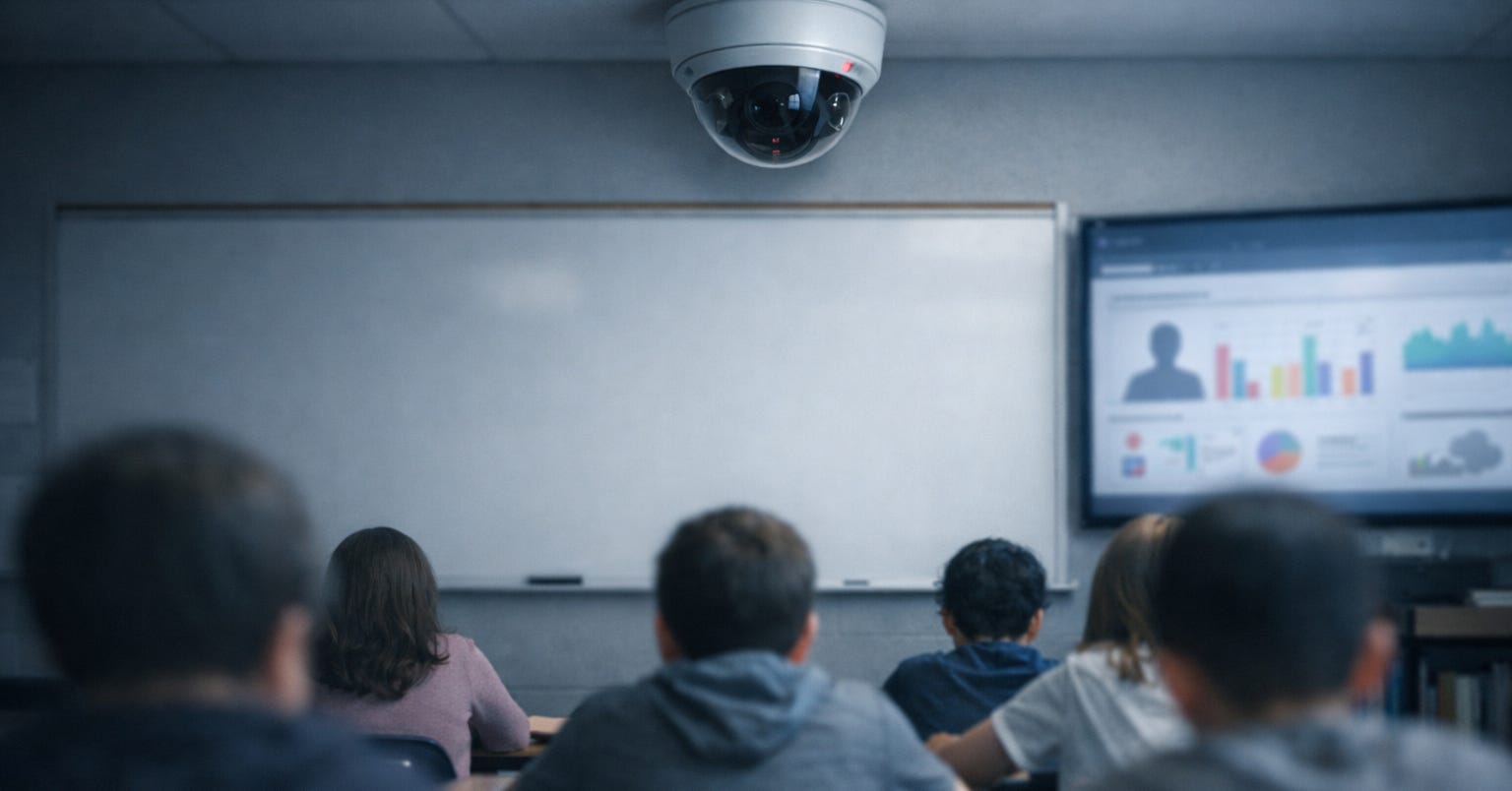
Most parents have no idea that the U.S. Department of Education is quietly rewriting the rules on how their children can be watched, tracked, analyzed, and judged. There’s no press conference, no public hearing, no televised debate. But behind closed doors in Washington, federal lawyers are weighing whether to approve a new generation of AI surveillance tools for America’s public schools, systems originally built for police departments, intelligence analysts, and corporate security teams.
The companies that make these tools already know what’s coming. They’ve met with senior officials. They’ve submitted early drafts of the language they want written into federal guidance. And they’re pushing a definition of “school safety” so broad it could turn a classroom into a soft version of a security checkpoint, where a child’s posture, facial expression, friend group, hallway movement, online habits, and emotional state become data points stored in someone else’s server.
This isn’t a debate about metal detectors or campus police. It’s the quiet expansion of a surveillance architecture that has been moving from the border to the streets to the workplace, and now, into K–12 classrooms. And it’s happening without a single parent being asked for permission.
The first real fight over AI guardrails in America won’t start with a Senate hearing or a sweeping piece of legislation. It will start in the classroom your child sits in every day.
This Community Is Powered by You
What started as a small circle has grown into something much bigger, and it’s all because of readers like you.
Every time you forward this email, post it on socials, or bring someone new into the fold, you’re helping build one of the most passionate, independent political communities out there.
📢 Want to keep the momentum going?
Share this newsletter with someone who should be part of this conversation.
Thank you for being here. It means everything.
Parents Don’t Know This Fight Has Already Started
The Quiet Rulemaking No One Knows Is Happening
Inside a suite of offices at the Department of Education, a handful of career attorneys and political appointees are working through dense federal statutes, searching for the exact legal hook that would let the agency regulate — or quietly permit — a new era of AI surveillance tools in public schools. There’s no bill moving through Congress. No public docket drawing attention. Just an internal guidance process that gives the agency enormous power to shape how 50 million students can be monitored.
Education agencies issue technical guidance all the time. But this isn’t technical. This is structural. Because if ED concludes that existing laws like FERPA, Title VI, or Title IX are broad enough to cover AI-based monitoring, then the entire question of whether these systems should exist in the first place becomes moot. The decision shifts from elected lawmakers to bureaucrats and from public scrutiny to a controlled drafting process in which only invited stakeholders have a voice.
And guess who got invited? The companies building the surveillance tools.
Documents reviewed by education watchdogs show multiple AI vendors met with senior ED officials over the past month. These companies weren’t seeking permission. They were shaping the outcome. They provided “pre-guidance recommendations,” crafted definitions of “behavioral data,” and pitched a flexible national framework that sets a weak federal floor while allowing states and districts to deploy as much monitoring as they want.
Meanwhile, parents, teachers, school boards, disability advocates, and civil rights groups weren’t even told a rulemaking conversation had started. The people who will actually live with the consequences were silent not by choice, but by design.
This is how modern federal power moves: not through televised hearings or sweeping new laws, but through quiet recalibrations of authority that redefine what government and private companies are allowed to do. And right now, that recalibration is happening in the space where your child spends most of their day.
These Tools Were Never Meant for Children
What These AI Tools Actually Do, And Why They Weren’t Built for Schools
The companies selling these systems call them school safety platforms, but the underlying technology didn’t come from classrooms. It came from police contracts, counterterror programs, and corporate security labs trying to predict theft, violence, or “suspicious behavior” before it happens. Schools became the next market only after those sectors were saturated.
Most parents hear “AI monitoring” and think of camera upgrades or automated attendance. What they’re not told is that the systems under review can:
Track a child’s posture, including slouching, fidgeting, or “erratic movement.”
Log facial micro-expressions and assign emotional labels like “agitated,” “disengaged,” or “elevated risk.”
Infer attendance from camera feeds even when a student walks into the wrong room or sits outside the frame.
Monitor peer groups, noting who spends time with whom and for how long.
Score students on behavioral risk, a pre-crime logic repackaged for school administrators.
Flag “anomalies” in hallway traffic patterns, including loitering, backtracking, or moving too quickly.
None of this technology was designed with educational nuance in mind. The systems don’t understand developmental stages, cultural differences, neurodiversity, or the simple truth that teenagers are unpredictable because they are human. They treat a school like a subway platform or a warehouse: a place to scan for outliers and escalate alerts.
Once a child is flagged, the system rarely explains why. These alerts feed administrative dashboards that treat algorithmic guesses as behavioral facts, a dynamic that creates an invisible disciplinary record no parent can review or contest.
Even tools marketed as “early-warning support systems” use the same predictive architecture that private-security firms built for shoplifting risk and crowd-anomaly detection. It’s not educational technology. It’s surveillance technology wearing a lanyard and calling itself student support.
This is the heart of the problem: federal officials are deciding whether to bless tools originally built to police adults and predict threats, not to nurture or educate children. If they approve them, even quietly, it legitimizes a new norm in which kids grow up assuming that being constantly analyzed is simply part of school, and later, of life.
The School-to-Surveillance Pipeline Isn’t an Accident
The DHS Fingerprints: When School Surveillance Looks More Like Counterterror Tech
If you trace the money behind many of the AI systems now entering public schools, the trail doesn’t start with education grants or classroom innovation funds. It leads back to the Department of Homeland Security.
Some vendors pitching “student behavior analytics” received their initial funding through DHS innovation programs aimed at detecting threats in transit hubs and crowded public spaces. Others built their architecture in partnership with regional Fusion Centers, the same intelligence-sharing hubs that coordinate with local police, state agencies, and federal counterterror units. A few of the companies now branding themselves as school-safety pioneers originally specialized in airport screening, border-area monitoring, or retail-theft prediction.
In other words, these tools were not born in a classroom. They were repurposed for one.
Districts often never learn this history because the origins of the technology are buried deep in procurement language. A vendor demo shows a clean interface, a dashboard of colorful indicators, and soothing language about “student wellness” or “threat mitigation.” What doesn’t appear on the screen is the part where the same system can plug directly into law-enforcement data feeds or export behavioral flags to outside agencies through standardized reporting protocols.
This interoperability — the ability to hand data off to police or intelligence systems — isn’t a hidden feature. It’s a selling point. Some vendors openly promise seamless integration with local police dispatch or school resource officer alerts. Several highlight compatibility with DHS threat-assessment models. In private meetings, companies boast about their ability to translate “school anomalies” into the same formats used for public-safety intelligence.
When federal officials consider blessing these tools through new guidance, they risk institutionalizing that pipeline, turning routine student behavior into data that looks suspiciously like counterterror intelligence.
This is where the language of “school safety” becomes dangerous. It masks a merging of two worlds that should never touch: a child’s school day and the machinery of domestic intelligence. And once the architecture exists, once the data flows are established, once the dashboards become normal, the burden shifts. It becomes parents — not government — who have to fight to claw back their children’s privacy.
Districts Aren’t Buying Safety. They’re Buying Insurance
“Safety” as a Trojan Horse: How Liability Drives Surveillance Adoption
If you want to understand why school districts buy these systems, don’t start with student safety. Start with lawyers.
For years, districts have been told they could be held legally responsible if an incident occurs and they didn’t adopt the latest security technology. After every high-profile school tragedy, vendors flood administrators with sales pitches framed around one chilling implication: If something happens and you didn’t have our system, a jury will ask why.
That fear drives purchasing decisions far more than evidence, because the evidence, frankly, is thin.
Independent reviews show no consistent reduction in violence, weapons incidents, or behavioral crises after schools adopt AI-based surveillance. There’s no peer-reviewed data showing that posture tracking prevents fights or that emotion-scoring catches distressed students earlier than a trained counselor. But the absence of proof doesn’t dampen sales. It accelerates them. The risk-averse culture of school administration creates an opening for companies selling the illusion of control.
Those companies know exactly how to exploit the moment. Their marketing materials don’t just cite safety concerns; they cite liability exposure. They hint, quietly, that failing to adopt their products could be construed as negligence. They frame their tools as “best practices,” even when no governing body recognizes them as such. They even circulate sample talking points that administrators can use to justify the purchase to parents and boards.
Behind the scenes, insurance carriers play a role too. Some have begun offering premium adjustments or “risk-mitigation incentives” to districts that install certain monitoring technologies, effectively nudging schools toward systems that may do little to improve safety but look good on paper.
This is how “safety” becomes a Trojan horse. On the outside, it speaks the language of protection, vigilance, and preparedness. On the inside, it carries a fundamentally different payload: legal insulation. When a district installs these tools, it can say it “took every reasonable measure.” Whether those measures actually help children is almost beside the point.
When federal officials consider giving these systems their blessing — even indirectly through guidance — they risk amplifying that dynamic nationwide. Once ED signals that AI surveillance fits under the umbrella of acceptable or encouraged “safety practices,” districts will adopt it not because it works, but because they’re afraid not to.
It’s not about student welfare. It’s about covering institutional backs.
And children become the data in the middle.
Industry Is at the Table. Parents Aren’t Even in the Building
The Lobbyists in the Room And the Parents Who Aren’t
While parents and teachers remain unaware that federal guidance is even being drafted, the companies building AI surveillance tools have already pulled up a chair inside the Department of Education. Not formally, not through a public advisory panel, but through the quiet channels Washington always reserves for well-funded industries: early briefings, pre-docket comment submissions, and closed-door meetings labeled as “stakeholder consultations.”
Several vendors, including mid-size firms with deep ties to security contracting, have already delivered suggested language for what they hope ED’s new guidance will say. Their goal is simple: shape the definitions before anyone else enters the conversation. If they can influence how “behavioral data,” “student safety,” or “risk indicators” are defined, they effectively shape the rule.
And their preferred framework is clear: a weak national floor with no meaningful ceiling.
This is the industry’s dream scenario, a federal baseline so minimal that it amounts to a green light. Such guidance would give states and local districts enormous leeway to adopt any monitoring system they choose, while giving vendors a powerful new talking point: “Our tools comply with federal expectations.”
That statement would be technically true, and entirely misleading.
Who is not in the room while this is happening?
Teachers’ unions
School boards
Child-development experts
Disability-rights advocates
Civil liberties organizations
Parents, especially from communities disproportionately targeted by surveillance systems
These groups haven’t been invited to early consultations. They haven’t been briefed. Many don’t even know a guidance process is underway, because ED has not publicly announced anything, not even a broad inquiry into AI and student privacy.
This silence isn’t accidental. It’s procedural. Internal drafting always happens first, behind closed doors, where the earliest influences leave the deepest fingerprints. By the time guidance becomes public, if it ever does, the scaffolding will be in place. The definitions will be set. The momentum will be established.
This is how industry influence works in 2026. Not by writing the rules outright, but by shaping the context in which the rules are written. When the only voices heard at the beginning are corporate voices, the “public interest” becomes whatever those companies can argue it should be.
Meanwhile, the people who trust schools with their children every day are kept in the dark. Not because they’re unimportant, but because transparency would slow the process, and slowing the process might jeopardize the outcome the industry wants.
When the public is invited late, it isn’t invited to shape. It’s invited to accept.
The Kids Who Need Understanding Get Punished Instead
The Civil Rights Crisis Inside the Code
Beneath the clean interfaces and polished vendor language lies a harder truth: these systems don’t treat all students equally. They can’t. The models were trained on data that reflects the biases of the environments they came from — policing, private security, corporate monitoring — and those biases don’t disappear just because the tools are moved into a classroom.
Across multiple studies, AI-powered surveillance consistently misidentifies or misinterprets behaviors exhibited by:
Black and Latino students, who are more likely to be flagged as “agitated,” “noncompliant,” or “high-risk.”
Neurodivergent students, whose natural movements and expressions fall outside what the algorithm considers “typical.”
Students with disabilities, whose assistive devices, postures, or sensory responses register as “anomalies.”
English-language learners, whose facial expressions or speech patterns confuse emotion-scoring models.
Low-income students, whose schools are more likely to pilot untested technologies because vendors offer steep discounts or “free trials.”
The impact isn’t abstract. These flags feed into the same bureaucratic machinery that shapes student discipline, counseling referrals, security interventions, and special education evaluations. A biased algorithm isn’t just a glitch, but a pipeline. Once a child is tagged as a “behavioral risk,” that label can shadow them for years.
The systems don’t explain their reasoning. They don’t reveal the data they were trained on. They don’t disclose error rates. They rarely distinguish between a student in distress, a student who is bored, and a student who simply doesn’t conform to the model’s expectations. Yet administrators may treat these automated judgments as authoritative because they appear data-driven.
And here’s the part that almost no one realizes: FERPA, the foundational student-privacy law, doesn’t meaningfully protect biometric or behavioral metadata.
That means the data generated by posture tracking, expression analysis, peer-group mapping, or risk scoring may not be protected in the same way as academic records. Vendors can store it, analyze it, repurpose it, or use it to train new models. Parents cannot easily see it, challenge it, or demand its deletion.
This creates a civil rights blind spot so large it becomes an open invitation to discrimination. The very students who most need understanding and support — children navigating disability, trauma, cultural difference, or developmental complexity — are the ones most likely to be misread by the system and punished for it.
When AI gets it wrong in a shopping mall, a customer is inconvenienced.
When AI gets it wrong in a school, a child’s future narrows.
Federal officials are now considering whether to bless systems that routinely misread the children they claim to protect.
A Federal Power Shift With No Public Permission
The National Pattern: How 2026 Governance Shifts Power Without Public Consent
What’s happening inside the Department of Education isn’t unique. It’s part of a broader shift in how federal power operates in 2026: quietly, bureaucratically, and increasingly without public deliberation. Agencies are stretching old laws to cover new technologies, not because they’re reckless, but because Congress has effectively stopped legislating in any meaningful, anticipatory way. When elected lawmakers refuse to update rules for a world defined by AI, data brokers, pervasive surveillance, and corporate analytics, the executive branch fills the vacuum.
And it does so behind closed doors.
This is the new normal:
Major policy shifts are made through guidance documents instead of statutes.
Definitions rewritten inside federal workgroups, not public hearings.
Industry influence is front-loaded, while public feedback comes only after the scaffolding is already locked in place.
Rights reinterpreted instead of re-debated, meaning the meaning of privacy, consent, and accountability changes without a single vote cast.
Because this policy can be enacted through administrative guidance, the Department of Education does not need Congress’s approval, meaning it can become national practice without a single vote.
We are living through a slow-motion transfer of power from democratic institutions to administrative ones, not because of a coup or a conspiracy, but because gridlock creates opportunity. When Congress cannot or will not govern emerging technology, the agencies improvise, and industry choreographs the improvisation.
AI in schools is simply the latest example.
We saw the same pattern in:
DHS expanding its biometric “continuous vetting” without congressional oversight.
FTC and FCC struggling to regulate AI-generated misinformation, leaving agencies to issue informal advisories instead of enforceable rules.
EPA scientists raising alarms about environmental threats while political appointees suppress or delay publication.
OMB drafting sequestration contingency plans without public explanation because budget decisions have become hostage to politics, not policy.
The surveillance of children just feels more shocking because it hits closer to home. Structurally, the process is the same: the federal government makes a massive policy choice before the public even knows there was a question on the table.
The danger is not just the adoption of AI surveillance in schools. The danger is the precedent.
Once an agency can quietly redefine what counts as acceptable monitoring of minors — minors — it becomes much easier to apply the same logic to workplaces, public spaces, transit hubs, housing programs, or benefit systems. Today’s “safety technology” becomes tomorrow’s “eligibility verification,” “risk mitigation,” or “public order algorithm.”
If the public doesn’t intervene early, the decisions made inside these quiet rooms will harden into norms. Those norms will harden into expectations. Once institutionalized, expectations become extremely difficult to reverse.
This is the pattern: Silence → Guidance → Adoption → Normalization.
Once something is normal, even if it shouldn’t be, it becomes invisible.
Your Child Isn’t a Student to These Systems. They’re a Data Source
The Kitchen-Table Stakes: What This Means for Your Child
It’s easy to get lost in the technicalities of federal guidance, vendor lobbying, and AI models. However, at the kitchen table, where real families live, the stakes are brutally simple. These systems don’t just analyze school environments. They analyze your child.
Every fidget, every slouch, every frustrated look, every social interaction in the hallway becomes a data point. A teenager having a bad day can be flagged as a threat. A neurodivergent student can be mislabeled as “disruptive” because the algorithm doesn’t understand their body language. A shy child who avoids eye contact might be scored as “withdrawn,” a category some systems treat as an early indicator of emotional risk.
The data doesn’t stay in the moment. It accumulates. It forms patterns. It becomes part of an invisible behavioral profile that administrators consult when deciding who needs intervention, who is “escalating,” who might cause trouble, or who should be monitored more closely. These judgments can follow a student from grade to grade, year to year, teacher to teacher.
Parents aren’t shown these profiles. Students don’t get to challenge them. Districts often can’t even explain how the scores were generated.
What begins as software becomes a shadow record, one that shapes how teachers perceive a child before the child ever opens their mouth. A flagged student walks into a classroom carrying not just a backpack but an algorithmic presumption.
Because these tools run constantly, they blur the line between childhood and compliance. Kids learn to self-monitor not because it helps them grow, but because the system rewards conformity and penalizes deviation. The classroom becomes the first place they’re taught that privacy is conditional, behavior is data, and someone is always watching.
This isn’t about disagreeing with technology or resisting modernization. Parents understand safety. They understand preparation. They understand the need for tools that genuinely support student well-being. But they also understand something more fundamental: childhood should not be an unbroken stream of surveillance data feeding into a private vendor’s servers.
Yet unless the public steps in, that’s exactly where we’re headed.
The rule being drafted behind closed doors won’t just guide how a school buys software. It will set the baseline definition for what kind of monitoring children must accept as the cost of getting an education. Once those baselines are set — once children grow up believing constant observation is normal — the long-term consequences spill far beyond the schoolyard.
What a child learns to tolerate at age six becomes what they assume is unavoidable at sixteen and what they barely question at thirty.
That is the kitchen-table truth.
The Fight Isn’t Over the Tech. It’s Over Who Owns Your Child’s Future
The Question No One Is Asking: Who Owns the Data, and Who Can Access It?
For all the talk about safety, innovation, and efficiency, the most important question in this entire debate is the one almost no one is asking: Who owns the data these systems collect about children?
Because once the data exists, once it’s captured, categorized, stored, and analyzed, the answer is rarely the parent, rarely the student, and often not even the school district. In many contracts, the real owner is the vendor.
Ownership matters. Ownership determines control, access, resale, retention, and deletion. Ownership determines whether a child’s behavioral history becomes a permanent commercial asset.
Most AI surveillance vendors require districts to grant them broad rights to:
store and retain the data indefinitely
reuse the data to improve their models
share “anonymized” or “de-identified” datasets with third parties
train future commercial tools using student behavior as the raw material
Some contracts even allow the company to maintain the data after a district ends its relationship with the vendor, meaning a child’s behavioral profile may live on long after the school stops using the system that created it.
Districts often don’t realize they’ve agreed to this because the relevant clauses are buried in dense service agreements that overworked administrators review, not privacy attorneys.
Parents almost never see those contracts.
Here’s the most troubling part. Federal student privacy law doesn’t meaningfully protect any of this. FERPA was written in 1974, in a world of paper files and manila folders. It covers grades, transcripts, disciplinary actions, and things schools intentionally collect. It does not account for posture-tracking metadata, expression-analysis labels, micro-movement logs, social-mapping graphs, or algorithmic risk scores.
Those categories exist in a gray zone where vendors can argue the data is not a “student record” at all, but a “system-generated output.” If ED validates that interpretation through guidance — even indirectly — the loophole solidifies.
If it solidifies at the federal level, there will be nothing to prevent vendors from combining or monetizing behavioral datasets across districts, states, or regions.
Imagine:
A company building “student risk profiles” across millions of children.
Behavioral datasets being sold to researchers, insurers, or outside analytics firms.
Records used to predict future performance, discipline likelihood, or mental-health risk.
A child’s emotional patterns becoming part of a permanent model they can never escape.
These scenarios aren’t speculation. They’re already emerging in adjacent industries, from workplace monitoring tools to consumer-behavior analytics. The school is simply the next frontier because children generate data constantly and have no legal ability to refuse.
The danger isn’t only that someone else owns the data. It’s that someone else decides what the data means.
Left unregulated, these systems don’t just record childhood. They define it. They turn the everyday unpredictability of growing up into a proprietary dataset that shapes how a child is perceived, treated, tracked, and potentially scored for the rest of their educational life.
Once that data exists, it becomes almost impossible to pull back, which is why the ownership question isn’t a footnote. It is the core of the power grab happening in silence.
The Fight Over AI Guardrails Doesn’t Start in Washington. It Starts in Homeroom
The First Real AI Guardrail Fight Starts in the Classroom
For months now, federal officials have been quietly drafting guidance that could reshape the future of student surveillance in America. Not through a vote. Not through a national debate. But through the slow grind of bureaucracy, the kind of silent policymaking that moves faster than the public can react and lasts longer than most political cycles.
If this guidance lands the way industry wants, schools will be able to deploy AI tools that treat children like moving data points in a risk model. Vendors will own the behavioral records. Districts will fear liability more than bias. And Washington will claim it has “modernized safety standards” while sidestepping the question no one in power seems eager to answer: Should we even be doing this at all?
Because the truth is simple and uncomfortable: once a country normalizes surveillance in childhood, it normalizes surveillance everywhere. The habit of being watched becomes the expectation of being watched. By the time a generation grows up under that architecture, questioning it will feel like questioning gravity.
This is the real danger of drafting the rule behind closed doors—not just the technology itself, but the precedent it sets: biased, unproven, invasive. If federal agencies can redefine the boundaries of privacy for minors without public consent, they can do it for anyone. If they can bless AI monitoring in schools, they can bless it in workplaces, benefit programs, public housing, transportation systems, and policing. The slope isn’t slippery. It’s planned.
Yet, the classroom is also where this trend can be stopped. Parents, teachers, and school boards have more power over educational environments than they realize. Districts can refuse contracts. States can write explicit protections. Civil rights groups can demand oversight. Congress, if pushed, can close the loopholes that make this entire system possible.
The first real fight over AI guardrails in America won’t start with a Senate hearing or a sweeping piece of legislation. It will start with PTA meetings, school board votes, and small communities that collectively decide that children should be students, not data streams.
The decisions being made in Washington right now will shape the norms your kids grow up with— norms about privacy, autonomy, and what it means to be a person in a world that increasingly treats behavior as a commodity.
The surveillance architecture is already being built. The question is whether we let it become permanent.
The fight begins in the classroom, and it begins right now, before the rule is written, before the guidance drops, before the next school year starts, with an algorithm waiting at the door.
Support Independent Media
Kids shouldn’t grow up assuming surveillance is normal. And parents shouldn’t have to find out about federal policy changes after the fact. If you want journalism that gets to these stories early, before the rules are written, before the systems get installed, before the data starts flowing, then help power the Coffman Chronicle.
This publication survives because readers believe independent reporting still matters. If this story mattered to you, please consider becoming a subscriber today.
Subscribe to the Coffman Chronicle, and help protect the future your kids deserve.
Sources:
American Civil Liberties Union. “New ACLU Report Shines Light on Shadowy EdTech Surveillance Industry and the Dangerous Consequences of Surveillance in Schools.” Press release, October 3, 2023.
ACLU of Wisconsin. “Our Kids Deserve Safety, Not Surveillance.” News & Commentary, October 3, 2025.
Coalition for Critical Technology. “Abolish the #TechToPrisonPipeline: Crime Prediction Technology Reproduces Injustices and Causes Real Harm.” Medium, June 23, 2020.
“Helping K-12 Schools Navigate the Complex World of AI.” MIT News, November 3, 2025.
“As More Schools Turn to AI Weapons Detection, Questions Persist.” Undark, February 13, 2026.
“Risks from AI Use Are Growing Alongside Its Popularity in Schools.” K-12 Dive, October 10, 2025.
“6 Steps to Protect Student Data Privacy.” Edutopia, March 15, 2023.
U.S. Department of Education, Student Privacy Policy Office. “Student Privacy at the U.S. Department of Education.” Protecting Student Privacy (homepage), updated February 2026.
U.S. Government Accountability Office. Data Security: Recent K-12 Data Breaches Show That Students Are Vulnerable to Harm. GAO-20-644, September 2020.
“The Challenge of Data Privacy.” Educational Leadership 73, no. 7 (2016).
Common Sense. “Privacy Program.” Common Sense Privacy Program, 2021–2026.
These are not school security tools - they are the implements of a police state. It's time to properly train teachers and to give them the classroom autonomy that they once had - they type of freedom that led to students loving learning. Kids hate school now and for valid reasons - it's not interesting! Learning is fun - what they are doing is not.
Shades of Orwell's *1984* and the British1960s TV drama, *The Prisoner*, starring Patrick McGoohan. As a kidnapped former intelligence agent, he was taken to a secret seaside resort, given a number to replace his name, hounded for "information," surrounded with people he couldn't trust and foiled when he (often) tried to escape. I read it as a warning against a totalitarian threat. The climactic episode featured the captive hero's defiant question to the main computer: "Why?"--which destroyed it and the state.