


On October 31st, the U.S. government was legally required to submit a report to Congress outlining its progress under the Women, Peace, and Security Act of 2017.
It didn’t.
So far, there has been no explanation or delay notice. Just silence.
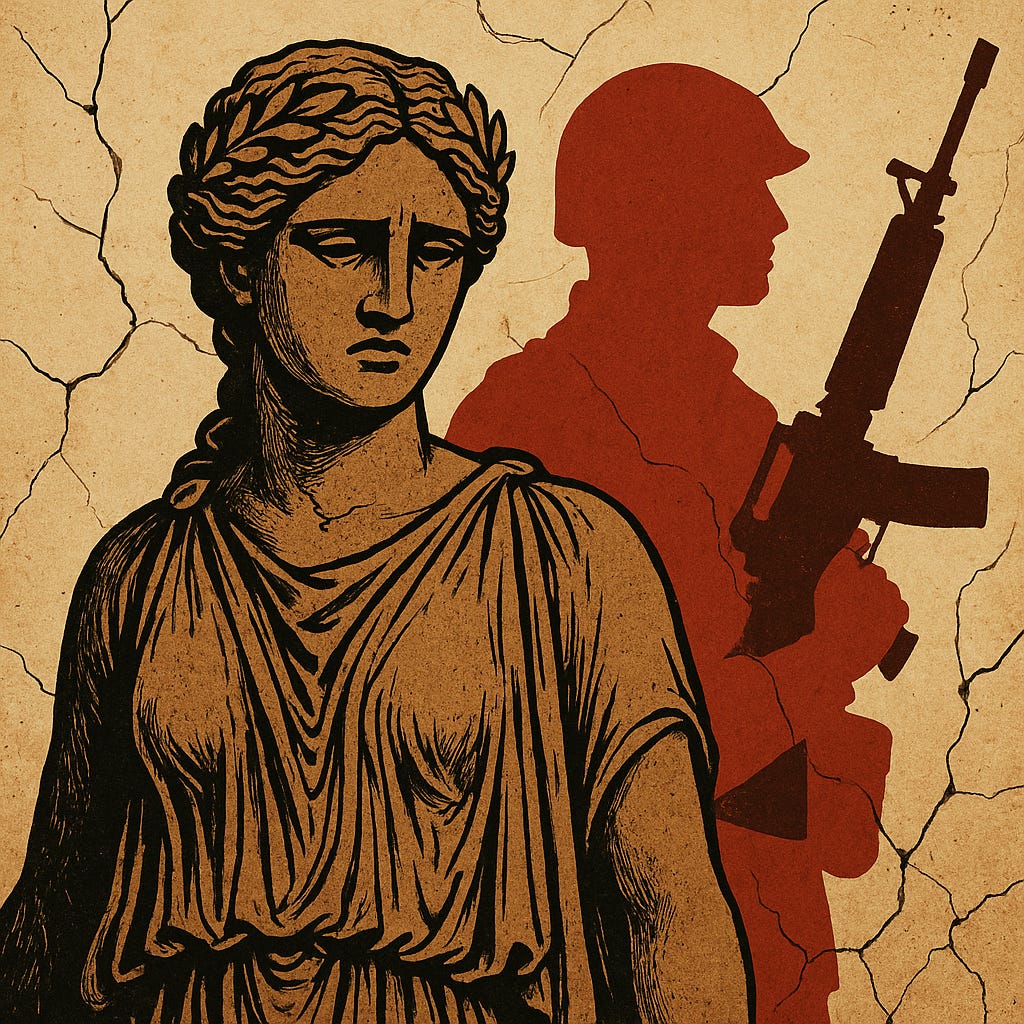
The Women, Peace, and Security (WPS) Act — once hailed as a bipartisan triumph, the first of its kind in the world — is being quietly abandoned. And with it, the last institutional signal that the United States believed peace should be inclusive, and that women had a rightful place at the tables where war and recovery are decided.
The missed report is not a clerical error. It’s not paperwork lost in a shutdown. It’s the predictable result of a government that no longer values what that report represented or who it was meant to include.
Want to Know Your Rights?
Download a free digital copy of the U.S. Constitution—the same document Trump is trying to bulldoze. Learn exactly what he’s breaking… and how to fight back.
40,000 strong — and counting.
This Early Black Friday, become a paid subscriber for just $1 a week and help us keep the truth alive.
Join The Coffman Chronicle — $1/Week Early Access
What the Women, Peace, and Security Act was supposed to do
Passed in 2017 with bipartisan support and signed by Donald Trump, the WPS Act committed the United States to something both simple and transformative: ensuring women have a central role in preventing conflict, negotiating peace, and rebuilding in the aftermath.
It required agencies like the State Department, USAID, the Department of Defense, and the Department of Homeland Security to create implementation plans, train personnel, and report progress to Congress. It was rooted in both research and reality. We know peace agreements are more durable when women are involved, that communities are safer, and that justice is more likely to emerge when power is shared.
It was about prevention, inclusion, and sustainability. It was meant to create peace that lasts.
And now, it’s gone quiet, because the very offices responsible for making it real no longer exist in any meaningful form.
The infrastructure has been dismantled
Let’s name what’s actually happened.
The truth is that the erosion began almost as soon as the ink dried.
Donald Trump signed the WPS Act in 2017, and within months, his administration began gutting the very offices that would’ve implemented it. Gender-related roles at the State Department were eliminated or left vacant. USAID’s gender equity and democracy programming was sidelined. U.S. delegations to multilateral forums scrubbed language related to women’s rights and inclusion. The law was passed, yes, but the machinery to make it matter was quietly disassembled.
Biden’s administration tried to rebuild it.
And then, in Trump’s second term, they didn’t even bother hiding what they were doing.
On Day One of his second term, an executive order froze nearly all U.S. foreign development assistance, including programs central to USAID’s mission and the very mechanisms of the Women, Peace & Security agenda. The Department of Government Efficiency targeted it boldly and brutally as their first act. Programs were slashed. Staff was reassigned or fired. Contracts were cancelled. Gender and conflict work were eliminated almost entirely. It was a quiet purge under the banner of “efficiency.”
The U.S. Institute of Peace, once a global symbol of American soft power, has been reduced to a legal battleground and a skeleton crew, also at the hands of DOGE. After mass staff firings and an attempted seizure of its headquarters, its future hangs by a thread.
At the same time, DHS — far from being gutted — has flourished. ICE received a budget increase. Domestic enforcement has become a priority while diplomacy, development, and human rights have become political liabilities.
This is not bureaucratic reorganization. It is a deliberate re-engineering of the U.S. government’s priorities: power over peace, reaction over prevention, militarization over inclusion.
The bipartisan silence is deafening
Only one of the original cosponsors of the WPS Act — Senator Jeanne Shaheen — has spoken publicly about its dismantling. The rest, including Kristi Noem, now serving as Secretary of Homeland Security, have remained silent. Some are directly overseeing the agencies responsible for its quiet collapse, including now Secretary of State Mark Rubio.
What was once a bipartisan achievement has become a bipartisan erasure.
This is performative politics at its most hollow: pass a landmark law, bask in the global praise, and then look away while it is gutted from within.
And meanwhile, the world burns
This silence comes as multiple global conflicts spiral, most notably in the Middle East, in West Africa, and in the Pacific. The U.S. has deployed naval forces to the Caribbean and is threatening action in Venezuela and Nigeria. Migration pressures are surging, not randomly, but because of the exact conditions WPS and USAID programs were meant to help prevent, such as war, instability, climate shock, sexual violence, and repression.
And what has the U.S. response been? Not renewed diplomacy or increased investment in prevention.
Instead, we have received an emboldened ICE, militarized raids in blue cities, a hollowed free press, surveillance, and executive overreach.
We’ve spent billions reacting to symptoms — the displaced, the desperate, the destabilized — while dismantling the institutions that addressed the causes.
This is governance by symptom
We are so focused on the symptoms, yet we refuse to see the causes. Then wonder why the symptoms never ease.
We cut off foreign assistance that stabilizes fragile states. We silence women’s voices in peace negotiations. We withdraw from climate resilience, gender justice, and conflict prevention. We cut DEI, blacklist words in federal documents, and purge diversity and dissent. Then, when the consequences reach our borders or the nightly news, we panic and reach for guns and fences.
This isn’t oversight. It’s intentional amnesia. It’s choosing short-term power over long-term stability.
And here we are, cosplaying strongman oligarchy
In just over nine months, we have militarized cities, a dictator-lite parade, executive orders sidestepping law, and a cabinet of billionaires issuing press releases about “efficiency” while gutting every public institution that doesn’t enforce, surveil, or detain.
We are not yet the authoritarian regime we fear, but we sure are rehearsing for it.
We are cosplaying strongman oligarchy with slogans, photo ops, and unchecked power draped in red, white, and blue.
And while we perform, we abandon the work— the slow, complicated, human work of peace, equity, and justice.
What the missed report really tells us
Some will argue, what does it matter? It is one report. Look at everything else that is happening. However, the Women, Peace, and Security report wasn’t just a line on a bureaucratic calendar. It was a test.
Would we defend what we once claimed to believe in? Would we stand up for peace, inclusion, and international leadership when the winds shifted? Would we stay at our post?
We didn’t.
We let the offices close, let the programs be erased, and let the silence take root.
And now? What do we stand for now? What do we believe in?
Control over compassion?
Empire over leadership?
Oligarchy over the shiny beacon of democracy?
We abandoned the post.
Sadly, it is easy to trace the erosion, and it isn’t even surprising that the earliest signs were women, minorities, diversity, equity, and peace. They told us in those first days after the WPS was signed where they were going. They practically drew a map.
Are we great yet?
Stay Informed. Stay Loud.
Subscribe to The Coffman Chronicle for no-BS political analysis, action guides, and daily truth bombs you won’t get from corporate media.
Sources:
Georgetown Institute for Women, Peace and Security — “U.S. Government Fails to Report to Congress on WPS Progress” (Nov 1, 2025)
USA Today — “Women, peace security: Trump can make feminist history by signing this bill” (Oct 3, 2017)
Council on Foreign Relations — “Three Things to Know: The Women, Peace, and Security Act of 2017” (Oct 13, 2017)
United States Department of State — “Marking the One Year Anniversary of the Women, Peace, and Security Act” (Oct 5, 2018)
CNN Politics — “Trump strategy on women and security wins wary praise, raises questions” (June 14, 2019)
The Independent — “Nearly every worker at the U.S. Institute for Peace is fired via DOGE” (Jul 14, 2025)
Associated Press — “Unspent aid worth billions lacks oversight as Trump dismantles USAID, watchdog warns” (Feb 10, 2025)
Reuters — “Trump administration eliminating 1,600 USAID jobs in the U.S.” (Feb 24, 2025)
Council on Foreign Relations — “Hegseth Announces End to Women, Peace and Security Program” (May 2, 2025)
MS Magazine — “The Women, Peace and Security Framework Is Not ‘Woke’” (May 13, 2025)
