


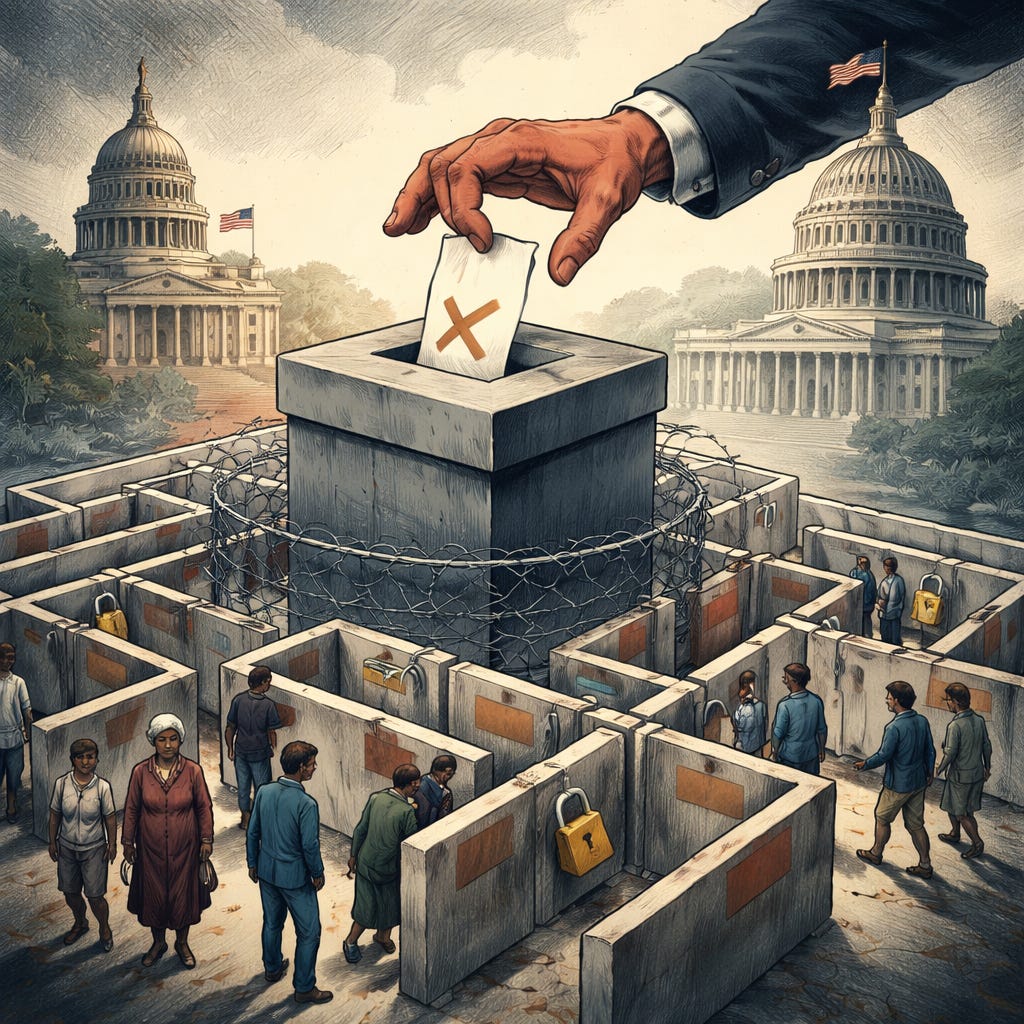
On February 11, 2026, the House of Representatives passed the SAVE America Act by a vote of 218–213, with only one Democrat, Henry Cuellar of Texas, joining Republicans in support. The bill is being sold as a straightforward election-security measure: proof of citizenship to register to vote, photo ID to cast a ballot, and tighter limits on mail voting. In reality, it is something very different. It is the most significant attempt in decades to narrow practical access to the ballot, to pull voter-roll management closer to federal control, and to normalize the idea that the President can rewrite election rules himself if Congress refuses.
To see how radical that is, you have to set it against the actual history of federal voting-rights law in the United States. For more than a century, when Washington stepped into the way states ran elections, it was almost always for one reason: states were using their power to block people who were already legally entitled to vote.
The SAVE Act does the opposite.
This Community Is Powered by You
What started as a small circle has grown into something much bigger, and it’s all because of readers like you.
Every time you forward this email, post it on socials, or bring someone new into the fold, you’re helping build one of the most passionate, independent political communities out there.
Want to keep the momentum going?
Share this newsletter with someone who should be part of this conversation.
Thank you for being here. It means everything.
How Federal Voting Law Has Traditionally Worked: Removing Barriers, Not Adding Them
The Constitution leaves the “Times, Places and Manner” of elections to the states, but the post–Civil War amendments put real limits on what states could do with that power. The Fifteenth Amendment barred disenfranchisement on account of race. The Nineteenth enfranchised women. The Twenty-Fourth Amendment banned poll taxes in federal elections. The Twenty-Sixth lowered the voting age to eighteen. Each of these changes expanded the circle of people who could vote everywhere in the country. None of them created new hoops that eligible voters had to jump through.
When states, especially in the Jim Crow South, refused to honor those guarantees, Congress stepped in again. The Voting Rights Act of 1965 was not a neutral “tightening of rules,” but a direct response to literacy tests, “good character” clauses, poll taxes, white primaries, and outright violence that kept Black citizens from the polls despite their formal eligibility. The National Voter Registration Act of 1993, the “motor voter” law, did something similar for registration. It required states to offer registration at DMVs and other public agencies and set basic rules so that signing up to vote was not an obstacle course. Federal intervention in elections has historically meant removing barriers erected by states, not constructing new ones from Washington.
Against that history, the SAVE America Act is a reversal. It does not enfranchise anyone who is currently excluded. It does not say, “here is a group of Americans who are being denied their constitutional rights, and here is how we will ensure they can participate.” Instead, it uses the language of “integrity” to justify adding paperwork hurdles and documentation demands for millions of people who are already citizens, already eligible, already participating, and already subject to serious penalties if they lie.
What the SAVE America Act Actually Does
The SAVE America Act builds on an earlier proposal, the Safeguard American Voter Eligibility (SAVE) Act, H.R. 22, which passed the House in April 2025 but stalled in the Senate. That earlier version focused on voter registration. It would have amended the National Voter Registration Act to prohibit states from registering anyone to vote in federal elections unless the applicant presented documentary proof of U.S. citizenship, such as a passport, birth certificate, or naturalization certificate. States would have been required to create ongoing programs to scour their rolls for suspected non-citizens, using data from federal and state databases, and to remove those names, under threat of lawsuits and even criminal penalties for election officials who registered someone without the required paperwork.
See our previous reporting here:
Note: Articles over 45 days roll into our archive. Become a paid subscriber for full access to our extensive article archive and exclusive perks.


The new SAVE America Act goes further. Introduced in the House on January 30, 2026, by Representative Chip Roy and pushed hard by Speaker Mike Johnson and the White House, it passed on February 11 by that 218–213 margin. It retains the proof-of-citizenship requirement for registration and then extends the model to voting itself. Under the bill, states could not accept a federal ballot unless the voter presents a physical photo ID that meets new federal standards and reflects citizenship status; digital IDs would not qualify. Mail-in voting would be sharply restricted, with new documentation requirements and narrower eligibility.
In other words, the bill tries to move the country from the current system, where voters register by signing a sworn statement under penalty of perjury that they are citizens, and states decide what identification is required at the polls, to a strict, document-based system for both registration and voting, specified in federal statute and backed by private lawsuits and federal enforcement.
The Fraud It Is Supposed to Solve Barely Exists
The justification for all of this is the claim that non-citizens are registering and voting in large numbers and that the current “honor system” is too easy to exploit. It is an alarming story. It also falls apart as soon as you look at the evidence.
Non-citizen voting in federal elections is already illegal. It is a felony punishable by fines, prison, and, for non-citizens, deportation. Existing federal law already requires every person who registers using the national form to affirm under penalty of perjury that they are a U.S. citizen. Lying on that form is a crime in itself, and states already have tools to follow up and prosecute.
When researchers look for actual cases, they find astonishingly few. Analyses by nonpartisan groups and even conservative-leaning organizations have repeatedly concluded that non-citizen voting is extremely rare and that most of the handful of known cases appear to be accidents or misunderstandings, not organized fraud. A recent review by Nonprofit VOTE described the SAVE Act as “the wrong solution for a non-problem,” noting the tiny number of documented incidents compared to the hundreds of millions of votes cast. The Migration Policy Institute has similarly concluded that there is “no evidence that noncitizens vote in significant numbers in federal or state elections.”
None of this means non-citizen voting never happens. It means the problem is so small as to be statistically irrelevant. The existing combination of attestation, penalties, and state-level checks appears to work. Redesigning the national registration and voting system to address that tiny slice of cases is not a proportionate response. It is a pretext.
Who Pays the Price for New Paperwork Barriers
We already know from state-level experiments what happens when proof-of-citizenship rules are turned from a scalpel into a sledgehammer. When Kansas implemented a similar requirement several years ago, roughly one in seven new registration applications was held “in suspense” over missing or mismatched paperwork, even though the vast majority of those applicants were eligible U.S. citizens. Arizona’s dual-track system, where voters who could not provide documentary proof were shunted into a separate category and denied state-level ballots, generated years of confusion and litigation before courts stepped in.
The burden is not random. It falls hardest on people whose lives and documents do not neatly align with bureaucratic expectations. Older Americans who were born at home, in segregated hospitals, or in rural areas may not have an easy path to a certified birth certificate. Adoptees may have sealed original records or confusing paper trails. Women who changed their names through marriage and divorce—and anyone else with a name change—can find themselves having to assemble marriage licenses and court orders to “prove” continuity between the name on their birth certificate and the name on their ID. Very low-income people often lack secure storage, money for vital-records fees, or time off work to navigate another trip through the bureaucracy. Naturalized citizens, who already face a higher risk of being misflagged as noncitizens in federal or DMV databases due to lagging updates, are put in the position of having to guard a single, expensive naturalization certificate as the key to their voting rights.
Our earlier reporting on the first SAVE Act fight has gone through these stories in detail, from elderly voters struggling to dig up documents from distant counties to women whose registrations were challenged because their married names did not match their birth certificates. That lived reality does not go away under a federal mandate; it scales up.
Quietly Pulling Voter Rolls Toward Federal Control
The SAVE America Act’s database provisions are a quieter but equally important shift. Under current law, states maintain their own voter rolls. They use a mix of tools—death records, change-of-address data, jury lists, criminal records, occasional federal and state database checks—to keep those lists accurate. The federal government does not maintain a national voter file and does not, as a matter of routine, sit in the middle of voter-roll maintenance. That decentralization is both a feature of American federalism and a privacy protection.
The SAVE framework edges away from that. The text of H.R. 22 already requires states to set up programs to identify suspected non-citizens on their rolls using information from federal and state agencies, including immigration and Social Security records, and to remove them. The SAVE America version builds on that architecture. That means two things. First, it pushes state election officials to rely on federal databases that were never designed to be a clean, real-time list of who is and is not a citizen. They are administrative tools that often lag reality, particularly for naturalized citizens. Second, it increases Washington’s practical visibility into who is on state voter rolls and how those lists are being cleaned.
No single provision of the bill creates an official national voter registry. However, the combination of mandatory data-matching, required purges based on those matches, and private lawsuits against officials accused of being too lax moves us closer to something the United States has historically rejected: a system where access to the ballot is tightly tied to federal information systems rather than state-managed lists and local verification.
“Nationalizing” Elections: Trump’s Escalating Rhetoric
If all of this were just a bad bill lurching through Congress, it would still deserve pushback. However, the context makes it even more troubling.
On February 2, 2026, in an interview on “The Dan Bongino Show,” President Trump said Republicans should “nationalize” voting and “take over” the process in at least fifteen places around the country. He repeated his false claims that the 2020 election was stolen and suggested that federal action was needed to prevent Democrats from cheating again. His comments drew immediate criticism, including from Republican Representative Don Bacon, who said there should be no federal takeover of election administration and reminded listeners that the Constitution gives states primary authority in this area.
See our recent reporting on how the Trump Administration is continuing to litigate 2020 election integrity here:


Against that backdrop, the House passage of the SAVE America Act on February 11 was not an isolated legislative event. Rather, it was the concrete piece of a larger project the president was describing. Two days later, on February 13, Trump made the escalation explicit. In a Truth Social post published while he was aboard Air Force One, he wrote, “There will be Voter I.D. for the Midterm Elections, whether approved by Congress or not!” and promised to present an “irrefutable” legal theory to justify it. He added that “the People of our Country are insisting on Citizenship, and No Mail-In Ballots, with exceptions for Military, Disability, Illness, or Travel.”
That is not the language of a president promising to faithfully execute whatever laws Congress passes. It is the language of a president signaling that if Congress refuses to give him what he wants, he will try to do it himself by executive order. It is, in other words, a direct challenge to the basic separation of powers in elections. Congress writes the rules for federal contests, states administer them, and the executive branch enforces those rules. There is no honest way to spin a unilateral national voter-ID order as merely “implementing” existing law. There is no statute that gives the president the power to impose new proof-of-citizenship and ID requirements on the states if Congress declines to act.
Legal experts have already pointed out that any such order would collide with both the Elections Clause and decades of practice that leave core election administration choices in state hands. A federal court blocked a similar Trump order in 2025 that attempted to require proof of citizenship for federal registration and reject late-arriving mail ballots, finding that he lacked authority. However, the fact that courts would likely strike down the next attempt does not make the threat benign. When a president tells the country that Congress’s refusal is not the end of the story, that he will search for “legal arguments not yet articulated” to get his way anyway, he moves the Overton window. Parliamentarism—“if the legislature won’t do it, the executive will”—is not how the American system is supposed to work.
From Expanding the Franchise to Sorting Voters
Taken together, the bill and the rhetoric look less like an effort to solve a genuine problem and more like an effort to decide whose participation is welcomed and whose should be made harder.
The United States has been here before in different guises. Literacy tests were technically neutral; they did not say “Black people cannot vote.” Poll taxes did not name the poor. However, everyone understood who would be stopped at the registrar’s desk. Today, a national proof-of-citizenship and photo-ID regime that relies on fragile documents and inconsistent records will, in practice, not fall equally on everyone. It will fall on older Americans, people with complicated name histories, the very poor, naturalized citizens, and anyone whose life does not fit neatly into the boxes on a federal form.
Defenders of the SAVE America Act insist that “American elections are for American citizens,” as Senator Mike Lee and others have put it. That is true and already the law. The right question is not whether non-citizens should vote. It is whether we are willing to make it harder for large numbers of citizens to vote, in the name of guarding against a type of fraud that has been documented at only tiny levels in twenty-plus years of searching. It is whether we are comfortable nudging states toward a deeper federal role in voter-roll management while a sitting president talks openly about “nationalizing” elections and imposing rules, whether approved by Congress or not.”
If you care about election integrity, this should worry you. Real integrity is not just about who shows an ID at the polls. It is about each branch of government staying in its lane, about states retaining genuine control over how elections are administered within constitutional limits, and about every eligible American having a reasonably clear, reasonably accessible path to the ballot. For more than a century, that has been the direction of federal action in voting: amendments and statutes that expand access and enforce equal rights when states falter.
The SAVE America Act and the executive-order threats surrounding it point squarely in the opposite direction. They make voting harder for many who are already eligible. They pull voter-roll decisions closer to federal databases and presidential influence. And they test how much unilateral power the executive can claim over a domain that is supposed to belong to Congress and the states. That is not a technical policy fight. It is a question about whether the United States continues to move, however haltingly, toward a more inclusive, balanced democracy, or whether we start undoing that progress under the banner of a fraud crisis that the evidence simply does not support.
Sources:
ICYMI: Chairman Steil Leads House Effort to Pass SAVE America Act - Press Releases - United States Committee on House Administration,“ Commitee On House Administration, February 13, 2026.
“US House passes bill to require proof of US citizenship for midterm voters,” Reuters, February 11, 2026.
“House passes Save America Act, Trump-backed bill to impose new voting rules,” The Guardian, February 11, 2026.
“House GOP pushes strict proof-of-citizenship requirement for voters ahead of midterm elections,” AP News, February 11, 2026.
“House Passes SAVE Act 2.0 to Suppress Millions of Eligible Voters,” National Women’s Law Center, February 11, 2026.
“The SAVE Act and the Election Power Grab,” Brennan Center for Justice, February 10, 2026.
“Trump says Republicans should ‘nationalize’ voting in at least 15 places,” Reuters, February 2, 2026.
“Trump’s call to ‘nationalize’ elections draws furious pushback,” Reuters, February 3, 2026.
“Thune throws cold water on Trump’s call to ‘nationalize’ U.S. elections,” PBS NewsHour, February 3, 2026.
“‘Republicans ought to nationalize the voting’: Trump eyes radical power-grab,” MSNBC / MaddowBlog, February 3, 2026.
“‘We want to take over’: All the (recent) times Trump has attacked voting ahead of the midterms,” Democracy Docket, February 7, 2026.
“Trump: ‘There will be Voter I.D. for the Midterm Elections, whether approved by Congress or not!’,” Democracy Docket, February 13, 2026.
“Trump threatens to impose photo ID for voters for midterm elections,” The Guardian, February 13, 2026.
“Trump threatens to bypass Congress and order new voting laws ahead of midterms,” Le Monde (English edition), February 14, 2026.
“Trump says he will issue executive order on voter ID if legislation fails,” ABC News, February 14, 2026.
“Leader Schumer Floor Remarks On How The SAVE Act Would Disenfranchise Millions Of American Voters, Says It Is Dead On Arrival In The Senate,” Office of Sen. Chuck Schumer, February 6, 2026.
“Senate Minority Leader Schumer says SAVE Act would bring back Jim Crow-style voting,” KATU / TNND, February 2, 2026.
“House passes SAVE Act 2.0 to suppress millions of eligible voters,” NWLC, February 11, 2026.
Why not wait until after the midterms then bring it back out without the amendments and I’d bet it would be close to anonymous with Democrats
It's about disenfranchising voters. Because they feel it's the only way that they can win. But this may backfire spectacularly on them. Why? Because their voting block is older seniors on fixed incomes.
They're struggling trying to pay rent, bills and put food on the table. They can't afford a to spend money on getting a Real ID or a Passport just so they can vote.